Your Family Counts
The race to bedtime begins: dinner, showers, pajamas, Shema, a Chassidishe story, a kiss to the mezuza, the children are already in bed, and you’re already thinking ahead and considering which task to start, as the list is so long. Just before you breathe a sigh of relief about another evening successfully completed, one of the little ones cries out with half-closed eyes: “Mommy! We didn’t count the Omer!”
True, counting the Omer is a short-term project, forty-nine days in total. And it really doesn’t take more than a few minutes. But perhaps precisely because it’s not a constant presence in our daily lives, it can be forgotten, and we might see it as a burden we want to get over with.
So how do we do it differently?
Let’s look at the mashal we all know from kindergarten days, and that our children’s teachers continue to tell. The style might vary slightly from kindergarten to kindergarten, and the names of the characters too, but the principle is always the same. Someone waiting for a big promised gift in forty-nine days, and counting the days with excitement. An old and charming mashal, but with years of learning Chassidus behind us, we can understand and feel more deeply the size and value of the gift, the journey that the Jewish people took from the forty-nine gates of impurity to receiving the Torah, the wisdom and will of Hashem. This journey that we actually take every year, a path of improving our middos, a journey of getting closer, a journey of reconnecting and receiving the Torah anew.
When we think about it, the entire counting of the Omer takes on a different, deeper flavor. We develop a desire to be there day by day, to remember to count with a bracha every evening.
When the concept of counting the Omer becomes more alive within us, it will be easier to unite the children around it. Even though they are still at the first stage of the mashal the kindergarten teacher told. But as always, when a mother is passionate about something, excited about it and living it, the children “catch” it from her. And this is something each of us knows from personal experience.
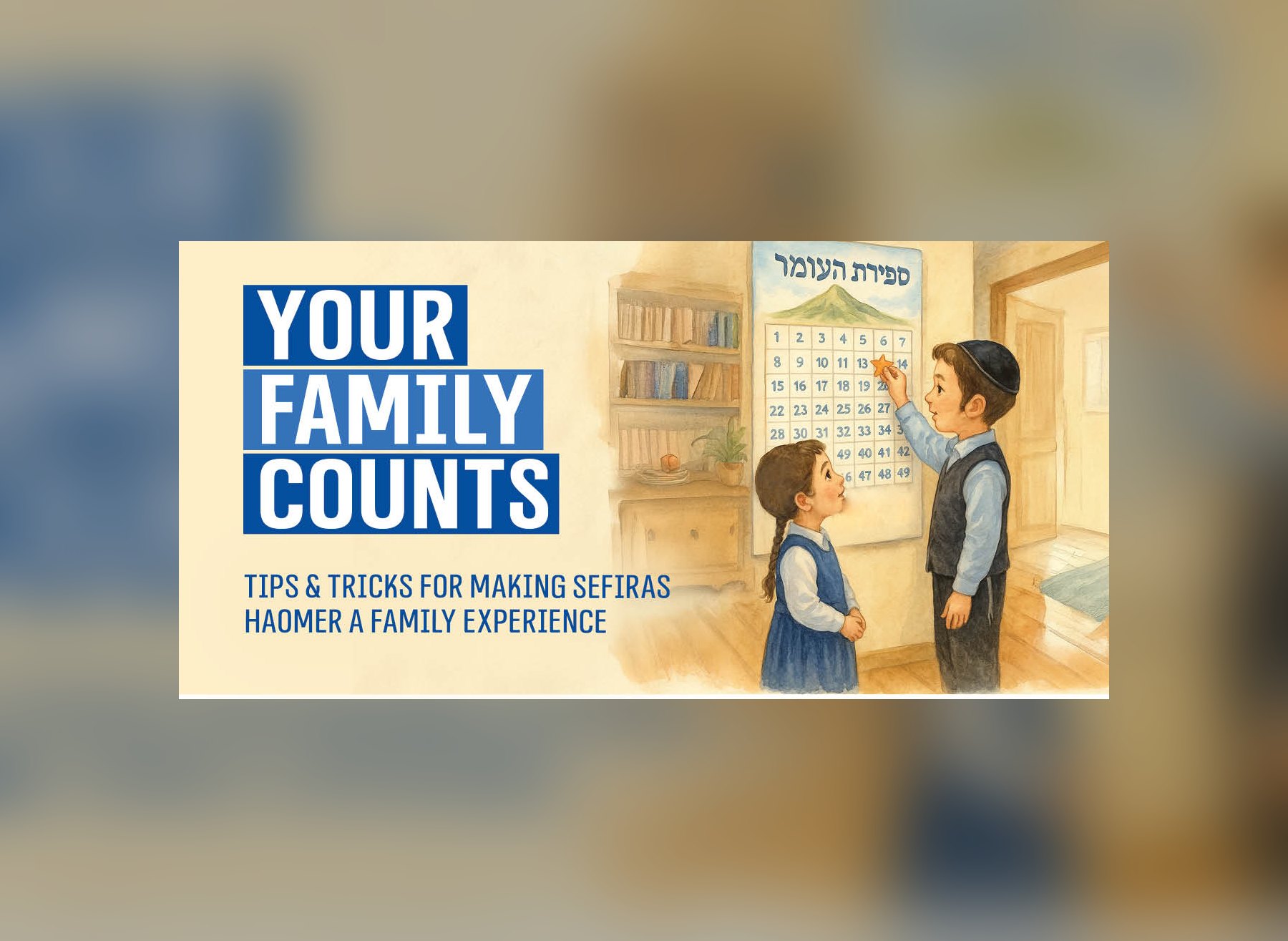
From here, it’s a short step to turn the counting of the Omer into a family celebration. For younger children, you can prepare a large Omer counting chart from poster board or foam board, and hang it on one of the walls in the house. You can buy colorful stickers, and each day after counting, choose a different child to put a sticker on the day’s number or mark a check or any other mark. (Although they usually all have counting charts they receive in school, the large chart makes the counting much more prominent and festive.)
How not to forget
You can do a number of things to avoid forgetting, chas v’shalom. You can set an alarm clock for the time when the stars appear, when it’s already possible to count the Omer, or set a reminder on your phone. From experience, usually, if you appoint the children – or at least one of them – to remind you, they will stand guard and not miss the important role they received.
Incorporating the counting into a specific place in the evening routine also helps to remember. When the children are young, this will naturally be the final act before saying Shema, after the Chassidishe story. And when they are older, it can be after supper, for example. Either way, at the right moment, call everyone ceremoniously, everyone stands together, says the bracha, counts, and if you made a chart – also marks it. And… compliment yourselves for not forgetting today. And how wonderful that we can continue to count with a bracha!
By the way, you can listen to the Rebbe reciting the bracha and counting the 11th day of the Omer (chabadinfo.com) and the 26th day of the Omer (chabad.org).
B’ezras Hashem, after you succeed in counting the Omer with a bracha throughout the period, prepare a special dish for Shavuos, as a treat for the children’s (and your…) nefesh ha’behamis, for persevering in the task.
And even if you didn’t manage to hold on for the entire count with a bracha, it’s okay. You can still continue to count every evening with joy and celebration, checking with the children how far we’ve come and how much time is left until Shavuos.
And you shall count for yourselves
It’s a good idea, in our family Omer counting, to expose the children, according to their age and level of understanding, to the topic of the changing Sefiros each day and explain their meaning. For younger children, we can explain simply: Chesed (kindness) – to practice love for fellow Jews, to help siblings, friends, and so on; Gevura (strength) – to hold back from doing something wrong; Tiferes (beauty) – to have compassion for those who need it, to be alert to the weak and needy in the environment; Netzach (victory) – to defeat the yetzer hara; Hod (glory) – to thank Hashem for everything, to be humble; Yesod (foundation) – to connect to the Rebbe; and Malchus (kingship) – speech of holiness, Torah, tefilla, connecting to the King of the world and to the Torah He gave us.
Each week we’ll remind the children what the weekly midda is. With older children, we can delve deeper and also explain the various combinations: Chesed within Chesed, Gevura within Chesed, and so on. In any case, it’s good to give examples from our daily lives for each Sefira, to think with them how we can make progress in the main Sefira of the current week, to make it present in our daily lives, and to advance in our preparations toward receiving the Torah.
Of course, this conversation doesn’t have to be reserved for the minutes of the Omer counting itself, when we are already ending the day. We can talk about it during the day, during a meal together, or at any other time that works for us. It’s advisable to encourage the children to share both general ideas and their personal experiences from the day that passed, how they progressed and acted according to the weekly Sefira.
The family Omer counting can become a real experience if we make it one, and serve as a lever for personal and family advancement toward receiving the Torah, with joy, pnimiyus and chayus.
Beis Moshiach #1459 • pp. 40-41
© 2026 Beis Moshiach Magazine. All rights reserved.
This article originally appeared in Beis Moshiach #1459. You are welcome to share it with friends and family by email or in print, provided that you do not change, add to or omit any part of it, you credit the author and Beis Moshiach, and you include a link to archive.bmoshiach.org (written out in full in printed copies).
To republish this article in a newspaper, magazine, book or website, please request permission in advance at [email protected].