The Maharshal & Arizal Make Peace
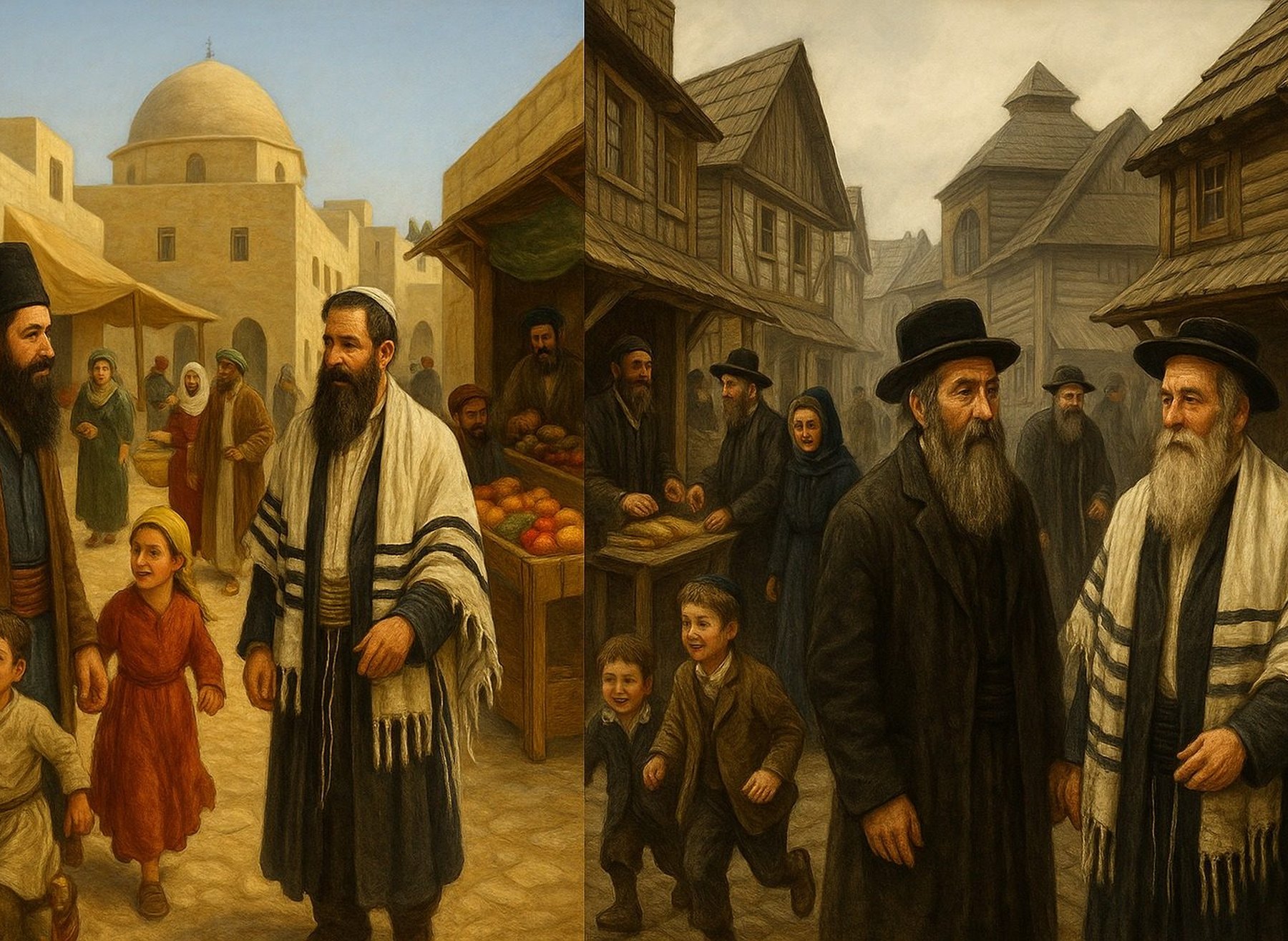
Previously: The Arizal’s students come with kefitzas ha’derech to Lublin, the Maharshal’s city, and announce that the Rav of the town was thinking about horses in middle of Shemone Esrei. Everyone is naturally upset of how these guests embarrassed their Rav, but the Maharshal asks to explain what happened:
From the TzaddikStory.org collection
“Every day, in the bracha of Hashiva Shofteinu in Shemone Esrei, in which we ask Hashem to bring back Yiddishe judges to rule the court cases, I think about the rulings, the Halacha, that I made that day. People ask me what the right halacha is for their situation, and I ask Hashem for help giving the right answers. Today, someone who sold a horse asked if he should also sell the accessories too, like the saddle. The buyer demanded the expensive saddle, and all the stuff that usually goes with the horse… so I actually was thinking about a horse’s saddle.”
The townspeople in shul had their mouths hanging open. How could these random visitors read their rabbi’s mind?! Then they looked at one another and shook their heads.
Maybe these two strange-looking figures were special. Were these secretly angels from heaven?
One person put his arm on the guests’ shoulders, and another brought them hot black tea.
“Fun vanem kumt a Yid?” They asked. Where are you guys from?
“Banu MiEretz HaKodesh.”
“Welcome to Lublin,” the locals said at last, while the Maharshal nodded slowly and stroked his beard.
“So tell us, holy visitors… What brings you here?”
“We’re from the holy city of Tzfas. We’re here about a possible cherem. Great Rabbi, can we speak with you?”
“Come to my study in one hour.”
* * *
At the expected time, they were seated in front of the great Maharshal.
Indeed, he was a great leader in that part of the world, a giant of Torah. How could he want to hurt their Rebbe, the Arizal?
“Master,” they said. “We’ve come from Tzfas today. As in, we left today and arrived today. Our Rebbe sent us.”
“Ah! Another ‘miracle’ your rabbi is up to. I don’t approve of all these magic tricks…”
“But wait, great Maharshal, there’s nothing wrong -”
“Silence! I am the grand rabbi. I’ve heard about your group. I don’t want anything to do with the likes of you, and I’ll warn all the rabbis in Poland and nearby lands…”
“But, great leader, we’re all just servants of Hashem. Just as you teach your followers -”
“Nonsense. I don’t teach words from the Zohar, or reveal secrets that are hidden, or make miracles. This stuff is forbidden.”
“Rabbeinu Maharshal, tell us what angers you about our master, the Ari.”
* * *
The Maharshal looked at the two students seriously. “Do you not remember the dowry situation from about ten years ago?”
Rabbi Chaim blinked. “No… what’s this about?”
“Please explain,” said Rabbi Yisrael.
The Maharshal sighed. “It’s not something I enjoy remembering – or talking about. But I suppose it’s time.
“There was a fine young kallah from a small town not far from here. A match was made with a good, G-d-fearing bachur from Egypt. Yes, Egypt – very far from here. East and West, as they say.
“The kallah’s father gave the couple a large dowry – he was a wealthy man and wanted to give generously. One thousand dinars! A small fortune.
“But then…” the Maharshal’s voice dropped. “After the wedding, the kallah became sick. And she passed away, not long after.”
Rabbi Yisroel and Rabbi Chaim lowered their heads.
The Maharshal continued. “Now, what happens to the money? The father gave it to his daughter – to help her begin her new life. And now, she’s gone. No children – they hadn’t even been married a year.
“The father believed the dowry should be returned. After all, according to Rabbeinu Tam, if a wife dies within the first year with no children, all her property returns to her family.”
“So he asked for it back?” asked Rabbi Chaim.
“Yes. He traveled by horse and boat to Egypt. Sat on the floor of his mechutan’s house, drank tea, and asked kindly: ‘Please return the dowry. It was meant for my daughter.’”
“What did they say?” asked Rabbi Yisrael.
“They disagreed,” said the Maharshal. “They told him, ‘We have our own Rabbanim. And we don’t see it that way.’
“But then they agreed to go to a local Rav – one they all respected. A young man named Rabbi Yitzchok… your Rebbe. The Ari.”
Rabbi Chaim and Rabbi Yisroel exchanged a look.
“Yes,” the Maharshal said. “They trusted him. His father was Ashkenazi. His mother was Sefardi. Maybe he could make peace between the families.
“But instead of giving a ruling, the Ari took the bride’s father aside. He whispered: ‘I don’t think you should ask for the money. I can’t force you, but I’m telling you – it’s not worth it. Go home. Forget about it.’
“The father said, ‘But what do I tell the Rabbanim who wrote to me, saying I’m entitled to the money?’
“The Ari answered: ‘Tell them the Torah says, V’eleh HaMishpatim. These are the laws.’
“‘That’s it?’ said the father. ‘Just say that? That’s your psak?’
“‘Yes,’ said the Ari. ‘And say no more.’
“And so,” the Maharshal finished, “the man returned to Europe. I saw him in shul, and I asked, ‘Nu? Did you get the dowry money back?’
“He looked down and mumbled, ‘No, great Rav. Rabbi Yitzchok in Egypt… he told me to let it go.’
“‘Why?’
“He looked around and said the phrase the Ari had given him: V’eleh HaMishpatim. That’s all.”
The Maharshal sat back, clearly frustrated. “And that was that. No explanation. Just a vague random quote. That’s not Torah. That’s not halacha. That’s not how a Rav should rule. Quoting random things like that. He found a clever way to let the money stay with the groom’s family – and wrapped it in mystical words.”
He leaned forward, his voice sharper now.
“You see why I was suspicious? Add to that the letters I keep receiving – people telling me about the Ari’s ‘miracles,’ how he knows people’s secrets, how he sees hidden things… But we must ask ourselves – is it kedusha? Or is it magic?”
He turned to them, his voice serious.
“Torah must be rooted and based in halacha. It must be crystal clear! If you mix it with riddles, mystery, and magic tricks… how do we know what’s true?”
* * *
“Ohhh… that’s what you’re talking about?” said Rabbi Yisroel Sarug with a knowing look. “Perhaps there’s more to that tale than you realize.”
The Maharshal turned to him, interested to hear more.
Rabbi Chaim Vital stepped forward.
“Rebbi,” he said respectfully, “may we share something with you? A part of the story that might completely change how you see it?”
The Maharshal nodded slowly.
Rabbi Yisroel began: “This story… it didn’t begin with the wedding. It doesn’t even begin in this lifetime. It began many years ago, in a different generation entirely… with two men traveling by boat.”
“A boat?” the Maharshal repeated.
“Yes,” said Rabbi Chaim Vital.
“There was a man named Reuven – he was wealthy, with bags full of gold and silver. And with him on the ship was Shimon, who was extremely poor. He didn’t even have a single coin to his name.”
“They stood on the deck watching the waves,” continued Rabbi Yisroel, “and they began to talk. They became friends. Reuven saw Shimon’s hardship and said, ‘I’ll lend you some money. No worries. Just pay me back when we return home.’”
“And did he?” the Maharshal asked.
“That’s just it,” said Rabbi Chaim. “Shimon was grateful. The loan helped him survive. But when he got home… Reuven was gone. His house was empty. The neighbors said he had gotten sick far from home, and no one knew if he was even alive.”
Rabbi Yisroel continued, “Shimon searched, but eventually, he gave up. He had tried. Life moved on. And eventually… Shimon passed away.”
The Maharshal leaned in.
“But in the Heavenly Court,” said Rabbi Chaim, “Reuven was waiting for him.”
“You never paid me back!” Reuven cried. “I helped you when you needed it most. My family could’ve used that money! That was a lot of money I lent you.”
“I tried!” Shimon answered. “You vanished! I couldn’t find you! I didn’t even know if you were alive!”
The Maharshal frowned. “They were both right.”
“Exactly,” said Rabbi Yisroel. “Shimon couldn’t return the money. Reuven deserved to be repaid. So the Beis Din in Shamayim made a plan. All right, we’ll have to make a solution to this problem.
“They sent their souls back to this world. Reuven would return as a boy, Shimon as a girl. And it was decreed… they would marry.”
The Maharshal’s eyes widened.
“At the wedding,” said Rabbi Chaim, “the kallah’s family would give the chosson a large dowry – the money to support the couple…the same value as the original loan in the previous lifetime. Soon after… the kallah would pass away. And then, once the chosson had the money… he, too, would leave this world.”
“This way,” said Rabbi Yisroel quietly, “everything would be settled. The debt would be repaid. Their souls could rest in peace.”
Silence filled the room.
The Maharshal whispered, “This… is not a regular story. This is something from the upper worlds.
“How could you possibly know all this…?”
“Our Rebbe,” said Rabbi Chaim, “the Ari HaKadosh… he sees things beyond this world. He understands the secrets of souls and their journeys.”
The Maharshal was stunned. “I never imagined this was what lay behind the wedding. Tell me more. I want to understand.”
“We’d be honored,” said Rabbi Yisrael, “but the teachings are very holy. We must go somewhere quiet – perhaps the cellar?”
The Maharshal nodded, and the three men descended into the dark basement.
There, surrounded by silence, the students began to share teachings of the Zohar, just as they had heard from the Ari himself. As they spoke, a soft white light began to glow around them – warm, peaceful, and holy.
The Maharshal looked around in awe. “This… this is Torah. This is truth! Maybe I was wrong to doubt what’s happening in Tzfas.”
The students smiled.
“Our Rebbe sent us on a mission to show you just this,” said Rabbi Yisrael. “Now that we’ve finished – and you understand – there’s no reason to place a cherem on the holy Ari HaKadosh. We’ve completed what we came for.”
He paused and added, “We’re heading to Tisovich. Which road should we take?”
To be continued
Beis Moshiach #1461 • pp. 54-57
© 2026 Beis Moshiach Magazine. All rights reserved.
This article originally appeared in Beis Moshiach #1461. You are welcome to share it with friends and family by email or in print, provided that you do not change, add to or omit any part of it, you credit the author and Beis Moshiach, and you include a link to archive.bmoshiach.org (written out in full in printed copies).
To republish this article in a newspaper, magazine, book or website, please request permission in advance at [email protected].