What Happens When We (Don’t) Sleep?
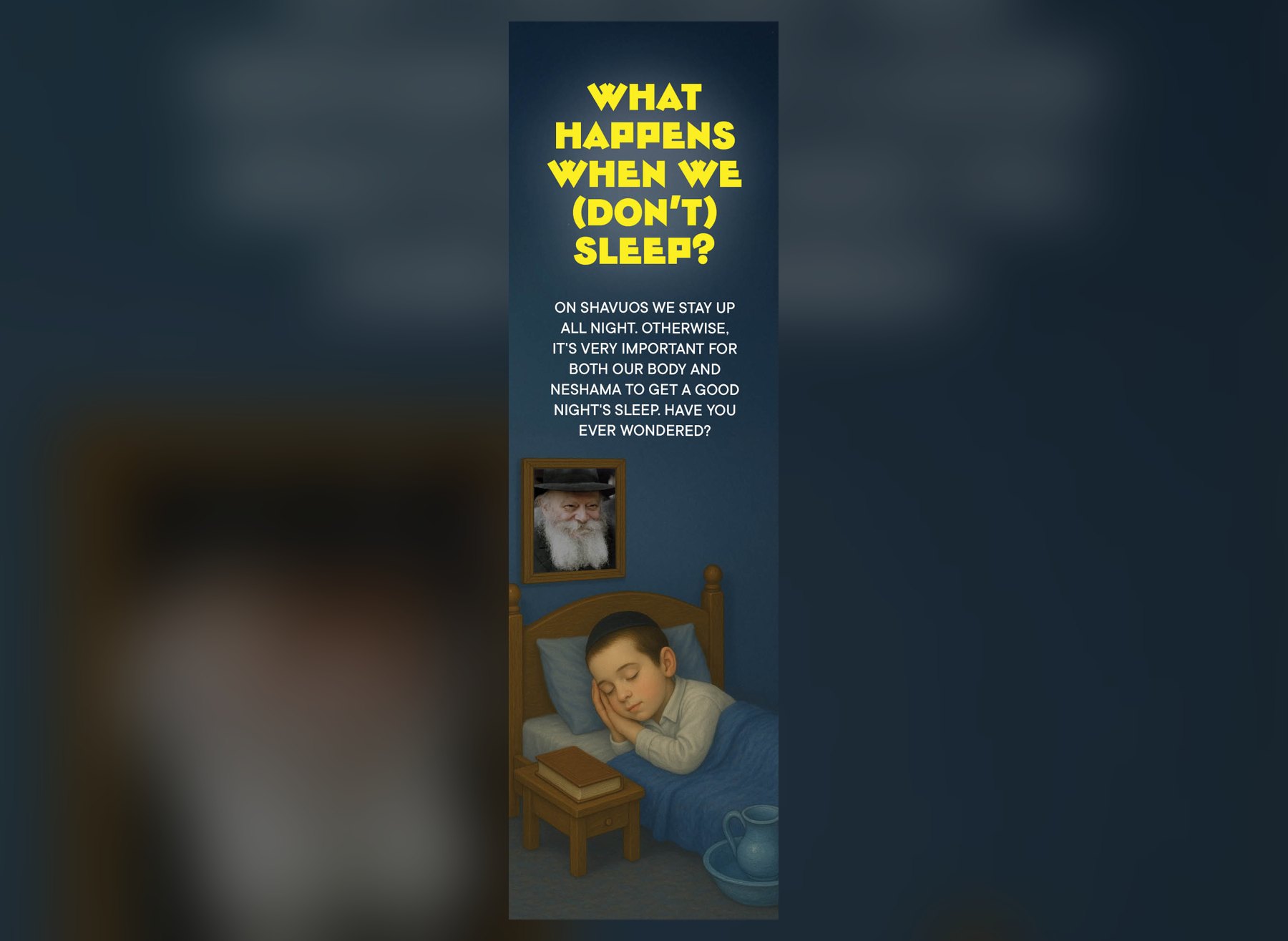
On Shavuos we stay up all night. Otherwise, it’s very important for both our body and neshama to get a good night’s sleep. Have you ever wondered?
Asher:
Zalmi looked at me with tired eyes. He spoke slowly, stuttering, uttering fragmented syllables. His eyes were red and swollen, his posture unsteady, and his steps wobbly.
“You need a doctor right now,” I declared firmly, deeply concerned about my dear friend’s health. “I’m just tired,” Zalmi finally managed to utter, and limped away.
“If you’re tired, then there’s only one remedy,” I called after him. “And that’s simply to go to sleep.” Zalmi gestured that he understood and walked away.
I really hoped that he would go to sleep because, according to my calculation, Zalmy had not slept enough the night before, which was Shavuos. You know, the minhag is that one stays awake Shavuos night saying the Tikkun Leil Shavuos and learning Torah.
Truth be told, I myself struggle to keep my eyes open for several hours and eventually find myself dozing off at the table—until someone, in their kindness, helps me get home.
That’s how it is every year except for the year when the shuls were still closed because of Covid, and Zalmi joined a ‘balcony minyan’ in his building’s courtyard. The fresh air and light refreshments helped, and Zalmi proudly reported that he stayed up all night and only took a short nap before Shacharis.
This time, Zalmi hadn’t slept enough at night, and it’s no wonder that he was now extremely tired. It seems Zalmi went home to sleep, and I was left with difficult questions, such as: what exactly changes during sleep? Why do humans need to sleep? And what happens to someone who decides to just stay awake and refuses to fall asleep at all?
That night, I went to sleep while these questions were still buzzing in my head. But the next day, I met Zalmi—refreshed and energetic as usual. He told me he had slept properly and was now ready to answer all my questions. And so he did.
Zalmi:
One of the most basic human needs is the need for sleep. Just like eating, drinking, or breathing. Without sleep, people can suffer severe, even irreversible, damage. Our Chachamim say that one who swears not to sleep for three days is given lashes for a false oath, since it is impossible to fulfill.
During sleep, the soul ascends, leaving only a minimal life-force in the body. In that time, the soul’s elevation leaves the body slightly vulnerable to forces of impurity, which is why when a person wakes up, these forces recede and remain only at the fingertips—hence the custom of washing hands upon waking.
Chassidus explains something fascinating: during sleep, the body’s vitality retreats, and a person cannot speak, see, or think freely. But precisely because of this, certain otherwise hidden powers become active—such as digestion, which mostly occurs during sleep. It’s like the flame of a candle, whose full glow appears only when it’s away from a large fire.
In sleep, our mind and body enter a unique state of reduced responsiveness to surrounding stimuli. That is, we don’t react to faint noises, light scents, or gentle touches. The body and brain are active; fascinating processes take place, and by morning, the person awakens renewed. One must not underestimate sleep—it takes up about a third of a person’s life and is vital to both physical and mental health. Still, it’s interesting that despite its importance, our knowledge about sleep is still relatively limited, and many of its aspects remain under-researched.
The Rebbe explains that the neshama needs sleep in order to be freed from the limitations of the body and to rise to a higher spiritual state.
It’s fascinating to know that sleep isn’t a single, uniform state—it is divided into several stages that cycle throughout the night. Scientists have managed to decipher some of these stages, which differ in how the body and brain respond. One of these stages is called “dream sleep,” and when a person is awakened from this stage, they almost always report a dream they were immersed in. During these moments, the brain “paralyzes” the body’s muscles to prevent the dreamer from physically acting out their dreams.
Sleep helps regulate blood pressure, lowering it to healthy levels. This is because the chemicals released during sleep reduce the heart rate, causing blood pressure to drop.
Usually, the body operates on a “biological clock,” meaning we naturally tend to sleep during dark hours and be awake during daylight. There are also two major time frames when people are most prone to sleepiness—middle of the night and late afternoon—and two time frames when alertness peaks—early morning and evening.
This “biological clock,” like any clock, can malfunction—due to irregular sleep patterns, prolonged exposure to artificial light, or simply being a “night owl” who delays sleep. The ideal sleep duration also varies. Most studies recommend 7 to 8 hours per night, but many people sleep less, which leads to various illnesses and risks.
Of course, with our Rebbes and leaders, the situation is different. The Rebbe Rayatz said about the Rebbe that he is never asleep at 4 a.m.—because either he hadn’t yet gone to bed or had already risen…
The Rebbe explained one Shabbos in 1990 that the reason Hashem made it so that people need to sleep 7-8 hours daily—essentially “wasting” a third of life—is to give each person a daily opportunity to “start anew.”
Sleep aids in the release of essential brain and body chemicals. In children, lack of sufficient sleep can cause numerous problems—physical, behavioral, and emotional. It’s very important to ensure adequate and restful sleep.
As we know, like every aspect of a Jew’s daily routine, even sleep has its own laws and customs: Before sleep, one says the Shema and the bracha of “Hamapil,” after which one should not speak. According to custom, one sleeps on the left side.
It is accepted among Chassidim to follow a specific order of action, speech, and thought before sleeping: preparing negel vasser at the bedside (action), reciting Shema (speech), and then thinking positive thoughts until one falls asleep (thought).
Beis Moshiach #1461 • pp. 58-59
© 2026 Beis Moshiach Magazine. All rights reserved.
This article originally appeared in Beis Moshiach #1461. You are welcome to share it with friends and family by email or in print, provided that you do not change, add to or omit any part of it, you credit the author and Beis Moshiach, and you include a link to archive.bmoshiach.org (written out in full in printed copies).
To republish this article in a newspaper, magazine, book or website, please request permission in advance at [email protected].