The Lubavitcher Rebbe Fights the Black Magic (3)
Previously: Michoel, a young Jew from France, gets involved with an African tribe that practices black magic. He regrets it and leaves the tribe, but they are after him with their impure powers. He writes to the Rebbe who sends him to Rabbi Hillel Pevzner who tries to help him, but he seems to be drawn again to the tribe
From the TzaddikStory.org collection
Rabbi Pevsner was out helping another family at the time—but his son, also a rav in Paris, was nearby and jumped in to help.
“Listen closely,” the younger Rabbi Pevsner said. “First, tell your son to call me. Right away. Second, that letter—it’s dangerous now. Since it crossed the boundary into your property, we have to destroy it properly. Take a bowl of water and dunk it inside. The Gemara says that water is the strongest thing to break kishuf.”
He paused, then added, “And one more thing. Write down exactly what the letter says—word for word—and send it to me.”
Michoel did call, and the younger Rabbi Pevsner listened patiently. For hours. He didn’t argue or interrupt. He just let Michoel pour it all out—his fears, his confusion, even his memories of the wild rituals he had seen back in Africa.
Meanwhile, the letter arrived. And it was… terrifying.
“We’re sure you received our quite painful regards,” it said. “We know he got the message. Just know—we are very angry. You still owe us hundreds of francs for the unfinished training. And on April 20th, we will gather around the grand mirror to perform the mirror trick on you. If you’re still alive by then, we suggest you run back to us—fast.”
The mirror trick?
Maybe you’ve never heard of it. But let’s just say—it’s not a magic show.
The “mirror trick” is a spell the sorcerers use where they say a bunch of strange words… and suddenly, they can see the person they’re cursing right there inside a mirror. Like a creepy, magical screen.
And once they see the person—they can hurt him.
Poke him. Slam him. Even kill him.
They were planning to do that to Michoel.
What could Rabbi Pevsner do now?
He had already tried everything. The parchment. The davening. The phone calls.
* * *
Rabbi Pevsner hung up the phone and sat back in his chair, his face pale. He had done everything he could. The parchment. The tefillos. The advice. But Michoel was still in danger. And this wasn’t regular danger — this was real magic. The kind you read about in seforim. The kind that comes with curses and threats and dark forces.
He picked up the phone again. This time, he called the Rebbe’s office in New York.
“Hello? I need to speak to the Rebbe’s secretary,” he said urgently.
When the secretary answered, Rabbi Pevsner explained everything. “I did what the Rebbe said — I wrote the pasuk, I gave Michoel the parchment, I’ve spoken to him for hours. But this is too much. This is real kishuf. I don’t know what to do anymore. Please, we need the Rebbe to take over. We need someone holy — a real tzaddik and mekubal, someone who understands the hidden parts of Torah.”
The secretary listened quietly. Then promised to deliver the message.
After that, Rabbi Pevsner called Michoel.
“You need to go see the Rebbe yourself,” he said firmly.
“No way,” Michoel said. “I can’t.”
“Why not?”
“I have… things. Work. Stuff. It’s complicated. I just can’t get on a plane right now.”
“Michoel,” Rabbi Pevsner said gently but firmly, “This isn’t a game. They are after you. This is serious. You’re not dealing with pretend spells. This is real kishuf – real magic – and we need help. Real help. The Rebbe is a tzaddik. His kedusha is stronger than all the magic in the world.”
Michoel still hesitated.
“Do you think just because I keep a little Torah,” he said slowly, “that I’m safe from them? That they can’t get me? We are playing with serious fire here.”
“Yes,” said Rabbi Pevsner. “You are. That’s why we need someone with true light. And that’s the Rebbe.”
He paused, then added, “Believe it or not, Michoel… you’re not the first Yid to go through something like this. There are stories — old, hidden stories — of Jews who dealt with dark forces. And they were saved by Tzaddikim. Let me tell you one.”
Michoel was quiet.
* * *
This story comes from the town of Yanovitz, passed down from one person to the next. Zalman Lipshitz was a kind and gentle pharmacist who dealt with medicine and he lived in the small town of Yanovitz. His father had been a doctor, and Zalman had followed in his footsteps, always helping others. He had just welcomed a new baby into his family, and the house was filled with joy.
But then something strange happened.
On the night before the baby’s bris, the newborn passed away. No warning. No illness. Just a healthy baby — gone. The family mourned. They sat shiva. Friends tried to comfort them. Maybe it was a tragedy. Maybe it was nature. No one understood what had happened.
But then, it happened again.
Another baby was born. Another celebration. And again — on the night before the bris — the baby died. Exactly the same way. No Explanations.
That’s when Zalman knew. This wasn’t something normal. Something was wrong — something hidden. Something he couldn’t explain.
So he traveled to a Rebbe. No one knows for sure which one. Some say it was the Rebbe Rashab of Lubavitch. Others think it was someone else, maybe even a hidden tzaddik or perhaps the Baal Shem Tov himself. But the Rebbe listened carefully and gave Zalman clear instructions:
“On the night before your baby’s bris, do three things. One: Light up the house brightly. Two: Stay up the whole night learning Torah and davening with a group of ehrliche Yidden. Three: Find a poor man — a guest — and bring him into your home. Feed him. Let him sleep there. Don’t ask questions.”
Zalman went home and did exactly what he was told.
When that night came — the third baby’s vachnacht — he kept every light in the house shining. He invited older men from the community to learn and sing and stay awake. And just before midnight, a man knocked on the door.
He didn’t look like a beggar. He wasn’t loud. Just quiet. Strange eyes. A torn coat. Zalman offered him a warm meal, but the man refused.
“I only need a place to rest,” the man said. “If you don’t mind, I’ll lie down on the stove.”
The family was confused. Sleep on the stove?
But Zalman remembered the Rebbe’s words: Don’t ask questions.
The man lay down and closed his eyes.
Then — just before midnight — it happened.
A loud crash. The door to the nursery swung open, even though it had been locked. A huge, black cat bolted into the room, its eyes glowing. The baby started to cry. The men learning Torah froze. And before anyone could move, the guest — the quiet stranger — leapt from the stove.
He ran into the nursery, grabbed the cat by its neck, and smashed it against the wall. Again. And again.
“Go!” he shouted. “Out of this house!” He kept kicking and hitting the poor cat.
He opened the front door, threw the cat outside, and slammed it shut. The whole house was silent. The stranger returned to the stove, lay down, and said nothing.
The rest of the night passed without another sound. The baby was safe. Everyone stayed awake.
In the morning, a messenger came running from the estate of the poritz, the cruel nobleman who lived nearby.
“Something happened last night!” the man cried. “The poritz’s father went out just before midnight — and he returned half-dead! He’s lying in bed, moaning, covered in bruises. No one knows what attacked him!”
Zalman’s eyes widened. He looked toward the stove.
But the guest was already gone.
He had vanished. No name. No goodbye. Nothing.
Only later did people realize: that guest wasn’t an ordinary person. Maybe a malach. Maybe a hidden tzaddik. Maybe someone sent from Heaven to break a curse.
The poritz’s father had long been feared. Some whispered he had studied dark, forbidden things — magic, curses, strange powers. And now it all made sense. That black cat… the one that had crept into Zalman’s home in the middle of the night… it wasn’t just a cat.
It was him.
And from that day on, no more babies in his family were taken in the night.
* * *
Rabbi Pevsner got to work. He knew what had to be done. They needed the Rebbe.
He made a phone call.
“Michoel can stay by you for Shabbos, right?” he asked a friend in New York.
“Of course!” the friend said. “And I’ll take him for Sunday Dollars. When we get to the Rebbe, I’ll say, ‘This is the man with the witchcraft story.’”
It all sounded perfect.
But then… it wasn’t. That week turned into a nightmare. Every time they tried to book the ticket, something else went wrong. One day, the payment didn’t go through.
Another day, the computer froze. And when they finally bought the ticket, it could only be picked up at a tiny travel office on the other side of town. “But if Michoel drives there, he’ll never make it to the airport in time!” his family panicked.“ Can someone else pick it up?” they begged.
But everyone was busy, or stuck, or too far away. Michoel was getting frustrated. He tried to call Rabbi Pevsner to ask what to do. He dialed the number…
Ring…
A random man answered. “Allô?”
“Uh… is Rabbi Pevsner there?”
“Who?” Michoel hung up and tried again.
This time — a woman answered. He looked at the phone. Same number. What was going on?
It was like the phone was cursed. Each time he dialed, someone else in Paris picked up. People he didn’t even know! He finally got through… but as soon as someone picked up — click — the line went dead.
He tried again. Nothing.
Time was running out. Shabbos was coming.
Michoel was falling apart.
That Shabbos, he was pacing, crying, muttering to himself, “They don’t want me to go to the Holiness. They’re trying to stop me. I’m still trapped. They know I will break free.”
Rabbi Pevsner agreed it was weird. He didn’t know what else to do. He picked up the phone and called the Rebbe’s office.
“Rabbi Groner?” he asked the Rebbe’s secretary. “Please. Please go into the Rebbe’s holy room and tell him everything. Every detail. We need a bracha. We need to break this magic. Michoel must come.”
A short while later… The ticket was picked up. The ride was arranged. And somehow — miraculously — Michoel got on that flight. He was on his way to New York.
To the Rebbe.
* * *
Before Shabbos, Michoel wrote a long letter. Every detail was written down — the fear, the dreams, the accident, the mirror threats, the spells.
Sunday morning. he came to 770, to the Rebbe’s shul.
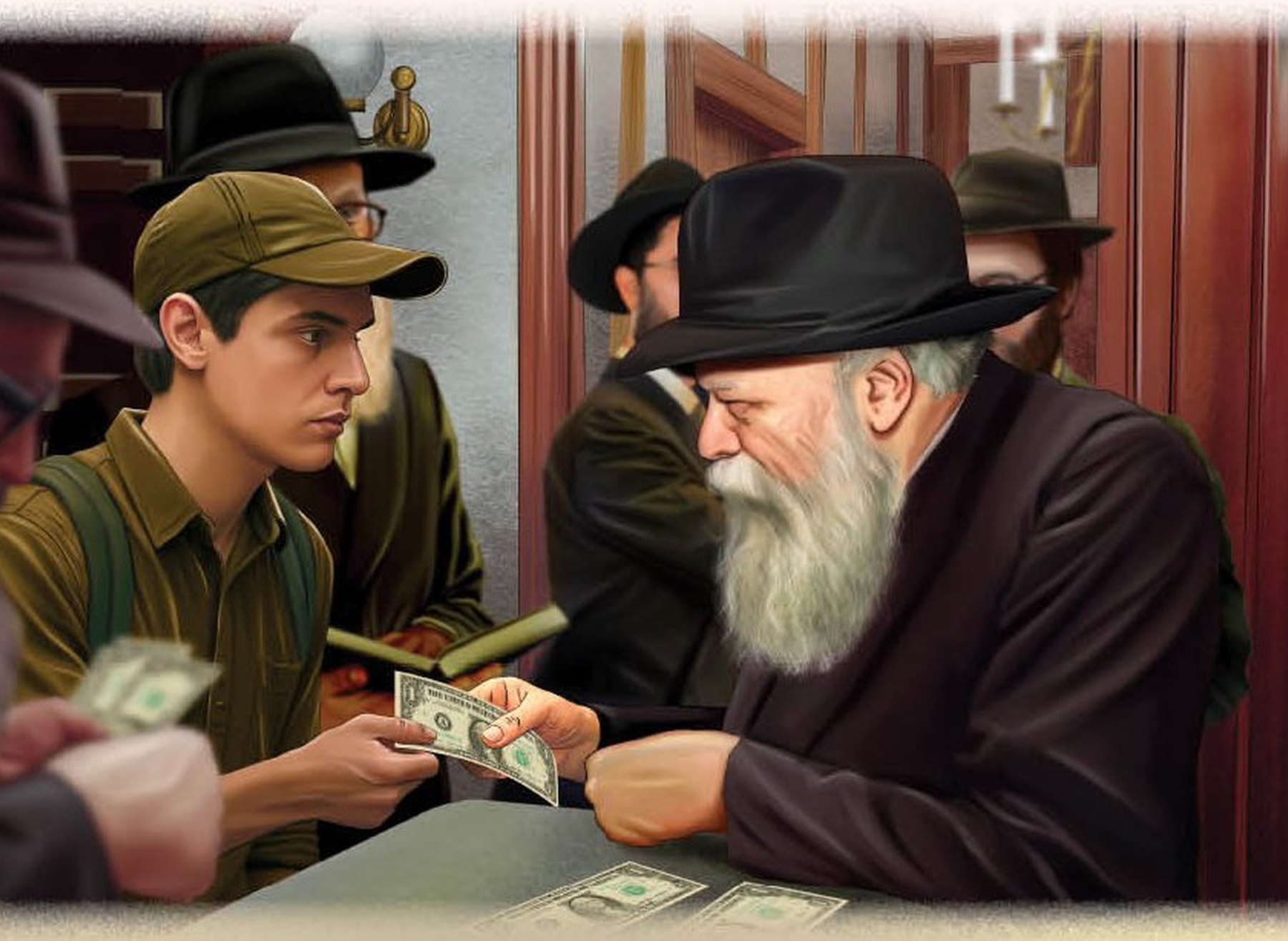
The line for “Sunday Dollars” was very long. Michoel waited quietly, holding the letter in one hand and his heart in the other. His whole body was shaking. When it was finally his turn, one of the attendants leaned toward the Rebbe and whispered, “This is the man Rabbi Pevsner called about.”
The Rebbe turned to Michoel and looked straight into his soul.
In strong Yiddish, the Rebbe said:
“Fargesen altz vos is gevhehn – Forget everything that happened.”
Then the Rebbe switched to French: “May Hashem protect you wherever you go.”
And then back and forth — in Yiddish and in French — the Rebbe gave more blessings: “You should have much hatzlacha. Besuros tovos. Good mazal.”
Michoel didn’t know what to do. Smile? Cry?
His heart felt like it was bursting. People behind him gently pushed forward — the line had to keep moving — but the Rebbe wasn’t done.
The Rebbe turned, looked back at Michoel, and motioned for him to come back. Michoel stepped back in front of the Rebbe.
The Rebbe looked at him again, deeply in the eyes, and said, “A kosher and happy Pesach.”
Michoel nodded, trembling, and stepped away. He sat down on a nearby bench. Something had happened. Was it over? Was he really safe?
He didn’t know what to think.
But a few hours later, someone handed him a small handwritten note — straight from the Rebbe.
It read: “The Torah promises: Hashem guards you when you come and when you go — Now and Forever.” The words now and forever were double underlined.
Under that, the Rebbe wrote: “Add in your Torah and mitzvos.”
Michoel understood. The Rebbe had given him two things:
A bracha: Hashem will protect you always.
A mission: Keep growing in Torah and mitzvos — make yourself a stronger vessel to hold all that good.
And from that day on? The magic never touched him again. Oh, they tried. Dont think they didn’t.
First, the tribe demanded money for food and “sleeping accommodations.” So Michoel’s family paid what was owed, just to close the chapter. Then, for a whole year, they kept sending letters. Threats. Promises. Tricks.
But on the day of the “mirror spell” … nothing happened. Absolutely nothing.
Because a tzaddik had spoken.
And Hashem had listened.
After that?
The witches gave up. Michoel was free. Because when light shines — real, holy light — darkness has no power.
* * *
When Michoel got married, he invited Rabbi Pevsner to come celebrate with him.
Before the chuppah, in the family house, they played a video clip of Michoel getting a dollar from the Rebbe years earlier. The screen was huge, and the video was crystal clear. You could see every detail — the Rebbe’s holy eyes, Michoel’s face filled with awe, and something else… something they hadn’t noticed before.
As each person walked by the Rebbe in the line, the Rebbe would give them a dollar and say a short bracha — “bracha v’hatzlacha,” or “success in everything.” It was always quick, always steady. But when Michoel walked by, something unusual happened.
The Rebbe didn’t answer right away. For a split second, it looked like the Rebbe’s lips were moving quietly. He was whispering something.
It was too fast to hear. But watching the video again, Rabbi Pevsner gasped.
“Could it be…?” Maybe — just maybe — the Rebbe was whispering the holy pasuk: “כִּי לֹא נַחַשׁ בְּיַעֲקֹב וְלֹא קֶסֶם בְּיִשְׂרָאֵל” “There is no sorcery in Yaakov, and no magic in Yisrael…”
That would explain everything.
In the Gemara, in Maseches Sanhedrin (67b), it says something powerful: Yes, magic is real. Yes, people can use kochos ha’tumah — dark forces — to hurt others.
But not a tzaddik. Not someone who is close to Hashem. Not someone who brings Hashem’s light into the world.
Because magic, kishuf, even the scariest spells — all of it is nothing when compared to the power of kedusha, holiness. And the Rebbe? The Rebbe was filled with kedusha. He didn’t need to scream, or fight, or cast spells. He just whispered a pasuk from the Torah — and all the darkness melted away.
From that day on, the kishuf never touched Michoel again.
Because when you hold on to a tzaddik — when you hold on to the Torah — You are holding on to Hashem. And Hashem is stronger than anything.
Beis Moshiach #1468 • pp. 54-59
© 2026 Beis Moshiach Magazine. All rights reserved.
This article originally appeared in Beis Moshiach #1468. You are welcome to share it with friends and family by email or in print, provided that you do not change, add to or omit any part of it, you credit the author and Beis Moshiach, and you include a link to archive.bmoshiach.org (written out in full in printed copies).
To republish this article in a newspaper, magazine, book or website, please request permission in advance at [email protected].