After Him, Into the Desert
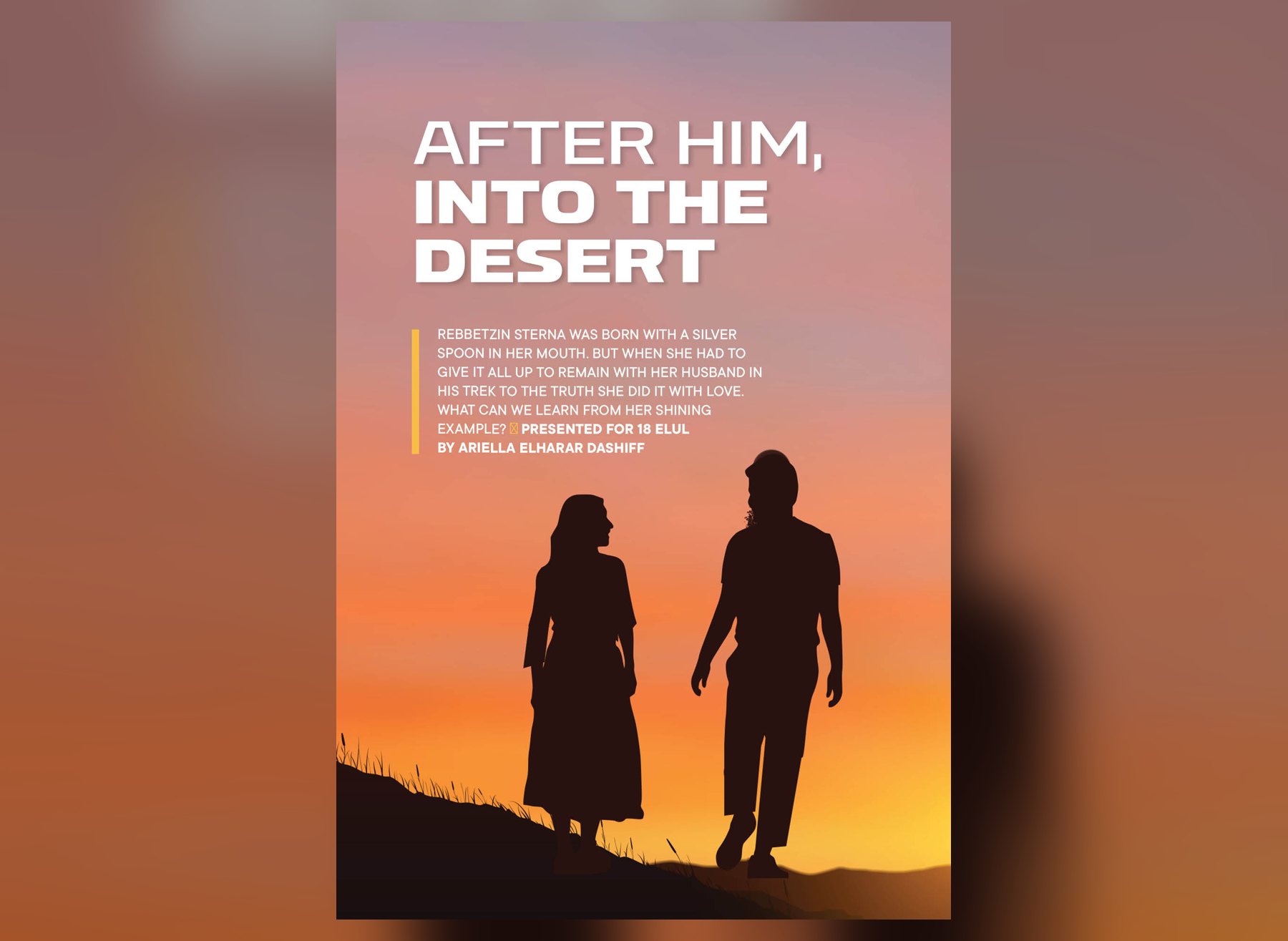
Rebbetzin Sterna was born with a silver spoon in her mouth. But when she had to give it all up to remain with her husband in his trek to the truth she did it with love. What can we learn from her shining example? Presented for 18 Elul.
Following You Into The Desert – Then
The city of Vitebsk was celebrating. Today was the wedding day of Sterna, daughter of the honored wealthy man Rabbi Yehuda Leib Segal, to Rabbi Shneur Zalman, son of Rabbi Boruch. It was a good shidduch, and Rabbi Yehuda Leib was extremely pleased with his new son-in-law. The young man was the object of his dreams – an outstanding and genuine Torah scholar, profound, sharp, possessing exceptional good middos, and above all, a great yerei shomayim.
However, it seems Rabbi Yehuda Leib did not know that his son-in-law possessed a lofty soul that seeks truth in its absolute form, and follows after it.
Indeed, immediately after the wedding, his nature was revealed. Rabbi Shneur Zalman began to invest his days and nights in study, with absolute self-sacrifice, to the point where he barely left the attic that his father-in-law had designated for him.
Later, when the Alter Rebbe joined the path of Chassidus, his father-in-law and mother-in-law became angry with him and completely severed their relationship with him and their daughter. More than once, the parents pressured their daughter to demand a divorce from her husband, but Rebbetzin Sterna stood firm and refused their demands, despite the great spiritual and physical suffering they caused her.
This story and other stories about Rebbetzin Sterna’s devotion to her husband illustrate the verse “Your following me into the desert, into a land not sown.” What courage, nobility of spirit, and sacrifice the Rebbetzin had for her husband’s sake.
Following You Into The Desert – Today
The version of feminine courage and sacrifice in our generation is very different, but no less powerful. Following one’s husband without regard for almost any difficulty that might arise in marriage is not simple and requires special qualities. In our times, this is especially difficult, not only because in today’s society it has become much more acceptable to abandon marriages, even in cases where there is no real difficulty, and not only because the changes that people undergo in their lives are numerous and sometimes extreme.
Another important and primary reason is the type of education we received and still receive. Every video, advertisement, or radio program deals with the same subject in different variations: reality must revolve around my desires and my worldview. Because my worldview is based on pure logic, and whoever has not reached identical conclusions to mine – their way of life necessarily harms them and their environment.
So how can we expect a home that undergoes such great upheavals to hold together? What is the thing that serves as life-giving oxygen for the home? What is the glue that will be strong enough to keep the couple together?
They say that a wise person’s question is half the answer. This is true here as well. What will keep the couple together is… the togetherness itself. What is actually the purpose of marriage? Certainly not that the other should fill some deficiency I have. Perhaps the purpose is fulfilling mitzvos? Let’s assume so. Fulfilling mitzvos. This answer contains both truth and a point of weakness. The truth is that the purpose of everything is fulfilling mitzvos, doing Hashem’s will.
But contrary to the superficial view of reality, where there are ‘good’ things and ‘bad’ things, in the Chassidic perspective, every situation is a good situation. Every situation is a backdrop for fulfilling Hashem’s will. If both spouses want to fulfill mitzvos, it won’t be difficult for us to identify this good, but if one of the spouses behaves differently than the other expected, what do we do then? The knowledge that this too is an opportunity to connect to Hashem, the absolute good, the true good, but in a slightly different way – this is the answer.
Kindness, Strength, and Beauty in Marriage
The Alter Rebbe explains that the mitzva of tzedaka is equivalent to all the mitzvos because it purifies the animal soul in a way that is incomparably more sublime than any other mitzva. A person puts himself aside and harnesses all his talents to earn money, and gives a portion of the money he worked so hard for to another Jew.
The Rebbe extends this further: spiritual tzedaka is no less than physical tzedaka and even exceeds it. When families are composed of observant and non-observant members, in order to give the other their spiritual nourishment, the love and honor their soul needs, the additional mitzvos they fulfill thanks to their spouse – the spouses need to put themselves aside and rise to a place that is above both of them. This place is called ‘together,’ and it is the goal of all our marriages: unity, honor, and love.
Honor is connected to the midda of gevura: I do not enter into my spouse’s private life. What he does between himself and Hashem is not my business at all. My role is to love him and honor him, meaning I will never demean him and will always see in him someone worthy of the best and most respectful treatment. Even when he errs!
Unity is connected to the midda of tiferes: He and I are one. Our shared goal is to unite, therefore I will avoid anything that might separate us. I will not complain about him, I will not speak about him behind his back, except for the purpose of deeper unity. I will not mock him for his weaknesses, even in jest, and certainly will not demean him in front of others, especially not in front of the children. Cynical speech is poison to marriage.
Open communication full of trust in the good in the other is very necessary to preserve the positive atmosphere and the deep and genuine connection.
Love is connected to the midda of chesed: to strive, as much as possible – to give, to provide, to compliment, to see the good, to rejoice in the other, to thank, to experience positive shared experiences, to laugh together. To be supportive during difficult times, and to be those who strengthen the soul.
Here is a short story that appears in Rabbi Shalom Arush’s book The Wisdom of Women: A woman came to Rabbi Arush to ask for a blessing for shalom bayis. She told him that her husband had deteriorated greatly and become addicted to dangerous substances. Rabbi Arush listened sadly. Since there were children involved in the story, he advised her to get divorced. The woman did not want this. She came to ask for advice to save the marriage, not to dissolve it. Rabbi Arush was impressed by her strength of spirit and told her that she should increase her tefillos and giving thanks to Hashem, and surely Hashem would help her. The outcome was that the husband overcame his addiction to dangerous substances after two years of joint struggle.
The power of love, the power of true honor, the power of unity. And the opposite is also true – without honor, love, and unity, there is no good and healthy foundation for marriage.
Following you into the desert of the time of the final hours before the dawn of the Geula.
Beis Moshiach #1475 • pp. 48-50
© 2026 Beis Moshiach Magazine. All rights reserved.
This article originally appeared in Beis Moshiach #1475. You are welcome to share it with friends and family by email or in print, provided that you do not change, add to or omit any part of it, you credit the author and Beis Moshiach, and you include a link to archive.bmoshiach.org (written out in full in printed copies).
To republish this article in a newspaper, magazine, book or website, please request permission in advance at [email protected].