Climbing Down The Tree
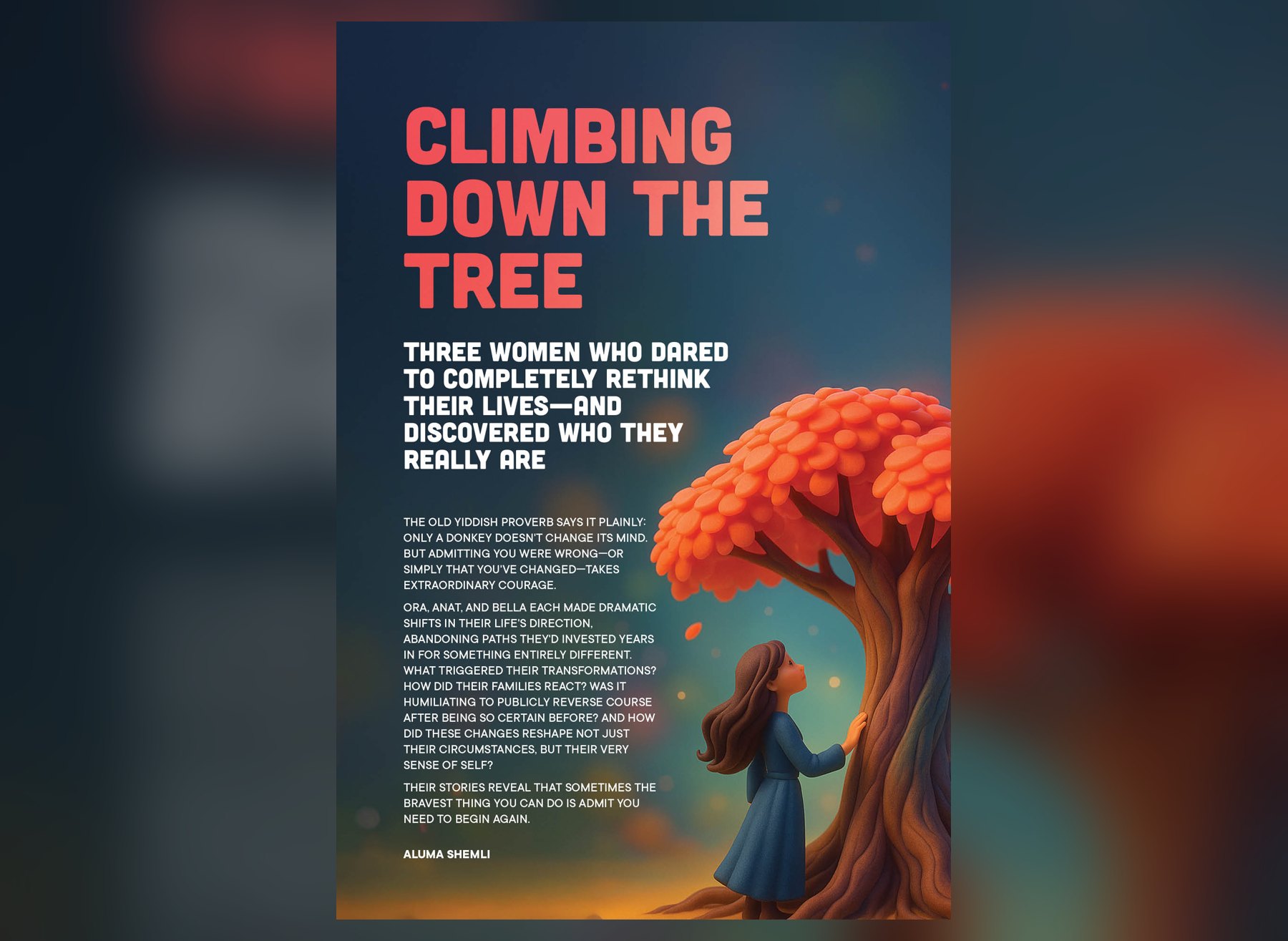
Three Women Who Dared to Completely Rethink Their Lives – and Discovered Who They Really Are
The old Yiddish proverb says it plainly: Only a donkey doesn’t change its mind. But admitting you were wrong – or simply that you’ve changed – takes extraordinary courage. Ora, Anat, and Bella each made dramatic shifts in their life’s direction, abandoning paths they’d invested years in for something entirely different. What triggered their transformations? How did their families react? Was it humiliating to publicly reverse course after being so certain before? And how did these changes reshape not just their circumstances, but their very sense of self? Their stories reveal that sometimes the bravest thing you can do is admit you need to begin again.
“It’s a principle of mine, anyone who knows me knows…” “That’s how it is with us, there’s nothing to do about it!” “No way, it’s simply not possible otherwise…”
Do you recognize these phrases that turn every principle into something sacred and get us stuck? That’s how we are. Fixed. The way we’ve become accustomed to thinking and managing our lives becomes sacred, allowing us to go along with what’s familiar without challenging our tired, burdened minds.
Sometimes only a serious jolt causes us to wake up, to reconsider everything. Sometimes following deep reflection we decide to change perspective. In any case, change is not easy, and it affects all our lives and also those around us.
Who I Was Before the Change
Can you please describe your life before the turning point?
Ora: Before the change I was a busy woman, managing the whole world. Very responsible and organized. I took on many, many areas of responsibility, even if they weren’t directly related to me. I was the type who would always volunteer to be on the building committee, organize the family party, file the joint claim for several people injured in the same accident…
I have talent in this area and I love organizing things, and I couldn’t sit still. So I volunteered to take care of basically the whole world.
Anat: I became close to Chabad in my youth. After several years I established a Chassidishe home, boruch Hashem. Today my husband and I are in important positions in our community in various respects. We’re a family that people look at. These two things together, both the status and my background as a baalas teshuva caused me for years to insist on being an example in all areas, especially regarding our children. After all, it couldn’t be that ‘the child of…’ wouldn’t be in first place in learning and conduct, and the daughter of a baalas teshuva must prove more than anyone else how Chassidish she is, to be a counselor at camps, fly to the Rebbe, preferably also compete in the ‘Dvar Malchus’ quiz…
I encouraged the children and pushed them to advance and succeed. I felt like a very Chassidishe mother, and didn’t think for a moment that I was actually concerned with my image much more than with their connection to Chassidus and the Rebbe.
Bella: I grew up in a poor family, like in the stories. Our financial situation was always bad, and although my parents tried to create an atmosphere of joy of life and love in the home, and give us what was necessary, our circumstances were very much felt. There were things I couldn’t even dream of. I grew up particular about every cent. I was the neighborhood babysitter, also helped with light cleaning work, and saved every shekel. I never bought myself just a candy or ice cream. I knew that one day there would be a trip, and my parents wouldn’t have money to pay, and there would be a textbook I’d need, and there just wouldn’t be a way to buy it. I wanted to be ‘covered.’
When I finished school and went to work, I saved literally every shekel. I thought my parents would struggle to pay even for the rolls at my wedding… I thought I’d have to deal with all the expenses myself. In the end, to my surprise, my parents managed to finance a modest, simple and very happy wedding for me, but I didn’t regret saving for all those years, that way I could furnish the small apartment we rented with good furniture and not just with ‘bargains’ that people threw away. I continued to save and calculate every shekel.
Although my husband and I have been working all these years, I don’t need to tell you that even two salaries aren’t enough with today’s cost of living, especially if you want to save for simchas to come, b’ezras Hashem. So I was always a very calculating woman regarding money, almost stingy.
Rethinking the Path
What made you rethink everything?
Ora: Two years ago, in the middle of several very important projects, I was injured in an accident. An accident considered very minor and that wasn’t my fault at all. I went to the emergency room, and that same night I was sent home with a cast on my right hand and many painkillers.
It seemed like just another challenge that would pass very quickly, and already in the taxi I started managing and planning in my head those two weeks, how I’d cook, clean, who would carry the groceries…
Pretty quickly I understood that the life I had wouldn’t return. The hand didn’t return to itself, and the pain disoriented and exhausted me. We went from doctor to doctor, and each one claimed the previous doctor was wrong, and suggested a new way to bandage the hand or a new pill to take. They also recommended physiotherapy, complete rest, and exercises… I tried everything, to no avail.
I reached a state where in the morning I have no idea what the evening or even the afternoon will look like. There are days when I manage to function not badly, and days when I go crazy with pain. Thus I was forced to lay the baton on the table, to allow someone else to take it. It wasn’t easy. At first I still tried to organize and manage the help at home, someone to clean. At some point I gave up.
But if at first it was real torture, feeling like I’d lost control completely, with time and with serious work and help from a wonderful therapist, I understood that there’s no loss of control here, just transferring the baton of control to someone else.
And not just to anyone, but to the One who manages this whole world and my life anyway, and managed everything even when I was sure I was the one managing every detail of my daily schedule. I simply chose to live a calm life without management and control, to do everything I could in every given moment and trust in Hashem that the other things would be fine too.
Anat: Our Mushky “taught me a lesson.” Already from a young age she didn’t connect to my goals. She was shy to do mivtzaim and didn’t want to review the Rebbe’s sicha in front of guests. She didn’t volunteer for positions at events or class parties, and generally chose to flee from the spotlight.
I tried with love and manipulation to get her to want to lead, organize something, join some class or group of girls. I so yearned for her to be completely occupied with mivtzaim and classes, and for her name to be listed in those small letters in thank-you ads for organizers in Beis Moshiach…
High school years passed on very low flame, after which she chose to leave everything. Simply everything. As if saying: “I’m not fulfilling your dream anyway and I’m not even close to it, so why try?”
We went through difficult times, like any family that falls into this nisayon. My children were my shop window to the world, the proof that our home was okay. It was a real collapse. I couldn’t show my face outside. I felt like a failure, a woman who didn’t even succeed in raising her daughter to Torah and mitzvos…
I went through a very internal and deep process, reminding myself that my children are people in their own right, sent by Hashem to the world for a very specific purpose and mission, nothing to do with me. I can and should do everything to connect them to the Rebbe and to Chassidus, but not try to impress anyone, only be grateful for my privilege to accompany them in their first years in the world.
Bella: Nothing specific happened in one moment. But the children grew, and it was no longer possible to buy them only the simplest cookies and cheapest snacks, and hope these would make them happy. Kids have other ideas, and you can’t choose clothes for them at the gemach anymore. Girls need to go to a store, and the modest item needs to give them a good feeling, and if not, they won’t want to be tzanua, ch’v.
I felt the situation was already starting to pressure me too much, and I prayed that we’d win the lottery, that I’d receive a higher salary, that Hashem would solve my problems.
It took me time to understand that for Hashem to solve my problems it wasn’t enough to win a large sum of money, because I would always continue calculating whether it’s worthwhile to spend it or invest it in some fund or rental apartment…
As long as my behavior didn’t change, no amount of money would help. I started working on this. I wasn’t reckless and didn’t accumulate overdrafts at the bank that no one knows how to pay, but I definitely let Hashem do His part in our parnassa. After all, He sustains and provides for all. What was needed, I bought. I didn’t waste. We always figured out how to pay for it.
It Was Difficult but Worth It
What reactions did you get from those around you?
Ora: The process required time. I had to release control immediately, but the internal transition from despair and frustration to inner peace and bitachon in Hashem was slow, so not everyone experienced it with me.
My children feel the change and are really happy. They tell me that when I was running things, it wasn’t easy to live with me… Today, when I am relaxed, they take on much responsibility, but because they want to and without constant supervision…
Anat: Those around me, contrary to my fears, accepted us with love and a big hug. Our nisayon is not the first and not the only one unfortunately. Except for one good neshama who knew how to explain to me that all this happened because I didn’t respect my husband enough, the rest only give us lots of strength.
Those who reacted to the change in me with surprise and positivity were the children at home. It turns out the other children also felt my pressure for them to represent us respectably. When I loosened up, and let them connect at their pace and in their style, the connection suddenly became different, full of chayus and enthusiasm, like anything a boy or girl does for themselves and not to please their parent.
Bella: Those around me are mainly my husband and children, because outwardly we’re still a frugal home and we don’t waste money. But at home I felt the relaxation immediately. The older children are more relaxed, and mainly I am. I don’t panic and don’t fall into mathematical computations. My sleep no longer is interrupted. I know we need to make our keili, go to work and be mindful in our expenses at a logical level, and Hashem will do His part and ensure we lack nothing.
How Hard Is It?
Ora: Very, very hard. We’re not talking about a behavioral change, which also isn’t easy at all. We’re talking about completely different thinking and behavior. To get into bed Friday afternoon because the pain doesn’t allow me to do anything, and simply let go, even though I have no idea who will prepare Shabbos.
This is not easy for any woman, not just for a manager like me. Sometimes I toss and turn in bed, my mind paints horrifying scenarios for me, until I remind myself that I’m not alone in this story, and I have Someone to rely on, and He has never disappointed me.
Anat: It was hard for me mainly at the beginning. I really blushed and was embarrassed every time I left the house. When I met someone new, I prayed she wouldn’t ask what my daughter does. What would I answer her? Wanders the streets?
Today, after I understood that my children are people in their own right, I really enjoy getting to know them, being impressed by them, by the choices they make, by their way of discovering life, the Rebbe.
Bella: Not like I thought… I needed to let go a bit, and at first it was quite difficult. But my husband was with me, promising we wouldn’t starve for bread. Everything would be okay. He also promised that if I let go too much, start to waste and allow myself to shop irresponsibly, he’d stop me (won’t happen…). I felt really like a child learning to walk, who suddenly needs to let go of her mother’s hand, walk on their own without holding onto anything.
I always held onto numbers, accounting sheets, the salary slip, today I’m learning to let Hashem take care of us from His full, open and broad hand…
Was it worth it?
Ora: The most worthwhile thing in the world. I wouldn’t have chosen this accident or the pains either, but I thank Hashem every moment anew for the quality of life I merited as a result. Sometimes I wonder if there’s any chance I would have reached such relaxation and freedom if I hadn’t been forced, preferring not to answer… I promise myself that the day I get rid of the pains, b’ezras Hashem, I’ll still remain calm, relaxed and free.
Anat: Very worthwhile. Really. This change was blessed for my children, but also for myself. It took me time to understand that when I tried to get my children to represent me respectably, I actually didn’t accept myself either. I never felt good in my own right. I always had to prove to everyone that I’m okay, that we established a good Chassidishe home. Since I learned to accept my children as they are, I’m more forgiving toward myself too.
Bella: A completely different world. Like walking in the dark carefully and fearfully, and suddenly someone turns on the light. This knowledge that Hashem commands us to support our family, but doesn’t leave us alone in the battle for even a moment, fills the lungs with oxygen.
Yes, I Changed!
Tell about a moment, an incident, when you suddenly understood how much you’d changed…
Ora: The moment when guests arrive was always a very stressful moment for me. Everything had to function well. I couldn’t deal with the thought that they’d chas v’shalom see something not organized in the house, an unsettled child, imperfect refreshments. Of course I preferred guests to come with advance notice, and if it turned out I had a surprise guest, I’d be very stressed.
Today my home is open to whoever wants to come, usually everything is more or less organized, and also purchased refreshments wait in the cabinets. This is my home, this is my life, and whoever comes to visit, comes to be hosted by me as I am, not to pass judgment on me.
Today I enjoy the guests much more, the hosting experience, the conversations. I couldn’t enjoy this before, when it was important to me to impress and I was busy ensuring everything functioned properly.
Anat: We went out together, Mushky and I, to arrange something. I, a Chassidishe mother wearing a sheitel, she in her clothes, minimal, and with earrings in places our grandmothers didn’t imagine possible… We entered a chareidi area and drew quite a bit of attention and looks.
Suddenly I felt it really didn’t bother me. On the contrary, I felt proud. A mother of someone struggling, not afraid. Even Mushky looked at me surprised, “Doesn’t it bother you to walk around like this next to me and everyone’s looking?” she asked genuinely, not defiantly.
“Really not,” I told her. “I love you as you are and enjoy walking with you.”
It was a healing moment for both of us, it was a moment when I understood what an amazing process I’d gone through.
Bella: It was Erev Pesach. The many expenses stressed me every year. This time I decided to write for myself what was essential and must be bought, and find a way to buy these things without giving up anything. So of course in a Chabad home food takes a place of honor. Vegetables, fruits, meat and wine. The matzos of course. You can’t economize on food. After all, we can’t make do with crackers or a little fried matza… Also cleaning products were necessary and would enter our shopping cart; after all the house must be clean as required.
When I got to the clothing section I started to deliberate. After all the children didn’t walk around in worn rags all winter, and they have decent clothes, so why must we buy? It’s a big expense! On the other hand, we’re talking about simchas Yom Tov. In the end I decided to go ahead.
I wouldn’t go to the most expensive stores, of course, but a festive and cute garment for each girl was put on the list of things we needed. I returned home, hanging the spring dresses in the closet, trying to be happy and not worry so much, reminding myself that even a monkey’s body can bring home a real treasure like in the famous story.
To distract myself I attacked the living room, scrubbing for Pesach. I stood on a ladder, cleaning the top shelf in the bookcase. I took out several books from their place, and suddenly, like in a dream, money began falling on me…
I counted several two-hundred shekel bills and called my husband alarmed. “Ah, right!” he remembered, “Levin returned the loan he asked for in the winter and I looked for a place to put it meanwhile, so the kids wouldn’t touch it… I forgot to deposit it.”
I felt Hashem was really smiling at me: “Buy what you need, my daughter, I’m paying…”
My Tip
Good advice for someone hoping for change?
Ora: I myself didn’t succeed in doing this, but still: Make the change voluntarily; don’t wait for life to force you.
Anat: Internal change is really difficult, but worthwhile. If you feel something in your thinking, in your conduct, in your view of life isn’t right, don’t be lazy. Go for help if needed, but do the process. It’s a gift you give yourself.
Bella: There are many workshops and lectures today about abundance consciousness and such. I think we just need to remind ourselves that we’re daughters of Hashem, He has everything and He wants to give, so why worry?
Beis Moshiach #1482 • pp. 44-49
© 2026 Beis Moshiach Magazine. All rights reserved.
This article originally appeared in Beis Moshiach #1482. You are welcome to share it with friends and family by email or in print, provided that you do not change, add to or omit any part of it, you credit the author and Beis Moshiach, and you include a link to archive.bmoshiach.org (written out in full in printed copies).
To republish this article in a newspaper, magazine, book or website, please request permission in advance at [email protected].