Healing the Trauma of Birth
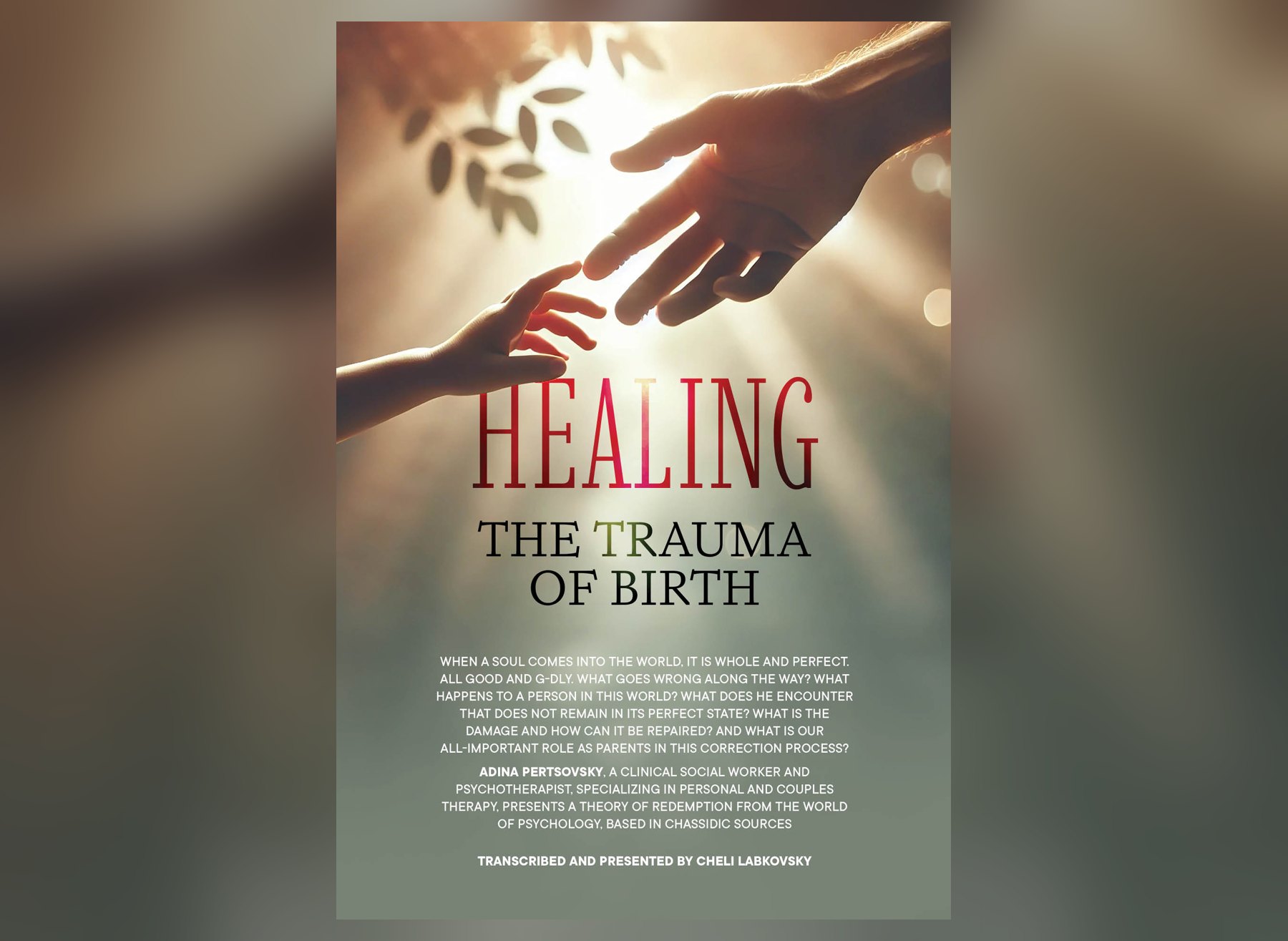
When a soul comes into the world, it is whole and perfect. All good and G-dly. What goes wrong along the way? What happens to a person in this world? What does he encounter that does not remain in its perfect state? What is the damage and how can it be repaired? And what is our all-important role as parents in this correction process? Adina Pertsovsky, a clinical social worker and psychotherapist, specializing in personal and couples therapy, presents a theory of redemption from the world of psychology, based in Chassidic sources.
The soul above and the totality of all souls are openly together with Hashem. Coming down to this world is to feel alone, moving away from an open existence with Hashem, each in its own body and feeling separate. A world devoid of Hashem’s revealed presence, the absence of togetherness, and the feeling of loneliness. This is the trauma and exile representing the soul’s descent into this world. Loneliness is a sense of internal lack, lack of meaning and lacking in everything. To feel empty. Thus, it is precisely here in this limited and emotionally lacking world that we have a role to discover and act with greater wholeness than ever before. Discovering wholeness from our limitations is like the advantage of light over darkness. How do we do this in practice?
The Experience Of Self-Fulfillment
We are born into this world with a Divine role. This is the human being seeking to experience self-completion. A person wants to express the fulfillment of his strengths according to the role that the Aibishter has given him, and to be a part of Creation as He intended him to be.
A word about this thing called “self”: In order for there to be an experience of self-completeness, in order for a person to believe that he has these strengths and can properly utilize them, he first needs to realize that he really is capable, and this is a very positive thing. Every person descended into the world in order to have an influence according to the abilities he possesses. There are maamarim of the Rebbe from Rosh Hashana and by the Rebbe Rashab as well, explaining how a Jew can influence the world for the good, how fulfilling a mitzva of the Torah can actually and literally change the world.
Descending Into The World – Embracing Within Our Limitations
Let’s describe for a moment the experience of descending into this world: The soul comes from under Hashem’s Throne of Glory, where there is a feeling of goodness, revealed G-dliness. The soul actually feels that it’s literally a part of Hashem Himself Above. Then, the soul comes down and becomes a created being. On the way from the world of souls to this world of ours, the unborn child first encounters the experience of being in the womb. There’s an experience of completeness, nothing is missing. Then, the child is born, and becomes an entity onto himself. The first thing we hope he will encounter is the embracing arms of his mother, which allow him to melt into a state of goodness. The experience is that there is goodness that surrounds him, he is a part of goodness. The baby then feels that goodness is real and exists within the world.
Then comes the encounter with the limitation known as reality – the world is difficult, it doesn’t always give you everything you need, this is galus. And then there is the emotional pain, which stems from encountering the world and its limitations, and yours as a person. This is one of the most difficult experiences that the world provides.
The Parents – Support And A Mirror
Then, just as in the Seder Hishtalshelus, each level takes care of the level below it, and this one in turn takes care of the level below it. Similarly, in this base material world, the father and mother take care of their child. The platform they provide for him is supposed to precede reality, such as the mother’s enveloping arms before encountering the harsh outside world. A child who experiences his father and mother as strong and benevolent figures has a protective shell that facilitates and allows for this encounter with life’s limitations and subsequent reality. It’s ingrained in the child’s soul that first of all there is good here, father and mother, whom the child trusts. Hence, it’s important to be calm when you’re with your children, so that they feel that they can trust their parents. When the parent is not calm, the child perceives him to be weak, i.e., someone he can neither trust nor wrap his arms around when facing the world’s reality.
This parent whose good the child unites within and with whom he feels good gives the child an overall feeling that there is good in the world and there is a Creator, something greater than man with real meaning. Thus, he can dissolve into meaning and goodness, being part of all goodness and the process of the world moving toward Geula.
Then, those parents, or other significant figures in the children’s lives whom the children deem as good, see in the children their own good. They essentially serve as a mirror for them. They see who they are with their difficulties and abilities, the good and the painful. And the children feel that they are being observed and noticed by these people, and therefore they know who they are. This vision helps the child to see herself as a capable person, a person who can influence the world and give of herself. She knows that her very existence is good and she has a G-dly role.

The child knows him or herself according to the parent’s vision. Furthermore, the child is also formed according to the parent’s vision. In other words, when the parent sees the child negatively, she learns to see herself negatively.
There is external vision and internal vision, and they are polar opposites. External vision is from the outside, vision of behavior and appearance. Internal vision is from the inside, the child’s emotions and true intentions. Every person, and especially a child, wants good. Naturally, a child wants to belong to his parents; he wants to do his job and feel his own wholeness. He wants to feel that he did well and that his mother looks upon him well. The child wants to be together with his parents, yet he doesn’t know how. He has different feelings that tend to interfere with his natural flow of feeling whole with himself. If we connect externally to his behavior, then we’ll distance ourselves from him more. However, if we look at him from the inside and understand that neither he nor we are giving up on his intention to be together – then we will truly connect with him. From the inside, you will see who he really is, he will feel you close and protected, and he will be able to experience his inner self with all the good intentions.
Disconnection – Criticism, Depression, And Trauma
Displays of self-criticism, depression and trauma, which we see around us today, are actually displays of disconnection from the good base occupied by the parents. In other words, an introverted woman who criticizes herself shows that she doesn’t see who she is, rather she sees herself in a distorted way, just parts and not the fullness of who she really is. A girl who has experienced trauma from a close person feels that the world is very hurtful, and she loses faith in the world’s essential goodness. As for a depressed woman, she feels nothing, except that she’s disconnected from everything. There is no foundation.
In general, the way to repair the disconnect they experience is by showing genuine empathy from someone who represents goodness and perceives their uniqueness and perfection. Empathy is a word that describes love of one’s fellow Jew. The Tzemach Tzedek explains in “Derech Mitzvosecha” that what is hated to you, do not do to your friend, i.e. that we hate when another person sees our shortcomings and enjoys them. The emphasis is on admiration. When you see someone’s shortcomings and it affects your emotional attitude towards him, you really don’t see him, you see their shortcomings. However, when you see the shortcomings and despite not admiring them your attitude continues to be completely respectful, i.e., you truly see it, you are a mirror of its truth, then you are empathetic to it.
Thus, seeing the shortcomings do not constitute a partition between you and the other person. You can be someone who will hold and maintain the feeling of connection to goodness. When someone is mirrored by a personage who is great and ideal, representing goodness, and this figure sees who she is, what her abilities are, and who she can be even though she doesn’t know it yet, the woman slowly feels that she is truly worthy.
There is reality and limitations and it all seems imperfect, but you see it as perfect, and can make it so. You give birth to your child in a state of perfection and continue its sense of fullness. This is the innovation of this world, unlimited yet remaining within certain limitations. Completeness comes precisely through incompleteness.
When parents see their child as an object, i.e., in a distant way, disconnected from him, separated by a partition, the look is on the child and not who the child is. Because of these and other shortcomings, the child is perceived as less cherished in the eyes of his parents and perhaps as someone who isn’t important enough. The child believes that this is how he really is, and he then lives life perceiving himself as an insignificant person. However, when a parent sees the child as a person who has feelings and capabilities, this view helps the child to develop in this place, into what he can be.
Getting The Whole Picture, Focusing On The Good
People who were hurt are usually hurt in two of their own self-needs (there are several). One self-need is the need to be part of the ideal and the good, a feeling of being part of something great. And the second self-need is that the great and good see her as a fully worthy person, as she is. The one who grew up in a critical environment, knows that she has a vital role to play and it is difficult for her to live without the feeling of being able to fulfill it. The Rebbe says that when a Jew is in his proper role, he is content, because he feels that he is a part of the Creation.
What prevents a person from being empathetic? To be empathetic, you need to be connected and feel that you are inextricably part of something great and significant in a place that is bigger and higher than you. In other words, if you are preoccupied with yourself, your flaws, what your child is doing that disappoints your natural and human dreams, harming your experience of wholeness, then even with good-will, you will not be able to be truly empathetic. For this you need to experience a sense of wholeness, an elevation of your soul, one that stems from true joy in being part of the Divine mission. This means feeling a significant part of something greater than yourself, part of the Divine truth in the world, feeling like a mother with a great, unique, and G-dly role. Thus, from the place of your experience of wholeness that stems from a connection to Hashem’s Truth, you will be able to perceive the other person’s own experience of wholeness.
The Rebbe Rayatz explains in the maamar “Asher Bara” in Kuntres Drushei Chasuna: “When a person is in a state of great joy…the recognition of joy is in his face, and he receives each person cheerfully, praising the honor of each and every person, because he is then in exaltation… And this exaltation is not a matter of pride and being…he is in great closeness with each and every person… Since then, he sees the virtue of each and every one, and because of the joy in his heart, he finds in each and every one a true virtue and advantage, that each and every Jew is a possessor of great virtue, also in his middos and his nature… as from the very nature of the Jewish People, they also have virtues and good qualities… However, sometimes for various reasons, they are hidden and we do not see them openly, not that they don’t exist, rather that they do exist, but they do not see them so openly, and in truth, this is someone whose good qualities as a Jew are not seen openly, for reasons known to the seer. And this is his shortcoming…that he always thinks only of his own affairs… And besides, this is what causes him not to give a true look at another to see the good that is in him, since all his concerns are with his own affairs… Thus, he pays no attention to others, and he sees them only from an external perspective.”
The Rebbe Rayatz emphasizes that the reason that the person observing doesn’t see the truth within another Jew is because he’s occupied with his own affairs, and therefore, at that moment, he really isn’t available to see this person. When you’re in a state of joy, you’re connected Above and you’re free to see the truth within others. Then, the other person is revealed to you in all his glory.
The Aibishter has given us the privilege and shlichus to be part of His Creation. Correcting, doing, creating. When you truly see your child, your husband, your society and every Jew in the right light, with a true vision of spiritual admiration for who he is, then you’ll see his wholeness, and he will actually feel whole. You constitute his completeness, and without your vision, he wouldn’t know it, but with your vision, he will experience a sense of self-fulfillment. You are a partner with the Creator in having a good influence upon the world and creating the good within it. The purpose is to bring Redemption – overall and personal.
Self Criticism

Let’s talk for a moment about a woman who is critical of herself – the critical voice within her says she doesn’t see who she really is, rather she sees only a part of who she is. Therefore, in order to understand why she came down to earth, it is vitally important to get the whole picture. It’s true we all have shortcomings, but the vision should be of the whole person, his strengths and virtues, his soul’s journey in this world, and what he can achieve and accomplish. The bad qualities are not all of who a person is, they are just a certain perspective. The true vision of a parent, friend, teacher, or mashpiah, who sees her for the whole person she is, will be a vision of Ahavas Yisrael. The Tzemach Tzedek writes that Ahavas Yisrael is the vision of the whole. The whole is the truth, the true vision of who the person really is.
The Rebbe Rayatz, says in another maamar “Asher Bara” he delivered at another daughter’s wedding (not Rebbetzin Chaya Mushka): When you look at a Jew, you must see the good in him. He adds that this doesn’t mean observing just the aspect of the G-dly soul, rather the animal soul as well. When you look upon the entirety of the animal soul, understand the virtues with which it was created and its individual mission, you can look at someone and say: ‘Wow, he is stubborn, but together with a clear vision of his personal strengths, you can see where he can go and what he is capable of doing.’ The Rebbe says that if you do not see the good, the problem is with you. During a state of joy, the heart is open and broad, and then there is the ability to see the good. When a person is b’simcha, he is uplifted, and from his higher position, he is able to see the truth – the wholeness in every Jew.
Empathy – Removing The Partition
What does it mean to see? To see means being empathetic. Empathy represents the removal of the partition. What does that mean? We have two people: Person A and Person B. Person A has a unique character, powers that only he has received and his own vision of reality. But if he wants to understand Person B, he can’t. First, he needs to see things from within Person B, how things feel to Person B.
For example: A person drinks alcohol. There is an outer view that says: Alcohol is not good for you, you can temporarily forget about your troubles, but it is an addiction that causes serious damage. This is an outer view. Someone from the outside sees facts and gives advice.
An inner view would be one that connects to the experience. Let’s return for a moment to the critical woman. You can look at her from the outside and say: She is such a successful woman, why does she think that way about herself? While these facts are true, they fail to help because they come from the outside.
The removal of the partition happens when someone from the outside feels what she is experiencing inside, i.e., her mental pain. This means bearing opposite forces within Yiddishkeit, being outside yet connecting to the inside. Subsequently, it means that someone can really feel this difficult experience of her feeling trapped within the criticism, and that’s really how she presents herself from within. Yet, at the same time, someone on the outside sees who she is and holds onto this viewpoint. She understands her good intentions and feels deeply how painful the criticism can be, while realizing that this criticism expresses her pain about the good she longs to do, e.g., how much her soul longs to be the good mother she wants to be. This vision provides the whole picture, the fact that she has a role in this world – and this empathetic vision brings everything into a different light for the critical woman, serving as a mirror that allows her to see her wholeness and uniqueness, and elevates her to where she really belongs.
The Suffering – Part Of The G-Dly Plan
Now let’s consider a woman who experienced hurt from someone close to her. What is she actually saying? ‘My sister hurt me, and there was no one there to protect me.’ If the harm is repeated and severe, constituting a deep injury to the soul, the experience may mean that she is a flawed person and not like everyone else. She doesn’t deserve the good like everyone else. Even if there is good in the world, it doesn’t belong to her, nor has she earned it. Her feeling that she’s part of the world’s grand plan has been damaged. In her own eyes, she is no longer worthy.
How can she be healed from this hurt? After all, it’s impossible to turn the wheel back. By showing deep empathy and connecting with a person, an idea, or an ideal that represents true goodness for her, she will slowly realize that what happened is part of the suffering of exile. It’s all part of the plan, and we don’t always understand the underlying reason. There are things far greater than us. However, she’ll eventually return to feeling part of the world, part of the good. She then will be able to come back and be a part of it, provided that there’s someone who can truly be a kind of magnetic pole of goodness for her.
Undoing Depression: Feeling A Sense Of Belonging
Now, a few words about depression. Depression comes from a place of disconnect. A woman in depression is indifferent, nothing moves or touches her. She is disconnected from the source of goodness that is supposed to nourish her, and show her who she is and who she doesn’t yet know she is. We need to know how this disconnect happened, and someone will have to be there for her and help her, to be that magnetic pole of goodness for her and touch the essence of her soul.
In the maamar “Atem Nitzavim” from the 23rd of Elul 5732, the Rebbe explains that Hashem is called the Light of the World. It is in constant existence, something eternal. Goodness never ceases because Hashem is good, He is eternal, and we are His only sons.
There is a parable from the Baal Shem Tov about a king who had an only son who was most gifted and virtuous. The king sent him to a faraway place where he could transform his virtues into action. The Eitz Chaim explains that the fulfillment of a person’s powers is revealed here in this world, and it then achieves a state of spiritual elevation expressed in a state of self-nullification and mutual inclusion. This is the good that the newborn baby knows and seeks because it knows and recognizes this good because it had been there in the supernal realms.
Then there is another level: the Jews and the King alone (Zohar). This means that the Jewish People and Hashem are together alone without any disturbance from outside elements. They are together, listening, wanting to understand each other with no intrusions. Yet, they are two separate entities. There is another even higher level, “becoming integrated in the King,” meaning that we become one reality. The Mezeritcher Maggid says about the verse: “Make for yourself two trumpets” that trumpets are two halves of one form, the children of Israel and Hashem, which complement each other.
About the verse “Open for me my dove, my perfect one,” the Rebbe says that “my perfect one” speaks of the time when the Jewish People complete Hashem Himself. In other words, when a Jew understands who he is, then the third profound need (remember the needs of self?) that Hashem created within us is the need to feel a part of something. Why do we enjoy watching the girls dance at end-of-year parties? What is so enjoyable about it? They’re all dancing the same thing! Why? Because there’s a deep sense of belonging and worthiness. There is fulfillment here. A Jew has a need to complete Hashem, and the Rebbe says that the Aibishter sees in us his other half. Therefore, there exists this need to feel as if he really belongs.
Connecting To The Source Of Goodness And Strength
This can be seen in the three examples we gave earlier. There is the critical woman excluding herself from everyone else, as if to say: Everyone is good and I am not, I do not belong. The one who is depressed can’t feel that she belongs anywhere, while the one who is hurt also feels different from everyone else because she can be hurt. She’s not like everyone else. Thus, she cannot lift herself up and be a ‘twin’ to Hashem. –
If we want to help these women, we must make them feel capable, feel like twins. They have a role and they are able to perform it. Every Jew is unique and belongs, otherwise there is no fulfillment in the world. When a mother smiles at her child in the morning, she is Hashem’s twin. She is tender towards her child and thus is essentially a conduit of Hashem’s love to her child. Without her, the child would not know that Hashem loves him. The mother is the other part of the trumpet. In order to do this, she herself needs to be connected to Hashem. We are all here in the world to do our role, and for this we need to be connected to the source that gives us strength and shows us who we are and how we express all that is good, In this way, we can overcome our emotional difficulties and fulfill our shlichus.
Beis Moshiach #1484 • pp. 44-50
© 2026 Beis Moshiach Magazine. All rights reserved.
This article originally appeared in Beis Moshiach #1484. You are welcome to share it with friends and family by email or in print, provided that you do not change, add to or omit any part of it, you credit the author and Beis Moshiach, and you include a link to archive.bmoshiach.org (written out in full in printed copies).
To republish this article in a newspaper, magazine, book or website, please request permission in advance at [email protected].