The Kids Behind the Diagnoses
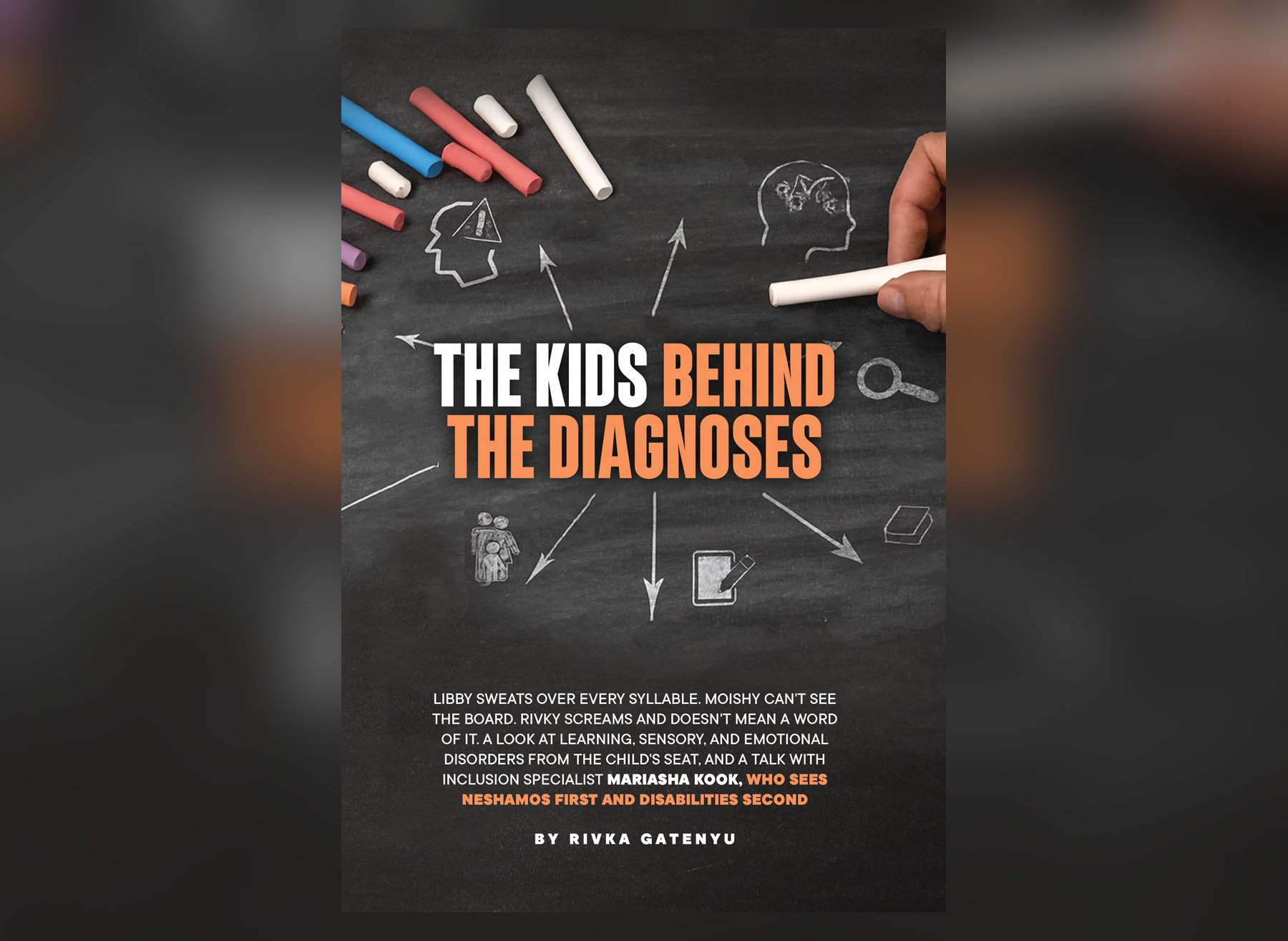
Libby sweats over every syllable. Moishy can’t see the board. Rivky screams and doesn’t mean a word of it. A look at learning, sensory, and emotional disorders from the child’s seat, and a talk with inclusion specialist Mariasha Kook, who sees neshamos first and disabilities second.
“Gimmel…Dalet…Hey…Lamed…Chof…Lamed…” Libby read syllable after syllable, trying to decipher the letters and connect the sounds. Beads of sweat sprouted on her forehead, and her bangs, which had managed to grow past her eyes, stuck to her skin. Her pudgy finger pressed hard on the previous word as she breathed heavily. She lifted her confused eyes for a moment towards her mother, the look on her face saying ‘I don’t understand a thing.’
From the other side of the room, her mother looked at her, and her heart went out to her. She wanted to go over to her, move her wet bangs off her forehead, and whisper to her that ‘everything will pass.’
And how can she make such a promise if she doesn’t know why it’s so hard for her Libby, and what can she do to help her?
Libby’s story is one among many. While boys and girls outwardly appear normal just like everyone else, they are compelled periodically to deal with various difficulties in class and at home. Sometimes this is due to learning disabilities, in other cases, it’s because of some other kind of disorder. In certain instances, they have difficulties diagnosing what the child is dealing with and finding ways to assist him and advance his educational achievements.
Learning Disabilities
Learning disabilities are specific difficulties during the learning process in contrast to other disabilities stemming from physical, sensory, cognitive, or emotional limitations and incapacities.
Yosse’le looked at the Chumash open before him, trying to decipher the written words, joining the syllables to one another. Here, he identifies the first letter, and even the second letter is familiar to him. However, what does it sound like? He glances around him. The rest of his classmates are holding their fingers on the end of the page; they’ll finish reading the page in another moment. He looks back to the first line, still trying to understand the first word.
“Who wants to read out loud?” the teacher asks, looking among the boys holding their hands aloft. Yosse’le’s heart began pounding rapidly as the teacher’s gaze came closer to him. He shrank in his chair, hoping that the teacher wouldn’t notice him.
Many children deal with learning disabilities similar to Yosse’le. This is a congenital neurological condition that influences a person’s ability to comprehend, process, and understand information, even though he has normal intelligence, perhaps even higher than average. In many instances, a learning disability takes the form of a sizable gap between ability and actual implementation in at least one of the following areas: reading, writing, verbal expression, written expression, reading comprehension, listening comprehension, mathematical logic, or mathematical calculations.
Learning difficulties due to ADHD are also included in this category.
Learning disabilities are characterized by a continual gap between the ability to think and learning achievements, a slow processing of information, repeating mistakes, attention and memory problems, refraining from reading or writing. Learning difficulties tend to bring frustration and harm to one’s self-image in an educational context.
Learning disabilities are divided into several forms of disorder, among them dyslexia, expressed in difficulties with reading, identifying and understanding the connection between tones, vowels, letters, and words. A child with this problem makes errors with letters, reads very slowly, and has difficulties in reading comprehension—as expressed in the inability to understand the meaning of the words, the concepts contained therein, and a weak vocabulary.
Another disability is called dysgraphia, characterized by writing difficulties. A child with this disorder makes mistakes in his writing, his handwriting is often illegible, and he also experiences problems in written comprehension. Another form of learning disability is dyscalculia. A child suffering from this impairment has difficulties solving mathematical problems. He has a hard time understanding quantities along with remembering and organizing numbers. He confuses numbers, symbols, and the multiplication table. He has difficulties estimating time, computing amounts, and even using a clock to determine what time it is. There also exists a disorder including working memory—maintaining information in his head while carrying out tasks, particularly multilevel instructions.
Attention deficit disorder is expressed by short-term memory loss and hypermobility, which makes it difficult for the child to sit in place and concentrate for a lengthy period of time. He is easily distracted, displays problems in organizing himself and impulsive behavior, such as interrupting others speaking, or difficulties in waiting his turn.
It’s possible to help the child, even help get his learning up to par. This can be done in a variety of ways, e.g., providing more time for classwork, reading the questionnaires out loud, use of a computer or keyboard. It is recommended to use multisensory instructions—visual, audio, motorial. Breaking the assignments down into smaller and clearer stages will make it easier for the student to deal with his learning difficulties. Even tangible models and recurring exercises on the learning material will help him a great deal. With ADHD children, it is recommended to seat the child close to the teacher and far from sources of possible distraction, and to give him short breaks to maintain a proper level of concentration. It’s important to strengthen the child and give him a feeling of capability, thereby providing far more positive feedback.
Communication Disorders
“And she doesn’t even realize what she’s saying,” Dini burst into uncontrolled laughter and everyone joined in the giggling. Chani stood near her classmates, maintaining a slight distance from them. She wanted so much to be closer, be a part of them, but she was worried. She gave a half-smile, yet she failed to understand why they were laughing. They were talking so fast, jumping from one subject to another, and by the time she found what to say, they had already moved on to another subject. Chani remained silent, having no idea whether what she wanted to say was right or not. The bell stopped the girls’ conversation, and Chani quickly made her way back to class, breathing heavily, where at least she knew when to speak and when to be quiet…
Chani and other children dealing with communication disorders have a hard time understanding things, processing information, or developing communication skills, whether verbal or otherwise. Such difficulties include a wide spectrum from language impairments to autism spectrum disorder (ASD). Children suffering from such disorders are liable to suffer from other problems capable of influencing communication: hearing loss causing speech and language delays, and neurological difficulties such as traumatic brain injury or epilepsy. There is also considerable influence from the immediate environment. If there is a lack of lingual stimulation at a very young age, this may create serious communication gaps.
Communication disorders can be expressed in difficulties understanding facial expressions, tone of voice, or other social cues. While children with this disorder usually speak in a proper linguistic manner, they still have problems expressing themselves in social contexts. They tend to be rather limited in scope, their conduct somewhat tedious. In various social circumstances, they are subject to confusion, anxiety, or seclusion.
There are numerous types of communication disorders, such as: Developmental language disorder (DLD) stems from difficulties connected to language and speech development, understanding and expressing ideas. Quite often, these problems are linked to delays in language development or disorders such as autism. These children display lags in speech or difficulties in building sentences, limited use of language for communicative purposes, lack of ability in understanding simple or complex instructions, difficulty in identifying their emotions, expressing them through non-verbal communication, e.g., body language and eye contact.

To help children suffering from such disorders, there is a need for a communication diagnosis that can identify the exact reason for the problem. After the diagnosis, work with a speech therapist on developing language skills that can help considerably with the progress and improvement of their communication aptitude. Similarly, there are other intervention approaches combining social learning and behavioral treatment. It’s most important to maintain normal and expected routine. Learning through visual support such as a printed daily schedule or illustrative drawings designed to assist the child cope with the matter more easily. Even dividing tasks into clear stages will help.
Another type of communication disorder is emotional communication problems, which can influence the child’s ability to connect in a clear and open fashion. Children suffering from these problems deal with traumatic experiences, depression, or anxiety. They usually speak very quietly, refraining from conversations or expressing themselves in an unclear manner.
Difficulties in this area likely cause them to abstain from social interaction due to fear of rejection. We can see changes within them in their tone of voice or their style of speech, while they have difficulty expressing their feelings verbally.
To help these children in such instances, it is recommended to conduct a psycho-diagnostic analysis (a comprehensive evaluation of their mental, cognitive, and interpersonal ability) as a means of identifying the source of the emotional problem. It would be appropriate to give them individualized or group emotional treatment, and above all, it is most important to secure the support of parents and educational staffs, thereby creating an inclusive and secure environment.
A third form of communication disorder is social communication problems, which cause difficulties understanding social dynamics or adapting the communication to the context of the discussion. These problems may be connected to social communication disorder (SCD). This disorder takes expression in difficulties understanding non-verbal hints, e.g., tone of voice and facial expressions, with an inclination to speak only about certain subjects without noticing that no one seems to be interested in the discussion, and unsuitable reactions to various social circumstances.
As a means of helping these children improve their social communication, we will develop their social skills through group work. Guided practice in social situations (simulations) accompanied by professional educators can be of considerable help. In a scholastic framework, the teachers can be of much assistance through social mediation. In addition, providing guidance for parents can provide them with the tools necessary to give proper support to their child and help him in forging connections and social integration.
Sensory Disorders
“One more minute and I’ll erase the board,” the teacher urged his students. Moishy narrowed his eyes, but the words on the board seemed to him as blurry shadows. The sound of pencils racing along the notebooks proved that his friends were busy copying everything down. “What’s written in the second line?” he whispered to Aryeh Leib sitting near him. Aryeh Leib moved his notebook slightly in his direction. “You can copy from my notebook,” he suggested to him, while he continued to copy from the board. Moishy tried, but his sheet of paper was totally blurred. He gave up and started scribbling in his notebook. “Let them think that I’m copying too,” he thought to himself, periodically sending a glance towards the shadowy board facing him.
Moishy suffers from a sensory disorder that occurs when one main bodily sense is harmed: vision, hearing, or feeling. This disorder creates difficulty in grasping information in his environment, thereby influencing his studies in school and his other daily functions. Children such as Moishy dealing with this ailment will experience difficulties in absorbing information via hearing or vision, difficulties in regulating behavioral reactions, increased exhaustion due to efforts to compensate through the use of alternative senses.
There are several types of sensory disorder, among them vision impairment, marked by damage to the sharpness or field of vision that cannot be repaired through use of eyeglasses or contact lenses, and hearing impairment, as evidenced by a partial or complete loss of hearing, which influences all areas of cognitive and social communication.
To make things easier for children suffering from sensory disorders, it is recommended they be seated in the front of the class, making use of visual means and proper lighting. Similarly, in helping children with hearing impairments, it would be appropriate to use a sound amplification system or the transcribing of class material. To help those with vision disabilities, it is suggested to enlarge the size of worksheets and use larger letters, thereby presenting information to the children in a clear manner, both in oral and written form.
To be continued
Beis Moshiach #1526 • ה׳ חשון תשפ״ז • pp. 40-43, 51
© 2026 Beis Moshiach Magazine. All rights reserved.
This article originally appeared in Beis Moshiach #1526. You are welcome to share it with friends and family by email or in print, provided that you do not change, add to or omit any part of it, you credit the author and Beis Moshiach, and you include a link to archive.bmoshiach.org (written out in full in printed copies).
To republish this article in a newspaper, magazine, book or website, please request permission in advance at [email protected].