Why Publish The Rebbetzin’s Photo?
Within the shloshim of Rebbetzin Chaya Mushkah נ”ע, a booklet titled Imeinu HaMalka – “Our Mother The Queen” about the Rebbetzin was published which included a photograph of the Rebbetzin in it. Rabbi Gavriel Zinner, a leading posek and author of the widely acclaimed series Nitei Gavriel (who corresponded regularly with the Rebbe) wrote to the Rebbe his concerns about this in a letter dated 11 Adar 5748:
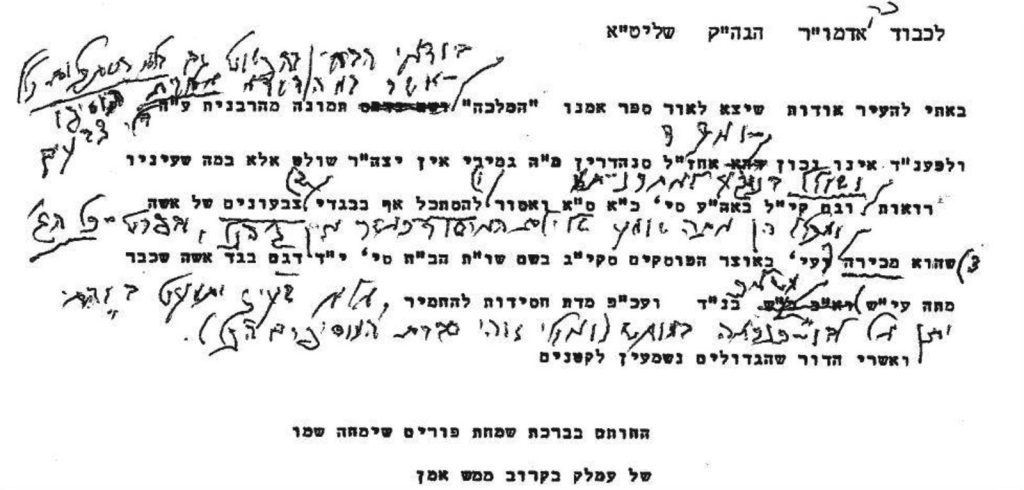
Rabbi Zinner wrote:
“I want to raise a concern about the book Imeinu HaMalka that was recently published, where it was printed a photograph of the Rebbetzin, of blessed memory. In my opinion, this is not appropriate because Chazal taught (Sanhedrin, chapter 5) that the evil inclination only has power over what a person’s eyes see. Furthermore, the accepted halacha in Even HaEzer (21:1) prohibits looking even at the colored clothing of a woman one knows. The Otzar HaPoskim (subsection 13), citing the Bach (Responsa, section 14), extends this prohibition even to a woman’s garment after she has passed away. Therefore, the same applies in our case. At minimum, midas chassidus, pious behavior would be to avoid this.”
The Rebbe’s Response:
Point 1: Regarding the photograph itself: The Rebbe crossed out “where it was printed” and wrote:
בודאי הבחין בהפשוט גם בלא הסתכלות כלל – אשר במהדורא אחרת הוסיפו בלי צבעים
“Surely you noticed, even without looking closely, that in another edition they printed it without colors.”
Point 2: Regarding the source from Sanhedrin: The Rebbe crossed out “דהא – because [Chazal taught]” and replaced it with ואף – “Even though [our Sages taught that the evil inclination has power over what one sees] – and wrote ושולל בנוגע לאחרנייתא – thereby negating [his power to cause improper thoughts] concerning another [woman he cannot see].” I.e., even though the yetzer hara has power over vision, he doesn’t have power over someone one cannot actually see.
Point 3: Regarding the Even HaEzer source: The Rebbe emphasized three conditions in the original text of the ruling by underlining the relevant words:
Looking intently
At colored garments
Of a woman one knows
And then added:
ומכלל הן אתה שומע שלילת האיסור דכאשר אין ג’ הנ”ל, ובפרט – כל הג’
“From this positive statement, you can derive the opposite – that when these three conditions are absent, the prohibition doesn’t apply. Especially when all three are absent.”
Point 4: Regarding the conclusion “therefore, the same applies in our case.” The Rebbe crossed out “therefore the same applies” and wrote instead: מה שאין כן – “Unlike [in our case].”
Point 5: The Rebbe then addressed Rabbi Zinner’s suggestion that at minimum it would be a pious stringency to abstain from publishing this photo by writing that:
אלא שעי”ז [שעל-ידי-זה] יתמעט ב”והחי יתן אל לבו” – כנראה במוחש (ואולי זוהי סברת המוסיפים הנ”ל).
“Except that this stringency would diminish the impact of ‘the living shall take to heart’ [=learning from the righteous who have passed] as is visibly evident. (Perhaps this is why these publishers included this photograph).”
Beis Moshiach #1493 • pp. 6-7
© 2026 Beis Moshiach Magazine. All rights reserved.
This article originally appeared in Beis Moshiach #1493. You are welcome to share it with friends and family by email or in print, provided that you do not change, add to or omit any part of it, you credit the author and Beis Moshiach, and you include a link to archive.bmoshiach.org (written out in full in printed copies).
To republish this article in a newspaper, magazine, book or website, please request permission in advance at [email protected].