The Fisherman’s Secret

From the TzaddikStory.org collection
This story was told by the Ben Ish Chai, a very holy tzaddik who lived in Baghdad, more than 100 years ago.
* * *
There was once a young boy named Shimon*, the son of a very wealthy man. Shimon was lucky, because he didn’t have to worry about parnassa. He could spend all his time learning day and night in the Beis Medrash.
As he grew older, all of his friends eventually left to find jobs and start working. But this bachur didn’t need to. Since his father had plenty of money, Shimon stayed in the Beis Medrash and continued learning the heilige Torah with great joy.
* * *
One day, Shimon’s friends came to visit him in the Beis Medrash with an interesting suggestion.
“Why do you always just sit day and night learning, like a baby chick who hasn’t even opened his eyes? There’s a whole world out there, Shimon!”
“Yeah!” agreed another friend, slapping Shimon on the back. “If my father had that much money, I wouldn’t stay here for even one more day! Why don’t you ask your father for 10,000 golden dinars and do some business already? You can travel to the famous city of Constantinople in Turkey, buy some merchandise, and sell it once you’ve come back home!”
Another boy chimed in, “And you’d get to see the world while you’re at it! Enjoy the views! Take in the sights! Oy, what I wouldn’t give for a chance like that…”
Although Shimon knew, deep down, that the Beis Medrash was where he belonged, his friends’ words managed to convince him.
* * *
But Shimon’s father wasn’t pleased with the idea.
“What do you need to make money for? You have all the money you need!” his father said.
“Tatty, I just want to give it a try. Maybe I’ll be successful!”
But Shimon’s father wasn’t only upset about the trip being unnecessary, he was worried about letting his only child travel so far out at sea, and for no good reason at that!
But as time went on, Shimon couldn’t stop thinking about the trip. The idea pulled at his heart more and more, until he became so sad he actually became sick.
His father felt he had no choice. He had to help his son. So, he decided to let him go. But not alone. He gave his son a treasure chest full of 10,000 golden dinars, his most trusted friend, and a servant to show him the way – as if he were a young boy, leaving home for the first time.
* * *
The three men set sail for the long journey and safely arrived in Constantinople after a number of days at sea. Before unloading their things, the three men decided to first find a place to stay. Shimon and his father’s friend went to wait in a popular park, where rich people liked to take walks, while the servant went to find somewhere to sleep.
Not long after settling down on a bench, the men heard an announcement nearby.
“What are they saying?” Shimon asked someone sitting next to them.
“A big tzaddik passed away today. They’re asking everyone to do the important mitzva of coming to his levaya,” he explained.
Shimon made a quick decision. “Okay, I’ll come along.”
“But why?” His father’s friend didn’t like the idea. “Why go out of our way? Your father will be happier if we stay focused on our job here.”
“Absolutely not!” Shimon argued. “This is one of the greatest mitzvos! I will not miss out on the opportunity!” And with that, Shimon began following the crowd.
But as he walked, he heard something very upsetting. Behind him stood two men who were cursing the tzaddik who had passed away – at his own funeral! What a disgusting thing to do! Shimon thought to himself.
Shimon turned around to the men. “Why do you curse this man?” he asked. “He was a tzaddik!”
“This man owed us money!” they said angrily. “And now that he’s gone, there’s no one to pay off his debts!”
Shimon became very uncomfortable. How can this tzaddik go on to Olam HaEmes like this…? He thought.
Shimon rushed to the front of the crowd and took a deep breath in. “STOP THE LEVAYA!” he called out with all his might. “STOP THIS FUNERAL RIGHT NOW!”
Shimon quickly ordered his servant to run back to the boat and fetch the chest with golden dinars.
“How much did he owe you?” He asked the two men.
Shimon wasted no time. He paid off the Tzaddik’s debts, and was left without a single coin in his chest. Only then did he allow the levaya to continue.
* * *
Shimon felt horrible. What a terrible place! He thought to himself.
He turned to his father’s friend with sadness in his eyes. “I don’t want to stay here even a minute longer. How could anyone curse such a holy man? He couldn’t help the fact that he had debts. His whole house burned down, with everything in it! He had nothing left! And these men were happy to curse him? I want to go home immediately.”
“Why not stay for four or five days? We’re here anyway. There are beautiful things to see here in the city.”
“Absolutetly not,” Shimon answered. “I’m going back to the ship NOW.”
* * *
When they returned home, his father was pleased by the news. Shimon was worried he might be disappointed, but was relieved that his father seemed to be focusing on the good.

“Baruch Hashem!” he cried. “My son is home safe.” He didn’t care so much about the money, and he was happy Shimon did a tremendous mitzva, too! “I’m so very proud of him!”
* * *
But back at the Beis Medrash, people weren’t celebrating.
“What a fool!” Shimon’s friend laughed. “You went all the way there, and you didn’t even buy any merchandise? You’ve gotta be kidding me!”
“Yeah, Shimon, there are bad people in every city,” added another friend. “Why’d you have to give up on the whole trip?”
Shimon’s friends convinced him, once again.
“You know… you’re right,” he said, thinking to himself. “Let me try again.”
* * *
Shimon approached his father again with the same request. His father was afraid of his son becoming sick again, so he gave him another 10,000 golden coins. But this time, he sent a whole group of friends and servants to keep his beloved son safe.
* * *
When Shimon arrived in Constantinople for the second time, he sat with his father’s messengers in the park, while a servant went to find a place to stay.
“For sale! For sale…”
Shimon heard a voice nearby and became curious. What could be for sale?
What Shimon saw made his stomach turn. There stood a man holding a heavy iron chain clipped to the wrist of a young girl, selling her like a slave! The girl looked like she came from a royal family. The whole scene felt so wrong and out of place.
How could this man be selling such a respectable girl?! Shimon thought, filled with anger.
“What’s going on here?!” Shimon asked someone in the crowd.
“Oh, they just came back from war, where they captured her. They’re selling her as a slave.”
Shimon felt sick.
“How much are you selling her for?” Shimon asked the man, feeling sick just saying the words out loud.
“500 golden coins,” answered the seller.
“I’ll buy her freedom.” Shimon quickly turned to one of his servants and told him to run to the ship and bring the chest to finish the sale.
Meanwhile, Shimon found the poor girl a place to sit while they waited. He looked at one of the men in his group. “I will never return to this terrible place!” Shimon said. “How could anyone sell a person in the market… as if they were… a horse, or a donkey?”
Shimon paid the man what he wanted, and made his way home, bringing the young princess along with him.
* * *
When Shimon’s father heard the news, he was very pleased with the choices his son had made. And the young girl? She was well-loved in Shimon’s home. His mother and father cared for her like their own daughter. Eventually, she explained she was a princess from a faraway land – an only child to her father and mother, but she was tragically captured during war. She didn’t know if her parents made it, but the war made it dangerous for her to return right away. She was safest here.
She appreciated how kind the Jewish family was to her, and she learned lots about them and how beautiful a Yiddishe life truly is. A short while later, the young princess decided she wanted to become a giyores, a convert, joining Hashem’s chosen nation. And that’s what she did, taking on the name Jewish name Sarah.*
* * *
Time went by, and Shimon turned 20 years old. He had become a man.
One day, his father approached him with a suggestion. “My son, the time has come for you to get married and to start a family of your own.” Shimon listened carefully. “You know, Sarah is 17, and she’s now fully Jewish! She has such beautiful middos. I don’t think you’ll ever find a wife as wonderful as she is. What do you say?” He waited for a response.
But Shimon thought for a moment then finally broke the silence. “You’re right, father. She’s special and we’ve all gotten really close. She belongs with our family. But there’s something I should do before I agree to marry her.”
His father looked confused.
“Her parents are sitting in their palace, far, far away, wondering, hoping, praying they will see their daughter again. They don’t know where she is, or whether or not she’s alive. I should ask them for permission to marry their daughter.”
“But my son, there’s no need! Her family lives so very far away, they probably don’t think they’ll see her again anyway. The seas are incredibly rough! How can I allow you to travel so far?” His father began to think. “I could hire a private ship for her to go herself, along with a large group of servants… five men and five women, who will make the journey with her, and she can ask her parents instead of you!”
“No,” Shimon answered, “it’s too dangerous. She’s already been kidnapped once, and if I really want to be worthy of her, I should be willing to protect her. I’ll take her there, and if her father doesn’t agree to our marriage, I’ll return home alone.”
And that was that. Shimon had made up his mind, and his father didn’t want to see his son become sick with worry, like he had in the past.
* * *
Shimon’s father knew the journey would be long and dangerous, so he hired only the best sailors and the strongest ship.
The voyage was indeed long and rough. Months passed at sea, and the ship finally found itself nearing its final destination.
But it was then that a dangerous storm caught up with them. The skies suddenly darkened and became black as night. The boat rocked and creaked, as the waves grew bigger and bigger. Finally, with a loud crack, the ship split in two, like a broken toy.
Crew members were tossed into the sea. Shimon and Sarah held onto a piece of wood for dear life and watched, wide-eyed, as the ship and crew sank into the deep waters at the bottom of the ocean.
* * *
It didn’t take long for the sea to calm down. Shimon and Sarah were still floating along, when all of a sudden, they were spotted by a fisherman.
Ribono Shel Olam, thank you! Shimon thought to himself, as he was carefully lifted into the little boat, along with Sarah.
The fisherman brought the two survivors to shore, where they caught their breath after everything they’d gone through. They were both so broken, but so grateful to be alive.
Shimon and Sarah introduced themselves, and then looked at the man with tears in their eyes. “Please, good man, tell me,” asked Shimon, “What can we do to repay you? You saved our lives. If not for you, who knows what would have happened to us!”
Sara nodded. “Yes, please let us do something to thank you.”
The man looked at them both and said, “I don’t want money or clothing. All I want is this… There is a small inn, a two hour walk from here. Go there and rest. Send a message to the king that you are his lost princess. The king will then send a group of soldiers to come and get you both. The palace is a three hour journey from the inn. Once you are welcomed, the king will definitely allow you to marry his daughter. You should make a chuppah there, but once you are finished celebrating, and all the guests have left, you should go home but not for long. Wait until everyone is sleeping and the kingdom is completely quiet. You should leave your room and come back to this very spot on the shore – bring along some nets, clay, and wood. You see, I’m a fisherman, and I want to build a deep watering hole I can cover with wood to store the fish that I catch. But make sure no one sees you. Only the two of you should come, on your own. Don’t tell anyone about our meeting here today… Oh, and don’t get lost!”
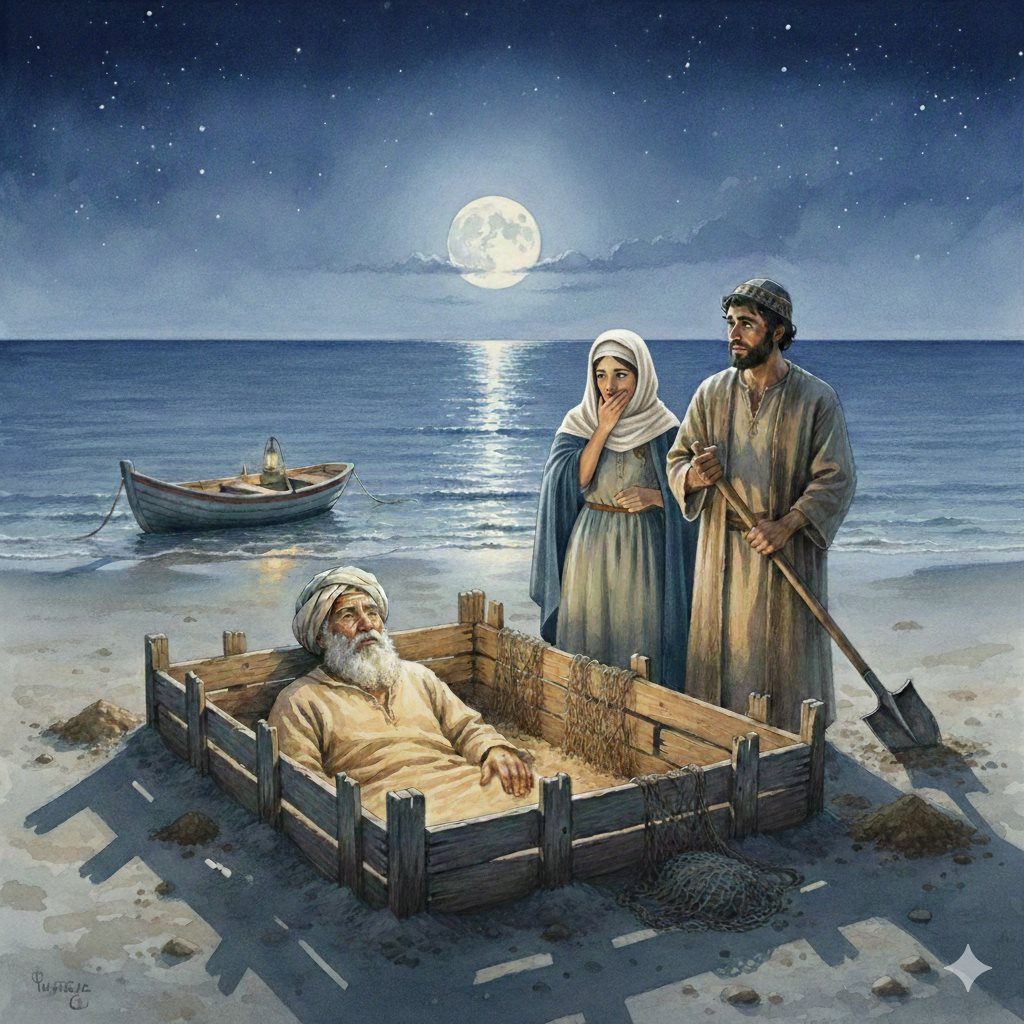
Those were the fisherman’s instructions, and even though the young couple found this very specific wish to be a little strange, they still made sure to perfectly memorize every detail in order to repay the man who saved their lives.
* * *
When Shimon and Sarah arrived at the inn, they quickly put the plan in motion and sent a message to the king. The fisherman was right. The king did send a group of soldiers to bring them back to the palace, and Shimon was welcomed with open arms as the hero who saved the lost princess.
The king himself came out to greet the soon-to-married couple, while music played softly in the background. When he reached Sarah, he fell on her shoulders and cried, letting out all the tears he’d held in for so many years, just wishing to see his daughter again.
A beautifully decorated chuppah stood in the middle of the city, and a grand party was arranged in honor of the chosson and kallah. Dancing lasted until two in the morning, when all the guests finally began to head home. The King and Queen returned to the palace, followed by Shimon and Sarah, who made their way to their room. They waited until all the doors were closed and everyone had fallen asleep. Then, in the silence of the night, they both crept out of their room and began the long walk back to the shore along with all the materials that the fisherman had asked for.
* * *
“You came,” said the fisherman, whose smiling face shone underneath the starlight. It was a beautiful night. The moon was full and danced with the stars over the calm water, which didn’t move at all. A soft breeze brushed their faces. “Hashem should bless you both,” he said
Shimon handed the man all of the things he had collected. “The wood, the clay, and the nets, as promised,” said Shimon, confused, but glad to have finally arrived.
“I’m an old man,” explained the fisherman. “Would you please dig the hole for me?”
The young couple agreed and began to dig, while the man showed them the exact measurements he wanted.
“Now, place some wood all around, so I can put my fish inside, and leave a small opening on one side. That spot shouldn’t have any wood.”
The young couple agreed and continued working, just as the fisherman had asked.
“Now, put the net on top of the wood, and then earth on top of the net.”
They followed his orders.
“Now, I want to go inside to see if it was done properly.”
The man went in and lay down.
The two watched without saying a word, completely confused.
“Listen,” he said to them, from his place in the pit, “I’m not… actually alive. I’m the Tzaddik from Constantinople. You came to my levaya and made sure I would only be buried after all my debts were paid. You made sure I would be buried with kavod, respectfully.
“The two of you were meant to die in the storm that night, along with the rest of your crew, but the incredible mitzva you did for me in Constantinople,” he pointed to Shimon, “saved both of you.
“Miracles should happen to someone through the person they once helped,” said the man. “That was why, on the night of the storm, Hashem put my soul back into my body, but dressed as a fisherman, so I could save the two of you. So please, now that I have done a chessed for you, do a chessed for me, and bury me with all the things that you brought – add extra earth onto the pile, and go back to your home in peace.”
Shimon and Sarah were shocked, but, too surprised to speak, they silently did as they were told.
* * *
The Ben Ish Chai taught that this story shows us the greatness of the mitzva of tzedaka. Not only was our chosson and kallah saved from drowning, but he was saved by the very person he had once helped! Through this tzaddik, who got up from his grave all the way in Constantinople, Hashem performed such a wondrous miracle.
Ma Rabu ma’asecha HaShem!
Beis Moshiach #1495B • pp. 56-62
© 2026 Beis Moshiach Magazine. All rights reserved.
This article originally appeared in Beis Moshiach #1495B. You are welcome to share it with friends and family by email or in print, provided that you do not change, add to or omit any part of it, you credit the author and Beis Moshiach, and you include a link to archive.bmoshiach.org (written out in full in printed copies).
To republish this article in a newspaper, magazine, book or website, please request permission in advance at [email protected].