Campus Shluchim In The Eye Of The Storm
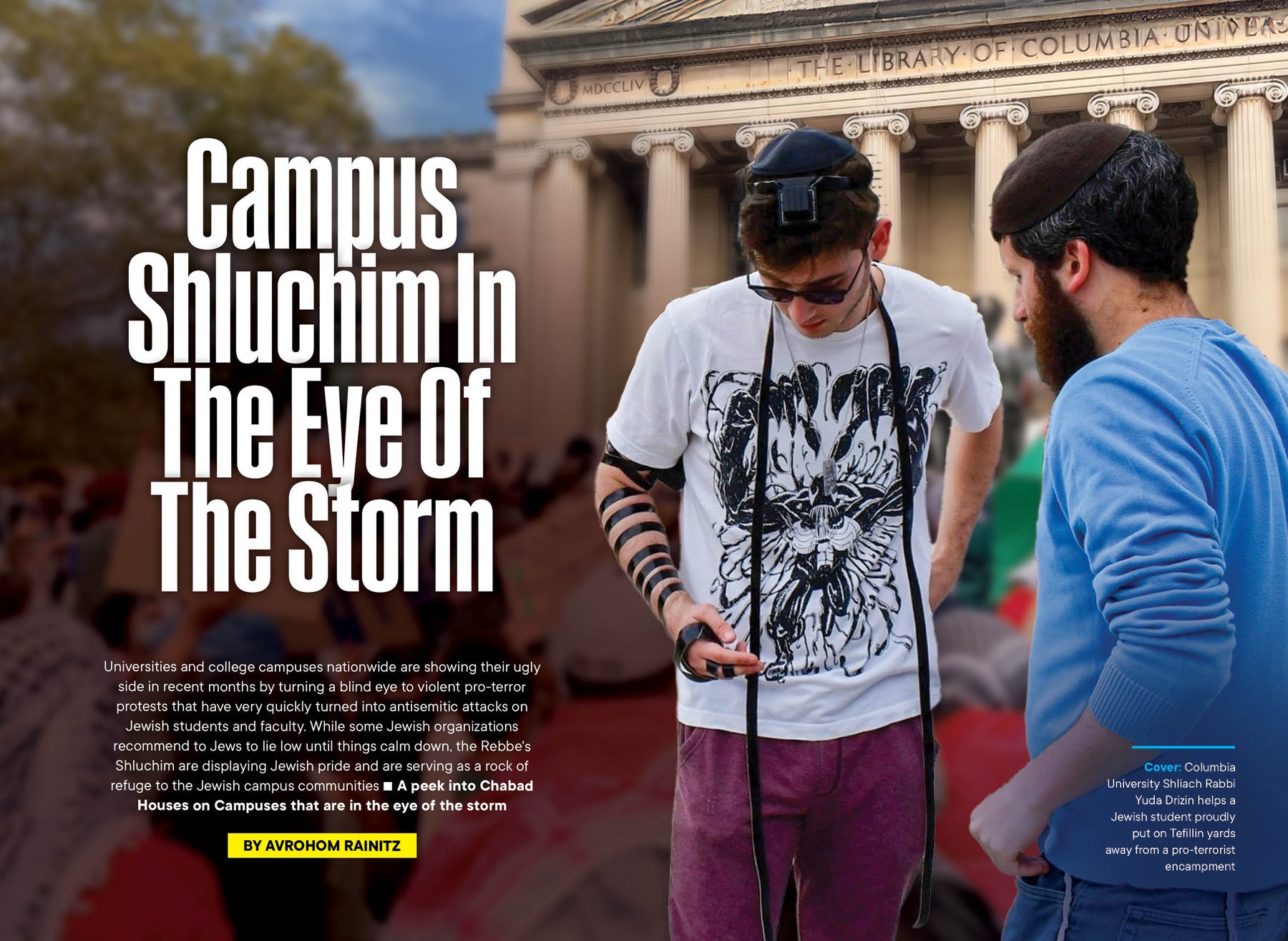
Universities and college campuses nationwide are showing their ugly side in recent months by turning a blind eye to violent pro-terror protests that have very quickly turned into antisemitic attacks on Jewish students and faculty. While some Jewish organizations recommend to Jews to lie low until things calm down, the Rebbe’s Shluchim are displaying Jewish pride and are serving as a rock of refuge to the Jewish campus communities ■ A peek into Chabad Houses on Campuses that are in the eye of the storm
American college campuses have turned into ideological battlefields. A wave of antisemitism has flooded the universities, leaving Jewish students fearful and confused. This comes along with a shocking 500% increase in reports of acts of antisemitism around the world since the war in Gaza, with a worrisome jump in the United States.
Social media is being used as a platform for incitement, delegitimizing Israel and the promulgation of antisemitic ideas. It creates a hostile, threatening environment for Jewish students.
Columbia University: an Inspirational Pesach
At Columbia University in New York, the Jewish students went through a particular challenging time. Menacing anti-Israel demonstrations broke out on campus and hate-filled chants echoed in the streets. Ariella, a second-year student, says, “When you go out on campus and hear calls to murder Jews, you can’t help but feel the hatred.”
Events reached a climax last week when dozens of policemen dispersed a pro-Palestinian demonstration using special forces and special anti-riot gear. The demonstrators barricaded themselves in Hamilton Hall and threatened not to leave until their demands were met including that the university divest itself of all financial investments associated with Israel. Dozens of police climbed into the building through a window on the second floor, using a ladder which was brought on a truck. Afterward, they cleared the demonstrators out of the building and brought them to the police vans.
The Chabad House at Columbia, led by Rabbi and Mrs. Yuda and Naomi Drizin, stood by the students. R’ Drizin, a charismatic fellow with a reassuring smile, spent the past month escorting frightened students to safety, giving out shemura matza for Pesach, and providing a sense of security and connection.
Despite the tense atmosphere, the Chabad House organized large Pesach Sedarim which were attended by hundreds of students. “The Chabad House was a space where you really felt free to be a Jew without reservation,” said Ariella.
The Pesach Sedarim at Columbia served as a source of large scale inspiration. Students who until then hadn’t connected to their Jewishness, were attracted to the beauty of tradition, to the power of community, and the feeling of belonging.
“What Rabbi Drizin kept repeating,” said Annika Erickson, a graduate of Barnard, “is that the best response to the wave of hatred is strengthening Jewish life.”
Other shluchim have also been turning the wave of antisemitism into a proactive Jewish response. More students are putting on tefillin, more students are keeping Shabbos; they want to connect more than ever.
Frank Conversation with the University President
Rabbi Yosef Carlebach, shliach at Rutgers University for 46 years, remembers stormy periods but never experienced such open antisemitism. The last semester at Rutgers saw a steady stream of antisemitic events and Jewish students were attacked with antisemitic slurs. Despite this, relative to other universities, the situation at Rutgers was considered “calm.”
R’ Carlebach has excellent connections with the top brass of local and national police and whenever there’s a warning about a demonstration or some other extreme activity, both uniformed and undercover police are stationed around the area of the Chabad House to make sure that no event gets out of control.
Unfortunately, many university administrations are failing to handle the rising threat and leave Jewish students feeling slighted and lacking support. The university administration has control not only over academics but over every aspect of life at the university, from security to health. Rutgers, with 70,000 students, is the size of a small Israeli city and the president of the university has the authority of a mayor and even more than that.
“As soon as the war broke out,” said R’ Carlebach, “I met with the president of the university. I began by quoting a statement of Chazal that people don’t lie about things which will eventually be revealed. ‘You should know that the truth will come out and the entire world will acknowledge who is right and who is wrong in this argument. Now is your opportunity to take a stand with Israel and against terrorists.’
“In the media, they speak mainly about the most extreme universities but when we analyzed the situation in our conversation, we came to the conclusion that ten percent will stand with Israel, ten percent with the terrorists, and the vast majority just wants a resolution of the conflict without getting involved on behalf of either side.
“Rutgers is considered one of the ten leading universities in the United States and I said to the president, ‘I’m willing to work with you but don’t sit on the fence. Show everyone that you’re on the side of the Jews who are in the right and against the terrorists. Ultimately, when the entire world will see the justice you will be accepted as a great leader!’
“At first, he went along with that approach and I went especially to meet with the president of Tel Aviv University to strengthen the ties between them and I also held long conversations with big supporters in Florida. Unfortunately, after a few months, the university administration did not withstand the pressure and began to approve demonstrations. It started slowly but now, at the end of the semester, they increased their pressure and the university president began caving in to their demands. At first he only said he’d think about it, in the hopes that he would make it to the end of the semester but now he’s deep in the mud and he doesn’t know how to get out.
“He allowed pro-Palestinians to set up tents in the center of the campus. When Jewish students wanted to make a barbecue event in support of Israel, he didn’t allow it with the excuse that you can’t make events on campus after the last day of the semester. The pro-Palestinian students were allowed to erect tents at this time.”
The students weren’t fazed. They moved the barbecue to a park near the Chabad House and turned it into a huge demonstration. “They can try to intimidate us,” said Michael Batushansky, co-president of ‘Students Supporting Israel,’ “but we aren’t afraid of demonstrating our Jewishness.” The story was widely reported in the New York Post.
Chabad: a Lighthouse in the Storm
The stories about Rutgers and Columbia reflect on a broader phenomenon. On campuses throughout America, Chabad Houses have become safe spaces for Jewish students, a place where they find support, warmth and Jewish pride.
At the University of Indiana, despite the protest encampment set up opposite the Chabad House, the Jewish community responded with a strengthening of Jewish identity. Many students began wearing yarmulkas and jewelry with Jewish symbols, and hung mezuzos on the doorways of their rooms.
“It’s an interesting phenomenon,” said one of the shluchim, “because in the past, when there were signs of hatred, Jews would hide their Jewish symbols and there were places where they even took down the mezuzos in fear of the goyim. Today though, they are demonstrating their Jewishness in the face of hatred, and if they didn’t have a mezuza until now, they want to put one up!”
Large Pesach Sedarim and other events were arranged at the Chabad House of Minnesota which gave students a place of refuge from the storm brewing outside. Dylan Zouber, from a family of Holocaust survivors, said, “Being able to have Chabad as a place of safety, comfort and community has definitely helped me control my emotions.”
Many students need a place where they can express their voice freely, a place where they can strengthen their Jewish identity; where they can heal from the administrative and social abandonment that they’ve been experiencing. Local shluchim are busy welcoming more and more Jewish students who come for the Shabbos tefillos.
Rabbi Zalman Teichtel, of Chabad of the University of Kansas, encourages Jewish students to increase their pride in their identity and not cave in to pressure. He set up a stand in the middle of the campus and enables students to do mitzvos openly.
According to R’ Carlebach, the work of the Chabad House has doubled. Programs like J Cafe and Sushi Soul that previously had about 200 students, now gets over 400 students.
Lighting a Candle Instead of Cursing the Darkness
The awakening of Jewish pride on campuses isn’t a passive reaction to antisemitism. It’s an active expression of identity, belonging, and of belief in Jewish values. The Jewish students are not submitting to fear but choose to light a candle instead of cursing the darkness.
One of the shluchim related: “At a Chanuka event, I met a Jewish student that I recognized from a pro-Palestinian demonstration on campus. I told her that although I opposed her view on this topic, she is still invited to the Shabbos meals and to all our other events. She couldn’t believe it; she was in shock that she was still wanted… Often, unconditional caring is all that’s needed to dispel the darkness.”

The ones leading this charge are the shluchim, of course, who spread the Rebbe’s view of fighting darkness by increasing the light. In conversations with students, they emphasize that the increasing darkness is a sign that the world is in the final moments of night and the darkness of galus, and in a short while the light of the Geula will break through with the revelation of the Rebbe.
Liel Leibovitz, editor-at-large of Tablet magazine, is enthusiastic about Chabad’s approach. “At Columbia, for example, the vast majority of the faculty, except for a few righteous exceptions like professors Shai Davidai and Ran Kivetz, remain silent, including Jewish and Israeli lecturers and deans who chose, like the lowest cowards, to remain silent. Chabad, on the other hand brought a truck, ‘the famous mitzva tank,’ into the heart of the darkness, with a loudspeaker which loudly played, ‘One who believes is not afraid.’ Anyone with any sense could clearly see the difference. On one side, a group of cowering weaklings with tenure, trembling lest one of their colleagues will look down on them and on the other side, proud Jews dancing joyously with belief that we’ve been through greater tzaros than these and we’ll get through this too.”
Stories of Hope
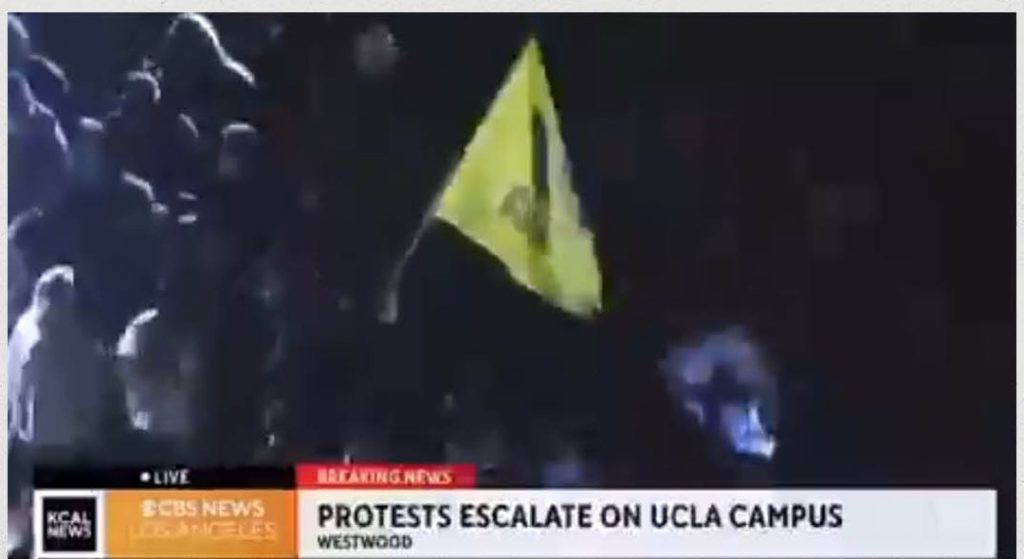
The media tends to focus on the violence and negative occurrences, but behind every headline there are thousands of human stories, stories of standing tall, bravery and hope. For example, R’ Carlebach relates:
“On Simchas Torah, a day after the massacre, an Israeli student came to the Chabad House in tears. She had just found out about a friend of hers who had been murdered. As she walked in, she was on the verge of fainting and my daughter gave her a bowl of soup with Osem soup croutons. It suddenly reminded her of home and enveloped her in the warmth that she so desperately needed. It was the first time in her life that she was in a Chabad House and when my daughter suggested that she take a package of soup croutons with her, she said she couldn’t take them because she had no money to pay for them. She was surprised to hear about giving without getting something in exchange and unconditional love.
“After that first time, she continued to come, and a few months later she said that her father came from Meah Shearim. Two years after he married, he went off the derech and cut off ties with his family. One Friday, her mother asked where she would be for Shabbos and when she heard that her daughter would be at the Chabad House, she fearfully said: Don’t become a baalas teshuva on me… Now, her daughter is on a path of coming closer at the Chabad House.”
Students at Columbia celebrated Pesach in an atmosphere of unity and Jewish pride, despite the tension and threats.
“We refuse to give into forces of hate. Instead, we’ve raised our voices in song and dancing throughout the nights of Pesach,” said R’ Drizin about the Sedarim and the Pesach meals at the Chabad House.
The Drizins rented a ‘dance truck’ that slowly traveled around the campus, collecting Jewish students for jolly holiday dancing, blaring Jewish music proudly. “We are going a little overboard because when things are rough, we need to work harder to be joyous,” said Mrs. Drizin.
Dark Present, Bright Future
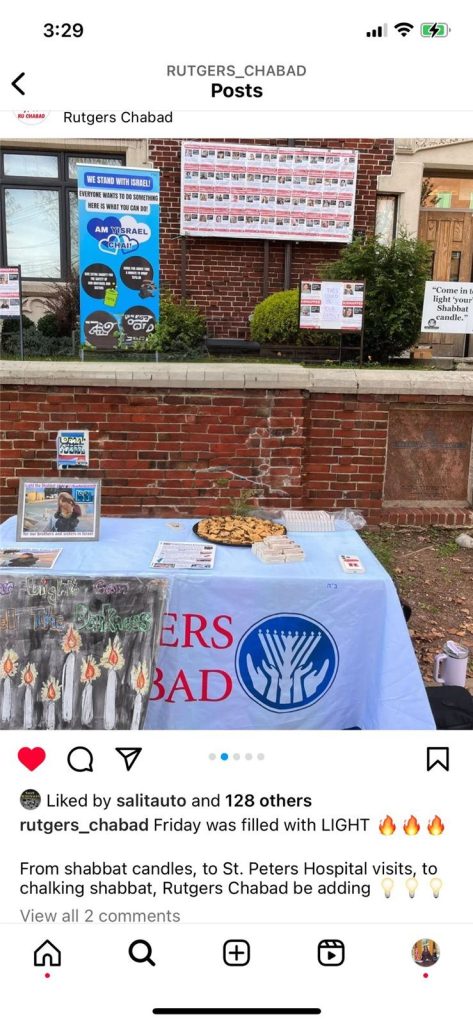
Antisemitism is still striking at America college campuses but the sparks of hope continue to burn. Jewish students, led by the Rebbe’s shluchim, choose light with love and Jewish pride.
Dealing with antisemitism on campus is a challenge for the young generation of American Jews but it is this challenge which is shaping a new generation of leaders, a generation proud of its identity, connected to tradition, and determined to fight for its values.
The shluchim on campus are leading this generation. They work tirelessly to reach every Jewish student, offering them a warm place, to light the spark of Judaism and prepare the world to welcome Moshiach now!
Beis Moshiach #1410 • pp. 10-16
© 2026 Beis Moshiach Magazine. All rights reserved.
This article originally appeared in Beis Moshiach #1410. You are welcome to share it with friends and family by email or in print, provided that you do not change, add to or omit any part of it, you credit the author and Beis Moshiach, and you include a link to archive.bmoshiach.org (written out in full in printed copies).
To republish this article in a newspaper, magazine, book or website, please request permission in advance at [email protected].