The Torah At The Battle Front
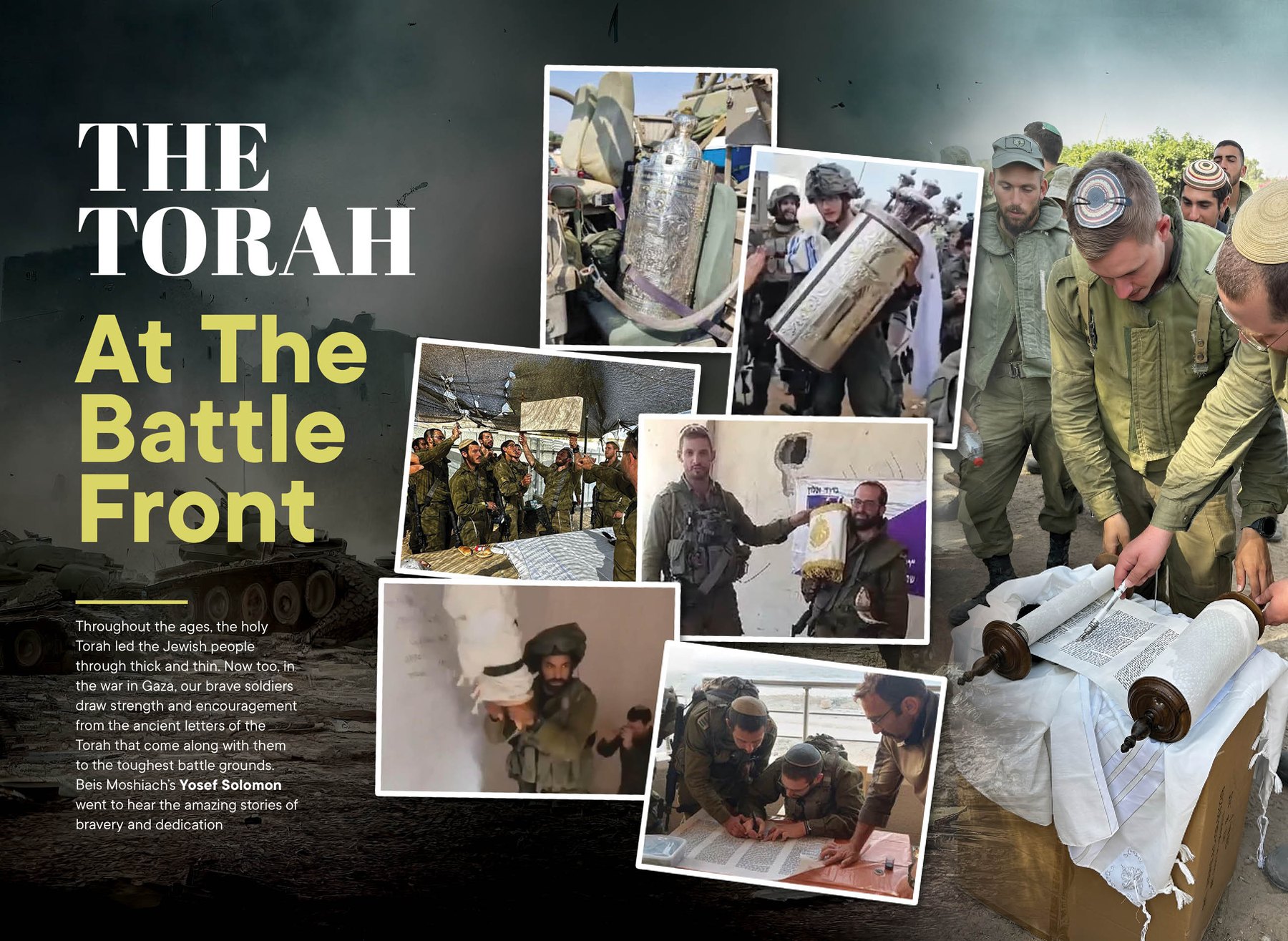
Throughout the ages, the holy Torah led the Jewish people through thick and thin. Now too, in the war in Gaza, our brave soldiers draw strength and encouragement from the ancient letters of the Torah that come along with them to the toughest battle grounds. Beis Moshiach’s Yosef Solomon went to hear the amazing stories of bravery and dedication
Even in the most difficult times in galus, the Jewish people did not abandon the holy Torah. Generation after generation were moser nefesh for it and were strengthened by its light, delving into with great love. Today too, as tens of thousands of our soldiers are in Gaza, fighting day after day, hour after hour, against deadly terrorists, the soldiers know that the Jewish people are shielded by the Torah and they want to hold on to it. The deadly alleys and cul-de-sacs, the tunnels teeming with darkness and the areas crawling with the terrorists of the enemy, all force the soldiers to be tense and on high alert for days, weeks and months on end. At the same time, they don’t forget the Torah. From here and there we hear stories and see pictures and videos of IDF soldiers cleaving to the Torah, whether by reading the Torah on Mondays, Thursdays or Shabbos and by learning in the small Torah booklets they took with them.
There have also been Hachnosas Sefer Torah celebrations within Gaza, and soldiers opened a makeshift shul and brought in a Sefer Torah with hakafos and dancing! Although there was no Hachnosas Sefer Torah truck, the simcha was tremendous.
From the Horrors of the Holocaust to Gaza
During the first days of fighting, Rabbi Major Martzbach looked for a Sefer Torah that he could bring to the soldiers in Gaza. He didn’t know where he would get one from; he just knew that it needed to be small enough so it could be carried on the back of the battalion rabbi and move around with the soldiers.
“Aside from the fact that it would enable them to read from it on days when the Torah is read, the Torah would accompany the soldiers and represent to them the connection to the chain of history. We decided that despite the challenge, we would put in the effort so that every battalion would have a Sefer Torah.”
R’ Martzbach posted on social media, asking to borrow a Sefer Torah. He ultimately reached Rabbi Benni Kalmanzon, rosh yeshiva of the hesder yeshiva in Otniel and expert in Jewish history. Over the years, R’ Kalmanzon has guided thousands of young men on trips to Auschwitz, where he shows them the history of the Holocaust which occurred just eighty years ago. Because of the many trips he makes, he looked for a small Sefer Torah that he can take on a plane with him. He found one and uses it on his travels.
When he heard R’ Martzbach’s request, he gave the Sefer Torah to him for the soldiers in Gaza. R’ Martzbach was astounded to discover the story behind this Sefer Torah.
The story is about a Jewish family from Poland during the second World War. As the Nazis approached their town, the father rushed to hide his wife and children outside the town, paying a fortune to a Polish friend so he would take care of them and provide them with food. The father was murdered but his family was saved.
One day, after the war ended, as the Polish rescuer was walking in the local market, he noticed strips of leather that were going to be used for shoes. They had Hebrew writing on them. He realized that the leather was from a Jewish Torah and he decided to use the money he had gotten from the father to buy the Torah and memorialize his friend and comfort the family.
He gave the parchment to the family as a sort of gift from their father. The family immediately realized it was a Sefer Torah. The family eventually moved to Eretz Yisrael and the son took the Sefer Torah to a sofer to have it checked. The son was delighted to hear that the Sefer Torah was fine.
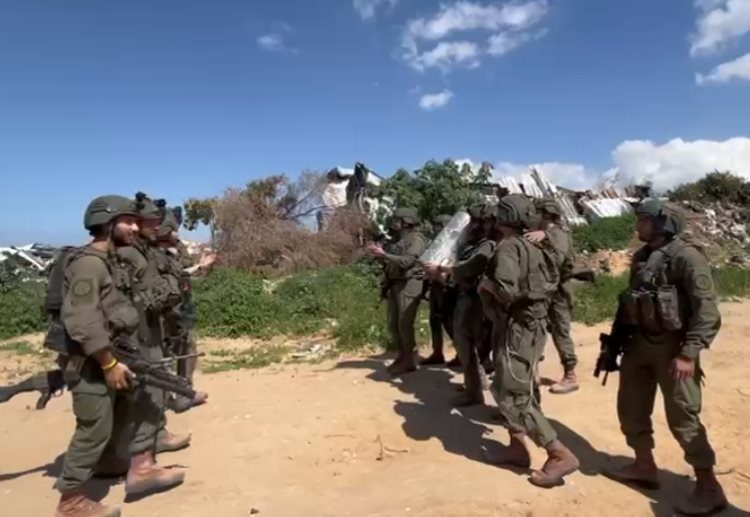
When the family heard that R’ Kalmanzon was looking for a small Torah to take with him on his trips to Poland, they couldn’t refuse him but they made the condition that on every trip to the concentration camps he tells the family’s story.
“When I went to R’ Kalmanzon to get the Torah from him,” says R’ Martzbach, “we became aware of another special story. On Simchas Torah, R’ Kalmanzon’s son served as the security chief/military liaison on the yishuv, Otniel. When he heard what was going on in the Gaza Envelope, he traveled there immediately to help the few who had taken the initiative and didn’t wait for army orders. He was able to help rescue about a hundred people from Be’eri before he himself was killed. This is why I decided that before we brought the Sefer Torah to the soldiers in the Gaza Strip, they would carry the Sefer Torah past the place where the son, Captain (Res.) Elchanan Meir Kalmanzon, Hy’d, was killed.
“When we brought the Sefer Torah to the soldiers in Gaza, we told them the double story, about the Torah during the Holocaust and the story of the heroic reservist, thus memorializing eighty-five years of Jewish history thanks to one Sefer Torah, small though holy, which provides inspiration and tremendous strength to the soldiers.”
A Sefer Torah Mobilized in Less Than a Minute
One of the most listened-to program on chareidi radio is the program of the “Sar HaSimcha,” R’ Ami Maimon on radio Kol Berama. Numerous times, Ami has helped people through his program by presenting a request to his listeners who step up and donate to those in need.
As Ami told me about the following request he was asked to bring to the public’s attention, he couldn’t believe how quickly it was donated:
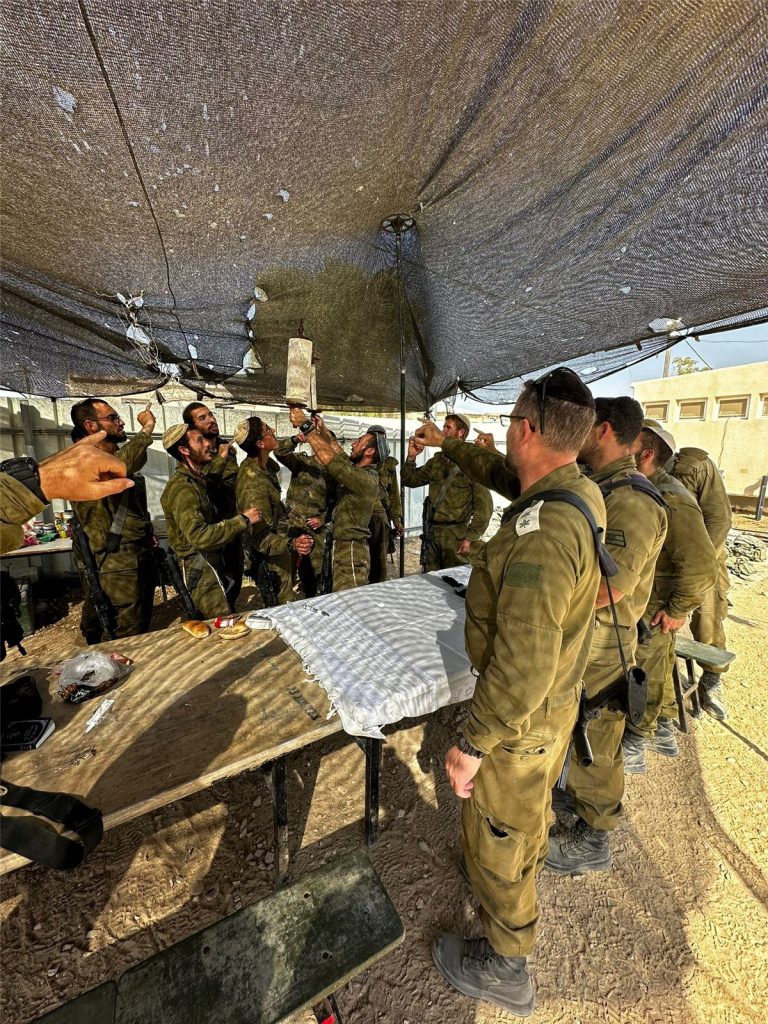
“At the beginning of the war, Rabbi Moshe Kinen who serves as a Lieutenant Colonel in the IDF, told the general manager of the radio station, Ariel Dery, that religious soldiers in Gaza had no Sefer Torah to read from on Mondays, Thursdays, Shabbos and Rosh Chodesh. He asked whether I could try to enlist a Sefer Torah for the soldiers, since I had been able to mobilize thousands of items through the radio broadcast.
“Despite everything I had managed to obtain through my listeners, I was a bit skeptical that I’d be able to successfully appeal for a Sefer Torah since this is a holy item that costs 120,000 shekels and up. But the harsh realities in Gaza compelled me to try. I mentioned the request on the program and to my astonishment, within just one minute, Ariel Dery sent me a text which said, ‘Ami, you don’t know how great Am Yisrael is! You just barely mentioned the topic and six people have called to donate a Sefer Torah to Israeli soldiers! Texts keep on coming in from people who want to give a Sefer Torah to soldiers in Gaza. Yashar koach to all of Am Yisrael!’
“We eventually got donations of more small Sifrei Torah for about thirty additional units that are in Gaza. I was so moved by this story. It generally takes time to arrange for the use of a Sefer Torah but here, within a minute of being broadcast, someone donated a Sefer Torah and not just one person, but six people! It shows how special Am Yisrael is.
“Yisrael is an acronym for ‘Yesh shishim ribo osiyos la’Torah.’ We see the deep connection between Am Yisrael and the holy Torah and the love within Am Yisrael.”
Probably, those in the army who had tried to do this on their own couldn’t believe it. How did they react?
“The soldiers were so happy! They couldn’t believe it. The manager of the radio station took the Sefer Torah from where it was donated in Petach Tikva straight to them on the Gazan border where he met Rabbi Lieutenant Colonel Moshe Kinen and gave the Torah to him. It was brought into the makeshift shul in Gaza with dancing and joy.”
The Torah Which Was Expelled, Was Brought Back
Journalist Amit Segal related:
This summer will mark nineteen years since the destruction of Gush Katif. When the residents of Netzarim were expelled from their homes, they took the Sefer Torah which was used by the community.
A few months ago, Army Brigade 9215, infantry and tank unit, entered Gaza. In addition to all the equipment, they brought along the Sefer Torah from Netzarim. They brought it to the place where the shul had been destroyed,
Segal added: This Sefer Torah was written a hundred years ago, survived World War II and the siege on Leningrad. Because the community whose Torah it was, was starving, they sold it and it was bought by Rabbi Barkan. Years later, the Torah was hidden by his granddaughter in communist Russia and it ultimately was brought to Eretz Yisrael to the shul in Netzarim.
On the terrible day of expulsion, the Jews of Netzarim left in a painful procession with the Torah leading the way. Now, the Torah has been restored to its rightful place, held by the battalion commander and the military rabbi, with hope and faith that soon the shul will be rebuilt along with the beautiful community.
The First Sefer Torah Brought Into Gaza
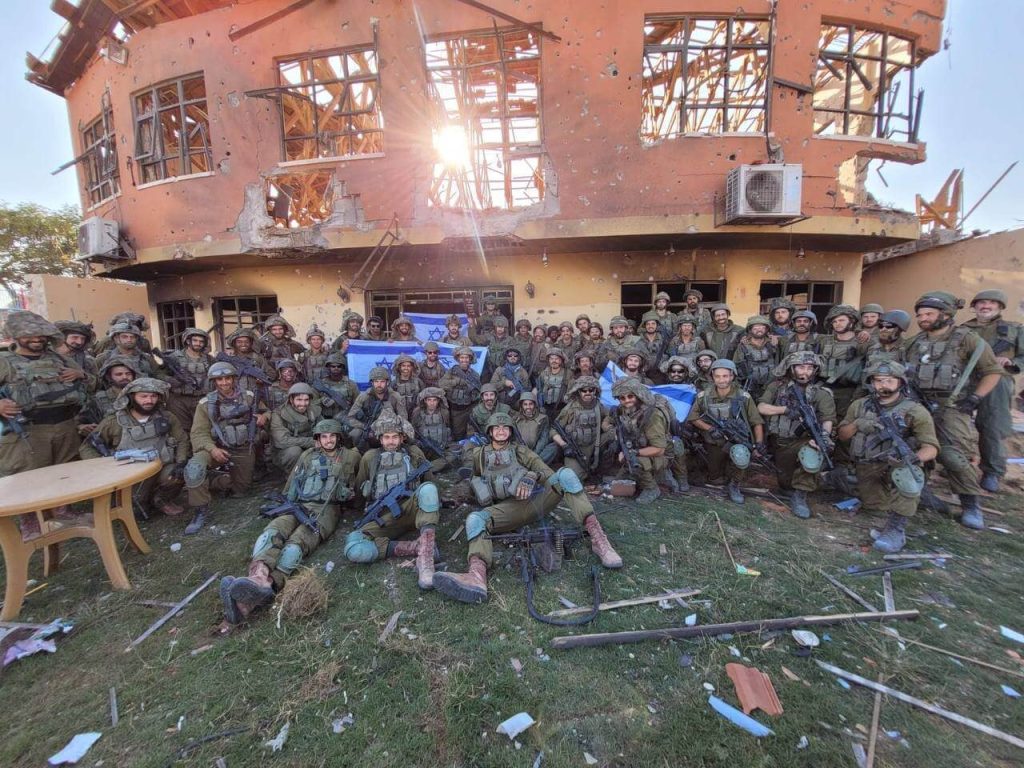
I met with the rav of the Ramat Chein shul in Tel Aviv, Rabbi Dovid Menachamov. He told me a story about a Sefer Torah which he himself donated to soldiers in Gaza.
“As part of the activities of the reservist unit of military rabbis, we organized hundreds of rabbanim in Eretz Yisrael and the world over and arranged to help the IDF soldiers, materially and mainly spiritually.
“I have a small Sefer Torah that I bought some years ago. It’s twelve inches high and very mehudar. I also built a beautiful holder and crowned it with gold.
“Two weeks after this war began, as soldiers were entering Gaza, I decided to donate my Torah to units entering Gaza. It first went in with the 188th Armored Brigade. It turns out that it was the first Torah to enter Gaza. I still remember the ‘course of action’ instructions we received before entering Gaza with the Sefer Torah. The instructor said that up until that point there hadn’t been a single military convoy since the outbreak of war which entered Gaza without coming under heavy fire from the terrorists. I thought, if there are so many Jews who are moser nefesh in war, I must give my Sefer Torah to them.
“Boruch Hashem, the Torah entered without any of us being harmed. The Torah was placed inside a heavily armored storage unit, but there was no room for the aron so it was placed inside without an aron. The soldiers themselves built a small aron for the Torah in Gaza made from mortar shells with the words ‘aron kodesh’ pierced into the metal, so there would be something ‘nice’ in line with conditions on the ground.
“When the soldiers left for some rest and renewal, they brought the Torah out with them. All the pretty crowns had broken from the bouncing around on the road. We made some surface repairs, built a tactical aron out of light aluminum, and added lights and bicycle tires to protect it from the bumps in the road. Then it went in a second time, this time with another brigade.
We saw to it that it be nice on the inside and protected on the outside, so that it doesn’t take any hits. The soldiers tell me that sometimes they read from it several times a day because more soldiers keep coming who hadn’t hear the Torah reading yet that day.”
Have you heard any new stories that happened with the Torah in Gaza?
“I got a picture of a soldier who hadn’t had a bar mitzva. He was in one of the houses in Gaza together with other soldiers. When he saw them reading the Torah, he told them that although many years had passed since he turned thirteen, he still hadn’t had a bar mitzva. On the spot they brought him tefillin and gave him an aliya and he marked his bar mitzva in Gaza.
“There are many other soldiers like him who have not marked their bar mitzva and are doing so for the first time with this Sefer Torah.
“Soldiers told me that they are in Gaza with terror all around them but after a while, they got used to this difficult situation in which they are on the alert every minute. Then, this beautiful Sefer Torah came and it reminded them how they are fighting in order to turn this evil into a better world. ‘This is our war,’ say the soldiers. ‘To remember that we are fighting for good. One reading in the Sefer Torah gives us strength, sometimes for long weeks in which we fight intense battles.’
“This Sefer Torah is part of my heart. I put a lot of money into it and now it’s in a place of danger like many Jews who are there and are moser nefesh every minute. But it’s a feeling of partnership. Although I’m not physically there, through this Torah I can feel that I’m there and it moves me. If only I could return to Gaza and pray there without being surrounded by enemies.”
Sign from Heaven
Rabbi Yehuda Arzoni, a military chaplain, relates:
“At the beginning of Teves, our battalion entered Gaza for intensive work in clearing out terrorist nests. Before going in, I debated about whether I should also bring in a family Sefer Torah that I have, since I was very concerned for the honor of the Torah. In the natural course of events, constant movement is required from place to place. I discussed this from a halachic perspective with one of my colleagues in the brigade and he said, to the contrary, it’s an honor for the Sefer Torah to be used and we would be careful to protect it. I was still left undecided.
As we spoke, I suddenly noticed my wife’s cousin. It’s his father who has the Sefer Torah. I told him about my indecision. He called his father to ask him and his father said, “Bring the Sefer Torah in.” I considered this a sign from heaven. I made sure that there was no actual concern for the Torah being harmed and brought it to our battalion. We use it on all the days when the Torah needs to be read.
“That was just the introductory story, for this Torah also has a history. My grandfather, Aryeh Kreinberg, was three-years-old when the Germans invaded Poland at the beginning of the war. Together with his mother and sister, they were able to disguise themselves as goyim and fled to Hungary with false papers. There, they managed to hide from the Nazis until the end of the war.
“His father was caught and taken to a labor camp where he survived the war. The family reunited. Thus, my wife’s grandfather spent his childhood on the run and in hiding. When he grew up, it was important to him to donate a Sefer Torah in memory of the million and a half children who perished in the Holocaust, Hy’d. It meant a lot to him for the Torah to move from place to place and bring the message of its significance to as many places as possible.
“During corona, the Sefer Torah returned to Eretz Yisrael, to Kfar Adumim, to a family which wanted to have it sent to soldiers in Gaza. From there, it reached our battalion and we have the privilege of reading from it inside Gaza.
“The Sefer Torah symbolizes life and eternity and with all the complexities of the battle, we must be connected to the conscience of the Jewish nation, which illuminates our path.”
QUESTIONS AND ANSWERS REGARDING A SEFER TORAH IN THE ARMY
Rabbi Shlomo Goldfarb
IDF Division Rabbi, and Rav of the yishuv Kfar Veradim, and member rabbi of Machon Halacha Chabad
Can a Sefer Torah be moved around?
If a respectable place was prepared for it, it is permissible to move a Sefer Torah to a place where it will be read even once. However, if it can be read three times in the same place, it’s better to leave it there.
In the army, there are mobile arons for field conditions, as well as Sifrei Torah dedicated on condition that they are brought to soldiers in the field under shifting conditions and not in fixed positions.
What should be done when there is an alarm or call for action while the Torah is being read?
If there is a call to action, the Sefer Torah should be closed and put back in place with the requisite honor. If a siren is heard during the reading, the people should go to a protected area. If the Sefer Torah can be taken along to a protected place, that’s preferable. If not, at least it should be covered.
If the minyan dispersed in middle of the reading, if most of the minyan remains, one continues reading. According to the Sefardim, one does not continue reading unless ten remain.
If a soldier or officer who was reading from the Torah was urgently called to do something, what should he do?
Someone else takes over from where he left off and he says a bracha at the beginning and end. According to the Sefardim, he only says a bracha at the end.
In the army there are religiously observant soldiers alongside those who aren’t yet religious and even those who desecrate the Shabbos. Can the latter have an aliya to the Torah?
Soldiers who aren’t shomrei Shabbos can have an aliya. This is what Rabbi Schwei a’h paskened and Rabbi Ashkenazi a’h agreed with him, both because in order to be in the category of “mechalel Shabbos b’farhesya” which appears in the Rambam, it needs to be done in front of ten kosher Jews, because of the din of a tinok shenishba and because of the din cited in Shut Shoel U’Meishiv and Shut Bnei Tziyon that since, unfortunately, this is the norm among so many, and the shomrei Torah are the exception, when someone desecrates the Shabbos he doesn’t see it as denying maaseh bereishis and recognition of G-d.
All the more so when, regarding soldiers, we are speaking of people of actual mesirus nefesh and not about those negative actions that they may even do intentionally ch’v.
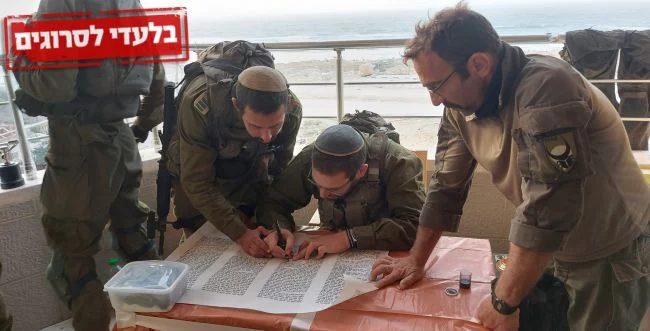
SOLDIERS WRITING A SEFER TORAH IN GAZA CITY
As related in the article, during the war, a number of Sifrei Torah were brought into Gaza. Recently, for the first time in their lives, soldiers were able to take part in a unique mitzva of writing a Sefer Torah, right there on the front lines.
Twelve years ago, Rabbi Yehuda Alon initiated a project called “Letters of Love.” The goal is to connect every Jew in the world to a Sefer Torah. His motto is, just as when a letter is missing in a Sefer Torah, the entire Torah is pasul, so too, every Jew, whoever he may be, is needed for the completion of the Jewish people.
Since then, R’ Alon has traveled the world and included Jews from all ends of the earth and all points on the spectrum in writing a letter in a Sefer Torah. Initially, he was joined in the effort by Ofir Liebstein, Hy’d, head of the Shaar HaNegev regional council who heroically fell on Simchas Torah as he tried to rescue people. Liebstein, who would hardly describe himself as a shomer mitzvos, considered this initiative very valuable and said Jewish identity is what will unite us.
Four months ago, R’ Alon decided to share this initiative with the reserve unit he serves in, a unit which has been deep in Gaza since the start of the ground incursion. As part of a special campaign, he came in with parchment and quill and went around among the units scattered in buildings in the destroyed city and included the combatants in writing a letter in the Sefer Torah.
Reserve soldiers, religious and not religious, responded with great excitement and some of them couldn’t keep back the tears. One of the soldiers said it was the most moving moment of the war.
Rabbi Yaron Adirian said, “This Sefer Torah, which was written close to the shore of Gaza, perhaps sums up the story of this war set upon by the government of Israel, on the day of the celebration of the joy of the Torah. The deep roots symbolized by the black letters on white parchment, are the story which connects us, as in its name and with its power our soldiers fight with mesirus nefesh.”
Beis Moshiach #1415 • pp. 10-19
© 2026 Beis Moshiach Magazine. All rights reserved.
This article originally appeared in Beis Moshiach #1415. You are welcome to share it with friends and family by email or in print, provided that you do not change, add to or omit any part of it, you credit the author and Beis Moshiach, and you include a link to archive.bmoshiach.org (written out in full in printed copies).
To republish this article in a newspaper, magazine, book or website, please request permission in advance at [email protected].