Gemini 4: A Grand Slam In The Foothills Of The Argentinian Andes
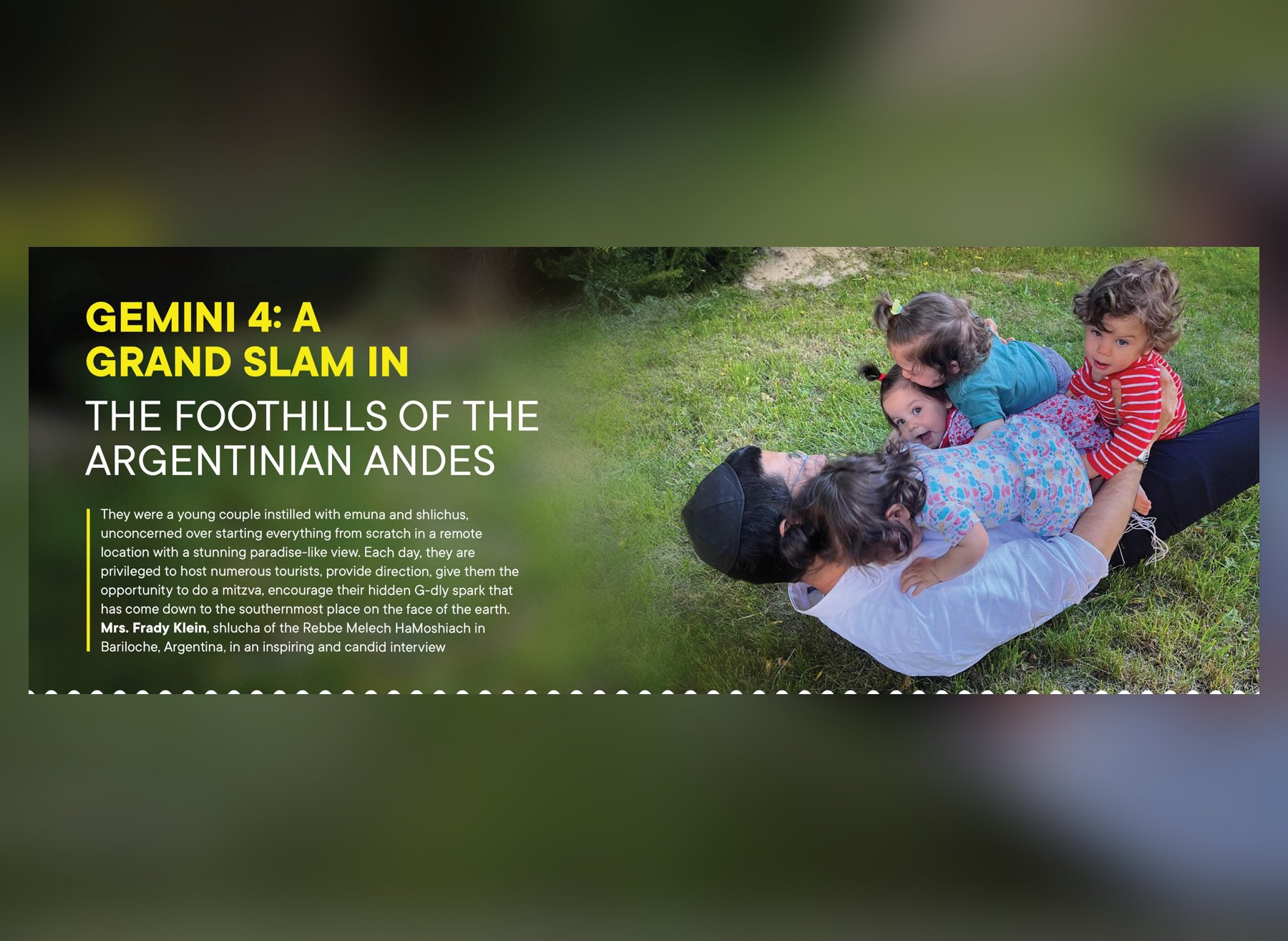
They were a young couple instilled with emuna and shlichus, unconcerned over starting everything from scratch in a remote location with a stunning paradise-like view. Each day, they are privileged to host numerous tourists, provide direction, give them the opportunity to do a mitzva, encourage their hidden G-dly spark that has come down to the southernmost place on the face of the earth. Mrs. Frady Klein, shlucha of the Rebbe Melech HaMoshiach in Bariloche, Argentina, in an inspiring and candid interview
Preparing an article about a shlucha of the Rebbe Melech HaMoshiach, our very own sister, who went out with mesirus nefesh to a remote location on the globe to reveal G-dliness there and prepare it for the coming of the Moshiach (especially if we’re talking about the world’s southernmost Chabad House – the closest Chabad House to the continent of Antarctica) is already a moving experience.
But to write about revealed miracles connected with bringing a child into the world – and not just one, but four! – is truly a rare and unique privilege!
Such is this article with Frady Klein, the Rebbe’s shlucha in Bariloche, Argentina who was honored a year and a half ago with another four young shluchim joining her family, precious soldiers of the Rebbe, in an exciting life’s story interwoven with faith and miracles.
I got a hold of Frady at an hour that was neither day or night – as if mothers of quadruplets even have nights…after a journey to Eretz HaKodesh lasting almost three days on three different flights.
The Other End Of The World
Where is Bariloche anyway?
Bariloche is a city in southern Argentina. Our Chabad House is considered to be the southernmost in the world, closest to the continent of Antarctica. The weather there is the exact opposite of Eretz HaKodesh and North America. During the winter, it has heavy snowfall that can even reach as high as three feet. In summertime, temperatures are cool and spring-like.
The city was founded more than a century ago by Austrians and Germans, although the local language spoken is Spanish (Castellano) as in the rest of Argentina. It was once considered a Nazi town, as many former members of the Third Reich government ימ”ש fled Germany after the Second World War and came to Bariloche. One of them was the infamous “Angel of Death” from Auschwitz and Birkenau, Dr. Josef Mengele ימ”ש.
To this day, there’s a quiet anti-Semitism in the air. The city has a German school that until recently celebrated each year the birthday of Hitler yimach shemo. While it isn’t dangerous to be a Jew in Bariloche, we periodically do encounter open demonstrations of hate, e.g., rock throwing, Fascist salutes, spray-painted swastikas, and knocked down menorahs.
Our Chabad House, in true ishapcha spirit, is located in a building that once belonged to the city’s first Nazi kindergarten. The walls were decorated with old pictures of people marching with swastika-bearing flags.
Bariloche is a beautiful city in a region with amazingly scenic views. It is considered a tourist attraction, offering hikes, lagoons, lakes, mountains, and picturesque landscapes. It presently has no Jewish community, only a few Jews with no religious affiliation. Therefore, our Chabad House turns to tourists from all over the world, especially from Eretz Yisrael, as the city is situated on a preferred path for recently discharged IDF soldiers taking an excursion to South America.
When and how did Hashgacha Pratis bring you specifically to this location?
It was completely due to the Hand of Divine Providence! We were a young couple, just three months after our wedding. I was only nineteen years old, still learning special education in a college program. My husband had then just completed his military service and was studying in the Ramat Aviv kollel. We had dreamt of being shluchim, but in Eretz Yisrael.
We were very young, and the desire to go out and contribute something to the world burned within us. By Hashgacha Pratis, we came across a notice that they’re looking for a shluchim couple to go to Bariloche for a period of three months. We decided to accept the offer, laughing that this is our post army trip… We wanted to begin our lives together with positive action. We set out on our journey with quite some daring chutzpa – we had just gotten married, and I still didn’t know how to run a proper home in a community with full Jewish infrastructure. Now, I would have to host hundreds of tourists in a location lacking everything.
We arrived at the site. We didn’t know a single word of Spanish and the locals hardly knew any Hebrew. We had no milk or meat there, only fruit, vegetables, and eggs – and without any budget. We rented a place and started our activities. On our first Shabbos in Bariloche, we hosted fifty Israeli tourists, and on the following Shabbos, the number had already risen to two hundred and fifty. At the end of three months, we realized that we could return to Eretz HaKodesh. However, no one was coming to replace us in conducting local outreach activities.
We couldn’t leave, feeling as if someone was lying wounded ch”v. How could we possibly just pack up and go? Since then, we’ve been there, baruch Hashem, for over fifteen years.
Sometimes, tourists come, certain that there’s some huge organization that funds us… When they internalize the fact that we’re simply here to stay, dedicating our lives to the place, they couldn’t believe it. How could this be? The truth that I try to explain to them is that what the neshama really wants and enjoys is to give, to provide from what I have to others with total devotion. This is precisely what we do, for us and for them.
How does Jewish life in Bariloche look today?
There still are no organized Jewish institutions in Bariloche because it has no local Jewish community. Our children are at home and we teach them. Our eldest, Shaina, learns at ‘Moshiach Kids’, an Internet school for shluchim children. We have Cholov Yisrael when we travel to watch the milking process and we bring meat from Buenos Aires, a twenty-four-hour journey from the city… Today, baruch Hashem, we have a mikva. Prior to that, we had to travel seventeen hours each time.
Even the nature of our activities with tourists has changed. When we first arrived, it was extremely difficult to communicate and there was virtually no Internet. Argentina was considered to be a Third World country, and people would come to meet with us and receive precise information. We made certain to set up an information wall, offer discounts on vacation spots, free Internet service, whatever could draw the tourists to us. Today, everyone has everything they need from their Smartphones. No one needs to come to us now to get updates, establish contact, or receive a nice discount – everything’s in the palm of one’s hand.
So, every tourist obviously knows that wherever he goes, there is a Chabad House waiting for him to get a Shabbos meal, and in case of tragedy or distress chas v’Shalom, the shluchim will be for him. There were the regular tourists who would always come, but in order to bring those who need us, we would have to think of other ways to serve them.
Today, we offer free luggage storage to tourists, just before they go out for another hike or trip in the surrounding region. We also provide traveling equipment for those in lack of supplies. Each evening, we organize free Chabad House activities. We give them a new name each time: Shakshuka Night, Beer and Singing, Hummus Night – whatever brings them to us. In the end, every evening event of this kind becomes a farbrengen with words of Torah, singing, and joint activities. Example: Each tourist in turn tells which mitzva he likes the most, which Jewish holiday he loves, and recommendations on interesting places for taking trips.
This year, there was an even greater intensity. Due to the war, people came, swapped stories, cried, and sought comfort. If we usually had between two to four hundred visitors a day during the height of the vacation season, this year on our biggest Shabbos, there were only one hundred and twenty people. It was quite different, and it had a special quality to it. Our tourists needed more personal treatment. Soldiers immediately after serving on the front line, still suffering from PTSD came to us. Some lost friends and witnessed terrible sights. They sat with us, telling about what they had lost, their fears and disappointments. There were also those who left our Chabad House to return to Eretz Yisrael for the purpose of enlisting for reserve duty and joining the fight. One of the tourists told us: “When people see a soldier in uniform, they honor and spoil him. You’re here for the soldiers after they have already removed their uniforms…”
Can you give us a taste of the moving stories that accompany you on your shlichus?
Over the past year, due to the war, we made dozens of bar-mitzvas for Jews who had never put on tefillin before. There’s a tremendous spiritual awakening. In Bariloche, there lives a Jew, a former resident of Eretz Yisrael, who has been in contact with us ever since we first arrived in the city fifteen years ago. Yet, he never agreed to put on tefillin.
While a close connection exists between us, for him not putting on tefillin was a matter of principle.
My brother, sheyichye, was ill at the time (baruch Hashem, he has already recovered), and we asked people to perform mitzvos in his merit, including giving Jews the opportunity to put on tefillin. I asked this man as well, and despite the fact that he usually didn’t consent to do so out of principle, for the sake of my brother’s good health, he gave in and agreed to put on tefillin.
Sometimes, you can plant the seeds and wait fifteen years before you start seeing the results…
Here’s another story that we experienced only recently: My husband went to one of the dairy farms to watch over the milking process so we could have Chalav Yisrael. The Gentile manager was a member of a Christian cult, and as he was milking, he spoke about the cult and its members. My husband inquired: Are there Jewish members in this cult?
The man quickly denied it: “Of course not. Only Christians.” After a few moments, he suddenly recalled that there was one middle-aged member in the cult who was called ‘Der Jude’ (=the Jew), although he didn’t know whether this was just a nickname.
My husband quickly met up with this Jew. This was a man one hundred years old, born in Germany to a Jewish family and hidden in a monastery during the Holocaust. He was a member of this Christian cult and lived in a location even more remote than Bariloche. As Divine Providence would have it, he had recently come to the city for medical treatment. As a result, he was privileged at the age of one hundred to meet Jews and put on tefillin for the first time in his life!
He was deeply moved and he said to my husband, “I have Jewish blood!” He remembered his parents and when he saw my husband’s outwardly Jewish appearance, he became very emotional. There wasn’t a dry eye when he put on tefillin with tears streaming down his face.
Bracha In Quantity, Bracha In Quality
Let’s talk about your quadruplets.
I’m delighted to! To tell you the truth, all our children were born through miraculous treatments.
For our eldest daughter, Shaina, we waited several years. We traveled to the Rebbe and I literally asked from the depths of my heart: “Rebbe, we set out on your shlichus to the other end of the globe. I do what you ask of me, please, I want a child!” Not long afterwards, I became pregnant. Baruch Hashem, Shaina was born after a relatively easy pregnancy and an amazing birth. When she received her Israeli identity number, I discovered that it had the numerals ‘770’ in it. She is literally the Rebbe’s little girl, a true shlucha.
Five years after Shaina was born, there came Shneur, and then the COVID-19 pandemic broke out. Argentina was completely barred from international air travel, and we eventually returned to Eretz Yisrael. The children and I left first, while my husband followed us on the last rescue flight leaving Argentina. We temporarily settled back in Eretz HaKodesh, and the Rebbe gave us a bracha to be involved in education, adding that those who invest in Hashem’s children, He will repay them with nachas from their own children and a blessing for more. We integrated education into our shlichus, and sure enough I became pregnant again.
When we came to the doctor, he was pleased to inform us that we were having twins. Slowly, his facial expression changed. He discovered a third and then a fourth fetus, and suddenly he was no longer all that happy.
He immediately began speaking with us about selective reduction, as he frightened us that the chances were more than likely that the fetuses would not survive and that multifetal pregnancies come at the expense of the children’s quality of life. He repeated this to make certain that we understood: Quantity at the expense of quality.
We left the doctor’s office stunned and deeply concerned. I felt quite strongly that I did not want to give up on any of them. I shared this with my husband, and I was happy to hear that he felt exactly the same way.
We consulted with a rav, who agreed with the doctor. It was only after we switched to another doctor, who expressed her expert opinion that, with Hashem’s help, it was possible to continue the pregnancy as normal with her treatment and follow-up evaluations that the rav directed us to listen to her advice.
We wrote to the Rebbe, and we received a letter filled with brachos. Above all, we felt that the Rebbe had written that “the bracha should be in quantity and quality”, calming words in contrast to the frightening words of the doctor that the quantity will come ch”v at the expense of the quality.
With such a bracha, we continued with determination, relaxed and tranquil. No one could pressure us any longer.
Baruch Hashem, the pregnancy went relatively easily. I was hospitalized during the final weeks in the high-risk pregnancy ward at Sheba Tel-HaShomer Medical Center in Ramat Gan, and we decided to change the ward’s name to “high-chance pregnancy”, a much more optimistic name, best suited to the Rebbe’s approach of always speaking in positive terms.
During the thirty-second week, I gave birth via C-section to four babies, two boys and two girls. Baruch Hashem, they were each born healthy and at a good weight. They remained in the NICU (neonatal intensive care unit) until they weighed at least five and a-half pounds, and then, Baruch Hashem, the boys entered the covenant of Avraham Avinu. We stayed with them for a while to keep a close watch on their progress, and when they reached the age of two months, we returned with them to our place of shlichus – our family now B”H doubled in size.
How do you even manage to raise quadruplets, especially on shlichus?
The truth is that Bariloche is not all that appropriate for children. Even the sidewalks aren’t friendly to baby carriages. The children are with us at home. We have a large and spacious house, and a local woman comes to help in caring for the children and doing kitchen tasks such as cutting and peeling fruits and vegetables. We maintain a daily schedule as best as we can on shlichus, and the kids enjoy and have fun with the tourists at the Chabad House. They have no fear of strangers… You can say that we are with them at home all day long.
Children in shlichus sometimes work even more than do us adults. Sometimes, our external appearance as frum Jews set us apart somewhat from the tourists, like a kind of ice that needs to be broken. However, children are children, pure and sweet. When they recite pesukim, explain something to the tourist, laugh with him, say a dvar Torah, it penetrates the person’s heart of stone. What we adults require a great deal of effort to achieve, a child can sometime do in an instant.
Even our amazing quadruplets, now eighteen months old, who still don’t do conventional mivtzaim, break boundaries in such a moving fashion. When people see them and realize that they’re quadruplets, it arouses something within their souls. We immediately started talking about neshamos, children, education, and childbirth.
It sounds quite sweet and magical. How do you deal with the difficulties connected with caring for quadruplets?
Raising quadruplets is not something that you can even imagine until it actually happens. We’re talking about work around the clock that never ends. There’s always someone who needs to eat, change clothes, or have a bath. In between, they also run away, spill things, and turn the house upside down, as would any other child, except times four… Sleeping through the whole night is something that we can’t remember for some time now.
Sometimes, tourists ask us: “Don’t you have any pity on your children? Why are you raising them in such a ‘hole’ without school, friends, and family? Don’t you think that your shlichus is coming at your children’s expense?”
The question always exists when quadruplets are born, no matter where they live. Even just one infant or toddler demands a great deal of attention, so when it’s quadruplets, in any scenario, with all possible goodwill, available time, strength, and resources have to be divided. There’s nothing you can do about it. Sometimes, they need to wait or get a little bit less.
We received this foursome through a miracle from Hashem, and it’s easy to believe with complete faith that He who blessed us with them and chose us to raise them, knew exactly what He was doing. This is what’s best for them, even if sometimes they need to wait a little until they get what they want and need.
By the same token, this emuna should apply towards our shlichus. Hashem brought us here by His Divine Providence, and this is what is best and most correct for us. It’s easy to imagine that if we were in Eretz Yisrael, near our extended family and closer to appropriate learning institutions, we would be happier. But is that what’s good for us?
When a mother truly believes that this is what is best and most correct for her children and herself, she conveys this message to the children and they do grow up happy and enjoy all the good things that only they have and other children don’t. However, if the mother is constantly filled with pangs of conscience that maybe she’s making a mistake and the shlichus is harmful to her children, even if she doesn’t say this openly, the kids feel it. In such a case, they definitely will not be happy.
This message is important to each of us, wherever we are, not just those raising quadruplets or out on shlichus (or both…) Wherever Hashem puts you, in your specific family situation, this is what is best for your children and you. If you look at it in this way, with Hashem’s help, they too will grow up happy and peaceful, soldiers ready to greet Moshiach.
Beis Moshiach #1424 • pp. 42-47, 50
© 2026 Beis Moshiach Magazine. All rights reserved.
This article originally appeared in Beis Moshiach #1424. You are welcome to share it with friends and family by email or in print, provided that you do not change, add to or omit any part of it, you credit the author and Beis Moshiach, and you include a link to archive.bmoshiach.org (written out in full in printed copies).
To republish this article in a newspaper, magazine, book or website, please request permission in advance at [email protected].