Pots Full Of Love
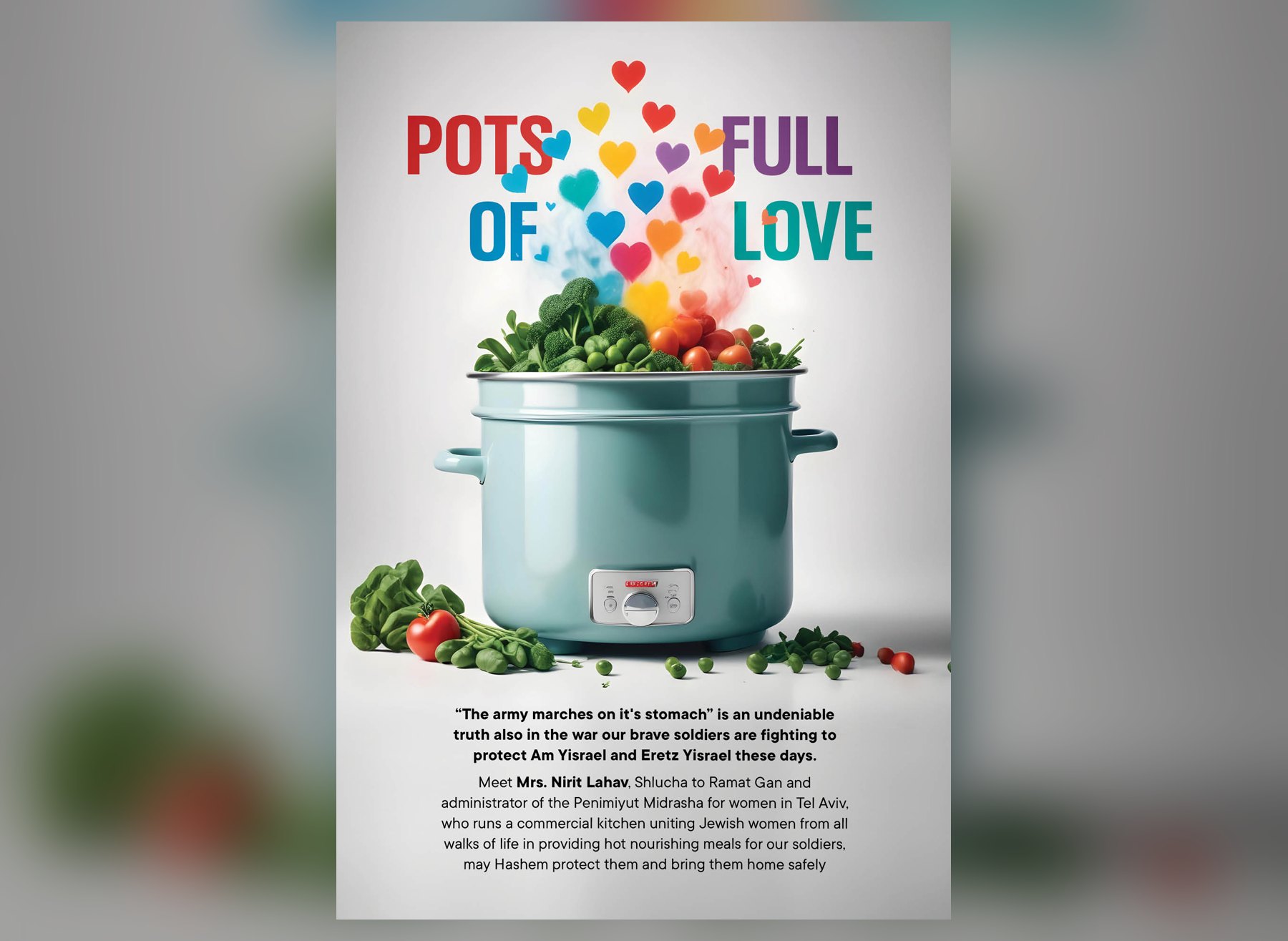
“The army marches on it’s stomach” is an undeniable truth also in the war our brave soldiers are fighting to protect Am Yisrael and Eretz Yisrael these days. Meet Mrs. Nirit Lahav, Shlucha to Ramat Gan and administrator of the Penimiyut Midrasha for women in Tel Aviv, who runs a commercial kitchen uniting Jewish women from all walks of life in providing hot nourishing meals for our soldiers, may Hashem protect them and bring them home safely
A Vision Of Achdus
If you were to ask Nirit Lahav, shlucha in Ramat Gan and principal of Pnimiyut in Ramat Aviv, what her vision is, about what she dreams and where she would like to see her work in her shlichus, she would certainly say, “Achdus, tolerance and love among the people in Ramat Aviv and Chabad shluchim in general, and the girls of the midrasha in particular. Achdus that includes mass participation events, women’s classes, gatherings, farbrengens and lots of blessed activities.
Boruch Hashem, the work in the city has been flourishing for many years already, but there too, like in other places, there are difficulties and opposition on the part of some of the people and it looked as though mutual cooperation was a distant dream.
Signposts
“For those who don’t know, Midreshet Pnimiyut has been around for twenty years. This is the tenth year that I have the privilege of being a part of it. We have about forty girls living there in five apartments. Each apartment has an eim bayit (dorm mother) and a mashpia.
“Previously, the midrasha was meant more for baalos teshuva, but today, most of the girls are from Chabad homes. Most of them come as the result of a journey of self-discovery at the critical time of seeking one’s identity, between the age of high school graduation and starting to study for a career and thinking about marriage. The girls receive lots of personal attention with an emphasis on an individualized approach for each one.
“Unlike other places where there is a tough set of standards and clear rules of where you need to be and what you need to be striving towards, we don’t seek to bring them all to the same outcome, but to help each one find her place on her unique journey by using professional tools and accompanied by our educational staff. At the midrasha we help and support each one until she establishes her Chassidic home. The girls go through a special, meaningful process and even after they marry, our connection is ongoing.”
‘Cooking Achdus In Pots Of Love’
Nearly a year ago, our lives changed beyond recognition. There is nobody in Eretz Yisrael whom the ongoing war didn’t touch in one way or another. All of us, religious and not-yet-religious, find ourselves these many long months within a dense exile darkness and we are all waiting for it to end with the victory cry of the true and complete Geula. Within this darkness, an initiative was started in Ramat Aviv which is all light and unity, uniting women from different walks of life under one roof .
“When the war began and our world was thrown off kilter, we had to think about what we could do to take part in the holy war. This acute situation had every Jew asking himself, ‘Ayeka?’ Where are you in the world? What have you done until now and what are you planning on doing?
“We also asked ourselves the same question. We wanted to do something meaningful that would add light in Am Yisrael and that would hasten the Geula. That is how our project, “Sirim shel Ahava” (Pots of Love) was born. The small kitchen that we had called to us to come in and start cooking. On the first day, we realized it wasn’t as simple as it sounds and we began to solicit donations to buy large quantities of basic items and pots.
“We joined with Revital Ben-Tzur, a wonderful woman here in Ramat Aviv, who runs a program preparing food for soldiers and delivering the food to the combat areas, manned by many volunteers. Revital brought to our kitchen those women who volunteer at her center of operations, women who were never at a shiur or farbrengen. If not for the war, it would have been very hard to get them in our Chabad House, at the midrasha.
“There we were, women who grew up in Chabad, the girls from the midrasha, and lots of women, who from their externals would seem to have no connection to a mehadrin kosher kitchen, standing together and cooking huge amounts of food, week after week, for our soldiers.
“Over the months, we cooked about 6000 portions and sent them to the front with the help of volunteers who traveled on their own to the border with Gaza, where they gave the fresh food to the IDF who brought it to the soldiers. One of the most moving pictures we received was soldiers sitting and eating our food inside a bombed house, without a roof, inside Gaza.
“Aside from being able to provide our soldiers with fresh, mehudar food (we heard from religious soldiers who said it had been a long time since they ate cooked, fresh food because of kashrus reasons), in our kitchen, there developed a rare tapestry of extraordinary Ahavas Yisrael, a connection that it seems nothing else could have made happen. As time passed, women began bringing recipes and even products from home. It was only because of the power of the achdus that had been formed, that we could set the boundaries of halacha firmly in place without antagonizing anyone. They learned about types of kashrus standards and became familiar with the Jewish kosher kitchen.
“It’s amazing to see women with different lifestyles, sitting around one table and carefully checking rice, sifting flour, and being particular about hechsherim. The war has torn down walls built over many years. There is no longer ‘us and you.’ There’s just ‘us.’ It’s not, ‘I’m right and know better, and you are mistaken.’ There’s ‘us, each with her view, but with one common goal, to do good together.’”
From Connection To Connection
“Our wonderful volunteers also joined ‘Shifra u’Puah,’ the organization that helps new mothers in Ramat Aviv, and they are so helpful in cooking and helping our dear new mothers. Who would have believed that a woman from Ramat Aviv, with certain views, and maybe even stigmas about religious women, would stand and cook a meal for a new mother who just gave birth to her tenth child, and do it with joy and a sense of mission?
“Something is happening here, an unbelievable vision being realized before our very eyes. Women, who look, at first glance, like they are distant and alien and that’s how we appear to them, but the moment we got together the walls came down and the connection has become closer and stronger than ever. These women are still living lives that are different than mine, but that doesn’t stop them from joining evenings of hafrashas challa, from saying the yehi ratzon and simply being part of us. Real sisters.
“I want to end with the story of a soldier who sent me a text in which he wanted to know how he could get yeast cakes like the ones he ate in our shipment. The cake was delicious and made him and his battle comrades so happy. I spoke to the woman in charge of our baking – his question really invigorated and empowered her and by that Shabbos, a shipment of about thirty-six hot fresh cakes, baked with love, by a woman who covers her hair and a woman who wears pants, was sent to Gaza.
It’s a Geula vision.
Beis Moshiach #1425 • pp. 44-47
© 2026 Beis Moshiach Magazine. All rights reserved.
This article originally appeared in Beis Moshiach #1425. You are welcome to share it with friends and family by email or in print, provided that you do not change, add to or omit any part of it, you credit the author and Beis Moshiach, and you include a link to archive.bmoshiach.org (written out in full in printed copies).
To republish this article in a newspaper, magazine, book or website, please request permission in advance at [email protected].