Roundtable: What It Took to Change Into Me
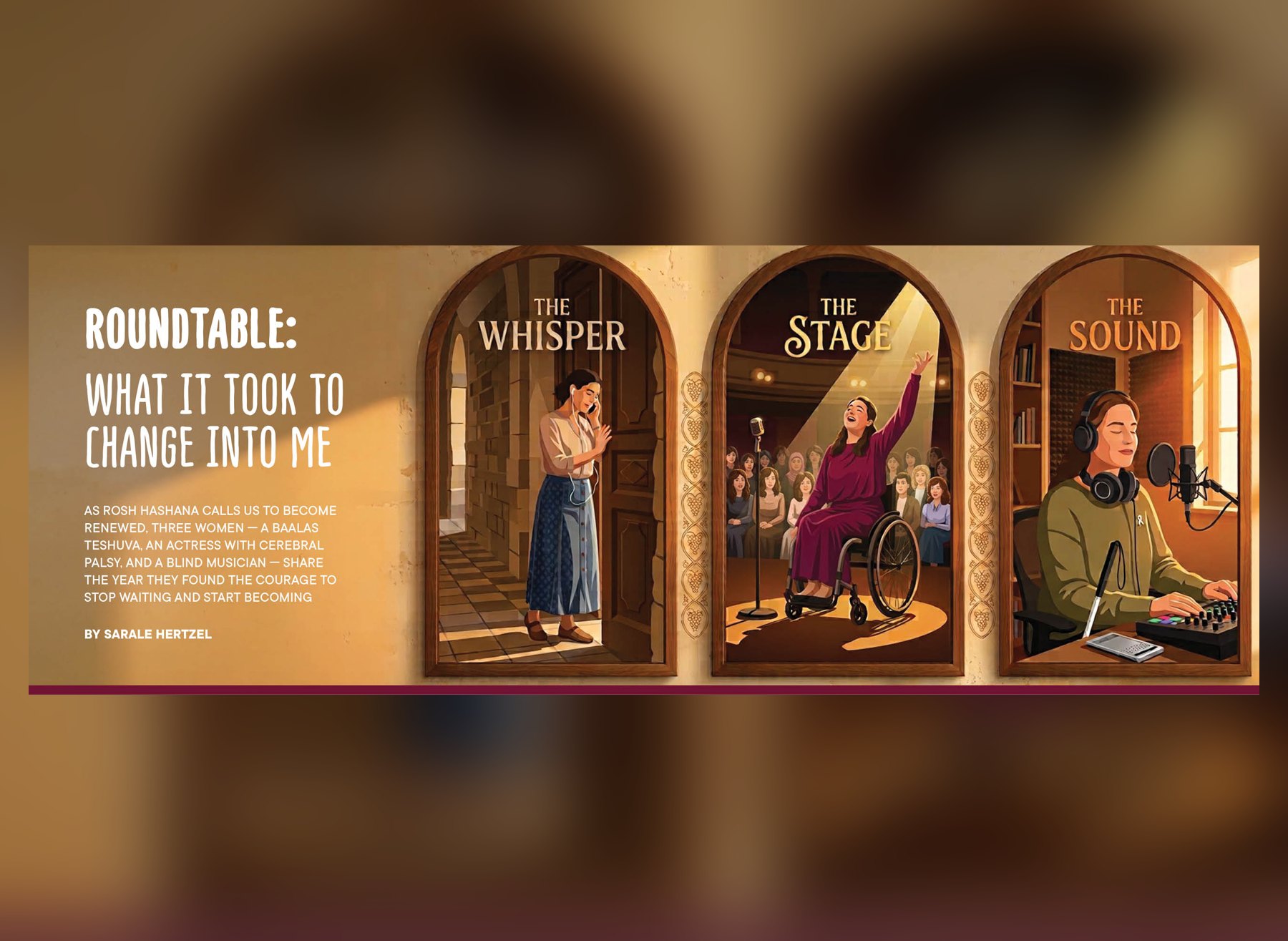
As Rosh Hashana calls us to become renewed, three women – a baalas teshuva, an actress with cerebral palsy, and a blind musician – share the year they found the courage to stop waiting and start becoming.
We all have aspirations and dreams, and we long to bring about changes in our lives. But change requires courage, boldness, and the will to do things differently than we’re used to, which is why change is so hard for us. Even when we do dare to begin a process, we sometimes encounter obstacles that discourage us.
Hodaya Avitan, Leah Ben Zeev, and Tikva Kashi brought about a significant change in their lives this year, despite all the challenges along the way, and they share with us their inspiring processes and important insights.
Tell us a bit about yourself
Hodaya: I’m forty-three, a baalas teshuva, mother of four sweet children, and wife of a former soldier who was discharged and became a full-time avreich (man who learns Torah). I’m a professional makeup artist with my own studio for makeup, hair, and beauty care, and I also teach makeup in a high school cosmetology track.
Leah: I’m twenty-six, the third of nine children. I live in Beit Chilkiya, and professionally I’m an actress, singer, and creator. I speak three languages—Hebrew, French, and English—and I love the world of the stage. Along with all this, I have cerebral palsy due to premature birth, which means I use a wheelchair and deal with motor difficulties and a learning disability that I feel in my day-to-day life. This is how I was born, and I don’t know anything different.
Tikva: I’m a musician who is blind, twenty-three years old, and I live in Netanya.
My Change
What significant change did you make this year?
Hodaya: My significant change is growing closer to myself through growing closer to Hashem from a more genuine and authentic place than before.
Leah: This past year I revealed my personal story to the world, and put out a powerful, moving show called “Mischak HaKisaot (Musical Chairs). The show presents episodes and insights from my life.
Tikva: The big change I made was the move from studying to real life and establishing an independent business in the field of music. My studies weren’t really supposed to lead me to teaching music in schools, or to further studies in music therapy but Hashem, with the life He gave me and the desires He planted in me, led me to perform singing shows, open a recording studio, and also teach music. Everything was new to me, and there are things I learned on my own as I entered the workforce.
What motivated you to make the change?
Hodaya: My mother became sick and that triggered an incredible spiritual awakening in me, and helped me feel Hashem’s choosing of me, and my choosing of Him. I started listening to Torah lectures.
One morning, while I was listening to a shiur, I noticed that my daughter Talia, who has special needs, wanted to tell me something before leaving for the bus to school. I paused, and she told me she’d decided to start wearing skirts (until then she’d worn pants, because she found it difficult to wear skirts given her condition), and she added, in her unclear speech that I understand well: “Ima, if I can do it, you can too.” I told her I’d think about it. She gave me a good-morning kiss, left, and left me stunned and shaken. It was clear to me that something was happening here.
I raised my eyes to Hashem and asked Him to give me a sign and strength, and continued listening to the shiur. To my astonishment, the rabbi suddenly moved on to talk about the topic of tznius. I saw this as a divine revelation, an open display of hashgacha pratis. I turned to Hashem in tears and in simple words told Him that I understood and knew I was in the midst of a crisis, at the bottom, and that the whole purpose of it was for me to grow closer to Him and trust in Him more deeply and strongly. It was all from Him, and for my own good. It’s clear to me that He loves me and wants things to be good for me, and wants me to reach a much greater aliya. And so it was, with siyata d’shmaya. I strengthened tznius in the way I dressed, switched to a simple phone, began saying one tefilla a day, said Tehillim, I say the Shema before bed, and go to shul on Shabbos. That’s how I broke my habits, and every time I made progress in something, even something small, Hashem repaid me double!
Leah: The desire to create a shift in consciousness regarding the perception of people with disabilities, and the desire to give women and girls strength and hope. This is something I always dreamed of doing. And what turned the dream into reality was a failed employment assessment conducted for me by the National Insurance Institute, which determined that I was fit only for sheltered employment. I left there in great pain and with a firm resolution: “B’ezras Hashem, I will yet show the world what I am capable of!” So the decision matured in my heart to bring my life story to the world in a professional way.
Tikva: Honestly, these were hidden childhood dreams, the kind I never dreamed of fulfilling, but Hashem led me to them. In my second year of music studies, I met the singer Shira Linshe and started performing. Even though I’d done that before too, my studies made me take it more seriously. Suddenly I entered groups and forums of musicians and studio owners, and started frequently recording songs in the studio, as a way to relax. When my studies ended, I felt I didn’t have enough strength and maturity to study therapy, and I didn’t see myself in teaching either, partly because I’m blind, and I felt that the discipline of it put me in uncomfortable visual embarrassment in front of people. And then the old dreams resurfaced, which I began, with heaven’s help, to fulfill with the encouragement of my vocal development teacher. Who would have believed then that I’d know how to sing correctly and beautifully like I do today…
Challenges
What difficulties did you face on the journey to change?
Hodaya: My husband always wanted me to grow stronger in observance, but when the moment of truth came, he found it hard to process and accept such a sharp and rapid change, and it stressed him out. It also didn’t go smoothly with my children and the wider surrounding community. In addition, switching to a simple mobile phone reduced and limited my advertising options, which were very important to me because of my work.
Leah: I wanted to enroll in acting classes to gain knowledge and tools that could help me build my show. Five acting schools I tried to get into closed their doors to me because of their apprehension about my disability; most of them did so already during a phone conversation. Once I saw that was the case, I decided to move forward without them. During the process of constructing the show, which took about two and a half years, quite a few difficulties and challenges arose. More than once I thought about giving up.
Tikva: I mostly like to use the word “challenge.” I still have many challenges, not all of which I manage to solve. There’s difficulty with vision, which gets in my way with a lot of technical things, like preparing advertisements and doing graphic design. Those are the points where the lack is felt most. Beyond that, as a self-employed person, I sometimes experience a feeling of loneliness, because at my workplace there’s no team, just colleagues, and each one thinks about her own business. Sometimes I also have to deal with criticism, whether more or less fair. In general, change is a significant process, and it has an aspect of nisayon, a kind of measure of the level and strength of my emuna.
What gave you the strength to change, especially in the face of difficulties?
Hodaya: In the face of difficulty I strengthened my bitachon in Hashem, and fine-tuned the understanding that had blossomed in me that, in truth, the difficulty is a gift from Hashem who loves me and wants my progress, and that I should be thankful for it. I asked Hashem, and continue to ask, that with every challenge He give me the strength to withstand it and do His will as my will. Besides that, I frequently reminded myself that the change is personal, mine alone. It doesn’t obligate others, and so I need to be patient, sensitive, and respectful.
Leah: Thanks to willpower and a team of good shluchos (I am grateful to the writer and director Chaya Reiner, to Esther Kalifa and her team, to Shira Asulin, to the actresses, and lately, dearly, to Hodaya, my sister, who is first and foremost a devoted sister, and then also secretary and de facto show manager)—and tefilla from the heart—I made it through this journey, with siyata d’shmaya. I learned to reach out for help when needed, so it would be easier to cope without collapsing, chalila. When I wanted to give up, I pictured girls in situations similar to mine who remained in the shadows because they didn’t believe in themselves enough. I aspired to be in a different place.
Tikva: Mainly my parents. My father gives me pep talks when needed. Sometimes they’re hard to internalize, and don’t match the gloomy mood I’m in, but in the end, I’m grateful to him for it. My professional studies (sound theory, vocal development, and piano playing) also gave me a lot. And yes, the encouragement of the people around me, the residents of the nursing homes where I worked, who would give me positive feedback, and the picture I painted before my eyes of my dreams and desires coming true—all of these gave me strength.
How do you feel today about the change?
Hodaya: Wonderful. I’m happy, more connected to Hashem and to my inner essence.
Leah: I thank Hashem for the zechus He grants me, in His goodness, to give His daughters a quality hour of a multi-sensory experience full of emotion, humor, and content, an experience that carries a charge of emuna, trust, and resilience. I feel that this exposure gave me an opportunity and an invitation for an inner process of healing, which included touching deep places within me and processing them into something mature.
Tikva: Honestly, I’m still in a state of astonishment, and I can’t believe that I, boruch Hashem, am fulfilling my childhood dreams. It’s a great sense of satisfaction. A feeling of bechira. I sit and remember that as a six-year-old girl, I sat on the couch next to the tape recorder, and my mother asked me what my dream was. I told her that I imagined myself performing on stage with everyone applauding for me, and that I saw myself recording people in a studio, and also recording myself, a lot, a lot, a lot. Still, there are challenges. Like in any new business, the profits aren’t yet large, and there are also losses. I try to work by the approach of “think good and it will be good.”
How does your environment respond to and get affected by the change you made?
Hodaya: Today, the environment surprises me for the better again and again. I’ve gotten to see with my own eyes the truth of the saying: “Don’t try to change your environment. Change yourself, and the environment will change accordingly.”
Leah: I receive a lot of feedback from women who are moved by the show and impressed by its high production level. I was especially touched by a nonverbal reaction from a girl, also with a disability, who sat and laughed in recognition throughout almost the entire show. I was also deeply moved by a school principal who, after watching my performance, invited me to a staff training day at her school, so I could expose the staff to my world and help them best absorb a student with a disability who was going to study there.
Tikva: The change I made includes opening a home studio where clients come to record songs. My family is adjusting to strangers coming into the house, which wasn’t so common for us in the past. As a child, when I would invite friends over, there was pressure for the house to be properly neat. Today the household members welcome guests calmly, naturally, and simply.
What makes me happiest is that my sister, Chaya Tehila, who is a violinist with an especially sharp ear, helps and encourages me endlessly, as do my parents and old friends. This encouragement helps me a lot. Without it, I would have given up long ago. So I say thank you that there’s a supportive environment around me. Without it, the change would probably have gone from challenging to impossible.
What is your message or tip for someone who wants to make a change and is struggling to do it?
Hodaya: Believe that there’s nothing you can’t do and nothing that can stand in the way of your ratzon! Ask Hashem to help you. Tell Him that you really want to change, and that you need Him to give you strength, because sometimes you feel too small. From experience, it works. By the way, my mother has recovered, boruch Hashem.
Leah: I choose to express my message to you, the readers, in words from the show: “Yes. You’re there. You and you and you and you. Every one of you. If someone tells you that you can’t—at that moment tell yourselves: ‘I resign from the role of the one who can’t.’ We’re all resigning right now from the role of the one who can’t. We have a new job. It’s called: I am making it happen!”
Tikva: Come less from an approach of “I want change,” and instead just go with the flow and don’t be scared by changes. Still, it’s important to listen to your inner ratzon and make it happen in a thoughtful and sensible way but without too much fear and worry. When Hashem wants it, change happens. Actually, changes happen all the time, it’s just that we don’t notice all of them. The truth is, we’re capable of getting used to and adapting to far more than we think. So if you want something, and feel a connection to it, don’t be afraid to change. B’hatzlacha!
Beis Moshiach #1522 • pp. 44-47, 52
© 2026 Beis Moshiach Magazine. All rights reserved.
This article originally appeared in Beis Moshiach #1522. You are welcome to share it with friends and family by email or in print, provided that you do not change, add to or omit any part of it, you credit the author and Beis Moshiach, and you include a link to archive.bmoshiach.org (written out in full in printed copies).
To republish this article in a newspaper, magazine, book or website, please request permission in advance at [email protected].