A Dollar & Story Worth Gold
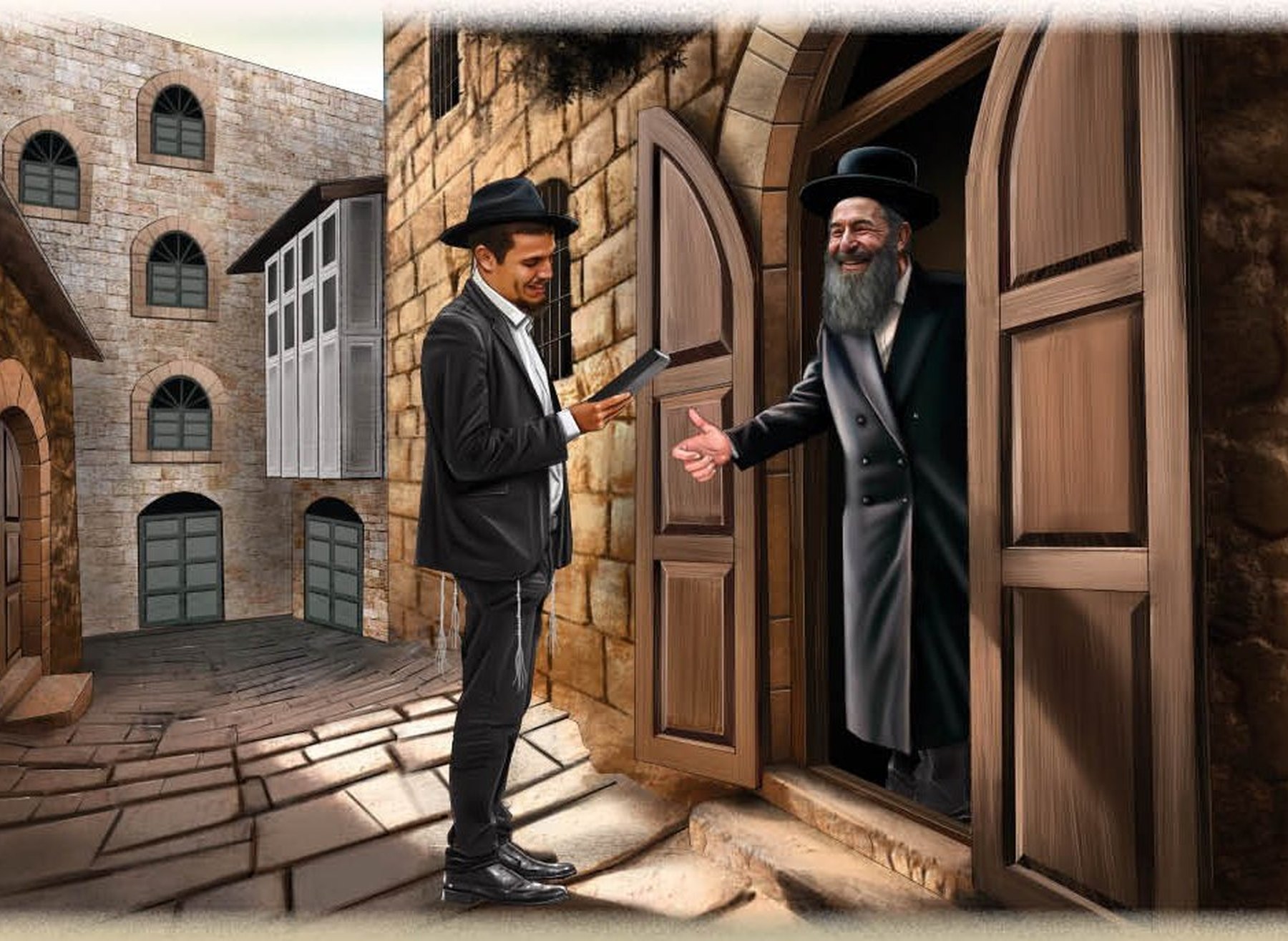
Dovi stood at the bottom of a long, twisting staircase. Dovi was a chassan, and chassanim in Yerushalayim had an old minhag of bringing their wedding invitation to their Rosh Yeshiva in person.
When Dovi was a boy, he had a hard time learning Torah. It was hard to focus for a long time, and as he got older, he realized he wasn’t like the other boys in class. Dovi liked different things. Slowly, he grew less excited about Yiddishkeit.
That’s when Dovi joined Rabbi Mishkofsky’s yeshiva for high school boys. This yeshiva was for boys like Dovi, who couldn’t spend the whole day learning Gemara. It was for boys who found it hard to focus and act like a Yid. Rabbi Mishkofsky believed that no neshama should struggle to act like a Yid! He knew some boys just needed more love, attention, and time. He wanted everyone to see how fun Yiddishkeit could be!!
Dovi had to work hard, but he graduated from Rabbi Mishkofsky’s yeshiva as a proud Yid who loved Torah and mitzvos! Later, he got even more excited about Yiddishkeit by learning Chassidus. Even though his journey had been long, Dovi knew Rabbi Mishkofsky helped him get back on track. That’s why he was so happy to bring his Rosh Yeshiva an invitation to his wedding!
Dovi reached the top of the steps, and came to the familiar door of Rabbi and Rebbetzin Mishkofsky’s home. He knocked loudly and waited for the door to open.
CREEEAAAAK!!
The heavy, wooden door opened to an older Rabbi Mishkofsky, who seemed very surprised. He recognized Dovi right away, but hadn’t seen him in so long, and hadn’t expected him at all!
“Dovi!” Rabbi Mishkofsky exclaimed, hugging him tightly. “What’s my wonderful talmid doing here?” he asked with a big smile. Dovi had been one of the yeshiva’s students, really early on, and his beard and black hat gave the Rosh Yeshiva so much nachas.
“B’ezras Hashem, Rebbi – I’m engaged! I have to have you there,” Dovi said, excited as he stretched out the invitation. “I wanted to bring it to you myself.”
The Rabbi carefully looked over the invitation.
“Is the kallah’s family Lubavitch?” the Rav asked, his eyes wide with curiosity.
“We both are,” the chosson said with a proud smile.
Rabbi Mishkofsky stroked his beard, thinking and smiling. “Excellent,” he said warmly. Then, with a twinkle in his eye, he asked, “Tell me, do you happen to know when your kallah’s mother last got a dollar from the Rebbe?”
Dovi’s eyes widened in surprise. What a funny thing to ask, he thought. Even though Rabbi Mishkofsky wasn’t Chabad – he was very yeshivish – Dovi, as a Lubavitcher, knew exactly what his Rosh Yeshiva was talking about.
“Actually, no, I’m not sure,” Dovi said, scratching his head. “I’ve never asked her mother about that. It’s been more about, you know, wedding plans, and all that stuff…” He gave a little chuckle. “I’m sure she has a dollar from the Rebbe, but… why do you want to know?”
Rabbi Mishkofsky smiled. “Oh, just curious! Those dollars are special, you know. They hold a lot of bracha.”
Dovi nodded. “They really do! I can ask next time I see her, then come back to let you know.”
* * *
“Shevat, tav shin nun alef, January 1991!” Dovi called out, panting after running up all those stairs to Rabbi Mishkofsky’s home. He was out of breath, but happy to finally bring his Rosh Yeshiva the answer.
“Mmmhhmmmm,” Rabbi Mishkofsky said, stroking his beard with a big smile. Dovi stood there, waiting. This is getting really strange, he thought.
Rabbi Mishkofsky looked at Dovi with a twinkle in his eye. “I have a story for you, Dovi. It’s worth one million dollars.”
Dovi blinked, completely confused. “One million dollars…?” he repeated, wide-eyed.
“Yes,” Rabbi Mishkofsky said seriously. “But for you, I’ll tell it for just $10,000.”
Dovi’s heart raced. “$10,000?! Rebbi, I don’t have that kind of money! What kind of story is worth that much?!” he asked, still catching his breath.
Rabbi Mishkofsky chuckled. “It’s a story that could change your life, Dovi.” Then, after a moment, he added with a grin, “Tell you what—if you invite me to a sheva brachos meal with both families, I’ll tell the story for free.”
Dovi’s eyes lit up. “Oh! Of course, Rebbi! I’d love to have you at a sheva brachos!”
Rabbi Mishkofsky patted Dovi on the shoulder. “Good. Then it’s a deal.”
Dovi left more confused than ever. What was going on? Why did Rebbi ask about the Rebbe dollars? Why a million-dollar story? But one thing was sure – whatever this story was, it must be amazing.
* * *
Dovi and his kallah had a beautiful chassuna! The hall was filled with happy friends and family enjoying delicious food, and the band played lively music that made everyone dance with joy. Under the chuppah, Dovi’s heart raced with emotion as he stood with his kallah, surrounded by the people he loved most. Camera flashes lit up the room, capturing all the smiles and happy moments. The night passed in what felt like the blink of an eye, and before they knew it, they were celebrating sheva brachos.
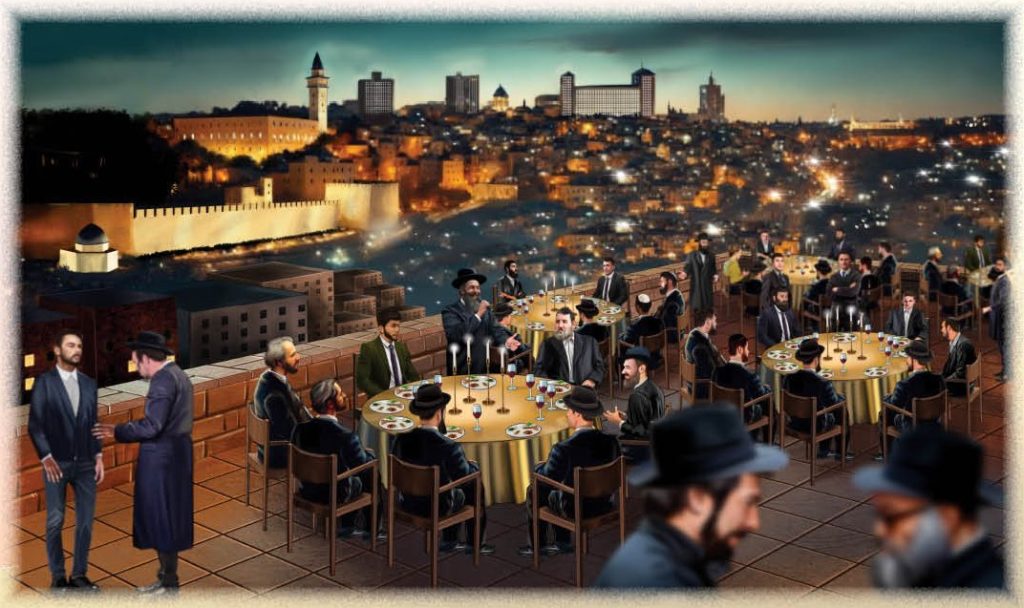
Dovi and his kallah were heading to their final sheva brachos in a beautiful park in Yerushalayim.
“Can you believe tonight’s the last one?” his kallah asked, smiling.
“I know! It went by so fast,” Dovi replied, shaking his head. “And tonight… Rabbi Mishkofsky is coming.”
“Oh, the million-dollar story?” she asked, raising her eyebrows.
Dovi nodded. “Yep – I can’t stop thinking about it. Whatever it is, it’s got to be good.”
His kallah laughed. “I guess we’ll find out soon!”
* * *
After enjoying a delicious barbeque, the speeches began. The guests waited and waited, until Rabbi Mishkofsky finally stood up to speak.
Stroking his beard with one hand, holding the microphone in the other, Rabbi Mishkofsky began telling the story, from the beginning.
“It all started when I was a newly married yungerman,” he began, his voice steady but full of warmth. “My wife, Chani, and I knew we’d lead simple, meaningful lives, filled with Torah and mitzvos. We didn’t need much – just enough to live and learn. I had a plan: I’d learn in a kollel in Netanya and teach the bachurim in yeshiva. Baruch Hashem, everything started off exactly as we hoped.”
The guests leaned in, listening closely as Rabbi Mishkofsky shared these early memories. Dovi’s heart raced, wondering where the story was going next.
“We were young and full of dreams,” Rabbi Mishkofsky continued, “and life was good. We had our little apartment, and every day was focused on Torah and learning. But then something unexpected happened…”
Rabbi Mishkofsky cleared his throat and began, “You see, after a while, I noticed something that really upset me. There were boys in yeshiva, boys from good Jewish homes who had learned in frum schools, drifting away from Torah and Yiddishkeit. They weren’t acting like bachurim anymore, and they were getting interested in things that, well… Yiddishe boys shouldn’t be involved with. Even worse, they were bringing other boys down with them.”
The crowd listened carefully as Rabbi Mishkofsky continued. “That’s when I had an idea. I rented a house for those boys, separate from the other bachurim, so they wouldn’t distract the other students. It wasn’t like a regular yeshiva, but they had a place to belong.”
Rabbi Mishkofsky smiled a little, but then his face grew serious again. “But… I didn’t realize how hard it would be. I was young and full of ideas. I went from being a full-time kollel guy with no money, to running this new yeshiva for these boys. I had to pay for their food, rent, and everything they needed. And more than that, these boys needed a lot of attention. They needed love, time, and someone to show them they mattered. That became my most important job.”
Rabbi Mishkofsky looked straight at Dovi. “But because I was spending all my time with those boys, I wasn’t home much. My wife needed me too, but I didn’t realize how much.”
Rabbi Mishkofsky continued, “Then came the big argument. One evening, I came home late again, after spending the whole day with the boys. I was exhausted, and as soon as I walked in, I could see Chani was upset.
“‘This isn’t working,’ she said, her voice shaking. ‘You’re never home, and when you are, you’re too tired to even talk to me!’
“I sighed and said, ‘But Chani, these boys need me! I can’t just leave them! They’re in real trouble, and if I don’t help them, who will?’
“Chani shook her head. ‘But what about us? What about our family?’ she asked, her voice getting louder. ‘This isn’t the life we planned! You’re always running around, and I’m left here alone! I need you, too!’
“I felt my heart sink. ‘I know, Chani. But I’m doing something really important. I don’t want those boys to leave Torah and mitzvos completely. It’s pikuach nefesh!’
“She crossed her arms and looked at me with tears in her eyes. ‘But what about me? Don’t I matter? Don’t we matter? I can’t keep living like this.’
“I realized then how bad things had gotten. ‘You’re right,’ I said, quietly. ‘Let’s take a break and figure it out together.’”
Rabbi Mishkofsky took a deep breath. “That’s when we decided to drive up north and not come back until we had a plan to fix things.”
The crowd was completely silent, waiting to hear what happened next.
* * *
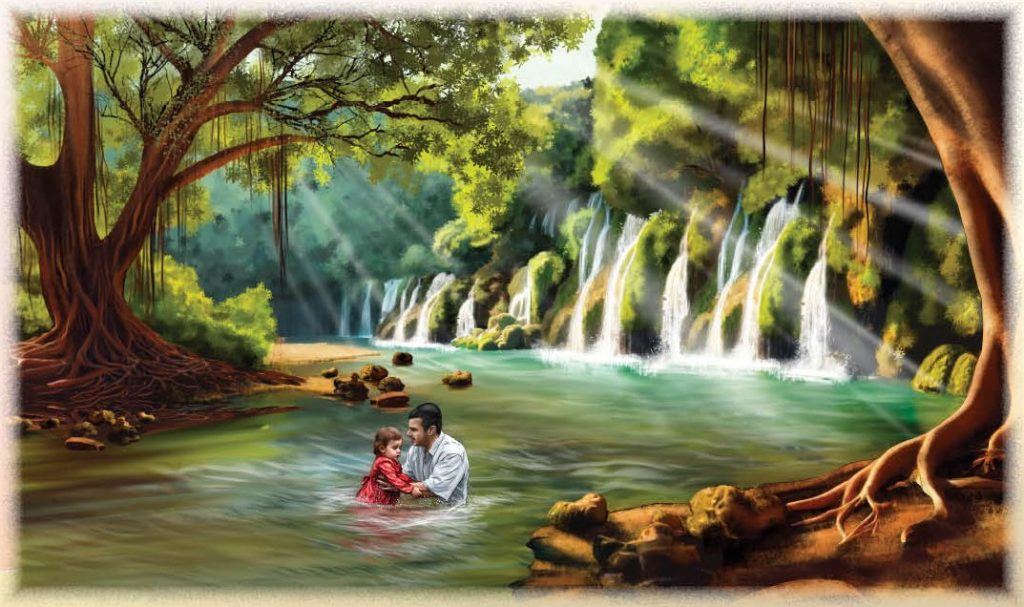
“We drove and drove until we reached Park HaYarden, almost in the Ramat HaGolan,” Rabbi Mishkofsky continued. “The streams and rivers were beautiful, the grass was green, and there were tall trees all around us. But inside, we were both upset.”
“As we were sitting there, I noticed something red, falling down the waterfall. At first, I wasn’t sure what it was, but then I realized it was moving! Before I knew it, I was running into the river. The little red thing floated closer to where we were sitting, and when I got to it, I couldn’t believe my eyes – it was a tiny girl, maybe two years old! She was bobbing up and down in the water, trying to breathe. But she was alive!
“I picked her up and rushed her back to the shore. Chani raced over with our picnic blanket, and we wrapped the little girl in it to keep her warm. We gave her a few gentle pats on the back, and amazingly, she coughed out all the water she’d swallowed. Baruch Hashem, she was breathing! She looked scared and shocked, but she seemed okay.”
Rabbi Mishkofsky paused, taking a sip of water while the crowd leaned in, waiting for more. “We realized she must have wandered away from her family, who were probably higher up, near the top of the waterfall. So, Chani and I climbed up the hill, carrying the little girl, and soon we found a big family spread out on blankets, enjoying the afternoon. There were lots of kids running around, and adults chatting, but no one seemed to notice the little girl had wandered off. They had no idea she’d almost floated down the waterfall!
“When I reached the family, dripping wet, holding the soaking, scared little girl, the mother immediately understood what had happened. Her eyes went wide, and she started screaming, ‘My baby! My baby! Oy!’ She ran toward me, faster than I’d ever seen anyone run in my entire life. She grabbed her little girl out of my arms, hugging her tight and kissing her all over, making sure she felt safe again.
“The mother was shaking, crying so hard. ‘Thank you, thank you!’ she kept saying, over and over again. ‘You saved her!’
“After she calmed down a bit, she looked at my wife and me with tears still in her eyes. ‘I have to give you something!’ she insisted, looking around in a panic. Someone, please go to the car and get me my purse! I need my wallet! she shouted to one of her older kids.”
Rabbi Mishkofsky chuckled a little, recalling the moment. “Please, there’s no need for that, I told her, but she wouldn’t hear it. No, I have to repay you! she said. You saved my daughter’s life!
“The mother, still holding her daughter tightly, looked at me with such gratitude. But without saying another word, she reached into her purse, took out her wallet, and pulled out… a single dollar bill.
“This is all I can give you right now,’ she said softly, her voice shaking. “Take it. It’s a dollar from the Lubavitcher Rebbe.”
“I blinked. ‘But Giveret, Madame! Please, don’t pay me! I was only doing what anyone would do!’ But she wasn’t giving up, so I decided to try a different approach. ‘Really,’ I said, trying to sound polite, ‘I have no use for a Rebbe dollar. I’m not Chabad. This dollar is clearly very special to you. You should keep it! I don’t need it.’
Rabbi Mishkofsky chuckled. “But she wasn’t going to take no for an answer, so I had no choice but to accept it. I walked away with a Rebbe dollar in my hand, still thinking, What am I going to do with this? But let me tell you something… boy, was she right. That dollar brought more bracha than I could have ever imagined.”
* * *
At this point, Rabbi Mishkofsky slowly reached into his coat pocket and pulled out a well-worn dollar. The room went silent as he held it up, revealing the date “Shevat, 5751” written across the top.
“You see,” he said, his voice soft but full of emotion, “you may think that I saved that little girl all those years ago, but the truth is, she saved me. She was part of something much bigger than I ever could have imagined.
“After we left the park, Chani and I were quiet for a while, both of us thinking about what had just happened. The car hummed softly as we drove along the winding roads, the sun setting in the distance.
“Finally, Chani broke the silence. ‘That wasn’t an accident, was it?’ she said, her voice full of thought. “It felt like a sign, falling straight down from Shomayim. But what does it mean?’ she asked, her voice filled with wonder. ‘
“‘I think Hashem was trying to tell us something,’ I said. ‘I’ve been doing pikuach nefesh work all along – saving these boys, helping them find their way – but maybe it’s time we make it even bigger. Maybe this is a sign that I’m supposed to do more.’”
“Chani glanced over at me. ‘More?! What do you mean?’”
“I paused, staring at the road ahead. ‘I think it’s time,’ I said slowly, ‘to open a yeshiva for boys who don’t fit into the regular system. Boys who need more time, more love, and more attention. Just like those boys I’ve been working with. Maybe it’s time we take this to the next level.’”
Rabbi Mishkofsky took a deep breath, remembering the moment. “And that’s when we knew. It wasn’t just about that little girl. Hashem was guiding us to our next step.”
“When we got home, we made a decision. We were going to move our family to Yerushalayim, where I’d open a school for boys who couldn’t manage in a regular yeshiva. Boys who needed Torah just as much, if not more, than the others.”
The room was completely still as Rabbi Mishkofsky paused, letting the story sink in. Then, with a warm smile, he turned to the chosson. “And our Dovi here… he was a student at that yeshiva!”
The crowd turned to Dovi, their eyes wide with shock. Rabbi Mishkofsky smiled warmly and leaned in. “And here’s where the miracle – the part that makes this The Million Dollar Story – comes in.”
He paused, letting the suspense build.
“Dovi,” Rabbi Mishkofsky said, “has just married the same little girl, the one in red, I saved that day at the waterfall.”
Gasps filled the room.
“Yes, the very girl who inspired my wife and me to start the yeshiva where Dovi learned,” Rabbi Mishkofsky continued. “And now, she’s standing here, marrying one of our first students.”
The room was silent, filled with wonder, as everyone processed how one small act had changed so many lives.
“He has a lot to thank you for,” laughed the Rosh Yeshiva, looking at the kallah. Rabbi Mishkofsky gave Dovi and his kallah a beautiful bracha, then pulled Dovi into a warm hug.
Adopted from Rabbi Hanoch Teller’s book “Too Beautiful”—Rabbi Teller heard it first-hand from the people involved.
Beis Moshiach #1432 • pp. 54-59
© 2026 Beis Moshiach Magazine. All rights reserved.
This article originally appeared in Beis Moshiach #1432. You are welcome to share it with friends and family by email or in print, provided that you do not change, add to or omit any part of it, you credit the author and Beis Moshiach, and you include a link to archive.bmoshiach.org (written out in full in printed copies).
To republish this article in a newspaper, magazine, book or website, please request permission in advance at [email protected].