The Mother of the Soldiers
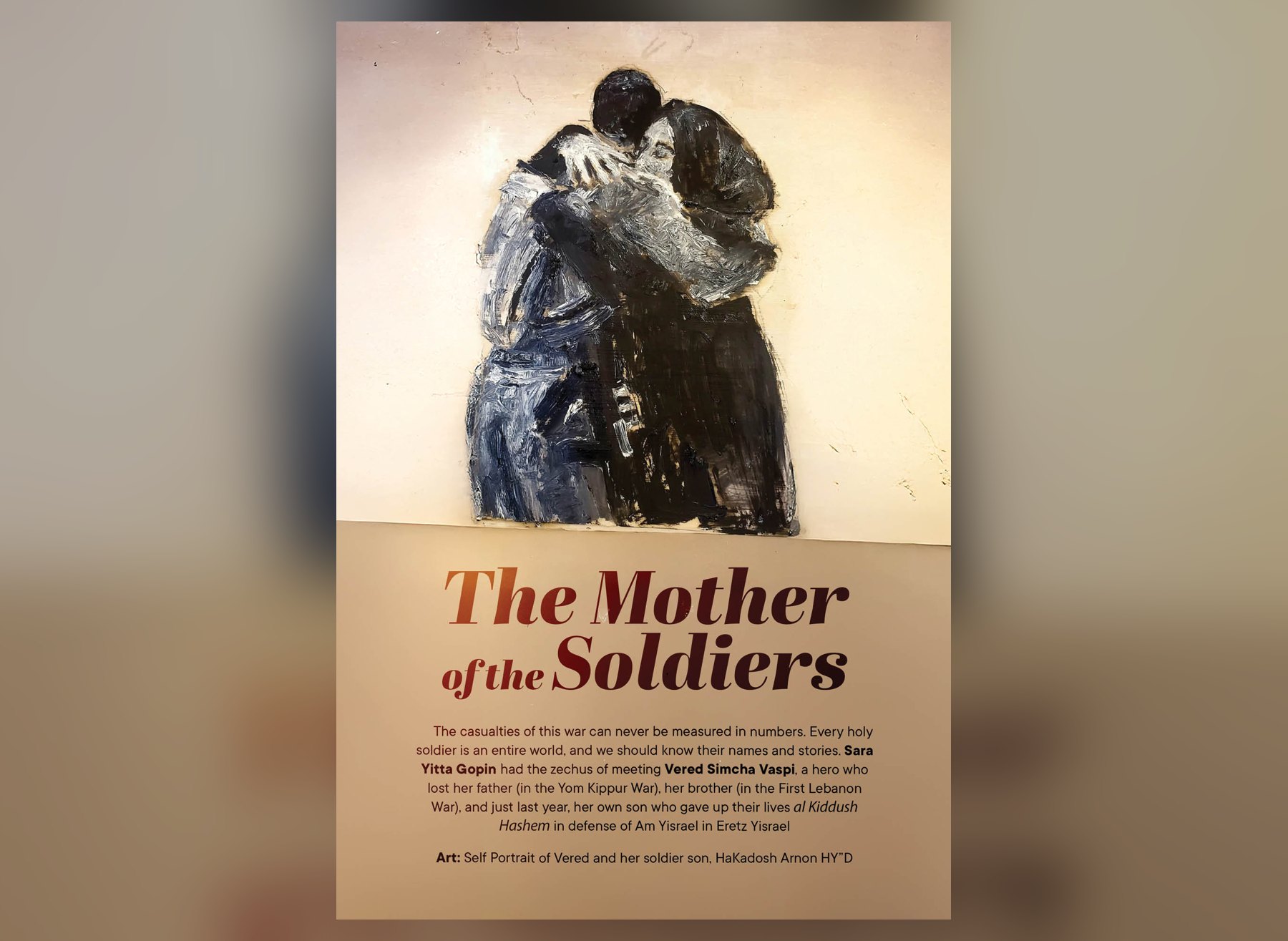
The casualties of this war can never be measured in numbers. Every holy soldier is an entire world, and we should know their names and stories. Sara Yitta Gopin had the zechus of meeting Vered Simcha Vaspi, a hero who lost her father (in the Yom Kippur War), her brother (in the First Lebanon War), and just last year, her own son who gave up their lives al Kiddush Hashem in defense of Am Yisrael in Eretz Yisrael
This casualties of this war can never be measured in numbers. Every holy soldier who gave up his life is an entire world, and we should know their names and their stories.
Three Generations of Kedoshim
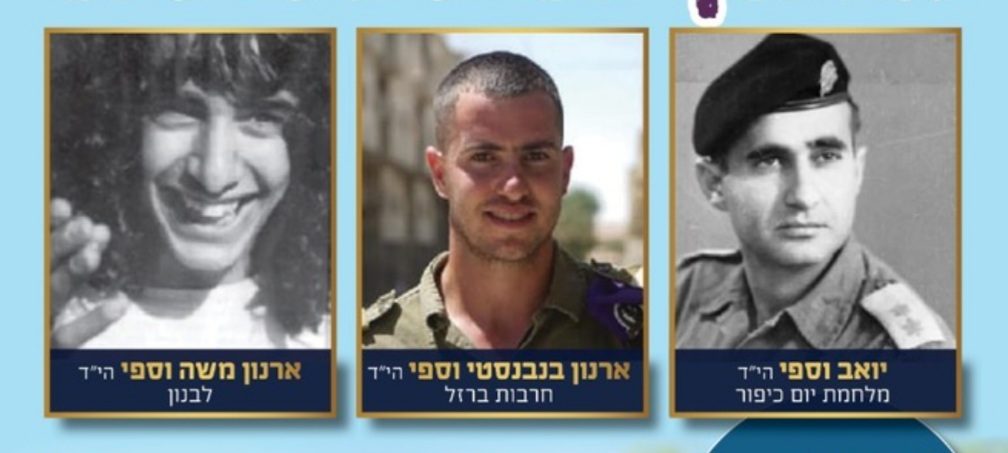
I had the zechus of meeting Vered Simcha Vaspi in 770. She was wearing an IDF identity disc, which she never removes. When I asked her about it, she replied, “This is the disc of my son, Arnon Moshe Avraham Benbenisti Vaspi Hy”d, who was killed in battle in Gaza on 7 Cheshvan 5784. He was twenty-six years old. Arnon was an officer and a paratrooper in the Givati Brigade. He was named after my older brother, Arnon Moshe Vaspi Hy”d, who lost his life in the First Lebanon War. He was nineteen, and was a paratrooper too. My father, Yoav Vaspi Hy”d, was a general who was killed in the Yom Kippur War, in a battle conquering Ramat HaGolan.” Three generations of kedoshim.
Both Vered Simcha and her mother Sara Vaspi had been given the option by the IDF of signing a paper which would have released their sons from the combat corps, so that their army service would be outside of the battlefield. They refused.
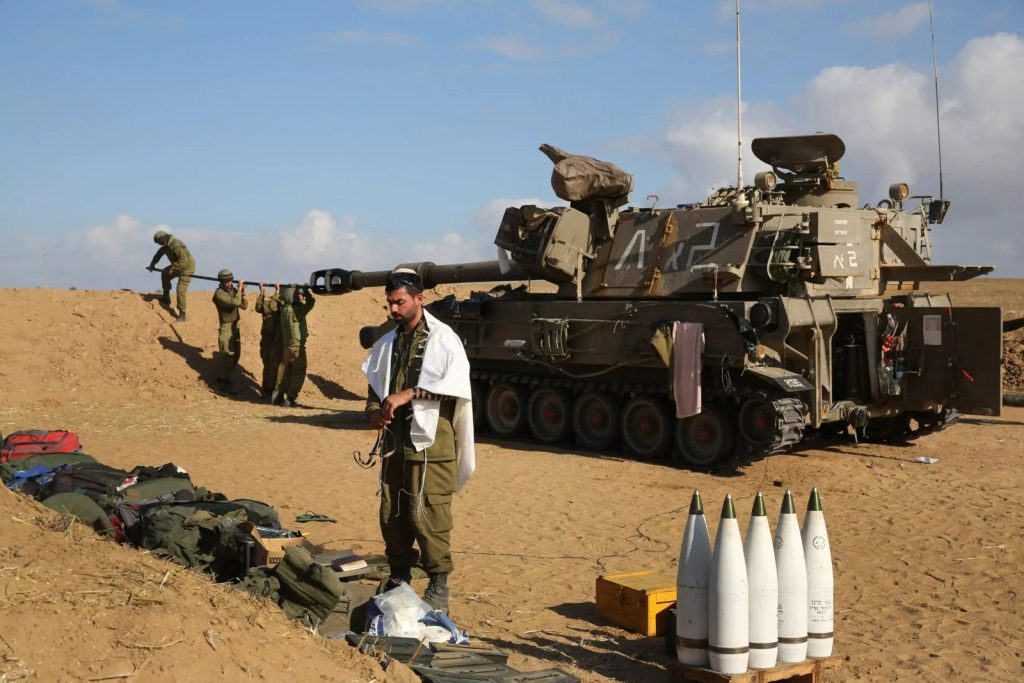
She continues, “As soon as the war broke out Arnon miraculously succeeded in bringing down from the Northern border to the South an airplane full of ‘Tigers’, which are highly armored military vehicles. He fought the terrorists day and night for two weeks, ‘purifying’ the kibbutzim and yishuvim. Then he went into Gaza. If he was needed anywhere, it was there. He saw the most horrific sights but was never afraid, and his high spirits kept up the morale of his troop as well.
“Arnon was the commander, the one who had to keep his head up while maneuvering the tank to ensure that the ammunition was aimed at the terrorists. The other soldiers in the tank protected themselves by keeping their heads down. Arnon gave up his life, and their lives were spared.”
It’s painful for Vered Simcha to talk about that fateful day, but she manages to say, “There I was, in my childhood home making stuffed peppers with my mother to send to the soldiers, when a delegation from the IDF knocked on the door to notify us about Arnon’s death. It was the most painful moment of my life. This time it was my son… During the shiva I kept having flashbacks of when my mother and I sat shiva for my father and for my brother.
“I want to ‘keep’ Arnon with me forever. I always saw him as the continuation of my brother, now they are buried side by side,” she says emotionally. “Arnon was extraordinary, full of so much light and goodness. His name symbolizes vitality, and he had the energy of ten people! He loved animals, especially horses, and was a horseback riding therapist. Arnon was sensitive and empathetic, whenever he’d see a child being bullied, he would run to protect him. That’s how he left the world, protecting his soldiers.”
Planting the Seeds
Our conversation turns to Vered Simcha’s heartrending life story. “I was only seven years old when I lost my father, and I always thought he was coming back. It left a huge void in my heart, and I craved fatherly love and security. When I was eighteen, I lost my brother Arnon too, and since then my heart would melt at the sight of every soldier. I felt like he was my brother.
“After such losses it’s hard to live a normal life. The vacuum propelled me to search for ruach, spirituality. I was drawn to a bohemian lifestyle, and at sixteen studied in a school of fine arts. Painting helped me relieve some of my pain, but not all…
“When I was twelve I participated in a Bat Mitzva shabbaton for war orphans organized by Shifra Golumbovich in Kfar Chabad. That was when I heard about the Rebbe and wrote to the Rebbe for the first time. Spending Shabbos in Kfar Chabad left a long-lasting impression on me, planting the seeds for my search for Yiddishkeit.
“At eighteen I was an ardent idealist with a dream of bringing peace to the world, apparently I’d inherited this drive from my father. I always believed that my life had a purpose, I just had to discover what it was.
“I decided to go to Mea Shearim, where I knew that religious people ‘still’ existed, and got close with several families there who truly cared about me. But after spending some time with them I saw that their lack of connection with the outside world didn’t suit me. Even then I understood that our mission is to turn the world into a dira b’tachtonim.
“I remembered writing to the Rebbe at the Bat Mitzva shabbaton in Kfar Chabad, and wanted to see the Rebbe. My friends in Mea Shearim told me that the Rebbe was in New York. The next stop of my journey was Machon Alta in Tzfas. I learned there for three years, and then studied in Machon Chana in Crown Heights.
“I davened to Hashem to be as close as possible to the Rebbe, in the Rebbe’s ‘dalet amos’. Then I received a phone call from one of the ladies who knew me asking if I wanted to take her place in the vaad mesader for the women’s dollar line on Sundays. Until today I still wonder what made her call me. For a few months I had the tremendous zechus of accompanying the Rebbe back to his private room. The Rebbe gave me personal closeness, from which I draw strength for everything in my life.
“Afterwards I taught Torah in the Schneerson Hebrew Day School in San Francisco. I got married to Dovid Benbenisti ob”m. Getting pregnant was a struggle, but I never gave up. Seven years after receiving a bracha from the Rebbe I was blessed with twins, Arnon Moshe Avraham and tlchtv”a Chaya Mushka. Three years later, after receiving another bracha from the Rebbe, specifically for ‘a son whom we should name Yosef Yitzchok’, my son Yosef Yitzchok was born. When Arnon was nine we moved to Yesod HaMaala.” She adds, “Yosef Yitzchok has also been fighting in Gaza, may Hashem watch over him.”
Revitalized By the Spirit of Arnon
“I had a choice either to fall into despair after Arnon’s death, or to take the great power that his soul is giving me and use it to bring achdus in Am Yisrael,” Vered Simcha says emphatically. “We should all be together, now more than ever. When I sat shiva every denomination came to comfort me.
“The beautiful, amazing soldiers keep calling me directly for help. I bring them whatever they need, whether it’s food, socks, chargers or anything else. Before Sukkos I was busy sending sets of lulavim and esrogim to soldiers in Lebanon. The roads near the Northern border are dangerous, they are being bombed all the time, but I get as close as I can to the army base.
“Presently every day I cook food for troops of soldiers in tremendous pots, cholent too… Chabad women in Yesod HaMaala help in preparing the meals, and we also receive monetary donations. We use the best meat, asado (short-ribs, plate flanken), so that the soldiers feel our love for them, and that we are one with them.
“I have an art gallery in Rosh Pina which I turned into a coffee house where soldiers, students and young people from all over Eretz Yisrael come to get chizuk. They sit in the garden, talk, play music, and feel the spirit of Arnon. Twice a week I give a class there for women in Chassidus.”
More Than Just a Photograph
“For many years there is a weekly Shabbos gathering of children in our shul, which is in the center of Yesod HaMaala and run by the Shaliach Rabbi Yaakov Reitzes,” Vered Simcha says. “My great, great maternal grandfather, Chacham Shlomo Mizrachi ob”m, founded the shul. The children sit with me outside in the garden of the shul and we daven, say Tehillim, and I speak about the weekly parsha.
“The constant barrage of rocket attacks in the North is extremely stressful, especially for children. I had an idea to build a playground in this garden, with slides, swings and other amenities for the numerous children who congregate there regularly. It will be called ‘Gan Hashlosha’, after my father, brother and son, three holy souls who were moser nefesh for Am Yisrael. I’ve been able to collect two-thirds of the amount necessary, boruch Hashem, all that’s missing is another 80,000 shekels.” She pauses, adding, “I want their memories to be more than just a photograph.”
Vered Simcha concludes with an upbeat spirit, “We don’t understand anything, but we do know that whatever the Rebbe says is chai v’kayam. The Rebbe told us that we are the last generation of exile and the first generation of Geula, and we want it now!”
Beis Moshiach #1433 • pp. 40-43
© 2026 Beis Moshiach Magazine. All rights reserved.
This article originally appeared in Beis Moshiach #1433. You are welcome to share it with friends and family by email or in print, provided that you do not change, add to or omit any part of it, you credit the author and Beis Moshiach, and you include a link to archive.bmoshiach.org (written out in full in printed copies).
To republish this article in a newspaper, magazine, book or website, please request permission in advance at [email protected].