It’s Not Your Fault You Took the Blame
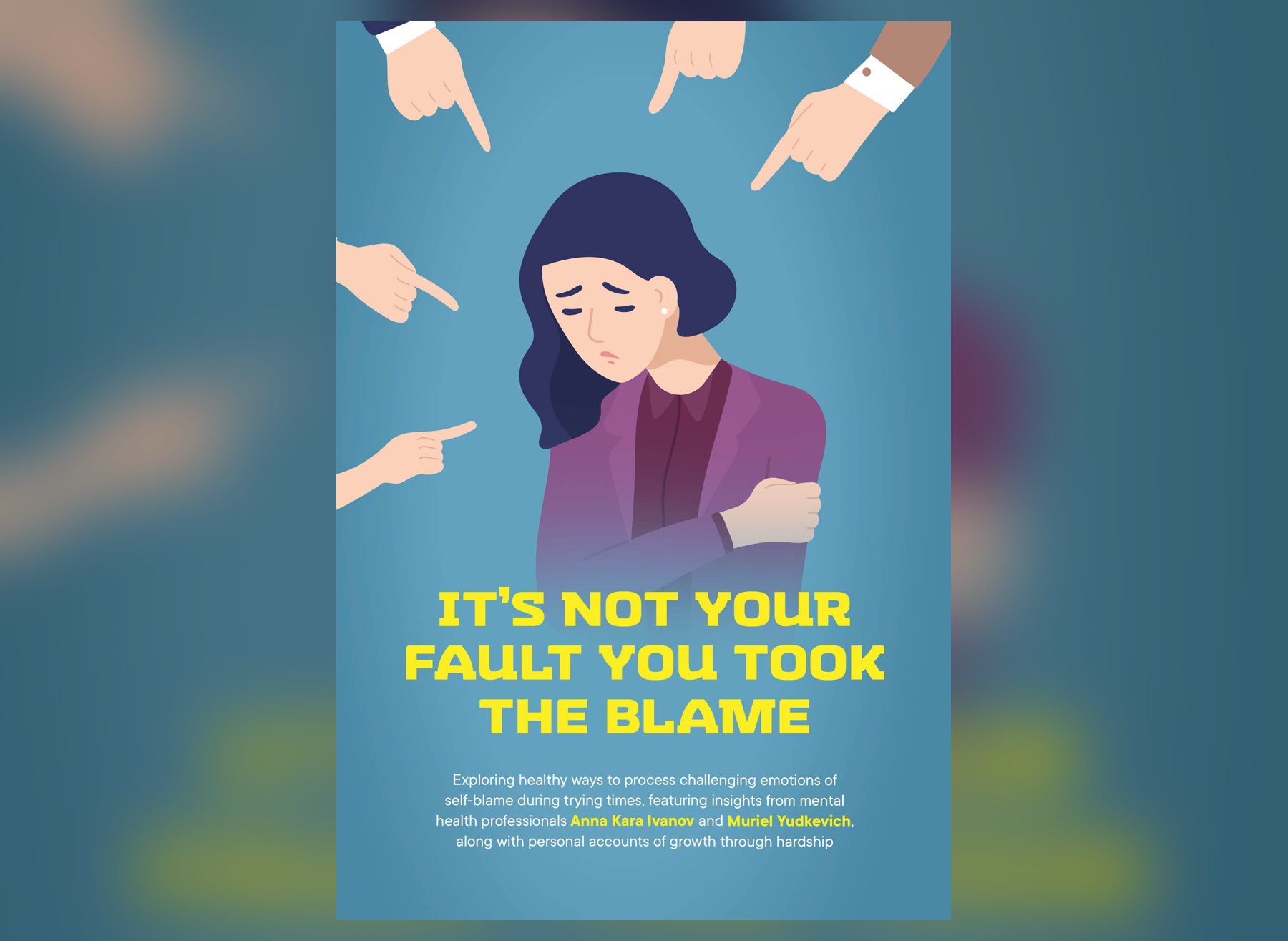
Exploring healthy ways to process challenging emotions of self-blame during trying times, featuring insights from mental health professionals Anna Kara Ivanov and Muriel Yudkevich, along with personal accounts of growth through hardship
Feelings of guilt, self-flagellation, and pangs of conscience are sensations that overtake us in every moment of weakness, certainly in times of trouble and war * Anna Kara Ivanov and Muriel Yudkevich, help us recharge with joy and self-confidence.
She Never Stops Criticizing
Sarah doesn’t like herself. Most of the time she thinks: “How terrible I am!” There’s a kind of small voice inside her head, “the critical voice,” she calls it. She thinks it’s actually good. “That’s how I am, passing every thought and action of mine through a filter of strict criticism.” This voice mocks every thought or idea that arises in her. It explains to her how stupid the thought is. Why the idea is not worthy. This voice explains to her again and again, after every conversation, why she should have responded differently. Say what she didn’t say, and be silent where she did speak. That voice also explains to her how bad a mother she is. “How you yelled at them tonight! You’re traumatizing your children! They’ll tell this to their psychologist one day, poor things.” It also has a lot to say about her relationships. In general, about her as a person. This voice is also the mother of endless pangs of conscience.
Anna Kara Ivanov, a clinical psychologist, begins:
First of all, it’s important to say that continuous self-criticism doesn’t happen for no reason. There are several reasons for this. Self-criticism occurs because our psyche gains something from it. Our psyche is smart in its response patterns. If it chooses the option of self-criticism, it probably believes that the alternative is worse, subconsciously of course.
Let’s explain: Our psyche is composed of many layers. On one level, this self-criticism hurts me, but on another level, sometimes self-criticism creates a feeling that I’ve fulfilled my duty of criticism, as the Rebbe says in a sicha about Eliyahu on Mount Carmel who called: “How long will you waver between two opinions?” That is, a situation is created where a woman both hurts herself and is satisfied because she feels she has fulfilled her duty of ‘cheshbon ha’nefesh.’
A second reason that causes self-criticism is that this is how that woman grew up. Sometimes a woman who was exposed to a lot of criticism in her childhood knows how to think about herself only in such terms. The critical voice is the voice she internalized from her environment, and through that voice she perceives herself. A question I like to ask my patients is: Whose voice is this? Who does it belong to? Who is speaking now?
Another reason: Self-criticism, criticism in general, stems from aggression. A word about aggression: We were all created with it and not for nothing. Measured aggression serves us well in certain cases, such as when we need to stand up for ourselves, or to be assertive. There are people who are unable to direct aggression outward, when necessary, and express what they need. In fact, constant self-criticism is a kind of self-abuse, in that it is aggression directed inward.
Of course, we’re not talking about the criticism the Rebbe Rayatz speaks of, balanced criticism about which he says: “It will set you upon the true height.” I want to emphasize that this is very individual, each one with her personal story. My answers are general and do not reflect the personal case of each individual. But it’s important to know that everyone has a story. The psyche is not stupid and doesn’t do things for no reason. There’s always a reason, you just need to understand it.
How To Correct Ongoing Self-Criticism
The first stage is to listen to ourselves, to see what’s happening inside us. We can also check how our environment perceives us; this will help us understand our patterns. It doesn’t have to be digging into the past. What’s important is to understand the mechanism.
For example: There’s a woman who notices that every time she’s sad, and she doesn’t know how to call the feeling of sadness by its name, her internal mechanism of self-criticism starts, because that’s how she expresses sadness. Another woman will notice that self-criticism begins every time she’s tired or when she’s angry at someone. This is how we identify the mechanism and then examine: How does it serve me and why does it happen?
There are clear and easy mechanisms that a woman can identify on her own. And there are more complex mechanisms that to break free from them necessitates help from others – a friend, husband, mashpia or therapist. The next stage is to understand that I don’t deserve to absorb these torrents of self-criticism. There’s an internal image for some women, that says: ‘I deserve to be bashed.’ It’s in the subconscious of course. So there needs to be an internal recognition that I don’t deserve it! There’s no person who deserves to absorb this on a daily basis. And from there, to reach a desire for it to stop. It requires identifying the situation, and a desire for it to be different.
Childhood Experience
Muriel Yudkevich, an educational psychologist, agrees and adds another possibility:
A large amount of self-criticism comes from childhood. A girl who grew up in a critical family and heard criticism most of the time will grow up to be an adult who criticizes herself a lot. Parents who criticize usually do so out of a sense of low self-esteem. A strong feeling that they are worth nothing. And then the girl is born, and she’s like a blank slate, absorbing and hearing everything, all the words of criticism, and believing them. And it penetrates her and becomes reality for her. Her experience is one of: ‘Why would anyone appreciate me? I’m worth nothing after all.’
This also leads to victimhood, the girl feels that she’s a victim because she was criticized so much, and it hurts. It could also be that there wasn’t criticism at home and the self-criticism stems from social difficulties. But if social life is normal and at home they didn’t see the child as she really is, and she didn’t receive tools for growth, then she will grow up to be a woman with a lot of self-criticism.
Sometimes parents feel that they’re giving their maximum and doing the best for the child, but the child feels that she wasn’t seen or that she didn’t receive the response she needs. The reason for this is that the parent fails to detach the child from them and separate the child’s individual need from the need that they, the parent, see as right. The parent doesn’t sufficiently perceive the child as different from them.
I like to give an exercise to parents where they are required to ask the child: How do you know that mommy loves you? One child will say, “Because Mommy hugs and kisses me,” another child will talk about the gifts he receives from his parents, and a third child will say “Because Mommy tells me a story.” Every child and their need. There can be ten children for the same mother and each of them has a completely different need. I recommend doing the correction for continuous self-criticism in therapy. There we unpack all the heavy packages of childhood and do good self-work.
Aside from that, gratitude is very effective. Every morning write five things you’re thankful for. Small things like a beautiful garden, or a child who succeeded on a test. Really try to see the good in everything and be thankful for it. And mainly, find the good within us and allow it space. Relate to our successes.
When The Light Is Out
Leah is apathetic. It’s not that she hates her family. But she doesn’t love them either. She feels nothing. Her husband is sorry to see her lying in bed most of the day. Once she cared, she cared about his suffering. Today not. “At least eat,” he begs her. But she’s not interested. Not in the pleas and not in the food. The children come cuddling up to her, telling her stories from kindergarten and school. Once she had a maternal feeling that made her smile at them, listen and be interested. Today she remains with a blank stare, barely looking at them. Waiting for them to leave. She has no energy for anything.
Anna says: This is really sad and quite common and many women go through it. The main thing that characterizes depression or melancholy is the loss of motivation, despair. Something that disconnects from reality and shuts down. Lying in bed and lack of movement affect movement, eating and sleeping, as if the woman is saying: ‘Game over,’ I’m not playing anymore.
What happens is that the psyche feels that something is happening that is too much for it and then it’s like shutting itself down. Like a computer that overheats and shuts itself down. The computer can tell that it needs rest and shuts itself down. Human beings don’t always know how to stop in a way that isn’t extreme, to stop in time – when there are signals. So the psyche has no choice and it stops everything in a drastic way.
This mechanism at its base is a mechanism for self-preservation. Like the computer that shuts itself down so as not to crash. True, the result is not desirable but the logic is self-preservation, the psyche in a survival move says: “I’m not cooperating anymore; if I don’t stop it will be really bad.”
Many times this mechanism is the overload switch of the mechanism we talked about in the previous situation, if I ‘put myself down’ all day, my psyche will reach a state where it will feel that it has to stop everything. They did a study on children growing up in an unsafe, abusive or neglectful environment and what characterized those children was apathy. Not the anger or aggression that we would expect to see. It seemed that the children didn’t care. Because when it’s too awful the psyche says “enough.” The cost is steep and the psyche does this for self-preservation but that’s not really what happens. The internal flogging voice doesn’t shut off when the woman is depressed, on the contrary, it even intensifies: “Look what a terrible mother you are! Lying all day and doing nothing.” This is terrible suffering.
No Prisoner Frees Himself
A woman who has reached such a state should really seek professional help and if she’s already in a state where she has no motivation even to get help it’s advisable that those close to her do so, if this lasts more than two weeks. If we return to the example of the computer, sometimes a computer also needs outside intervention from a technician.
Depression in women is common. There are periods in life that are more prone to depression such as during pregnancy, after childbirth, a case of death in the family, G-d forbid, an accident, moving or a crisis situation. In general, there’s no reason to suffer like this.
Sometimes there are comments like: “Come on get up, learn Chassidus, it will do you good.” This is an unsympathetic response that doesn’t help. Because there are cases where learning Chassidus no longer helps. It’s not for nothing that in halacha for example there’s the definition of a ‘shoteh’ and the attitude towards him in halacha shows that a mental state affects a person’s ability to learn Torah and fulfill mitzvos.
In general, it’s advisable that the environment be as empathetic, supportive, tolerant and embracing as possible. Depression is a state of “no prisoner frees himself from prison” and indeed professional help is required. There are letters from the Rebbe who sent people in certain mental states to therapists, in years when these treatments were not as common and accepted as they are today.
When a woman in depression goes for treatment it’s already the beginning of “freeing herself from prison.” The very willingness to go is the beginning of healing. It’s work to get up and admit that there’s a problem here and you’re willing to go and deal with it, and to speak your soul’s pains with the therapist. And again I want to emphasize: Depression in women is something that happens, women are prone to it especially in challenging periods. It’s okay and it happens. It doesn’t say about you that you’re abnormal or that you’re not okay. Hashem created depression and created a solution for it.
No Longer Drowning In The Sea Of Depression
Muriel brings another perspective: Depression can be caused by a crisis or trauma from which I can’t rise above. There are two types of depression: overt depression and covert depression. What helps to get out of depression is focused treatment. The best treatment is to look for meaning. There’s a story about a depressed woman who came for yechidus with the Rebbe, and the Rebbe advised her to distract herself from the thoughts and focus on the shlichus she’s doing.
I heard a woman who was in a depression says that her mashpia told her to get up and arrange a farbrengen at her house. She thought: ‘What farbrengen, I can barely get out of bed’… But she got up and made a farbrengen and it helped her. The mashpia knew that she likes to organize farbrengens, that it’s something that gives her pleasure.
Meaning can be in anything, to look at one of the children and say: “I want to be at his wedding, I’m doing everything for this.” To find a talent I have and enjoy developing it. There’s a concept called: “Gesher Me’ached” (unifying bridge) which is an acronym (in Hebrew) for seven resilience factors that help us get out of a state of depression:
Gimmel – Gashmi (Physical). Anything physical that does me good. Eating, drinking, sleeping. Sports and exercise do wonders for feeling good. Food – preferably healthy, but if a square of chocolate is what makes you happy, eat a square of chocolate. A hot shower.
Sin – Sechel (Intellect). Find where you can direct your thoughts with the intellect. Try to find some reason to write every morning about good in your life.
Reish – Regesh (Emotion). Identify emotions and express them. The identification is important. Sometimes prolonged fatigue can be mistakenly interpreted as depression.
Mem – Mishpacha (Family). It’s always good to get help from a relative for those who have a supportive family.
Alef – Emunah (Faith). Connect to simple faith that it will be good.
Ches – Chevra (Social circle, friends). Go out with friends. If I’m sociable, depression disconnects me from society and affects me strongly in a negative way.
Dalet – Dimyon (Imagination). Read books, escape to the world of imagination and stories. Think, what does me good: Hiking in nature? Coffee with a friend? And do it immediately, don’t wait, because it will help to get you out of a depressed state.
Hurt Without End
At night, especially at night, when thoughts wander freely, Dana is very angry. Her older sister hurt her for years. ‘Real emotional abuse’ she thinks and her heart beats in rage again. The dentist told her that you can see on her teeth that she grinds them at night. Because at night she dreams frustrating dreams and during the day she thinks again and again about what her sister did to her, feeding these thoughts in an endless cycle. She imagines, over and over, how she stands in front of her sister, answering her. Venting her anger at her. Throwing at her all the hurts she felt. Imagining her sister ashamed. In actuality, she doesn’t dare to do anything. Too afraid. But inside? Inside the thoughts of insults and anger have a life of their own, and they bubble with growing rage. She’s mostly hurt and angry. Hurt and angry.
Muriel says: “I hear that she’s very hurt by her sister. Sounds like emotional abuse. It’s hard for me to answer like this when I just hear a description of the situation. If she was in front of me, I would ask a lot of questions, like: How is the relationship with her sister now? Is there a possibility to talk with her sister about the hurt? I would try to balance the hurt through narrative therapy. The intention is: to change the story that that woman tells herself through understanding the whole thing.
For example: There could be a situation where the parents are busy and they leave their child with her older sister who is herself a child and unable to provide her younger sister with all her emotional needs. Or she’s responsible for more children and she’s stressed, or she doesn’t have the strength to care because she’s young, as mentioned. So we need to understand the context of the story and within it try to understand the other’s place. If it’s the sister’s personality problem and she hurts that woman to this day, then maybe it’s better to stay away and not try to chase after her and maintain the relationship at all costs.
If my sister has a mental difficulty I need to understand that I don’t deserve to be hurt and I need to protect myself from her. And also understand that what I experienced is not my fault. Another important insight that helps is: ‘Not everyone is against me, everyone is for themselves.’ It could be that my sister was in survival mode or in some difficulty and she took out the difficult feelings that arose from the difficulty – on me. It’s also worth examining whether this is a pattern of mine. Is it only from my sister that I get hurt? Or from everyone? And if I get hurt easily by everyone then something in me requires a change of how I look at life.
Hurting Myself
According to Anna, the question is how much the hurt affects Dana’s daily life. Is it in her head all the time, does it interfere with her daily functioning? These are questions that need to be asked. “I think there are two parts here,” says Anna, “like in the story about Shimi ben Gera who cursed Dovid HaMelech. It’s clear that Hashem sent him, and David understood that this was a message from the Holy One.
Does this absolve Shimi from punishment? No, he was executed. There are two approaches, first of all the internal move between us and ourselves. If this is an old wound from a decade ago, a lot has happened in life since then – so what keeps me there? I need to understand what is happening to me and why I am so preoccupied with this.
These are situations where, if you study Chassidus, you can do inner work yourself. Feeling hurt is essentially a response to a situation. Every situation can evoke various reactions, and this is one of them. Alongside my internal work, I can try to talk to my sister, if possible, to try to understand the situation from her perspective. Of course, there are certain deep wounds that affect the soul in a profound and unsettling way, to the point that something within the soul changes. That’s how G-d created us, that certain severe vulnerabilities shake the soul strongly. Then the process and self-work will not be enough, and one must consult a professional (for physical injuries, for example).
There are situations and relationships where we may have a fantasy that there will be healing and conversation about what has hurt. This fantasy is not always realistic. Not everyone who hurt me is willing to accept that I was hurt and talk to me about it. In such cases, it is advisable to understand that this is the reality and to accept it as it is. To make a decision whether I want to continue living with the hurt or not. By continuing to revive the hurt, I am actually hurting myself.
To Stop Wallowing
How do you do all of this?
The first step is to understand what keeps me there. What does my soul gain from this? The second step is to come to terms with reality. To remember that what happened has happened and life goes on. Sometimes a person continues to wallow in the pain and prefers not to do the necessary work to move on from the experience of hurt, because they fear that if they come to terms with the pain, all the years they have lived with it will make them look ridiculous.
For example: If I haven’t spoken to my sister in over a decade, and now I understand what’s going on there, and I come to terms with reality and even with my sister, what does that say about me that I haven’t spoken to her for so many years? Did I make a mistake for so long? It’s not an easy price to pay, and to resolve this, there needs to be a lot of self-compassion. Self-compassion means: this was my way of coping with the hurt all these years, and today I am in a place where I can do the work and come to terms with reality.
Another reason that can lead to years of stagnation within a certain trauma is some kind of unconscious and impossible desire for someone to erase the hurt, to erase what happened. That there be a different reality. They are not ready to accept what happened. True acceptance is to acknowledge that what happened – happened!
A Different Perspective On The Situation
There is a maamar by the Rebbe, “Nosata L’Yerei’echa Nes L’Hisnoses 5736,” in which the Rebbe explains that in our generation, the avoda of birurim has come to an end, and only the avoda of nisyonos (tests) remains. What does it mean? Our generation is a generation of abundance and goodness. Obviously, we do not ignore the situation in Eretz Yisrael, and unfortunately, there are still severe disasters and troubles for Am Yisrael, however, compared to previous generations who were constantly preoccupied with daily survival from hunger, pogroms, and the persecutions of a wicked regime, etc. our generation, despite everything we see and are exposed to, lives in a much less violent time, and this is backed by research.
It’s enough to see the global shock from the horrors revealed by the terrible massacre perpetrated by the Arabs, yimach shemam, in the communities surrounding Gaza – today’s world is not accustomed to such sights! This is happening in preparation for the Geula, when there will be abundance. The difference between the avoda of birurim and the avoda of nisyonos is how much reality is involved in it.
For previous generations, the work of birurim was with a reality that never ceased to challenge. The avoda of our generation, says the Rebbe, is an inner work. In the words of the Rebbe: “There is a matter that stands to conceal and hide.” The entire work is about the fact that there is a barrier in my soul that hides the divine light from me. You can really see that the current reality is exactly as the Rebbe said; this generation is one where the main struggle is the inner struggle.
We are the seventh generation, and we have many strengths but also a very specific struggle. There are those who will say that this is an easier challenge; I think it is a harder one. For example: In the Western world, which is abundant in material wealth, there is a constant rise in the number of depressions and suicides. In contrast, in third world countries, where there is hunger and people are struggling for survival, the number of suicide cases approaches zero.
I want to summarize and say that the bottom line of everything I’ve said is that we need to work on ourselves. To recognize when it’s too much for us and we can’t manage alone, and then it’s a matter of “no prisoner can free himself from prison” and we need to seek professional help. There is no shame in seeking help and emerging from inner exile to true personal redemption.
Beis Moshiach #1433 • pp. 44-51
© 2026 Beis Moshiach Magazine. All rights reserved.
This article originally appeared in Beis Moshiach #1433. You are welcome to share it with friends and family by email or in print, provided that you do not change, add to or omit any part of it, you credit the author and Beis Moshiach, and you include a link to archive.bmoshiach.org (written out in full in printed copies).
To republish this article in a newspaper, magazine, book or website, please request permission in advance at [email protected].