I Will Strive To Run The Rabbinate In The Rebbe’s Model of ‘Uforatzta’
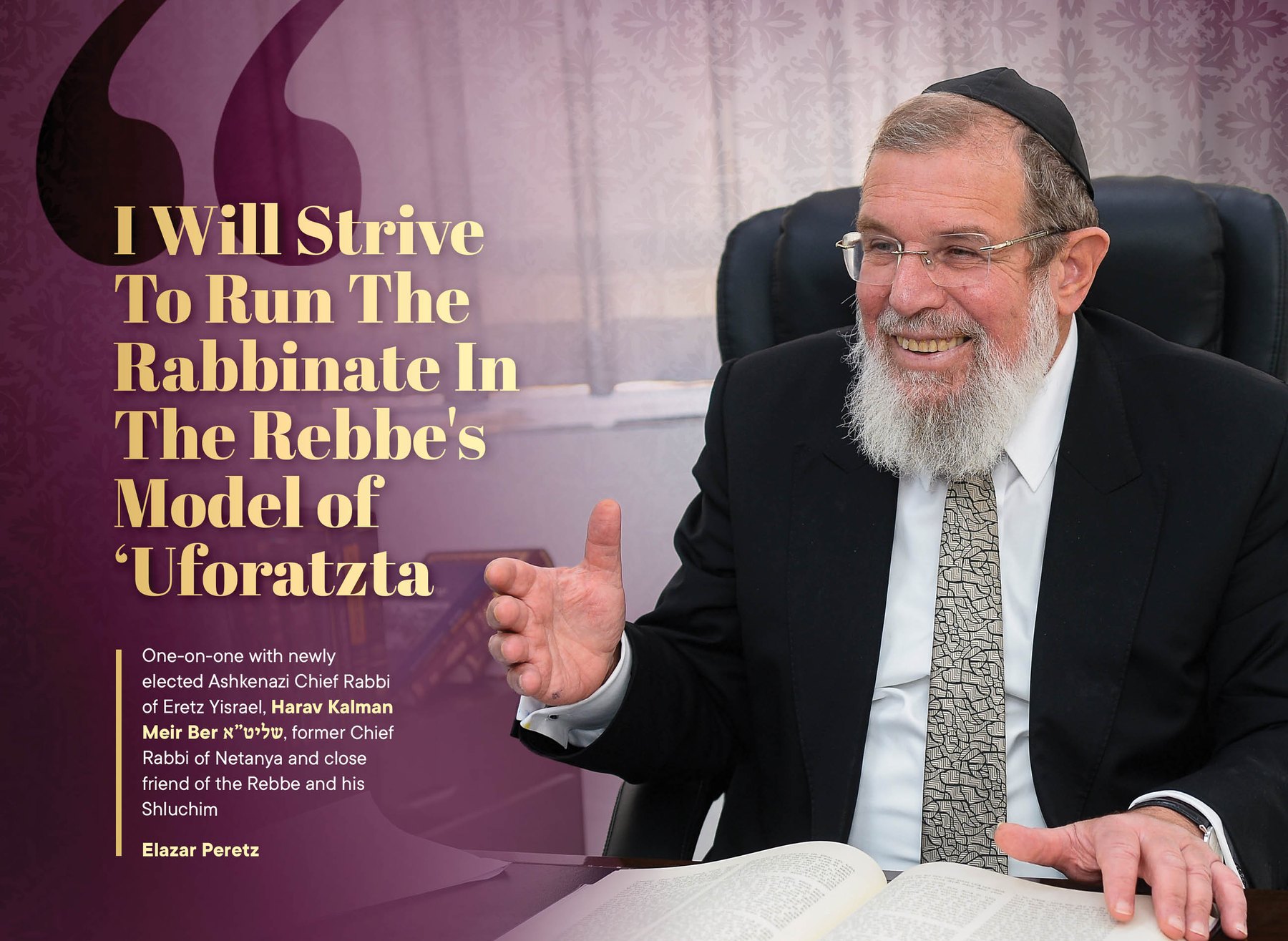
One-on-one with newly elected Ashkenazi Chief Rabbi of Eretz Yisrael, Harav Kalman Meir Ber שליט”א, former Chief Rabbi of Netanya and close friend of the Rebbe and his Shluchim
Rabbi Kalman Meir Ber was elected Ashkenazi Chief Rabbi after serving as Chief Rabbi of Netanya for the past decade and established the “Hiddur HaKashrut” division within the Netanya Rabbinate’s kashrus system. He will work alongside Sefardi Chief Rabbi Dovid Yosef.
Rabbi Ber was born in 5718 in the Yad Eliyahu neighborhood of Tel Aviv. He is a descendant of Rabbi Akiva Eiger, Admorei Izhbitz and Radzin and Rabbi Klonimus Kalman Epstein, author of Maor V’Shemesh for whom he is named.
He attended the yeshiva high school in Netanya run by Rabbi Simcha Kook. In 5735, he began learning in the hesder yeshiva, Kerem B’Yavneh. He served in the IDF as a soldier in the Nachal Brigade.
In 5746 he was appointed by Rabbi Chaim Yaakov Goldvicht as a “r’m” in yeshivas Kerem B’Yavneh. He served as head of the women’s seminary at Kibbutz Chofetz Haim and as a rabbi at Talpiot College.
Rabbi Ber granted an interview to Beis Moshiach saying, “I am familiar with the magazine. I subscribed to it for a long time and enjoyed its chassidic content.”
Mazal Tov!
Thank you very much. May we be faithful emissaries to bestow good on Am Yisrael.
How did it feel when you heard you had been appointed Chief Rabbi of Israel?
Of course, I was very excited. I thanked G-d for enabling me to be the faithful emissary of the holy nation here in the holy land, and I said “Mizmor L’Soda.”
I hope we will merit to sanctify G-d’s name and this is my goal: to bring nachas ruach to the Creator and be mekarev His beloved children to Him and to one another.
All of Am Yisrael Is Connected to the Creator
The nation today is very inspired, the likes of which we haven’t seen since the Six Day War. As Chief Rabbi, what is the best way to direct this hisorerus, to strengthen Torah and mitzvos?
Indeed, I too feel things as you describe. The people today, following the war, are very thirsty to hear the word of Hashem.
The Mishna in Maseches Yodayim says that all impure animals, if they are found in the sea, are pure since they “belong” to the water. This is true for all except the sea dog, which is impure. Chazal ask, what is the reason for this? After all, it’s in the sea all the time!
The explanation is that when the sea dog senses danger, it quickly flees to dry land. So what’s the significance of this? So, occasionally it leaves the water and goes to dry land, but most of the time it belongs to the water?
The answer lies in the internal direction toward which it is oriented; where does it feel it belongs? To the place it flees in times of danger, in real time; this indicates that it belongs there. If you flee to dry land, it’s a sign that you don’t truly belong to the sea.
One can say the same about Am Yisrael. Am Yisrael is holy and pure. Even when there are periods when it shows that it doesn’t care about Torah or mitzvos, and it protests and cries out, but when it senses danger one can tangibly see how everyone “flees” to HaKadosh Boruch Hu and strengthens their faith.
This fact teaches how holy and pure this nation is, and it only needs to have its spark ignited. Because in truth, everyone is thirsty and wants to hear the word of Hashem.
I can testify that in the past year, I gave twice as many Torah shiurim in Netanya than in any other year, which demonstrates the awakening and intense thirst that has come upon the people, particularly in the current time.
How do we keep this moving forward?

“B’darkei noam!” says Rav Kalman Bar decisively. “These days, particularly days of war, people want to be strengthened in the word of Hashem. We know that ‘netzach Yisrael will not lie and will not regret.’ We need to show everyone how Hashem protected us. How the unbelievable happened, and despite everything we went through in all generations, Hashem protected us because we are the chosen people, and we are Hashem’s ambassador.”
Am Yisrael wants to hear this, to learn more about our Jewish history, and everyone is thirsty to hear the word of Hashem.
Among Jews who don’t observe mitzvos, there are many voices saying that the Chief Rabbinate has no influence over them. How do you see the role of the Chief Rabbinate specifically regarding Jews who are not yet observant?
The Chief Rabbinate is intended for the entire nation: religious, chareidi, observant and non-observant. All are Jews. The role of the Chief Rabbinate is to bring the word of Hashem to the ‘people in the fields,’ and when you bring it in a pleasant and friendly way, everyone will be happy to listen.
Sometimes I organize special Shabbosos for Torah in Netanya. You need to see how people from all sectors, all types, come, wanting to connect to their roots. I know that the vast majority of the people want to connect to these roots.
I now see the current role of the Rabbinate as uniting between the factions; so each group should see the good in the other group. We must not enable rifts and divisions. Enough of this!
The pasuk says: “You are children to Hashem your G-d, lo sisgodedu (do not form separate groups).” The commentators ask why specifically before the mitzva of “lo sisgodedu” does the Torah note “you are children to Hashem”? Aren’t we children before other mitzvos listed in the Torah as well?
The Rishonim explain that it’s like parents writing a will. What do they write in the will? First thing, they write “my dear children, I ask that you stay together, make Shabbos together” etc., and only afterward do they get into other details.
Our Father in Heaven also asks us: Since you are my children, I ask that you don’t split into separate groups. It’s no kuntz to love another when you think like them and identify with them. On the contrary, even when you don’t think like them, try to find the common denominator and unite with them.
After all, the Baal HaTanya points out “Be among the disciples of Aharon, a lover of peace and a pursuer of peace, a lover of people and brings them closer to Torah” – who are those called ‘creatures’? These are people who have nothing positive, and are merely called ‘creatures,’ yet still one must love them and bring them closer. If you succeed in bringing them closer – how good, and if not – writes the Alter Rebbe in Chapter 32 of Tanya, you haven’t lost the mitzva of loving your fellow.
This is our role in these days.
Cooperation in a Way of ‘servants of Hashem’
During the vote counting in the Chief Rabbinate election, a situation arose where the Rishon LeTzion, the Sephardic Chief Rabbi Rav David Yosef shlita was immediately elected to his elevated position, while the results for the Ashkenazic Rabbi ended in a tie between Rav Kalman Ber and Rav Micha Halevi, the Rabbi of Petach Tikvah.
In the second round held after the Yomim Tovim, as mentioned, Rav Kalman Ber was elected as the Chief Ashkenazic Rabbi, thereby joining his colleague in this honorable position.
The Rav was elected to the position with Rabbi David Yosef already at his side. How will cooperation between the Rabbis work?
I have known, and even more so respected, Rav David Yosef not just from today, but for many years. Rav David Yosef is a great talmid chacham, great in Torah and pleasant to people. There is no doubt that our prior personal acquaintance and mutual respect will lead to close cooperation.
On Thursday, shortly after the announcement of the results, I came to his office and quoted the pasuk about “the two great luminaries,” when immediately after this description, the Torah seemingly “corrects” itself and says “the greater luminary and the lesser luminary”; there are no longer two great luminaries. Rashi brings Chazal’s words, that the moon said: Two kings cannot serve with one crown. HaKadosh Boruch Hu said to her: Because you said this, go and diminish yourself.
The question arises – why were they strict with the moon’s words, when it said something correct, that two kings cannot share one crown? The answer lies in the wording used. Indeed, two kings cannot share one crown, but two servants, two attendants, certainly can share one crown…
I know Rav David Yosef. He came to fulfill the nation’s mission, a servant to Am Hashem through a holy mission; that’s how I feel too. There’s no ego or honor here but rather a desire to be faithful emissaries to Am Hashem.
When a person sees himself as Hashem’s shliach – and the Rishon LeTzion Rav David Yosef sees himself as a shliach – there’s no doubt that with Hashem’s help we will merit to work in full cooperation.
* * *
In his ten years serving as Chief Rabbi of Netanya, Rav Kalman Ber elevated the status of the city’s mehadrin kashrus system. He streamlined the system, raised the standards of kashrus requirements, which led to great responsiveness from city residents to mehadrin kashrus.
As someone who established a mehadrin kashrus system in the Netanya Rabbinate, do you plan to transfer and build such a system in the national Chief Rabbinate as well?
What we did in Netanya was establish three levels of kashrus: there’s regular and basic kashrus, which is good kashrus, there’s mehadrin kashrus, and there’s ‘hiddur ha’kashrus.’ When you create something like this, market forces work. Whoever wants to be the most mehadrin takes ‘hiddur ha’kashrus.’ Everyone chooses according to their needs and capabilities.
I think this model that we created in Netanya proves itself daily. Over 95% of businesses in Netanya are within our kashrus system.
We’ve merited that everyone participates in and relies on our mehadrin level of kashrus, from all circles and communities.
I think this idea should also be in the national kashrus model. The Chief Rabbinate has all the tools to achieve this. There’s the enormous system of mashgichim, the supervisors, and the proper framework to establish good and reliable kashrus that everyone can rely on and enjoy good kashrus.
The Rav served as a dominant rabbi in Netanya. There was hardly an event or ceremony that you didn’t attend and honor with your presence as well as with words of Torah and blessing that touched many hearts. The Rav connected with many residents, and now suddenly the Rav is leaving the city and going up to Yerushalayim…
The Rav’s expression instantly changes. He thinks for a moment and then states:
One cannot really disconnect from Netanya. Netanya is part of us. Netanya is a beloved and warm city. I know how much I love the residents. Boruch Hashem, like water reflects a face back to a face so too does the heart of man to man – they also show great love toward me.
With Hashem’s help, we will continue to live in the city and be an integral part of the wonderful residents here. We can always continue to participate in those simchas, those events, and try to continue impacting this amazing city.
Connection with Chabad
Rav Kalman Ber has a close and warm connection with Chabad shluchim and Chassidim in Netanya. He makes an effort to attend almost every Chabad event or farbrengen to which he is invited. In various Netanya newsletters where he publishes his thoughts, one can easily see ideas from all gedolei Yisroel, including many ideas from the Rebbe and the Rebbe Rayatz.
You come from Chassidic and Admor lineage, and was even named after the author of the Maor VaShemesh. Can you expand on this?
It is written about Queen Esther: “And Esther found favor in the eyes of all who saw her.” The Gemara in Meseches Megilla says that each and every one saw Esther as a daughter of their nation. That is, Esther knew how to speak in the appropriate language for each and every person.
Today there are many sectors, and one needs to know how to speak in all languages… Indeed, I have, Boruch Hashem, Chassidic roots both from my father’s side and my mother’s side. My father was born and raised under his grandfather the Admor of Pshedborz, who was a great-grandson and descendant of the Baal “Maor VaShemesh.” My mother is also from distinguished Admor lineage: the house of Radzin, the Baal HaTecheles. This is the home in which I grew up.
Along with this, I grew up in distinctly Religious Zionist institutions, Yeshivas Kerem B’Yavneh and others. I personally have a connection with Chabad, which was very connected to us. We ourselves, since I grew up in Radzin where they followed Chabad customs, our tefillin laying is like Chabad and the siddur for davening is Nusach Ari. I see myself as connected and attached to the Lubavitcher Rebbe and even wrote him letters.
As I’ve heard, you wrote to the Rebbe already when you were a chassan…
Indeed, as a chassan I wrote to the Rebbe, and even received a blessing letter for the wedding with an addition of two lines in his holy handwriting. Also, afterward I requested a blessing for children after we unfortunately we didn’t have children for a while. I merited to receive a response letter from the Rebbe who instructed what he instructed, but these are, of course, personal matters.
Who knows better than you how much importance the Rebbe gave to the matter of ‘uforatzta’ and spreading Yiddishkeit everywhere. How can the Chief Rabbinate adopt this approach in its activities?
I think the Rebbe explained countless times – and many articles have been written about the Rebbe’s words – how to bring Jews closer to Hashem and His Torah.
I think exactly at this point we need to adopt what the Rebbe instructed regarding ‘uforatzta,’ to care for the physical and spiritual needs of every Jew.
This week we read about Avrohom Avinu. He provided eshel – eating, drinking, and through this he spread awareness of Hashem in the world – “don’t thank me, but thank He who spoke and the world came into being,” and thus he brought recognition of the Creator to many people “by the thousands and tens of thousands.”
When you take an interest in someone he feels that you truly care about him, and then you can find pathways to his heart in spiritual matters as well.
Here in Netanya we conducted countless chuppos for couples, and you show them that Yiddishkeit has something to say about every matter, about having a better marital relationship, about the Jewish home and even about financial matters. When they see this, they are also thirsty to hear about Yiddishkeit.
I personally attended many events where you spoke. More than once I’ve heard you repeating ideas from the Rebbe’s sichos…
I think that learning the Rebbe’s sichos is simply enlightening. Everyone should set a time to learn these sichos. The Rebbe is a flowing spring that continually renews without stop. It’s an almost superhuman phenomenon.
Furthermore, the Rebbe’s Torah isn’t in the style of nice ‘vertlach,’ but rather an approach and organized system with guidance in the ways of avodas Hashem. Therefore, I constantly study the Rebbe’s sichos; they enrich me not only in the conceptual realm, but also in the practical realm of how to serve Hashem.
I can say honestly that my Rosh Hashana, following the Rebbe’s sichos, changed completely. All my tefillos are done in a completely different atmosphere than how I was educated and accustomed… all my Yomim Noraim changed completely.
Some time ago, a large conference of rabbis was held, and my talk before them was about an idea from a sicha of the Rebbe that was said in 5735. I added embellishments to bring the ideas down to the rabbinic audience.
You also maintains a strong and warm connection with the shluchim here in Netanya, as well as with the Rebbe’s shluchim in Eretz Yisrael and worldwide.
How can one not be in contact with them?! How can one not love a Jew who faithfully does his work, and spends all day loving Am Yisrael and bringing them closer to their Father in Heaven?
The Rebbe’s shluchim are Jews whose entire purpose is to bring HaKadosh Boruch Hu’s children closer to Him. The Mesillas Yeshorim says, whom does HaKadosh Boruch Hu love? Those who love His children… so if HaKadosh Boruch Hu loves those who love His children, the shluchim, then shouldn’t we love them?!…
One sees how much work the shluchim do, and sometimes even with sub-par conditions and without anything. They truly sacrifice themselves for others. This is the reason that at almost every gathering of shluchim that I’m invited to, in Netanya and outside it, I try to be there and take part.
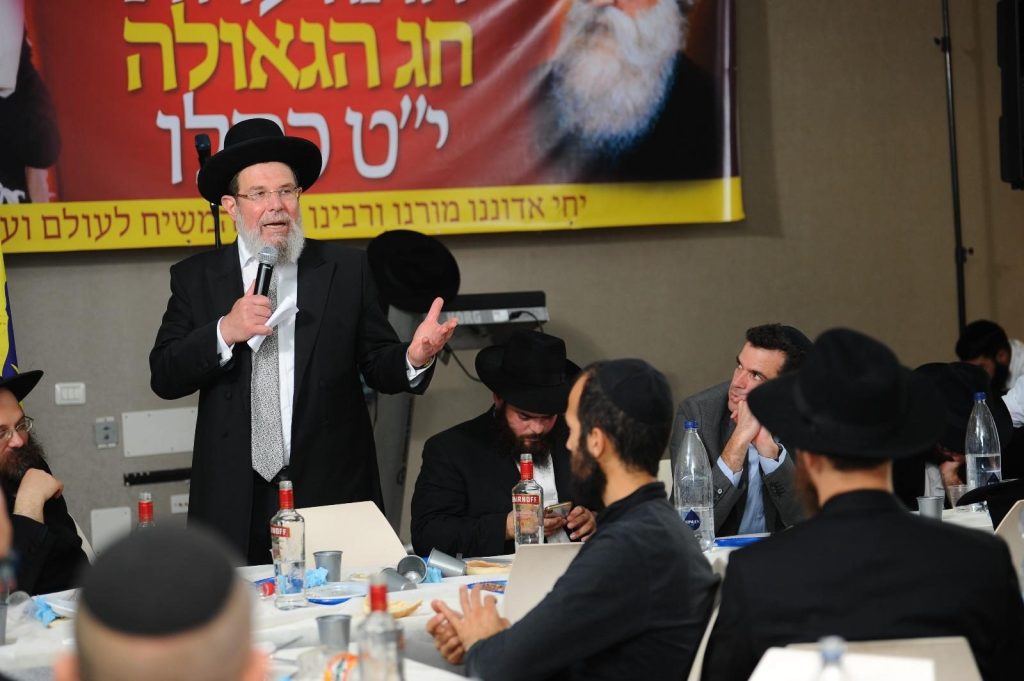
From a speech delivered by Rabbi Kalman Ber at a Chassidishe farbrengen in Netanya:
Who are we and what are we to speak about the Rebbe? We are fearful to speak about the Rebbe who is not within our conceptual framework at all. The Rebbe encompasses everything. The very fact that we speak and mention the Rebbe is itself a great zechus which opens gates of blessing, even when we don’t understand and have no comprehension.
Chazal ask about Yona HaNavi who flees from Hashem, a prophet who withholds his prophecy is deserving of death by heaven, so why did he flee?
Chazal say and Rashi brings this at the beginning of Sefer Yona: Yona was moser nefesh so there wouldn’t be an accusation against the Jewish people. Yona knew that if he went to Ninveh whose residents were goyim and they would do teshuva, this could cause a heavenly accusation against the Jewish people. Yona said: I will flee, give up my life, just so that no accusation will be made against the Jewish people. This is a faithful shepherd.
This is why, say Chazal, “And there was the word of Hashem a second time to Yona.” Hashem loves those who sacrifice themselves for other Jews.
Morai v’Rabosai, I don’t know anyone in the last generation who gave himself completely to the Jewish people like the Lubavitcher Rebbe. A great leader among giants, outstanding in Nigleh, Nistar, and all of Torah like a flowing wellspring, like a gushing well. Despite his genius, every Sunday he stood and gave of himself and his time for Klal Yisrael.
He is like Moshe Rabeinu who at first was called “Ish Mitzri” (an Egyptian man) and then “Ish Elokim” (man of G-d). Chazal say that one who sacrifices himself and his time for Klal Yisrael only rises to greater heights. By the Rebbe it was possible to see wonders and miracles rolling about under the table.
Ramchal in Mesillas Yesharim writes about true shepherds that Hashem desires, assists and loves, those who exert themselves for His sheep.
This is what the Rebbe taught us: to think what we can do, more and more, for Klal Yisrael, for another, and not stick to our own four cubits.
The very fact that we mention and speak of the Rebbe is certainly a zechus that stands in our stead.
The Gemara in meseches Brachos says that when Rabban Gamliel was ousted from his position, afterward he reconciled with Rabi Yehoshua. Rabban Gamliel said to Rabi Yehoshua: The walls of your house show that you are a blacksmith. Rabi Yehoshua said to Rabi Elozor: Woe to the generation whose civic head you are. Woe to the ship for which you are the captain.
Why the repetition, both civic head and captain?
A leader needs to be both, a captain whose job is to lead the ship to safe shores, which he does in a way that serves all the passengers equally. But a leader also needs to be a civic head. A civic leader is someone who guides each one individually, according to his capabilities and level.
The Rebbe is the leader of Am Yisrael’s ship, starting from his first maamar, “Basi L’Gani,” in which he issued a call of direction to all the Jewish people. At the same time, the Rebbe guided each individual according to his capacity.
Over thirty years ago, before I married, I wrote a letter to the Rebbe. In the letter I received there is a part that is typed, apparently the standard form, and there are also two lines that the Rebbe wrote with personal direction. Amazing!
When I received the letter, I felt like it was a real Yom Tov for me. I thought, the Rebbe receives hundreds, thousands of letters a month and he relates to each one personally; each one was given the guidance suited to him.
May we merit to continue with all of the Rebbe’s activities, thus opening for us the gates of blessing, gates of light, until we see, b’ezras Hashem, the speedy coming of Moshiach Tzidkeinu.
Beis Moshiach #1435 • pp. 20-29
© 2026 Beis Moshiach Magazine. All rights reserved.
This article originally appeared in Beis Moshiach #1435. You are welcome to share it with friends and family by email or in print, provided that you do not change, add to or omit any part of it, you credit the author and Beis Moshiach, and you include a link to archive.bmoshiach.org (written out in full in printed copies).
To republish this article in a newspaper, magazine, book or website, please request permission in advance at [email protected].