When I Refused To Sit on the Rebbe’s Lap…
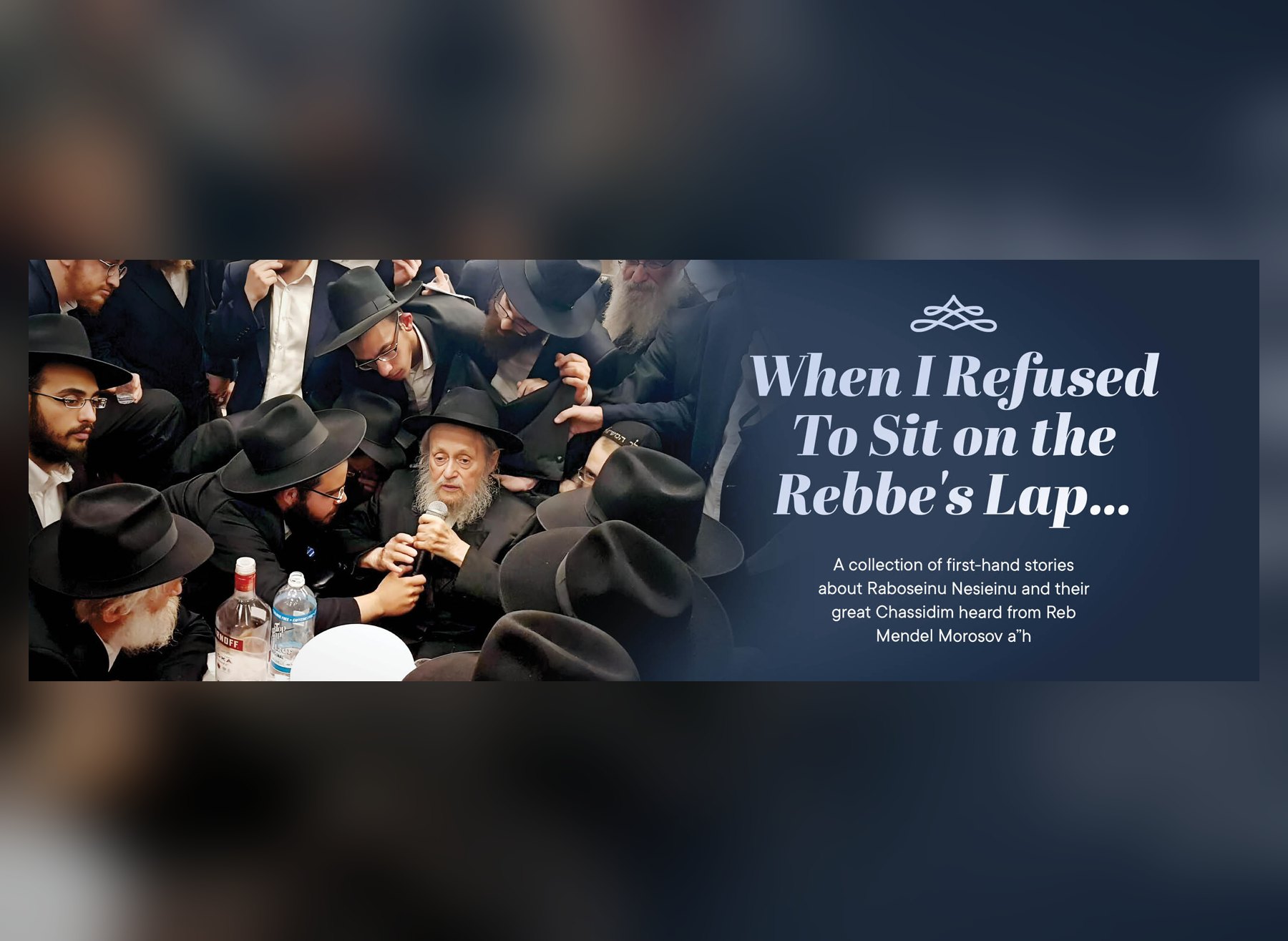
A collection of first-hand stories about Raboseinu Nesieinu and their great Chassidim heard from Reb Mendel Morosov a”h
Chonye Waited For An Answer And Became ‘Chonye’
It was the era when R’ Chonye Morosov was a bachur who lived in Minsk which was a misnagdic stronghold. One day, R’ Chonye met a Chassid by the name of R’ Peretz who suggested he join him on the trip to Lubavitch, to the wedding of the Rebbe Rashab’s only son, and he would pay R’ Chonye’s travel expenses. Chonye agreed, figuring that being poor and the trip to distant Lubavitch being expensive, who knew when he would have an opportunity like this again?
Within a few days, he was Lubavitch-bound, a trip that changed his life forever. Chonye and Peretz arrived in Lubavitch in the middle of Elul and the wedding took place on 13 Elul 5657. R’ Chonye was exposed to a new world which was completely different than anything he knew until then. More than anything else, he was captivated by the deep maamarim of the Rebbe Rashab. It was a series of amazing maamarim known the “Hemshech Sameiach Tesamach 5657.” The concepts were foreign to him and not understood, but this did not prevent him from being curious and strongly attracted to the teachings of Chassidus.
Speaking passionately, R’ Chonye later explained it to his son, the mashpia, R’ Mendel, “The maamarim amazed me. I heard a new path, a new approach, an entire philosophy that I hadn’t heard until then. The ‘haskala’ of Chassidus amazed me exceedingly. I would go to chazara once and again and ask for an explanation for everything. Obviously, I couldn’t understand it all. They let me know that many things I would first understand after some time when I would be immersed in it.”
He summed it up thus, “If I hadn’t gone to Lubavitch in 5657 and if I hadn’t stayed there, who knows whether I would have remained frum?”
He even once said that if he hadn’t gone, he would have become an interrogator for the Yevsektzia.
The mashpia, R’ Sholom Feldman, once said, quoting R’ Mendel Futerfas, that R’ Chonye heard the Rebbe’s question at the beginning of the hemshech and wanted to hear the answer. He waited for the continuation of the maamar that was said the following Shabbos but there still wasn’t an answer; the maamar went on and on and he waited and waited, and in the meantime, he became ‘Chonye Morosov.’
Twice Is Possible
While living in Lubavitch, R’ Chonye’s children: Dovid Leib, Rochel Leah, Sarah, Shmuel and Pinchas were born. The Rebbe Rashab was sandak at Shmuel’s bris, and the Rebbe Rayatz was sandak at Pinchas’ bris. After the bris, the Rebbe Rashab asaked R’ Chonye why he hadn’t given him the honor twice and R’ Chonye said this was based on the practice of not giving sandakaus to the same person twice.
The Rebbe Rashab said, “For us [i.e. a Rebbe], that is not pertinent,” and he explained that this practice is upheld only when the sandakaus is an honor for the sandak, but when the honor is for the baby, the honor can be given again.
Years later, when they were in Rostov, R’ Chonye honored the Rebbe Rayatz with sandakaus for his youngest son, Sholom, based on the previous account, since he was now the Rebbe.
My Door Will Be Open For You
In 5674, R’ Chonye was appointed as gabbai for the Rebbe Rashab. When he began in this position, the Rebbe Rashab said to him, “My door is always open for you and regarding anything that you don’t fully understand, you can ask.”
His son Mendel relates that his father always wanted to take advantage of this closeness and he could have asked the Rebbe to learn all of Tanya or maamarei Chassidus with him and he would have acceded, but every time he went to the Rebbe, he didn’t dare to open his mouth. R’ Chonye said he was unlike the mashpia, R’ Shilem Kuratin who would always discuss matters of Chassidus with the Rebbe.
R’ Chonye would say to his children that although the result of serving as gabbai was that he lacked in the area of ‘Chassid,’ it was worth it in order to see the Rebbe Rashab reciting the bedtime Shema every night.
Sometimes, he would describe to his children the Shema of the Rebbe at Shacharis on Shabbos. He would say how the Rebbe sang the niggun “Likras Shabbos” of the Alter Rebbe for the pesukim of Shema and ‘V’Ohavta.’
R’ Chonye, who himself was an outstanding baal menagen, would sing it for his children but when he reached the word ‘echad’ at the end of the pasuk, he found it difficult to copy the ‘ay’ at the end and he would say he was able to copy the entire niggun exactly the way the Rebbe sang it except for the ‘ay,’ which he could never get quite right.
If You Don’t Eat, Then …
In 5678, after the fall of the Russian czar and the takeover by the communists, as World War I raged, the Morosov family moved to Yekaterinoslav where R’ Chonye and his family developed a strong friendship with the family of Rabbi and Rebbetzin Levi Yitzchok and Chana Schneerson, to the point that R’ Levik and R’ Chonye would learn together.
One day, Rebbetzin Chana, who was good friends with Mrs. Morosov complained to her that her oldest son, later to be the Rebbe, did not eat much. Mrs. Bracha Morosov said to him, “Mendel, You need to eat! If you don’t eat, you won’t grow.”
After all the years of starvation and war, when Mrs. Morosov left Russia and had yechidus for the first time with the Rebbe, as soon as she walked in, the Rebbe stood up, looked at his shoulders and smilingly asked, “So, did I grow?”
The Rebbe Asked: What Do You Have In The Neshama?
In 5681, after the passing of the Rebbe Rashab and the appointment of the Rebbe Rayatz as Nasi, the Rebbe Rayatz fell ill, to the point that his life was endangered. In Elul 5681, the Rebbe Rayatz asked R’ Chonye to come to him in Rostov, “I greatly desire that you come and we can see each other, and my request in this matter is great. I am sending attached to this [letter] the amount of 43,000 rubles [not as large an amount as it would seem due to the runaway inflation in the early days of the Soviet Union – Ed], and you should try as much as possible to travel soonest.”
He first went alone but as soon as he arrived, the Rebbe appointed him as gabbai and when he realized he would be staying there on a permanent basis, he sent for his family to join him. Since they didn’t have the money to travel, the Chassidim who traveled with them, paid their way.
As soon as they arrived, the Rebbe appointed R’ Chonye as his personal secretary and had the family live in his home. The son, R’ Mendel, was five years old and he said what it was like: The Rebbe Rayatz would sit at the head of the table in the west of the room and on his left side sat his daughters in age order. During farbrengens, only special individuals could go in. R’ Mendel said he would go in with his father and would sit to the right of the table, on the east side.
R’ Mendel described the outside of the house they lived in, together with the Rebbe Rayatz.
During this time, the child Mendel had many kiruvim from the Rebbe Rayatz:
In my childhood I was mischievous and often played with the doorknob to the yechidus room. When the door was open, I would go inside and run around the room. On the left side from the entrance there was a couch and the room itself, although it was large, was full of sefarim.
One time, when I entered the room, the Rebbe was sitting in a corner on a plain chair. The Rebbe, who noticed I had come in, motioned to me to go over to him. As I did, the Rebbe asked me, “Where is your yetzer hara?” I pointed to the left side of my chest.
“And where is your yetzer tov?”
I pointed to the right side.
“And where is your neshama?”
I pointed at my forehead.
“And what do you have in your neshama?”
I didn’t know what to answer and kept quiet. The Rebbe said, “In your neshama there is another little neshama’le.”
When I left the room, the bachurim who noticed that the Rebbe spoke to me, picked me up (the doors were made of glass so you could, more or less, see what was going on there) and asked me what the Rebbe said to me. When I finished telling them, they began to discuss what the Rebbe meant by the little neshama’le. Some thought it was the yechida of the nefesh and others thought it was the “spark of the Creator.” I was just a little boy who didn’t understand what they were saying but I definitely remember the terms.
On The Rebbe’s Knee
R’ Mendel related that when he was a boy, about five, he went to the Rebbe Rayatz’s room and the Rebbe was reclining on the couch. When the Rebbe saw him, he called him over to play with him but despite Mendel’s young age, he knew it wasn’t respectful to sit on the Rebbe and refused to go.
Shaindel, the Rebbe’s third daughter, entered the room. When she realized what her father wanted, she picked him up and sat him on her father. Mendel immediately got up and ran from the room.
Even A Chassid Who Never Saw The Rebbe…
Rabbi Shemaryahu Sossonkin related:
On Purim 5695, there was a farbrengen in the home of R’ Zalman Kornitzer and R’ Chonye farbrenged. In the middle of the farbrengen, R’ Chonye asked R’ Shmaryahu, “Whose Chassid are you?”
R’ Shmaryahu was embarrassed to answer and remained silent. Then he asked Shlomo Matusof, “Whose Chassid are you?” R’ Shlomo said, “The Rebbe’s.”
R’ Chonye asked him, “Did you ever see him?”
Shlomo said, “No.”
R’ Chonye said, “That is the power of the Rebbe that even someone who did not see him, is his Chassid to the point of mesirus nefesh.”
Farbrenging At Three In The Morning
Many farbrengens took place at the home of R’ Meir Simcha Chein, the “gevir” of Nevel. He would tell stories that he heard from his grandfather, R’ Peretz Chein. Nearly all the farbrengens in Nevel took place in his home. Even the mashpia, R’ Zalman Moshe HaYitzchaki, when he was inebriated as he farbrenged, would say in the middle of the night, “Now we’re going to Meir Simcha.”
R’ Mendel related:
When we were twelve-thirteen-year-old boys, what we did at farbrengens on special dates in the calendar (once the yeshiva was closed by the government) was first we sat to farbreng amongst ourselves. Later at night, we would go to R’ Meir Simcha’s house.
At three in the morning we would knock at his door and his wife, Elka, would open it and ask, “What do you want, children?”
“To farbreng,” we answered.
She would ask us to wait a few minutes and we would hear how R’ Meir Simcha got out of bed, washed his hands, and twenty minutes later we would go in to farbreng with him. He was already an old Chassid by then and we didn’t see a problem in waking him up.
One Word Changed Everything
One time, R’ Meir Simcha Chein went over to R’ Zalman Kurenitzer when he was staying with his son in the city of Stararust and he said, “You should know that this is the last year of my life.”
“How do you know?” asked R’ Zalman.
R’ Meir Simcha said, “The Rebbe always writes me, ‘a blessing for long days and years,’ and this time, his letter only has a bracha for length of days but not length of years.”
R’ Zalman said, “In the Torah, sometimes the meaning of the word ‘days’ is also ‘years.’”
R’ Meir Simcha said, “Zalman, I’m no dope. I know good and well what it says here.”
Indeed, that year, on 4 Shevat 5694, he passed away at the age of seventy.
When R’ Meir Itkin heard the details of the story, he said to me, “Now I understand why at that time, R’ Meir Simcha kept talking about the histalkus of the neshama from the body.”
Not To Be Like A Goy
In Stararust there was a small group of Chassidim who davened with Misnagdim in the same shul. The Chassid, R’ Chaim Boruch Duchman would review Chassidus there every Shabbos.
One time, one of the Misnagdim, who was a big lamdan, said, “I already know all the maamarim by heart. The topics spoken of in Chassidus are all comprised of a few subjects and always speak about the same things. It’s just that sometimes one begins from akudim, nekudim u’berudim and goes on to tohu and tikkun and continue to sovev and memalei, and sometimes, the order is different.
R’ Yisroel Neveler, a Chassid known for his cleverness, responded, “I’ll give two responses. One, goyim in Russia call all Jews, ‘Avrasha.’ In other words, they do not discern the unique aspect within each Jew. Your understanding of Chassidus is like that of a goy, not discerning the unique quality in each maamar.
“Second, these are the only subjects that can be spoken about.”
From The Rebbe One Does Not Take; One Only Gives
When R’ Michoel Teitelbaum started yeshivas Oholei Torah in Brooklyn, at first he was helped with money that the Rebbe gave for the mosad.
R’ Michoel once spoke about this to R’ Nissan Nemanov who rebuked him by saying, “From the Rebbe one does not take; one only gives!”
After that, R’ Michoel did not take a penny from the Rebbe.
Beis Moshiach #1435 • pp. 30-33
© 2026 Beis Moshiach Magazine. All rights reserved.
This article originally appeared in Beis Moshiach #1435. You are welcome to share it with friends and family by email or in print, provided that you do not change, add to or omit any part of it, you credit the author and Beis Moshiach, and you include a link to archive.bmoshiach.org (written out in full in printed copies).
To republish this article in a newspaper, magazine, book or website, please request permission in advance at [email protected].