Reb Yaineh Is Looking for Shlichus…
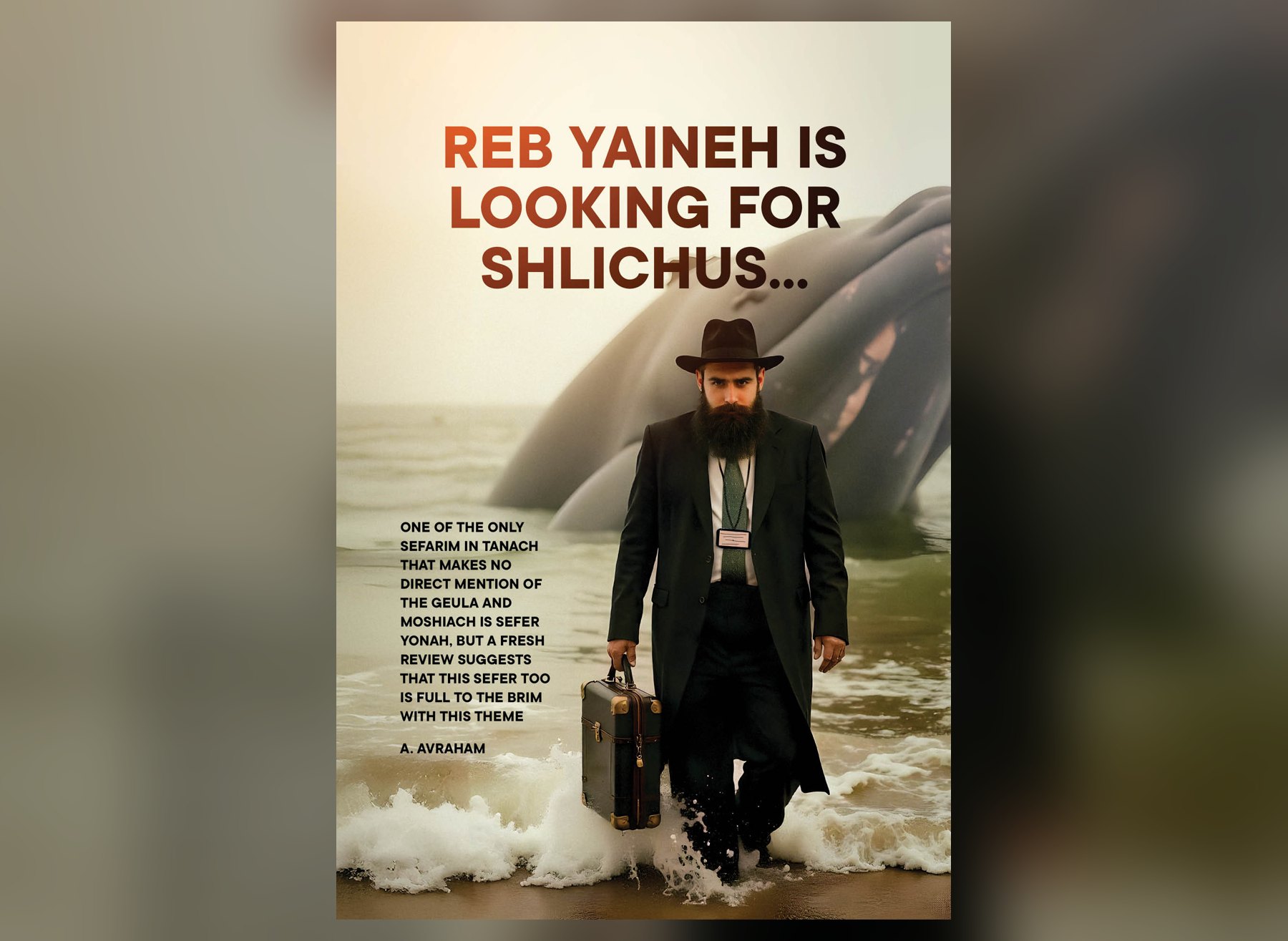
One of the only sefarim in Tanach that makes no direct mention of the Geula and Moshiach is Sefer Yonah, but a fresh review suggests that this sefer too is full to the brim with this theme
It is said that during the Yamim Noraim, the shul shamash would go around, knocking on house windows announcing “Yidden, shteit oif tzu slichos!” (Jews, wake up for Selichos!). And in these days of the Kinus HaShluchim, the Nosi HaDor knocks on the windows of our hearts declaring: “Yidden, shteit oif tzu shlichus!” Wake up, you sleepers from your slumber and you slumberers from your sleep, go out on shlichus, conquer the world, and prepare every Yid for the imminent arrival of Moshiach.
“Yidden, shteit oif tzu shlichus!”
And just as during the peak migraine of the Holy Day, when Yonah HaNavi manages to stir interest even in the back rows of shul, now too – after requesting very much due mechila – let us read the “Maftir Yonah” of the final generation of galus and first of Geula.
Sefer Yonah is one of the few books in Nevi’im that doesn’t explicitly mention Geula and the coming of Moshiach – yet a farbrengen about it reveals that it holds up a mirror to the generation of ikvesa d’meshicha, reflecting our trials and challenges, our questions and doubts, our uncertainties and crises. And above all – an uncompromising meshaleiach.
Let us emphasize again: As believing Jews, it’s clear to us that it’s not our place to read in our own ideas into the holy words of the nevi’im or to assess their madreiga. Their holy thoughts are not our thoughts, and their sacred ways are not our ways. But just as we’re permitted to expound on matters of “avoda” while learning Tanya – we can certainly apply the Rebbe’s instruction to study Inyanei Moshiach “all the books of the nevi’im are full of this matter” of Geula (those are the Rambam’s words, by the way), and to “live” the singular shlichus of Kabbolas Pnei Moshiach in every topic and matter.
These aren’t words of mussar coming to criticize any individual, chas v’shalom, particularly not our generation’s heroes, the Rebbe’s shluchim, who dedicate their entire lives to working for the Rebbe, each according to their understanding and ability – rather, this is to be taken as an internal dialogue with ourselves, to think and clarify again and again to ourselves what is now incumbent upon all of us without exception. And not allow good things distract us from important things.
So without any further ado, let us proceed to Maftir Yonah. Gabbai please:
Five thousand seven hundred and eighty-five Maftir Yonah tzum ershten mohl; Five thousand seven hundred and eighty-five Maftir Yonah tzum tzveiten mohl; Five thousand seven hundred —-
Reb Yonah Farbrenges With The Ziknei Hakohanim…
Our Chachamim tell us that Yonah ben Amitai received his nevuah at Simchas Beis HaShoeiva, “from where ruach hakodesh is drawn” – “Yonah ben Amitai was among the olei regalim and he entered Simchas Beis HaShoeiva and ruach ha’kodesh rested upon him.”
And so, our fictional Yonah ben Amitai traveled to the “primary Beis Rabbeinu sh’b’Bavel during the time of the Beis HaMikdash” – the Beis HaMikdash itself, and didn’t taste sleep during all the nights of the chag. The Levi’im’s orchestra of Reb Yossi Cohen played with gusto “al haselah hach hach” and the Ziknei Hakohanim farbrenged with yearning for the time in the future when a king from Beis Dovid would stand in the Azara upon a “bima shel eitz” and explain each night the connection to its special ushpizin.
Thus, our Reb Yonah jumped and danced, until at dawn they drew water from the Shiloach spring, a remembrance of the Smirnoff-water and Everclear zeks-un-neintziger his descendants would drink in the future. And then, at an hour that was neither day nor night, when in the corners of the Azara his ear caught a prophet quietly humming prophecies about a “line for the Rebbe’s lulav” – ruach ha’kodesh was permanently kindled within him.
A warm farbrengen he attended in a Yerushalmi sukkah was scorched onto his burning heart. The Zekeinim leading the gathering discussed how Moshiach would be brought not by the nevi’im, not by nezirim, not by baalei ruach ha’kodesh and not even by the Tannaim and Amoraim; It will happen through by people with strange clothes like ties and Borsalino hats, who would be called “shluchim.”
The farbrengen leader, one of the elders of the beis av, even dared to say that if there were 4000 shluchim on one side of the scale (while precisely describing how such a quantity of tie-wearers and badge-bearers could be positioned on several bleachers borrowed from a Boro Parker Gutte Yid in front of a glass fish-eye shaped lens) – and one of the nevi’im on the other side, the navi would outweigh all the shluchim –
“And nevertheless, he declared with gusto, it would be the shluchim who would bring about the future and eternal Geula!
And Reb Yonah HaNavi had already begun to come to peace with the fact that he no longer desired ruach ha’kodesh, no longer desired nevuah – he desired only to go out on shlichus! That’s it. Shlichus and nothing else!
Head Shliach of Tarshish City
While dreaming of becoming a “Head of State” with throngs of shluchim under him, and while mentally planning marble-clad buildings with a lobby guard who speaks only Tarshi and English, suddenly the spirit of Rabbi Chodakov descended upon him, and he realized he was about to receive a nevuah – a directive for shlichus. Under the circumstances back then, he could have certainly broken into a dance of “Shluchei Elokeinu.”
And then Hashem’s word spoke through him: “Arise, go to Nineveh, that great city, and cry against it, for their wickedness has come up before Me…”
What? Nineveh? Oooooh!
You understand what exactly he needed to do in Nineveh? Well, neither did he – so shocked was he that he hung up before the conversation even ended. He had been thinking about shlichus in a Western capital called “New-something,” populated by some of the wealthiest Jewish philanthropists in the world – and instead he gets a posting to some remote Middle Eastern town called Nineveh? Is it even safe over there?
What was he meant to do there again? “Cry out –-”
Cut.
– To make proclamations and unfavorable prophecies? And to goyim no less, about the Sheva Mitzvos Bnei Noach and such? He vaguely remembered that on those prestigious bleachers in front of the glass fish-eye lens they don’t like shluchim who make proclamations… This is shlichus?!! Why? Why? Why?
Yonah boarded the first Mehadrin bus from Yerushalayim to Yaffo. A shrewd travel agent sold him a standby ticket for a cruise sailing to Tarshish. When rushing, one doesn’t think, and in an entirely uncharacteristic move for the frum community, he paid in full, upfront — “vayiten secharah.” He waited anxiously, and finally managed to squeeze onto the cruise. His spirits lifted when the captain announced, “Welcome aboard, flight zero-five-one to Tarshish.”
Reb Yonah is Cast Into The Sea From Flight 101 To Tarshish
Things got complicated faster than expected. The gentile flight attendants couldn’t understand how their GPS hadn’t warned them about the hurricane raging at sea causing the heavy turbulence up high; they didn’t know then that this was a targeted storm from Above, and wherever they’d turn, the wind would chase them. As was customary in pre-Titanic days, the ship’s safety protocols mainly consisted of massive object-throwing into the sea and conducting ritual ceremonies on deck, hoping to stay alive until the storm passed.
And Reb Yonah ben Amitai? He was completely oblivious to all the commotion. Only a bachur who just returned from Tishrei, after ten days of dancing, could sleep so deeply in the depths of a ship about to capsize between stormy waves, while above deck several dozen goyim were screaming their souls out to sticks and stones with broken bones.
But the captain, undoubtedly a sturdy fellow, managed to make him jump – “Why are you sleeping?!”… “Arise, call upon your G-d!”
* * *
As Yonah was wiping the sleep from his eyes, things escalated on the upper deck. From Emergency Protocol A, they switched to Emergency Protocol B – and began casting lots. Time after time, the lots opened pointing to a man named Yonah. “And the men feared exceedingly… for they knew that he was fleeing from before Hashem, as he had told them.”
If the right person bought the maftir, they start crying at this pasuk; at the shocking revelation of a group of idolatrous gentiles standing before a Jewish rabbi, and prophet too… who tells them that… he’s running away from G-d Almighty…
“And he said to them: Take me up and cast me into the sea, and it will become calm… for I know that because of me this great tempest is upon you…” At this point, the pasuk specifically details the sailors’ dilemma: despite their primitive worldview, throwing living people into the sea was an excessive step even for Tarshish Airlines flight attendants. But there’s a terrifying economy of words here about something that seems completely incomprehensible: why not stop the storm with a simple declaration: “Hineni, I’ll go to Nineveh. I’ll cry out whatever proclamations You want, Hashem!” Why jump into the stormy waters?! From here you learn just how great is the nisayon of accepting a shlichus that the shliach’s mind isn’t comfortable with.
In any case, after failed attempts to row to shore and a brief prayer, Reb Yonah is cast into the sea. The sea’s surface becomes as smooth as a mirror, and the storm begins to rage somewhere in the depths.
Rebbe Oy Rebbe, We Need You
Reb Yonah the runaway shliach’s swimming skills weren’t put to a lengthy test, as he quickly received political asylum in the belly of a fish. Here too, we don’t skip the emphasis that repeats throughout every detail of the story: “And Hashem prepared a great fish” – hashgacha pratis down to the finest details.
As the meforshim explain, the first fish’s innards provided rather spacious living quarters (certainly for someone used to sleeping on terminal benches during long layovers returning from Tishrei). Therefore, so that the point would finally sink in, Hashem arranged for the fish to vomit him out and for a pregnant female fish to swallow him. Now the crowding among thousands of tiny fish was unbearable; imagine living inside a jar of gefilte fish from the supermarket – breathing fish broth and wrestling with carp tails. It’s like Birchas Habonim, Tekios and First Night of Selichos put together, just not in 770…
And indeed, the point finally hits home – “And Yonah prayed to Hashem his G-d from the fish’s belly.” And at the prayer’s climax, comes the heart-and-soul-piercing cry:
After endless hardships and suffering, it wasn’t the storm, not the depths of the sea, not the fish’s belly, nor the fish that bothered him. Only one thing shook his neshama:
“And I said: I am cast out from before Your eyes, yet I will continue to gaze toward Your holy Temple!”
Yonah suddenly realizes that running away from the shlichus placed upon him is like running away and separating himself from the very essence of life, from the place that is the soul’s desire, the connecting thread that unifies us with the source of abundant mercy and true kindness, from Beis Chayeinu. This is the greatest disaster and trouble – “I am cast out from before Your eyes!” And this is also the deepest prayer and request, like the only thing still keeping him going in these difficult moments: “yet I will continue to gaze toward Your holy Temple” – the longing for Tishrei, for Simchas Beis HaShoeiva! For the place where the Shechina dwells.
And there, among piles of carp, salmon, sardines or whatever fish it was – he understands that the path to Tishrei and to the Beis HaMikdash, the possibility to again “zich zehn mitten Rebbin” “Liros v’lheiraos – to see and be seen,” or in his words “to gaze toward Your holy Temple” – goes through fulfilling the shlichus exactly as commanded. True, it’s a uniquely difficult shlichus, very different from other missions – but this is the task at hand and nothing else.
Yonah has an enormous zechus – and he receives a second chance: “Arise, go to Nineveh, and proclaim to it the proclamation that I tell you… Yet forty days, and Nineveh shall be overthrown.”
First “We Want Teshuva Now” Stickers Appear In Nineveh
No. It wasn’t a walk in the park.
The pesukim, in their subtle way, make it perfectly clear with what enthusiasm and dedication Yonah carried out his new shlichus: “Now Nineveh was an exceedingly great city, a three-day journey; and Yonah began to enter into the city a journey of one day, and he proclaimed…”
The 3:1 ratio is quite clear. In free translation, he started putting up “We Want Teshuva Now” signs and stopped right there. Some say he also posted a few bumper stickers that read “Revolution is on His Way” with no identifying details.
But for the press, this was enough. Sixty Minutes, the New York Times and others began reporting about the Teshuva fever in Nineveh and the pressure in the big city skyrocketed. Four long pesukim describe the enormous shturem that this modest campaign created – from the king of Nineveh throwing off his royal robes to the last of the animals, all covered themselves in sackcloth, fasted, and called out to G-d mightily. Rabbinic websites published she’eilos u’teshuvos and precise instructions about what pregnant, nursing, and elderly animals should do regarding the fast.
* * *
Vos zogst du Gabbai? People need some time for the break?
Nu, hemshech yavo, to be continued…
Beis Moshiach #1436 • pp. 30-34
© 2026 Beis Moshiach Magazine. All rights reserved.
This article originally appeared in Beis Moshiach #1436. You are welcome to share it with friends and family by email or in print, provided that you do not change, add to or omit any part of it, you credit the author and Beis Moshiach, and you include a link to archive.bmoshiach.org (written out in full in printed copies).
To republish this article in a newspaper, magazine, book or website, please request permission in advance at [email protected].