The Father-Son Team Saving Souls in Buenos Aires’ Biggest Jewish Barrio
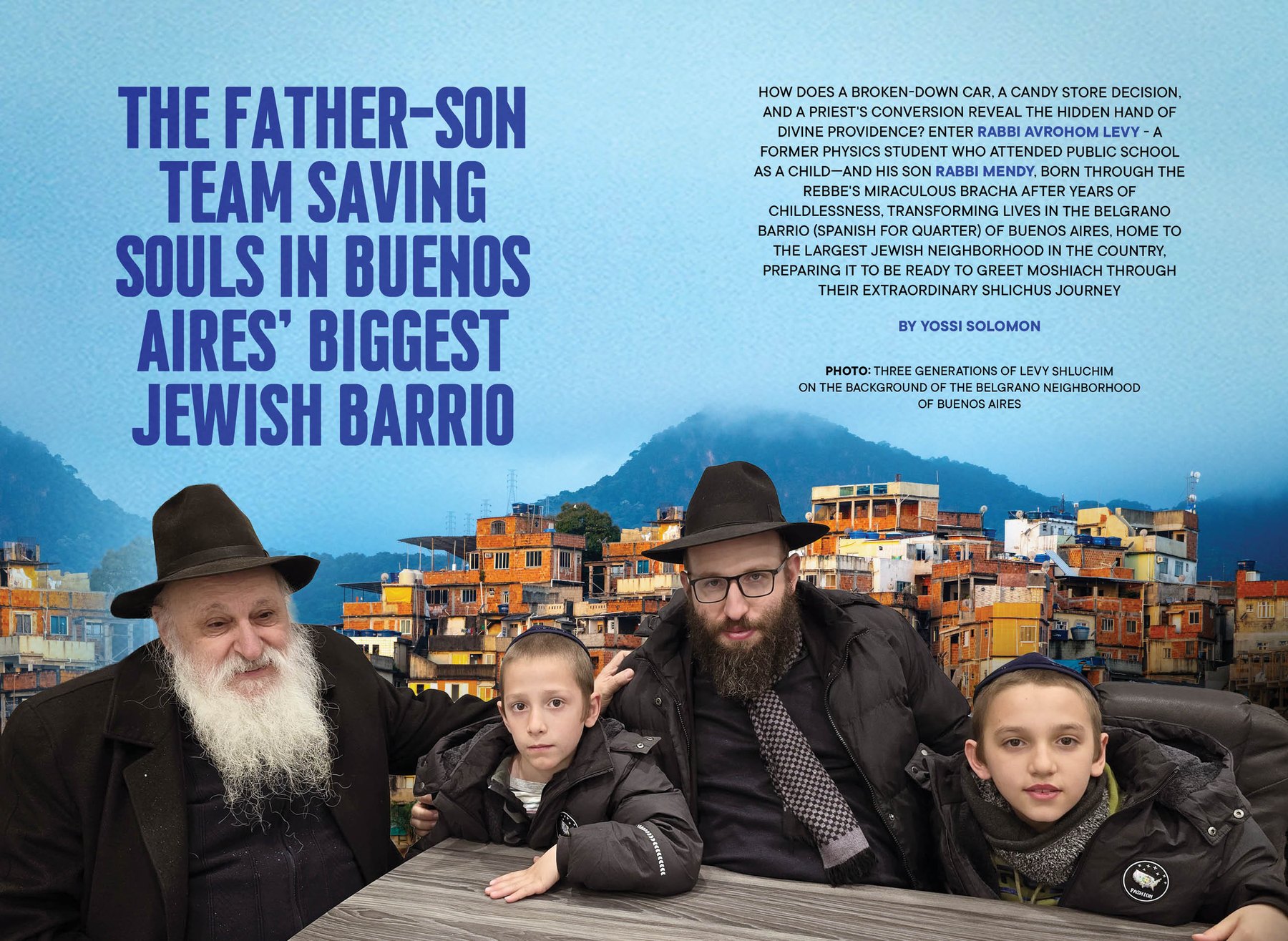
How does a broken-down car, a candy store decision, and a priest’s conversion reveal the hidden hand of Divine Providence? Enter Rabbi Avrohom Levy – a former physics student who attended public school as a child – and his son Rabbi Mendy, born through the Rebbe’s miraculous bracha after years of childlessness, transforming lives in the Belgrano barrio (Spanish for quarter) of Buenos Aires, home to the largest Jewish neighborhood in the country, preparing it to be ready to greet Moshiach through their extraordinary shlichus journey.
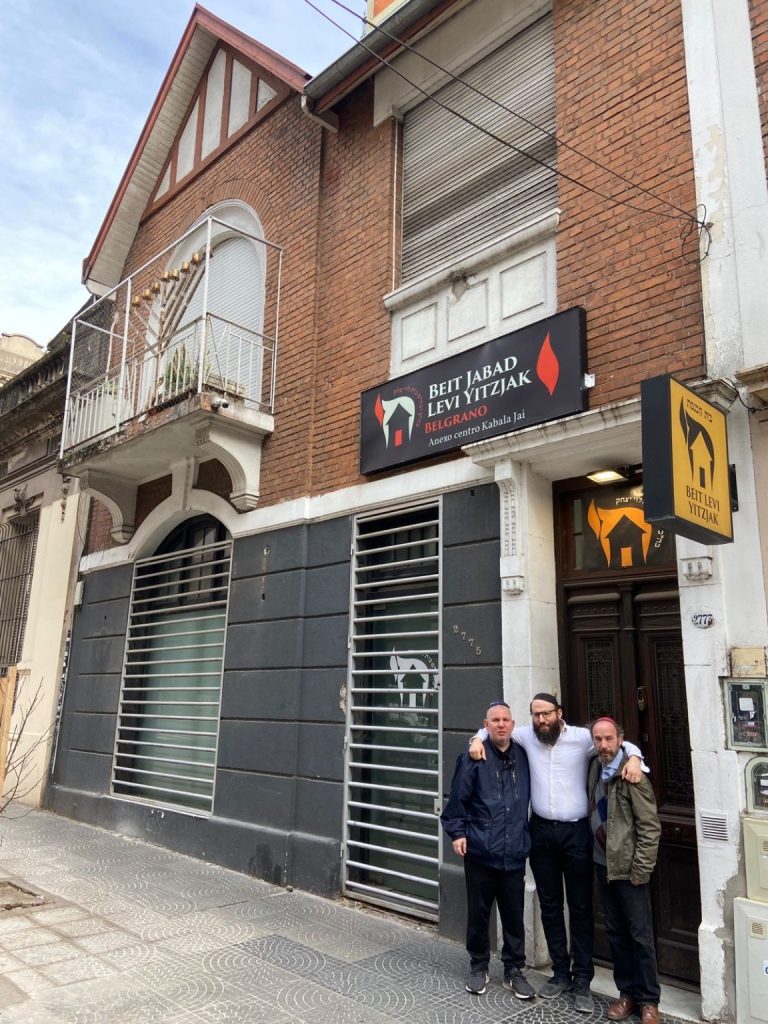
In the Belgrano neighborhood, the largest Jewish neighborhood in Argentina, there is a Chassidic Chabad gem that operates with love, dedication, and a vision of Geula. Meet: Chabad House ‘Beit HaLevi.’
This place is run daily by Rabbi Avrohom Levi, who spent his childhood years in a non-Jewish school, became a baal teshuva, and merited a special bracha from the Rebbe for the birth of his only son, Mendy, who was born exactly one year later – and today leads a vibrant shlichus together with his father.
During my visit to the place, I encountered stories you don’t hear every day: brissin at age 47, Jews who drew closer to Yiddishkeit from the street, from the garage, or from the park; a priest who discovered his Judaism and chose to convert only thanks to meeting smiling shluchim, and even a case where the rabbi saved a soul from spiritual shmad (destruction).
The children of the shluchim, Pinchos Raphael, Levi Yitzchok, and their sister Chaya Mushka – already take an active part in the shlichus, making every Shabbos and chag a heartwarming experience.
You can’t mistake it; here you feel the Rebbe in every corner, Ahavas Yisrael in every action, and shlichus as a way of life.
From Secular to Sacred
Rabbi Levi shares his personal journey:
I was born and raised in Buenos Aires, Argentina, in a traditional family. We weren’t Torah and mitzva observant, but we did maintain basic things, like Rosh Hashana, Yom Kippur, and the Seder night. Beyond that, there was almost no connection to Judaism in our daily lives. I spent my childhood years in a non-Jewish school, so I knew almost nothing about the Jewish world.
In 1983, I married my wife Yael. Neither of us was educated in Jewish schools or came from religious homes. We were tinokos shenishbu. Despite this, we felt something was missing in our lives; we felt a spiritual thirst. I myself studied physics at the university in those days, wanting to understand how the world works, what drives reality – but nothing I learned truly convinced me.
A few months after we married, we heard about Torah classes and events organized by the Rebbe’s shluchim in Buenos Aires. We decided to try it out. The first encounter was like a shot in the arm for us. We found there something we had been searching for a long time: truth, depth, warmth, and meaning. We felt as if we had found cold water in the middle of the desert. Within less than a year, we went through the entire process and became religiously observant.
At this stage, with the encouragement and guidance of the Rebbe’s shluchim – Rabbi Shaul Cohen a’h, Rabbi Shlomo Mizrachi and Rabbi Nosson Greenblatt – we decided to leave Buenos Aires and immigrate to Israel for several years so we could strengthen ourselves spiritually, fill gaps, and learn more.
We settled in Tzfas, where I studied in the local kollel. Simultaneously, I began giving classes for Machon Alte.
After several years, following a request from the Rebbe’s shliach Rabbi Moshe Oirechman, we moved to live in Krayot. There we began operating among the Spanish-speaking community. We met people there who were where we had been at the beginning of our journey not long before. I had the privilege of giving them some of the light we had received.
The Bracha Continues and Continues…
Throughout all these years, the Levi couple experienced difficult trials. One of their main struggles was waiting for children. For several years they tried having children but without success. They went to doctors, sought solutions – “but nothing progressed.”
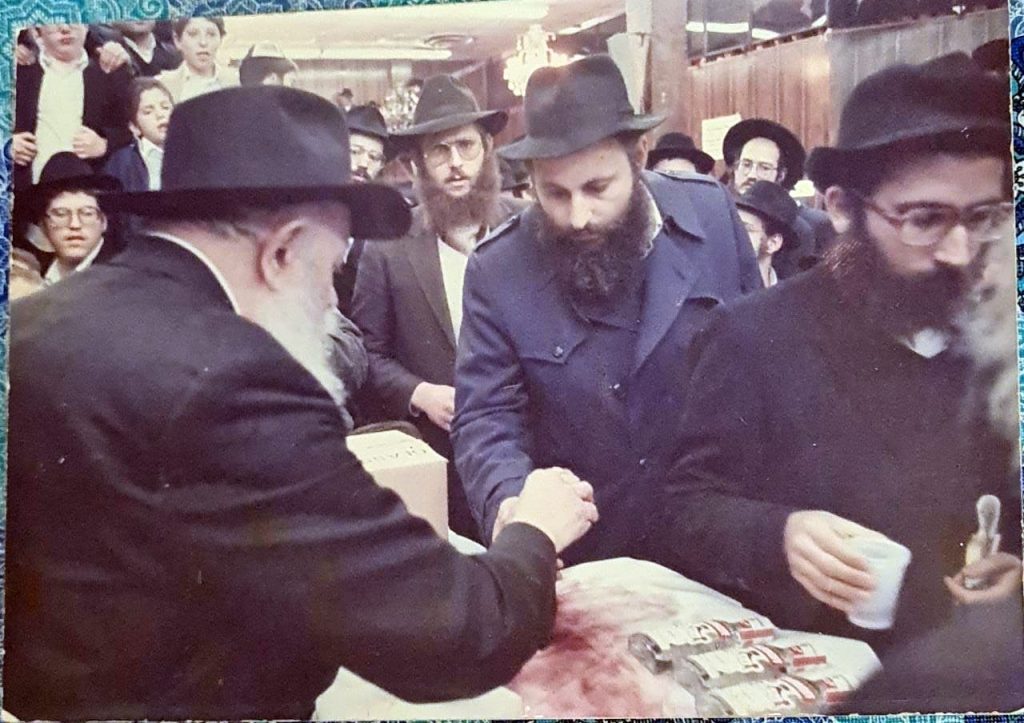
In 1988, R’ Avrohom decided to travel to the Rebbe. Although this wasn’t his first time seeing the Rebbe, as he had already merited being in his presence several times in the previous year, “This time I traveled with a clear purpose: to ask for a bracha for children!” Rabbi Levi recounts.
“I stood before the Rebbe during the dollar distribution, held the dollar in my hand but couldn’t get a word out of my mouth. It was a powerful and overwhelming moment. I felt time passing and the request couldn’t come out of my mouth…”
A year later, on Shavuos of 1989, he traveled to the Rebbe again. After Yom Tov, during the distribution of ‘kos shel bracha,’ he mustered the courage and asked the Rebbe for “a bracha for a ben zachar (a son).” The Rebbe blessed him with ‘bracha and hatzlacha’ and gave him a bottle of mashke for a farbrengen he planned to organize for Argentinians.
“Exactly one year later – on the 28th of Sivan – our only son was born,” Rabbi Avrohom recounts with emotion and gratitude to the Rebbe in his voice.
Rabbi Mendy Levi, son of Rabbi Avrohom Levi, carries this knowledge with him throughout his life. When I ask him how it feels to be born from the Rebbe’s bracha, he smiles:
A bracha from the Rebbe is not an ordinary bracha. It’s infinite, beyond measure and limitation. I feel it in every step of my life – already as a child in school, all along the way and until today, in the shlichus I operate. I’ll share with you a story that illustrates this point:
When I was in shidduchim, I was concerned about my parents’ financial ability to marry me off. I knew how tight their financial situation was, and I didn’t understand how they would provide for a wedding, especially with ‘harchava’ as the Rebbe blessed my father.
A short time after I got engaged, a woman we never met came to the Chabad house and gave my father 20 gold coins, each worth $2,000, totaling $40,000. This is a large sum today, and certainly in those years! With this money, my parents paid for all the wedding expenses with harchava… I have no logical explanation for this; it was simply a revelation of divine providence and the Rebbe’s bracha come to fruition.
I myself am an only child, but boruch Hashem, I have seven Chassidishe children – a bracha that continues and continues without interruption, says Rabbi Mendy with a smile.
I Started the Shlichus From Zero
After a period in Eretz Yisrael, the Levi family returned to Argentina in 2005, where they began their shlichus in the city of Buenos Aires. The choice came after a period of searching for a place for their shlichus.
“Family members suggested we return to Buenos Aires. There’s a large Jewish community here, with tens of thousands of Jews, and we knew there’s a lot of important work to do here,” recounts Rabbi Avrohom Levi.
At first, before they opened their own Chabad house, they assisted veteran shluchim operating in the city. Only after three years, when they identified a real need in another area of the city, did they decide to open an independent Chabad house.
And as always,‘all beginnings are difficult.’ The Levi couple experienced many challenges at the beginning of their shlichus.
“I started the shlichus from zero, without a penny in my pocket,” Rabbi Avrohom recounts. “I rented a small apartment where we held the Chassidus classes and tefillos. Slowly, with consistency and patience, and mainly with the Rebbe’s bracha that accompanies us at every stage, we managed to make headway. Today, boruch Hashem, we have a beautiful place that spreads light to all the Jews in the area.”
His son, Rabbi Mendy Levi, also describes the initial challenges: “In the early stages of the shlichus, the community was still very small. We couldn’t even organize a daily minyan. I remember how we would go out to the street to look for Jews to complete our minyan. It wasn’t simple. Today, boruch Hashem, we have a vibrant community, three minyanim daily, gabbaim, and sponsors who donate for kiddush and refreshments for the purpose of getting people to come and connect.”
What Does Your Shlichus Include?
Rabbi Avrohom and Rabbi Mendy recount: “Day to day, we take care of shul activity – tefillos with an organized minyan, Tanya and Chassidus classes, Gemara class, halacha classes, and Chassidishe farbrengens every Shabbos after davening. We have created a community learning framework that provides learning opportunities for the people throughout the week.”
The shlichus at the Chabad house is divided into several departments: ‘Beit Levi Yitzchok’ – which is the central shul. ‘Kabbalah Chai’ – a unique center for studying Kabbalah and Chassidus intended for those drawing closer, and open to all. ‘Maggid of Mezeritch’ – a Beis Medrash intended for advanced learners where high-level classes in halacha, Gemara, and Chassidus take place. ‘Women in Action’ – a women’s department including shiurim, hafrashas challah, and special activities led by the shluchos Yael and Devorah Leah Levi.
“In addition to programming at the Chabad house, we do mivtza tefillin and other outreach efforts in all the stores in the neighborhood. We’re talking about the ‘Belgrano’ neighborhood – the largest Jewish concentration in South America, but most of the Jews here are not Torah and mitzva observant, so locating them requires much work.
“Only recently did we acquire a mitzva tank which contributes a lot to our outreach. This began about two years ago when we received a unique donation – a ‘mitzva tank’ – from the shliach in Ukraine, Rabbi Moshe Asman. The tank gives tremendous momentum to street mivtzaim and added much of a ‘shturem’ to our work.”
Lifting Reincarnated Souls
Can you share stories from life on shlichus?
Rabbi Mendy reveals a glimpse into the depth of shlichus work and the extraordinary encounters that lead to real changes in people’s lives.
“In recent years we’ve organized many brissin for adults,” he recounts and brings several unusual stories: “One Shabbos we held a farbrengen at the shul. I raised a glass of ‘l’chaim,’ turned to one of those present and asked him to say his name so I could bless him.
“He said: ‘I don’t have a Jewish name.’
“I asked: ‘What do you mean? Didn’t they give you a name when they circumcised you?’ And he replied: ‘They didn’t circumcise me.’
“Obviously, we immediately ‘got on his case’ so he would undergo a bris. And so, at age 42, he entered brisso shel Avrohom Avinu. It was a moving moment for the entire community.”
In another story, Rabbi Mendy tells about a Jew who lost his parents in childhood: “He was distant from tradition, but after many conversations we managed to bring him closer. He agreed to put on tefillin and come to tefillos, but still didn’t have a bris mila.. After some time he made a decision – and at age 47 he underwent bris mila.”
And here’s another surprising story that happened in a garage of all places: “My car broke down, and for some reason I returned to the garage three times. The third time, the garage owner confided that his wife is Jewish and he has children. I explained to him that his children are Jewish, and it would be good to think about bar mitzva. He got excited, talked with his wife and she was very happy. We started teaching them, bringing them closer – and finally, the two sons, at age 16, also underwent bris mila,” Rabbi Mendy recounts and continues to another story of hashgacha pratis in mivtzaim:
“Every Friday, I go on mivtza tefillin in the area near the Chabad house. In the winter months, time gets shorter and shorter – and decisions become quick and critical: where to turn? Which street to enter this time?
“One winter Friday, I stood at a crossroads – literally. On the right side several stores, some with business owners who wait for me regularly. On the left side, were also Jews who wait regularly for tefillin. The clock already showed the approaching candle lighting time, and I had to decide. I chose the right side. Not because I gave it much thought, but more from gut feeling. Later I would understand this was extraordinary hashgacha pratis.
“I went to the familiar stores until I reached a candy store whose owner – a dear Jew named Yisroel Rothschild – puts on tefillin regularly, and we even made bar mitzvas for his two sons.
“At that moment his youngest son walked in, whom I hadn’t seen since the bar mitzva. A big smile, a hug, and the first tefillin laying since then until that day. As we spoke, I made a suggestion: ‘Come to the Chabad house, we’ll organize an easygoing class for young people on Jewish topics, with sushi and pizza.’ The boy surprised me with his response: ‘The truth is I’ve been feeling a desire to know more about Judaism for a long time’… He promised to talk with four of his Jewish friends to organize a weekly class.
“But that was only the beginning. Just as the conversation ended, a man around sixty entered the store. The store owner whispered to me: ‘He’s also Jewish.’ I turned to him with a smile: ‘Hello, dear Jew! What’s your name?’ He gave a Spanish name. I asked if he has a Jewish name, and he said no. ‘What about circumcision?’ I asked. ‘They didn’t do it to me,’ he responded. ‘I also never put on tefillin,’ he added. Also, his wife is not Jewish and his children are obviously not Jewish. He himself grew up far from Judaism. I immediately understood that I didn’t turn right today by chance…
“I explained to him about the importance of tefillin, about how it touches the soul even when the person isn’t knowledgeable about his Judaism, and he was convinced and agreed to put on tefillin. At that moment we held for him a kind of late ‘bar mitzva’ – at age 60 – with tefillin, brachos, and a warm hug. You could see the excitement in his eyes. For the first time in decades his soul felt a connection with holiness. We exchanged details and agreed to keep in touch. He also agreed to start learning about Judaism with me and progress toward bris mila.
“And so, from mivtzaim under time pressure, a shiur for young people was born, a ‘bar mitzva’ for a distant Jew was held, and additional proof that the ‘planting’ the Rebbe planted – continues to grow in every corner, at every time, and sometimes even when there seems to be no time…”
Every Jew is a Brother
Rabbi Avrohom Levi also shares stories: “There are moving stories not only about people who had brissin, but also cases where we had to fight assimilation,” he says.
“I met a Jewish young man who lived with a non-Jewish woman. I gently explained to him that he’s Jewish and can’t continue living with her. After some time he said he understood the problem and asked me to speak with her instead of him.
“At his request, I sat with her and gently explained that he’s Jewish, and he can’t continue living with her. It was hard for her, but in the end she understood and parted from him. Later the young man became religiously observant, married a Jewish woman, and even moved to Eretz Yisrael.”
Not only souls, but parnassa also receives siyata d’shmaya thanks to the shlichus:
“Like every shliach, I check mezuzas and tefillin. One day a Jew came to me and asked to check the mezuzos in his house. In one of them I found a problem in the pasuk, ‘so that your days may be multiplied upon the earth’ in that the word ‘adama – earth’ was pasul.
“I fixed the mezuza, and when I told him what the problem was, he got excited. It turns out he sells vegetables, and at that time he suffered from a sharp drop in income.
“When he came again after some time, he told me that since the repair of his mezuza – sales percentages rose amazingly…”
How do you manage to touch souls and bring them closer to Yiddishkeit?
“We believe that every Jew is our brother. The first and most important thing is to inquire about his welfare so he’ll feel we’re there for him, and he can share with us what he’s going through and that we truly care about him. When a Jew feels he’s welcomed with love just because he’s Jewish – it opens his heart.
“And indeed, many of the people who come to us at the shul tell us that what brings them back again and again to the place is the warm and family atmosphere they encounter with us,” say R’ Avrohom and R’ Mendy, adding: “Many times when someone in the community passes away, even his family members who didn’t come to the shul before, start coming to say Kaddish for him and connect more to the soul. This is obviously an opportunity to explain to them more about Judaism and bring them closer.”
How do you work to spread the subject of Geula, and how do the local Jews take to it?
“In every Torah class we give, we also speak about the Geula – about how the Rebbe is Moshiach, and how this is seen through his care for and impact on every Jew,” says Rabbi Mendy. “We also have regular classes on the topic of Geula and Moshiach, and I can tell you this is the class with the highest attendance… You can readily see how much people thirst for Geula – not just as Torah knowledge, but out of real anticipation.”
Rabbi Avrohom: “Beyond that, occasionally we hold special evenings of writing to the Rebbe, where participants write what’s on their hearts and ask for brachos. These evenings attract a large crowd and become a deep and connecting experience. Over time, even those who didn’t know about writing to the Rebbe begin to understand and internalize that the Rebbe is Melech HaMoshiach.
“Every time we fly to 770, many people give us personal letters for the Rebbe with strong faith that the Rebbe hears, answers, and continues to lead.
“A few months ago a priest came to us saying he searched for truth in his religion but didn’t find it; however, when he heard about the Rebbe, he connected. Following this, he came to our Chabad house and decided to begin the conversion process. He’s already in the final stages of the process…”
What is your message to your fellow shluchim?
“We are all charged with the shlichus to increase true Ahavas Yisrael – to feel the other, to listen, and to give of ourselves not because of what he does, but because of who he is – our brother,” say the shluchim. “When we act this way, we can bring hearts closer, awaken souls, and bring the Geula.”
Next Generation Shluchim
Rabbi Mendy Levi’s two sons, soldiers in Tzivos Hashem, Pinchos Refael and Levi Yitzchok, joined our conversation and we present a glimpse into their activities:
What’s it like to grow up on shlichus?
It’s a great zechus to be soldiers of the Rebbe, shluchim from birth. We constantly feel the responsibility of shlichus especially when we see how our outreach draws people to the Rebbe and gives him nachas ruach.
What do you do on shlichus?
We try going on mivtza tefillin every Friday together with our father. On Shabbos, we welcome everyone to the shul by saying, ‘Good Shabbos.’ We listen to whoever needs to be listened to and help out during the davening. We teach those who don’t know the alef-beis. We sing and make a Chassidishe, happy atmosphere in shul.
Our older sister Chaya Mushka is in charge of coordinating children’s programming at the Chabad House which includes shiurim, crafts and other projects.
You don’t have many Lubavitchers living around you. How does that feel?
We go to a Chabad school which is a half hour drive from the Chabad House. Every morning we meet up with the children of other shluchim, so although we don’t see Lubavitchers in our neighborhood, we have good friends at school.
Can you tell us a story of something that happened to you on shlichus?
Sometimes, we go to the park with our parents. Of course, we’re dressed as soldiers of the Rebbe with tzitzis, kippa and have Chassidishe books. One time, someone who didn’t look Jewish came over to us and my parents spoke to him about Torah and mitzvos. After that, he started regularly going to shul and taking an interest in Judaism.
It’s moving to see how even in the park, a Jew was inspired just be seeing children who look like us. It’s truly a matter of being on shlichus every minute.
Beis Moshiach #1470 • pp. 26-33, 21
© 2026 Beis Moshiach Magazine. All rights reserved.
This article originally appeared in Beis Moshiach #1470. You are welcome to share it with friends and family by email or in print, provided that you do not change, add to or omit any part of it, you credit the author and Beis Moshiach, and you include a link to archive.bmoshiach.org (written out in full in printed copies).
To republish this article in a newspaper, magazine, book or website, please request permission in advance at [email protected].