Where Was the Alter Rebbe’s Portrait for Nearly a Century?
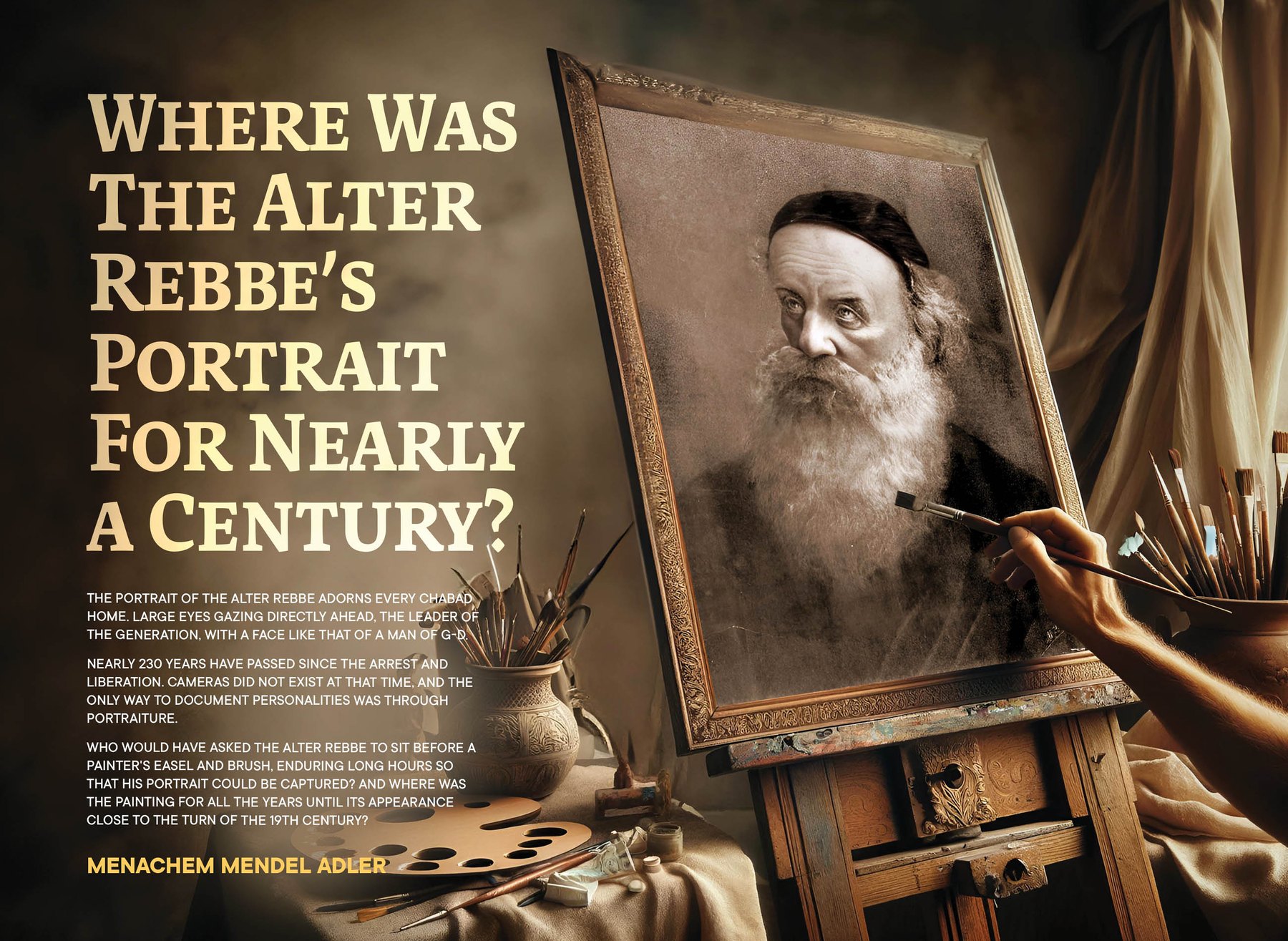
The portrait of the Alter Rebbe adorns every Chabad home. Large eyes gazing directly ahead, the leader of the generation, with a face like that of a man of G-d. Nearly 230 years have passed since the arrest and liberation. Cameras did not exist at that time, and the only way to document personalities was through portraiture. Who would have asked the Alter Rebbe to sit before a painter’s easel and brush, enduring long hours so that his portrait could be captured? And where was the painting for all the years until its appearance close to the turn of the 19th century?
It would seem like the portrait of the Alter Rebbe adorns every Lubavitcher home. Large eyes looking straight ahead, the impressive beard, with a face like that of a man of G-d.
Almost 230 years have passed since the arrest and redemption; cameras did not exist at that time, and the only way to document personalities was through painting. Who would ask the Alter Rebbe to sit in front of an artist’s easel and brush for long hours, so they could paint his portrait?
Indeed, no portrait was found of his son, the Mitteler Rebbe, or his great-grandson, the Rebbe Maharash. So how is it that we have an image of the Alter Rebbe? It turns out the story is interesting and quite fascinating.
5615 [1855]
It was in the winter of 1855 when his grandson, the Tzemach Tzedek, was invited to Petersburg to be one of the members of the Rabbinical Council that was supposed to discuss the printing of translated textbooks for Jewish children.
Due to his great weakness, the Rebbe sent his youngest son, Rabbi Shmuel, together with the Chassid R’ Aharon Lipschitz, rav of Belinitz, as his representatives.
The Maharash was granted favor in the eyes of the assistant of the Deputy Minister of Internal Affairs. The latter invited him to stay at his hotel. During the meeting, which lasted about two hours, he said that his father had bequeathed him a large collection of paintings, including many portraits. Since he was talented in the art of painting, he asked the Maharash for permission to paint him, as he was blessed with an especially dignified appearance.
Innocently, he mentioned that among the paintings in his archive, there was a painting of a Jewish rabbi who was accused of being a traitor to the government. His grandfather was the chief investigator of that Jewish rabbi, and he was the one who ordered the painting of the imprisoned rabbi’s face. After the trial, his grandfather took the painting home and kept it in the family collection.
Maharash immediately understood that this was likely a painting of the holy visage of the Alter Rebbe. “Can I come and visit the collection and see the painting?” he asked immediately.
Indeed, during a visit to the assistant minister’s home, the painting was shown to him. The inscription beneath the painting finally confirmed that it was the dignified face of the Alter Rebbe – Rabbi Zalman Baruchovitch [son of Baruch] of Liozna. It was also noted that the painting was made in 1798 [5559]. This was when the Alter Rebbe was sitting in the Peter and Paul Fortress. Next to the painting was the signature of Kirill Ivanovich Golovachevsky, a painter close to the royal court in Petersburg.
Upon returning to Lubavitch, the Maharash hurried to tell his father. The Tzemach Tzedek’s excitement was great, and he very much wanted to see the holy face, and waited for an appropriate opportunity.
Four years later, in 1859, when the Maharash traveled to Petersburg, his father asked him to search for the gentleman who had the painting, and request to purchase it for a thousand rubles. The Tzemach Tzedek added that if the gentleman would not agree to sell, at least he should allow it to be copied by an expert painter.
However, all attempts to find the assistant minister were in vain. For a month, the Maharash tried to trace his whereabouts, but it turned out that he had moved elsewhere. One can readily imagine how disappointed Maharash was when he was forced to return to Lubavitch empty-handed, without satisfying his father’s desire.
5621 [1861]
Two years later, in 1861, when Maharash traveled to Petersburg with his brother, he told one of the professors he knew that a few years ago he had seen a painting in the home of someone who lived on a certain street, but now he could not find him. The professor kept this in mind and a few months later, he sent a letter to Maharash in Lubavitch with the new address of that gentleman, which he had found with great effort.
In the summer of 1862, Maharash traveled to Petersburg again and made a special trip to meet the man who lived in the Czar’s village. The meeting was cordial. He managed to persuade him to lend him the painting for a month in exchange for government bills worth ten thousand rubles. With him came R’ Yisroel Chaikin, who was entrusted with the painting and was to return it to its owner after copying it.
The entire project was done in complete secrecy. No one knew about the existence of the painting or its arrival in Lubavitch.
But one day, one of the Chassidim managed to accidentally hear the Tzemach Tzedek say to Maharash: “The painting is as true as I remember him in his middle years, and yasher koach for this. We must warn Yisroel to be very careful that it not be damaged on the way, and not to tell anyone about it. We must warn him with a cherem of Rabbenu Gershom.”
Rebbetzin Rivka was also allowed to see the special painting, on condition that she would not tell anyone further.
For about two weeks, the painting stood in the Tzemach Tzedek’s room. Every day, Maharash would come, close the door, and place the painting on the table. His father, the Tzemach Tzedek, would dress in white Shabbos clothes, put on a gartel with solemnity, and stand looking at the picture for a long time.
After copying the painting, it was returned to its owner.
Only two years later, a rumor began to circulate among the Chassidim that a nobleman from Petersburg had arranged to have a painting made of the Alter Rebbe while he was in prison.
5648 [1888]
In 1888, the painter Boris Schatz found the painting with one of the nobles of the Tishkevich family. This family was known as great collectors.
How did the painting come to them?
It turned out that they had purchased it from the heirs of that deputy minister, the grandson of the investigator. Boris Schatz did not know who the righteous man in the painting was, but he remembered his name well. He also understood from the words of Count Tishkevich that this was a well-known “rabbin” among the Jews.
Boris Schatz therefore approached his friend from Warsaw, R’ Shmaryahu Schneerson, a great-great-grandson of the Alter Rebbe, and told him what he had seen. R’ Shmaryahu was amazed to hear it; he told Schatz about the Alter Rebbe and his spiritual greatness, and that he was a descendant. R’ Shmaryahu could not restrain himself and urged Boris Schatz to request permission from Count Tishkevich to copy the painting in order to distribute it.
R’ Shmaryahu invested great efforts until he received permission for this, and in the next period, a copy of the original painting was made. The copy was made, apparently, by the artist Eugenia Zhermondsky, who was “coincidentally” also Boris Schatz’s wife.
After copying the painting, R’ Shmaryahu received a copy authorization from Count Tishkevich attesting to its faithfulness to the original. And so wrote Count Tishkevich (translated from Russian): “I, the undersigned, testify that the copy, made by Miss Eugenia Zhermondsky at the request of Mr. Schatz, from an ancient rabbi’s portrait, under which is written ‘Rabbi Zalman Boruchovitch of Liadi from the year 1798,’ and which is found in my picture collection under the mark 127 – exactly matches the original. And I am giving permission to Mr. Schatz to make ‘photographs’ from the copy for distribution. And in witness thereof, I have signed with my seal.”
After receiving authorization, R’ Shmaryahu hurried to print copies of the painting. In many copies, he added a page with approbations received from rabbanim and Admorim of those days, who testified to the picture’s authenticity and warned against hasagas gevul [copyright infringements].
In the approbations given for publication, it was written, among other things: “…Anyone seeing the aforementioned portrait of the holy rabbi will be amazed and astounded by the radiance of holiness shining from his noble face. And from the gaze of his eyes, it is evident that the glory of G-d was hovering over him and was illuminating the land and its inhabitants.”
The author of the book Beis Rebbi, after praising the portrait greatly, added: “And we heard that even ministers and nobles who are not from our Jewish brethren are buying the painting. And they all praise, glorify, and venerate the name of our Rebbe, from whose portrait it is evident that he was a very exalted man, a wondrous sage, and a divine philosopher.”
Also in the work Toldos HaRav describing biographical details of the Alter Rebbe’s life, it was written: “In these days, a new thing appeared, the portrait of the precious one which was hidden and concealed for ninety years with the aforementioned minister who stood by his righteousness… Until now it was with his sons and grandchildren and no eye had seen it, and G-d arranged for it to be revealed now to everyone… And from his portrait, it is seen that he was awesome and fearsome, may G-d merit us to see him with the coming of our righteous Moshiach.”
The painting received widespread attention, and wherever it arrived, viewers expressed great admiration.
In the years that followed, copies of the painting were printed (with some variations) in books and various publications, until the painting became well-known.
5696 [1936]
In honor of Yud-Tes Kislev 5696 [1936], the second volume of the HaTamim was published, with the picture printed at the beginning with the inscription: “Portrait of the holy of holies, hod kevod kedushas, the Alter Rebbe, of blessed memory.”
This naturally raised many questions and doubts – to what extent this painting was authentic and reflected the Alter Rebbe’s appearance.
The editors of the HaTamim journal addressed this question in the eighth issue published on the occasion of Yud-Tes Kislev, 5698 (1937). The image was reprinted, and next to it, the editors refer to the questions:
“After printing the portrait of the Alter Rebbe, of blessed memory, in our second booklet, we received several letters from various sources with inquiry and investigation about how accurate this image is and its origin; as when this image was first published in the world in 5648 (1888) by Rabbi Shmarya Schneerson from Warsaw, there was debate about it in the Hebrew newspapers of that time. Some had doubts about whether this image was authentic.
“Therefore – the editors strive to clarify – we found it appropriate to turn to the Rebbe, may he live long, who was kind enough to give us, for publication in our journal, excerpts from his notes from 5656 (1896), in which stories are told about this image, which clearly testify to the precise authenticity of the image. The Editorial Board.”
In that issue, they published diary entries the Rebbe Rayatz wrote for himself in the month of Teves 5656, when he was 16 years old, about a conversation in his home in Lubavitch concerning the Alter Rebbe and the story of the image that had been published for all to see just eight years earlier.
In his notes, the Rebbe Rayatz describes how the image was found by the Rebbe Maharash (as told previously), and adds that he himself heard the full story together with his teacher, Rashbatz, from Rabbi Avrohom Dov of Bobruisk, who heard it from Rabbi Aharon Lipschitz, who was involved in copying the portrait for the first time.
The Rebbe Rayatz was not satisfied with this, and he tells how on Shabbos afternoon, during the Kiddush, the Rebbe Rashab asked his mother, Rebbetzin Rivka, whether she remembered the portrait that his father, the Rebbe Maharash, had brought and what her reaction to the portrait was. Rebbetzin Rivka responded, “I remember all the details as if it were yesterday, and the entire scene stands before my eyes as if it were today.” She even asked her grandson, the Rebbe Rayatz, to come to her later, when she would tell him the full story – which he subsequently wrote down.
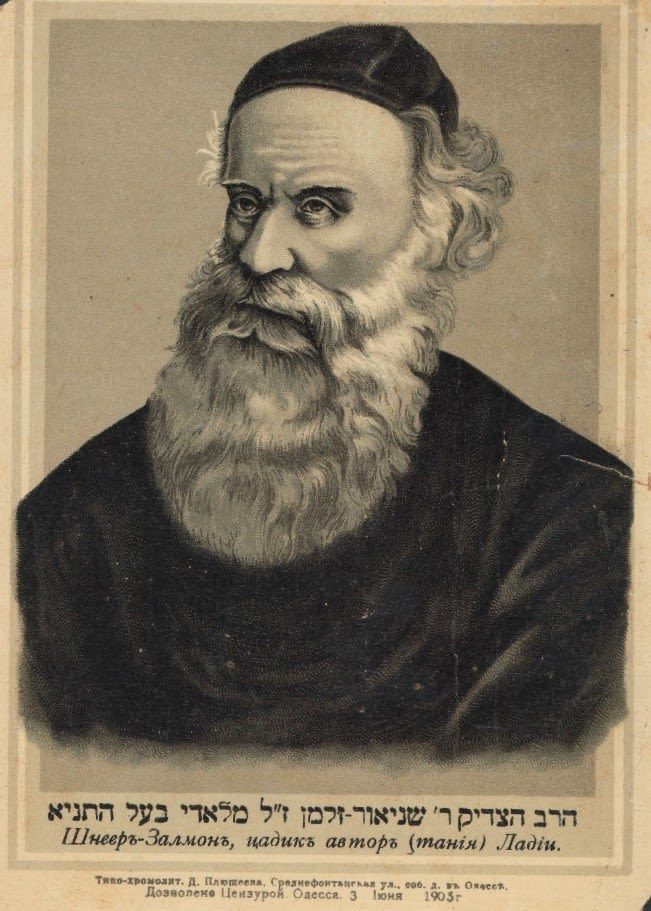
Additional testimonies confirming the portrait’s authenticity and how it was true to the ‘original’ were also cited. Thus, the Rebbe of Kopust testified in his consent to the printing of the image by Rabbi Shmarya Schneerson: “I heard many times from my honorable great-grandmother, the righteous Rebbetzin, that the image of her son, the famous Chassid, Rabbi Chaim Avrohom, was very similar to the appearance of his holy father, the Alter Rebbe. And the image of Rabbi Chaim Avrohom I remember well, as if he stands alive before me, and it is very similar to the portrait in the picture.”
When the Alter Rebbe’s picture arrived in Bobruisk, two elderly men who had seen the Alter Rebbe with their own eyes were present. One of them, whose vision was already failing, asked if the person in the portrait had a high and lined forehead, and if there was a kind of scratch on his nose. Both marks were clearly visible in the picture. The second elder immediately testified that these were the holy features of the Alter Rebbe.
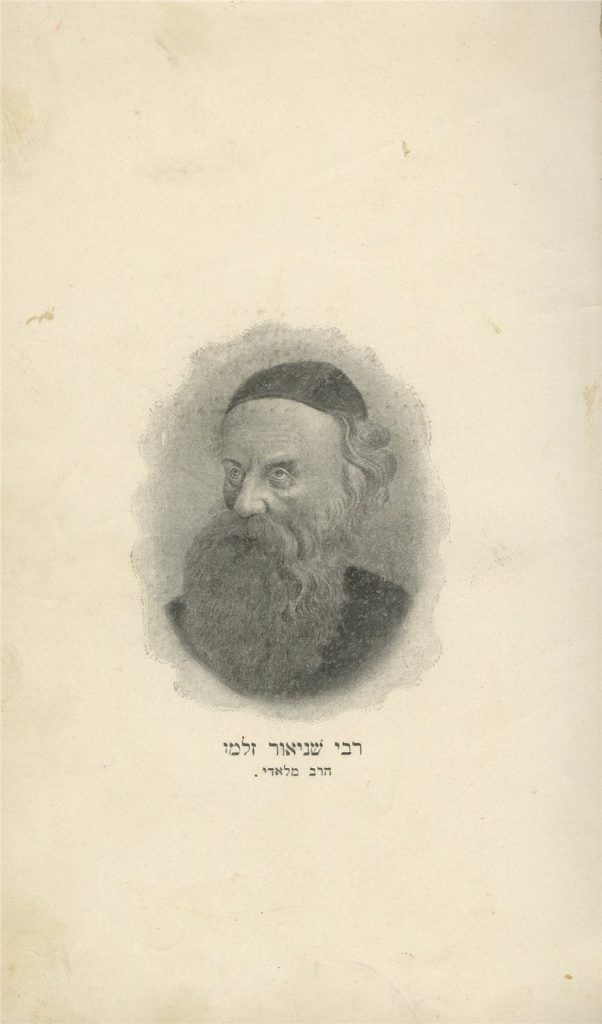
In addition, the HaTamim journal printed photographs of the approvals received by Rabbi Shmarya Schneerson from Graf Tishkevich, as well as the artist’s stamp and the short text written on the portrait indicating the Alter Rebbe’s name.
5689 [1939]
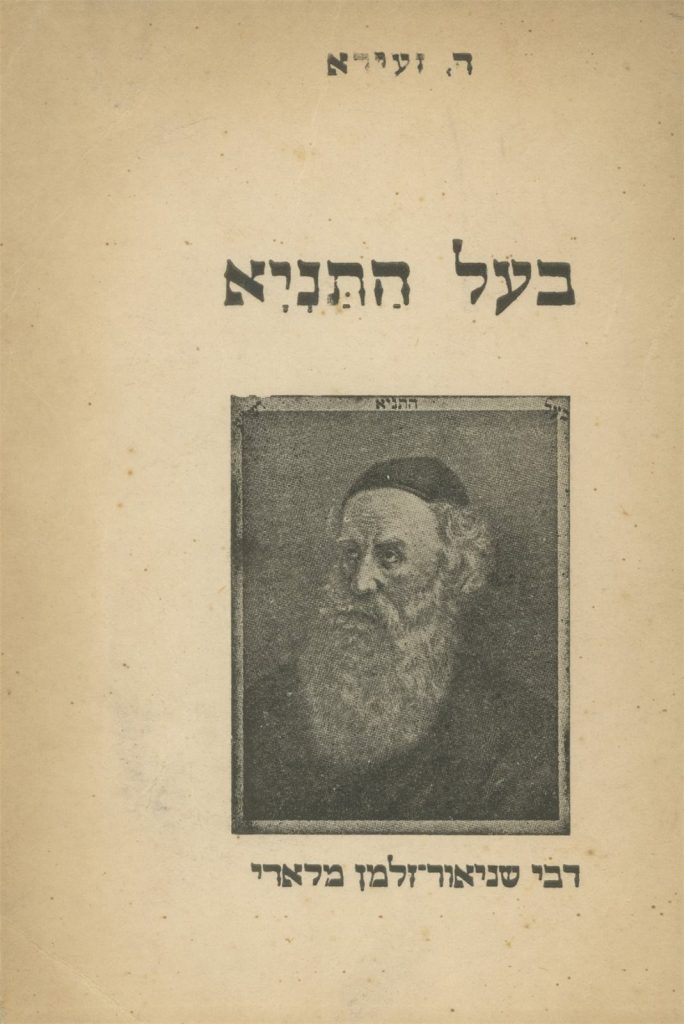
Later, two researchers, Mordechai Narkis and Avrohom Sharon, published a column in Haaretz, attempting to challenge the portrait’s authenticity. Under the headline “On the History of the Portrait of Rabbi Shneur Zalman of Liadi,” they confidently state that “the accepted picture is not a picture of him.”
They further elaborate that “throughout the Jewish world, the portrait of the Rebbe, R’ SZ of Liadi is circulated, published here. It is known in stone-printed portraits meant for wall hanging, and in copies in books. The image depicts the face of a Jewish man with a large beard, whose face expresses vigor and spirituality, with a curly beard and a cap covering his head. This image is considered authentic by Chassidic circles and researchers, as a portrait drawn or recorded according to the exact facial features of the rabbi while he was imprisoned in Petersburg. In truth, this is not the rabbi’s portrait at all,” they assert with remarkable certainty. Later, they bring evidence that the portrait was actually made based on the likeness of Rabbi Shmaryahu Schneerson, who was similar to the Alter Rebbe…
They sent the article to the Rebbe Rayatz and asked for his opinion.
The Rebbe Rayatz responded with an urgent letter, writing sharply: “In response to your letter asking my opinion regarding the article by Mr. Narkis about the portrait of the Alter Rebbe, printed on the fourth of this month in Haaretz. It was good and proper that he approached me with this question, but not at the right time, as he should have asked this question when they were collecting material for their article, perhaps there are some documents, letters, diary entries on this matter in the manuscript treasury inherited from our ‘first’ father.”
The Rebbe continues writing sharply: “I am very sorry about the storm they have caused in their improperly researched article among the people of Israel in general, and among the Chassidic community in particular. The style in which they wrote their aforementioned article raises suspicion of a bias towards an unfounded conclusion, and in any case, demonstrates a lack of understanding of the matter’s seriousness and a lack of feeling for what is holy to the Jewish people. Mistakes are common for every person and every matter, and those of pure heart who are only aimed at the truth will strive to correct what has been distorted.”
Years later, on the second night of Sukkos 5726 (1965), during a Yom Tov meal in the Rebbe Rayatz’s apartment, a Chassid asked the Rebbe whether the portraits of the Alter Rebbe and the Tzemach Tzedek that he saw in Chicago were authentic. The Rebbe replied: “From the Alter Rebbe and Tzemach Tzedek, there are the well-known portraits” – referring to those published by the Rebbe Rayatz in the HaTamim issues.
Interestingly, Rabbi Chananya Yosef Eisenbach recounted that the Avnei Nezer once arrived at a lodging and saw the portrait of the Alter Rebbe, author of the Tanya, and said to the proprietor: “For you, he hangs on the wall, whereas for me, he is within me…”
The mashpia, Rabbi Chanoch Hendel Kugel once said that the Alter Rebbe’s portrait can be seen in the Tanya.
This is how the Rebbe Rayatz tells the story of one of the wealthy men in the city of Petersburg, for whom the Alter Rebbe’s portrait caused a spiritual transformation.
* * *
The story involves one of the great wealthy men of the large city of Petersburg in Russia, a man in his prime years, from a Chassidic lineage, who, upon reaching the age of 14, settled in Petersburg. Due to various circumstances, the ebb and flow of life led him to an extremely distant environment, to the point of desecrating the Shabbos, eating non-kosher food, etc., may Hashem have mercy.
As a descendant of a respected Chassidic family in the Mogilev district, which was very connected to the Rebbeim – he labored, immediately after the publication of the Alter Rebbe’s portrait, to commission one of the great painters to copy the portrait for him, as well as the portrait of the Tzemach Tzedek in a large format. He paid a large sum for the portraits and, upon completion, placed them in his library.
Years passed, and his businesses expanded. To the children born to him, he indeed gave Hebrew names but immediately converted them to Russian names. The house was run with extraordinary wealth and in full pursuit of worldly pleasures and desires. As usual in such a situation – the society with which the householder associated was composed mostly of non-Jews or, l’havdil, of Jews who had long ago forgotten their Jewish origins.
It happened — by hashgacha pratis — that the wealthy man was in need of, for an important business matter, a certain rich, G-d-fearing, and pious Jew. As the matter was urgent — he hurried to the home of the Chassid.
Upon entering the house, he saw, in the spacious halls, many people seated at set tables, singing with great joy. The scene reminded him of similar scenes from his childhood with his parents.
The host came out to him and brought him to his room for a conversation about their joint business.
When the business discussion ended, the guest asked about the reason for the party, whether it was for a family celebration? And if so, he wished to say “mazal tov.” The Chassid, who knew the guest’s parents well and knew of his distance from Judaism, replied:
“Yes, this is a family celebration. We are now speaking by telephone with our parents and grandparents who are in Gan Eden, and out of great joy from the good news we are hearing from them — we are holding a festive party.”
The guest stood bewildered by the incomprehensible words, and seeing his confusion, the Chassid explained:
Today is the holiday of Yud-Tes Kislev (he knew very well what Yud-Tes Kislev was), and in the chamber of the Alter Rebbe in Gan Eden, there is great joy. All the tzaddikim have gathered in the Rebbe’s chamber to wish him “mazal tov” for his Geula and the salvation that came through it for thousands of Jews — who became Chassidim.
Our fathers who basked in the radiance of our Rebbeim, certainly participate in this joy, and we — their descendants — are happy in their holiday, our holiday.
After hearing these words — the “grandson” was struck by a strong desire to enter the party for a short while, but he felt himself foreign and distant from this atmosphere, and did not have the courage to express his wish. He was simply ashamed: what business did he, who ate non-kosher food, have at such a party?
The clever Chassid immediately noticed the “grandson’s” hesitation and invited him to the party: “Come and hear regards from the Zeide and the Tatte.” The Chassid even knew how to ensure the guest would feel comfortable at the “strange” party.
It is unnecessary to describe the nature of a seudas mitzva among Chassidim, especially a seuda for Yud-Tes Kislev, something which today is held, boruch Hashem, in all cities and towns across the world in all countries. It’s only that the Yud-Tes Kislev celebration in Petersburg (where the miracle occurred) forty years ago, during the life of the elder Chassidim, including the Chassidim R’ Yitzchok and R’ Zalman z’l Rubashov, who personally knew people, both Chassidim and misnagdim, who lived during the time of the miracle — was marked by unique enthusiasm, holiness, and joy.
Hours passed – one, two, three – the “grandson” forgot that he had ordered tickets to the theater with the government elites. He was so swept up in the Chassidic experience that for a moment it seemed he was in the old house with his Chassidic parents.
The Yud-Tes Kislev celebration awakened memories from his childhood years: Yud-Tes Kislev gatherings celebrated in his grandfather’s Beis Medrash, and the parties his grandfather would hold when he returned with his Chassidic friends from a trip to Lubavitch. His grandmother would be busy preparing the feast while his mother and aunts helped her.
His memory played out before him various events from the distant past, at ten, at twelve, his bar mitzva, and his Chassidic teacher, R’ Baruch who was the melamed.
In the end, after hours of spending time in the Chassidic atmosphere, he returned home.
One of his close associates told me that immediately upon arriving home, he entered his library room and davened Maariv with great weeping.
After a few days, the wealthy “grandson” changed his utensils to new ones, a kosher kitchen was established in his home, and the man was completely transformed.
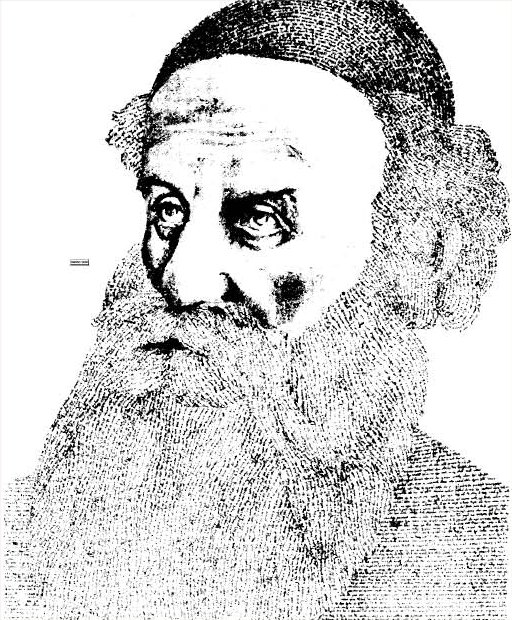
Portrait Of The Alter Rebbe Made Of The Letters Of Tanya
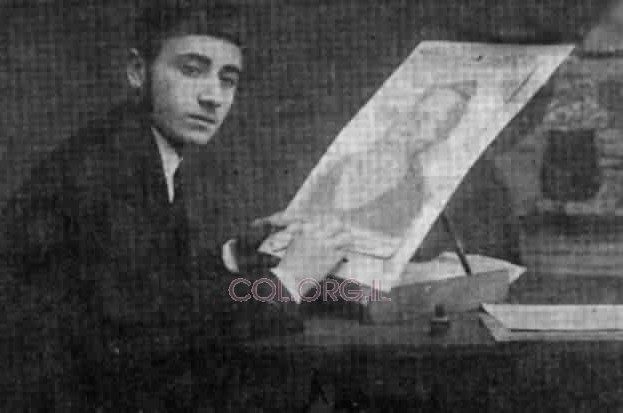
In telling the story of the Alter Rebbe’s portrait, there is a remarkable work created by a talmid of Tomchei Tmimim in Warsaw, named Moshe Greenberg, in 5690 (1930). He drew the Alter Rebbe composed entirely of letters from the Tanya.
About his unique creation, he said:
“It happened that I was caught ‘in the act’ at the yeshiva and found studying drawing. The punishment they assigned me was to learn seven chapters of Tanya by heart.
One day it became known in the yeshiva that I had drawn a portrait of the Alter Rebbe from Liadi – the entire image only from letters of his sefer Tanya, a large, beautiful picture that everyone praised. The yeshiva’s hanhala no longer reprimanded me for this deed; on the contrary, they brought the portrait to show the Rebbe of Lubavitch, Rabbi Yosef Yitzchok Schneerson, who happened to be in Warsaw, and I saw this action as a kind of validation of my handiwork, but all this was not supposed to interfere with my regular studies at the yeshiva.”
Elsewhere, the same bachur told how the story concluded: “The Rebbe Rayatz asked me to come in with my work. I entered the Rebbe’s room together with the roshei yeshiva, placed the drawing with great respect on the table, and the Rebbe gazed at it for a long time. After a moment, he turned his eyes from the portrait and said to the roshei yeshiva present in the room: ‘Leave him alone, let him continue.’”
Beis Moshiach #1439 • pp. 10-19
© 2026 Beis Moshiach Magazine. All rights reserved.
This article originally appeared in Beis Moshiach #1439. You are welcome to share it with friends and family by email or in print, provided that you do not change, add to or omit any part of it, you credit the author and Beis Moshiach, and you include a link to archive.bmoshiach.org (written out in full in printed copies).
To republish this article in a newspaper, magazine, book or website, please request permission in advance at [email protected].