The Life of the Mathematician Turned Book Merchant From President Street
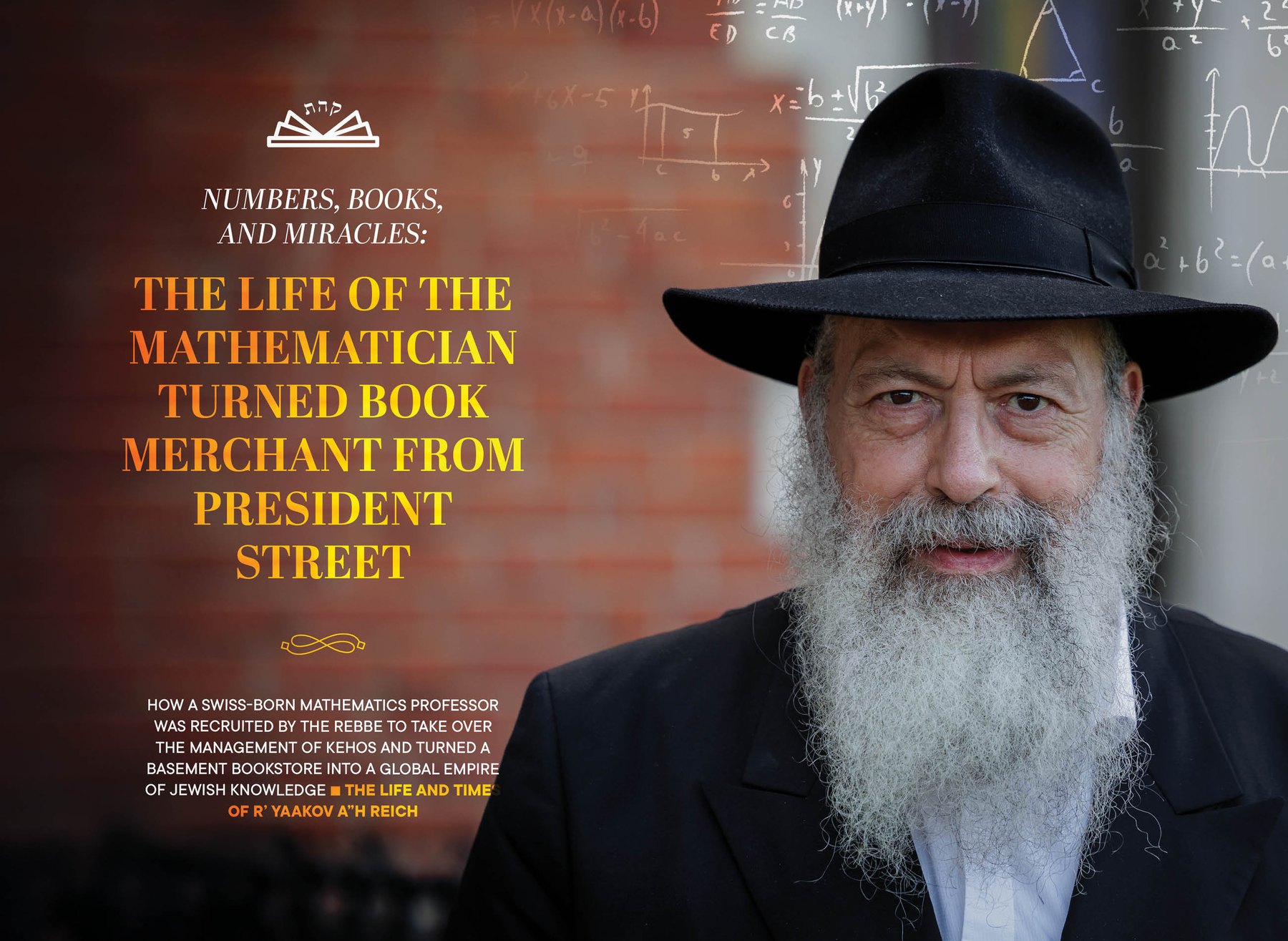
How a Swiss-born mathematics professor was recruited by the Rebbe to take over the management of Kehos and turned a basement bookstore into a global empire of Jewish knowledge. The life and times of R’ Yaakov a”h Reich
Shabbos, 7th of Teves, 5752. The clock showed 1:38 PM when the Rebbe entered the farbrengen at 770, Beis Chayeinu. The intense cold of New York’s winter remained outside, while inside, it was warm from the crowd and the holy atmosphere. Hundreds of Chassidim, young and old, crowded the large Beis Medrash. The song “Didon Notzach” erupted from the crowd—only two days had passed since the “Didon Notzach” celebration, marking the historic victory in the federal court.
During the farbrengen, the Rebbe spoke at length about the 10th of Teves and the return of the holy books and writings of our Rebbeim, urging everyone—men, women, and children—to add new sifrei kodesh to their homes and libraries. The Rebbe emphasized the special importance of paying for the books, recalling how the Rebbe Rayatz instructed to print the price on the pamphlets.
Then, the Rebbe introduced a new, revolutionary idea and called on the Chassidim to sign up as subscribers for books that would be published in the future. The new idea of book subscriptions was described by the Rebbe with a single Yiddish word that, surely, only a few in the audience were familiar with before. But since that conversation, it became an inseparable part of the Chabad lexicon: “prenumeranten” (pre-subscribers).
The concept of prenumeranten, beyond its spiritual value, connecting the Chassidim to the books even before they were printed – was also a brilliant business model. Rather than printing books and waiting to sell them – which requires large upfront financial investment and significant risk – money is received in advance from people committed to purchasing the books. This provides funds for printing, certainty about the required number of copies, and a healthy cash flow that allows for the printing of more books.
Rabbi Yaakov Reich, the manager of the Kehot bookstore, realized that he was the person who would need to implement this idea. At the end of the farbrengen, he went up to the Rebbe, who gave him a bottle of mashke with a special blessing for success in implementing the new subscription program.
Dancing In The Bookstore
As soon as Shabbos ended, R’ Reich sat down to work on the details of the program. About two hours after Shabbos ended, at 7:30 PM, the doors of the Kehot bookstore opened, with R’ Yaakov Reich behind the counter, ready to lead the prenumeranten program.
“It was an unforgettable sight,” described one of the diarists from 770. “A long line stretched outside the store. Thousands of Chassidim came to sign up for the subscription contract that had been hastily prepared, and of course, they bought from the selection of books available, as instructed by the Rebbe. The books were sold at a 40% discount, and everyone left with large bags of books. It was particularly touching to see the young children, when asked where they got the money, answering innocently: ‘Is there anything better to do with our Chanuka gelt than fulfill the Rebbe’s horaah?’”
In the middle of the bustling sale, some Chassidim, likely after having said many l’chaims at a farbrengen, burst in and started a spontaneous dance. The main salesman – Rabbi Reich himself – and the others joined in immediately, turning the sales counter into a place of joyous celebration.
The store remained open for about five hours, until late into the night, due to the many people who came. “It was a magical night,” recalls his wife, Mrs. Esther Reich. “You could see the joy in the people’s eyes, their excitement to fulfill the Rebbe’s will.”
The Rescue Journey In The Alps
R’ Yaakov Reich’s personal story, with his sheloshim on 5 Teves, begins in Switzerland shortly after World War II. During the war, when Vienna was under Nazi rule, his father, Rabbi Avraham Reich, managed to escape with his family through the Alps to neutral Switzerland.
In Switzerland, the family settled in a small town not far from Zurich. There, in 1948, Yaakov was born. His father, who came from a distinguished rabbinical family in Austria, instilled a love of Torah in his children, even though their private life wasn’t considered strictly Orthodox. Thus, Yaakov grew up with a deep connection to Torah and wisdom.
At a young age, it was clear that his academic future lay ahead, but he knew that in Switzerland, the options were limited. The dream of advancing in the academic world led him to make a significant decision—to emigrate to the United States.
From Mathematics To Chassidus
In 1975, Yaakov Reich arrived at the University of Wisconsin-Milwaukee. “It was interesting,” says his wife. “I arrived on the exact same date in Milwaukee for a dental internship. We both found our way to the Chabad House.”
At the time, the Chabad House in Milwaukee was an active center of Jewish life. Yaakov, who was immersed in his doctoral studies in mathematics, found the perfect connection between his worlds. “He was always a mathematician and a philosopher,” his wife smiles. “His mind worked differently and saw depth in everything. That’s why he connected deeply with Chabad Chassidus, its logic, and how it explains the deepest concepts.”
While pursuing his studies, he developed a special bond with the local shluchim, Rabbi Yisroel Shusterman and Rabbi Yisroel Shmotkin. They would sit together for long hours learning Chassidus. “He brought his mathematical approach to the learning,” recalls his wife. “He would analyze each Chassidus concept like a mathematical equation, deconstructing and rebuilding it until it was clear.”
With his deepening study of Chassidus, he understood the infinite difference between human science and the divine science of the Torah, particularly in Chassidus. He immersed himself in the study of Chassidus with great diligence.
In 1975, Yaakov and Esther were married. “It was a match made in heaven,” she says. “We both came from a Torah background, we were both in academia, and we both found our way to Chabad.” They began to build their home in Milwaukee but knew even then that this was just the first step on their journey.
Living Opposite The Rebbe’s House
“After our first daughter was born, we wanted her to attend the Rebbe’s school,” Mrs. Reich explains simply, as she describes the dramatic decision to leave quiet Milwaukee for Crown Heights, with all its challenges and dangers. “My mother asked, ‘What are you doing there?’ I told her, ‘The Rebbe is the closest thing to Hashem, and I am willing to sacrifice everything to be in his shadow…’”
The move was not easy. Crown Heights at that time was a tough neighborhood. The Beis Rivkah school was on Church Avenue, opposite a public school attended by low-income children. “There were even shootings inside the public school,” she recalls. “But for us, Beis Rivkah was the Rebbe’s school, and nothing deterred us…”
Initially, they lived at 1703 President Street, on the edge of the neighborhood near Utica Avenue, which was then a center for gang activity. They searched for a house in the heart of the neighborhood, and eventually settled at 1305 President Street, directly across from the Rebbe’s house. The house was in terrible condition. “It was practically destroyed. There was a non-Jewish man living there whose brother was smoking drugs there. Water was leaking from the ceiling. I didn’t even want to go in—it was really scary,” recalls Mrs. Reich. “But on the other hand, the idea of living so close to the Rebbe captivated me. I said to my husband, ‘Take it. Without even seeing it. It’s all worth it to live across from the tzaddik.’”
Many people from the community came to see the house, but no one wanted to buy it due to its poor condition. However, Mrs. Reich was determined, and they decided to write to the Rebbe about it. In the Rebbe’s response, there was both a blessing and guidance not to sign the contract with eyes closed, but first to see the house. Indeed, after visiting the house, they were able to negotiate with the seller and lower the price by ten thousand dollars, a significant amount at that time.
“Yaakov started renovating it himself, as much as he could,” she recalls. “The house wasn’t beautiful, but for us, it was the best it could be – we lived there, across from the Rebbe’s house.” Years later, when another opportunity arose, they bought the neighboring house as well. “A non-Jewish woman lived there, and we had a good relationship with her. She liked us, and once she told one of my children: ‘When you grow up – you’ll live in my house…’ And indeed, when she decided to sell the house, many people were interested. There was even someone who wanted to pay in cash, but in incredible hashgacha pratis, a big storm occurred on the day he planned to come, and because of this, she asked us to buy the house.”
Moments With The Rebbe And Rebbetzin
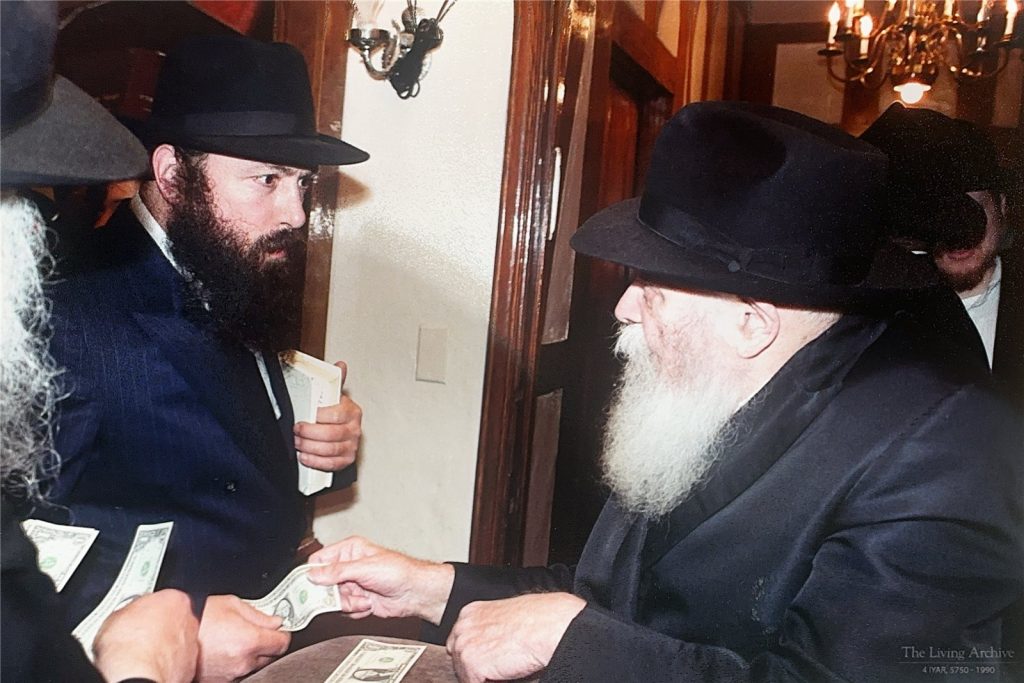
Life across from the Rebbe’s house brought special moments that remained etched in the family’s memory forever. “Every morning when there was no school, our children would stand by the stairs of the Rebbe’s house and have the merit of seeing him leave the house and get into the car,” Mrs. Reich recalls nostalgically. “The children would run after the Rebbe to the traffic light, and the Rebbe would wave goodbye… The driver always drove slowly until the traffic light, almost as if waiting for the children.”
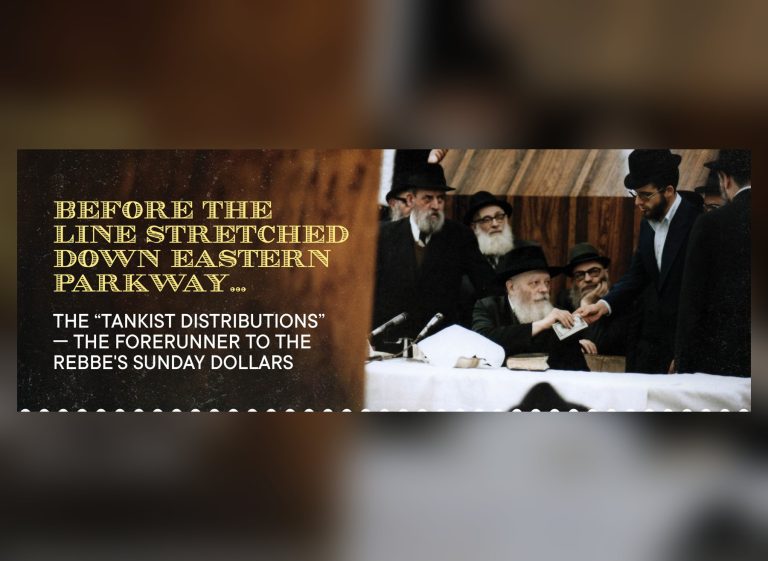
After the passing of the Rebbetzin, the center of the Rebbe’s life moved to his house on President Street, including the distribution of dollars on Sundays.
Once, the Reich family passed by the Rebbe, and their daughter Chana, who was then two-years-old, began to sing songs for the Rebbe from kindergarten. “The Rebbe stopped the line, listened to her with a big smile, and said: ‘You sing beautifully…’” recalls the mother emotionally. “They wrote about this then in one of the diaries. It was a special smile of the Rebbe, especially during those days when his face was very serious after the passing of the Rebbetzin.”
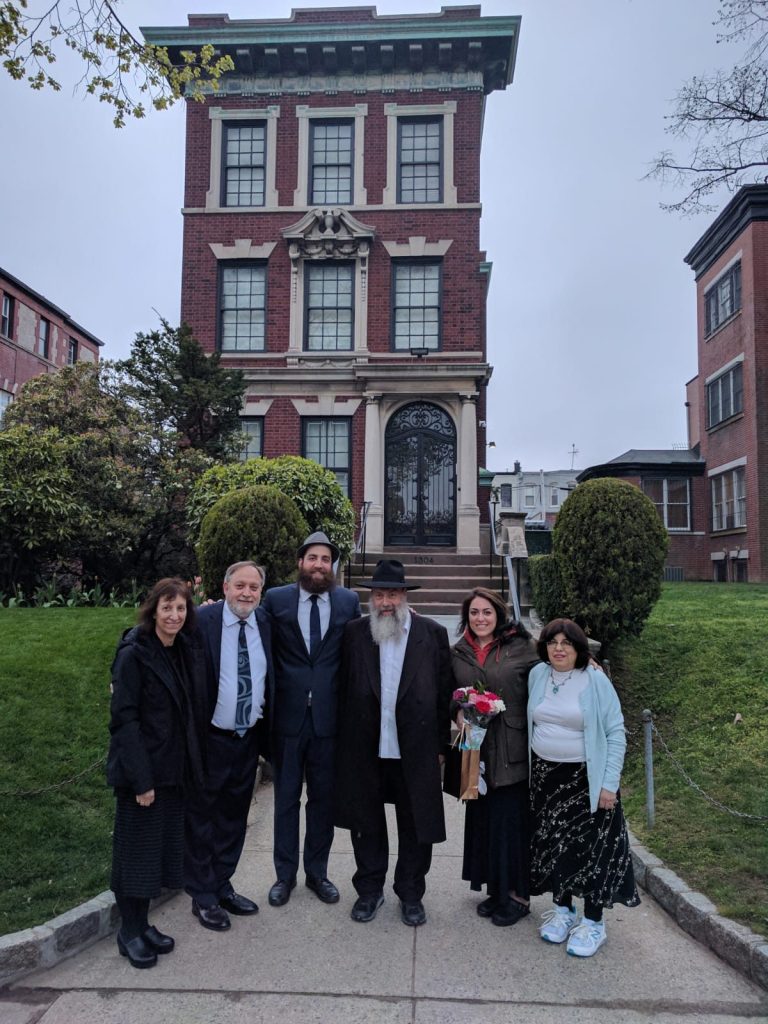
Even Rebbetzin Chaya Mushka, who chose to remain humbly in her home, was, of course, seen as one of the neighbors across the way… whether when she opened a window of her house, or when she opened the door to honor a special guest.
There were also moments of miraculous hashgacha pratis. Once, in the summer, when they went on vacation, they passed by Kehot because Rabbi Reich had to arrange something at the store. “Just as the Rebbe’s car made a turn to enter Eastern Parkway after the dollar distribution, on the way to the Ohel, I felt that the Rebbe was looking at us.” They drove on, and on the FDR they were suddenly overtaken by an intoxicated driver who caused a terrible accident, completely crushing their car, but miraculously, no one was harmed. “I felt that the Rebbe’s gaze saved us.”
The Revolution In Kehot – From A Small Basement To A Kingdom Of Books
Rabbi and Mrs. Reich first encountered the Kehot bookstore in the early 1970s. “We wanted to buy books for the children, but there were only black-and-white books, with very simple illustrations… the store itself was in a shabby basement next to Oholei Torah, with few books on the shelves.”
Even later, when the store moved to the corner of Kingston and Eastern Parkway, its current location, the situation didn’t improve. Sometimes it was open, and sometimes not. The shelves were half-empty, and often the desired book was not available, and they would say, “We’ll check if we have it in the warehouse. Come back next week, and we’ll see…” The situation was also poor in terms of financial management. People received books without paying, and over the years, the store’s deficit grew to enormous amounts.
During those years, a connection was formed between R’ Reich and Rabbi Shneur Zalman Gurary, one of the elder Chassidim and a leader in the Kehot management. R’ Reich regularly attended R’ Gurary’s Chassidus classes. One day, R’ Gurary approached him and asked him to take on the management of the store.
Rabbi Reich hesitated. He worked at Baruch College, a renowned university in the field of business, and was content with his position as a mathematics professor (by the way, both his job there and his wife’s job at NYU were miraculous, as they submitted their applications a month before the semester started, and despite the usual year-long process, they both got hired within a month!).
But one day, R’ Gurary came and said: “The Rebbe wants you to work here. I have a blessing for you from the Rebbe.”
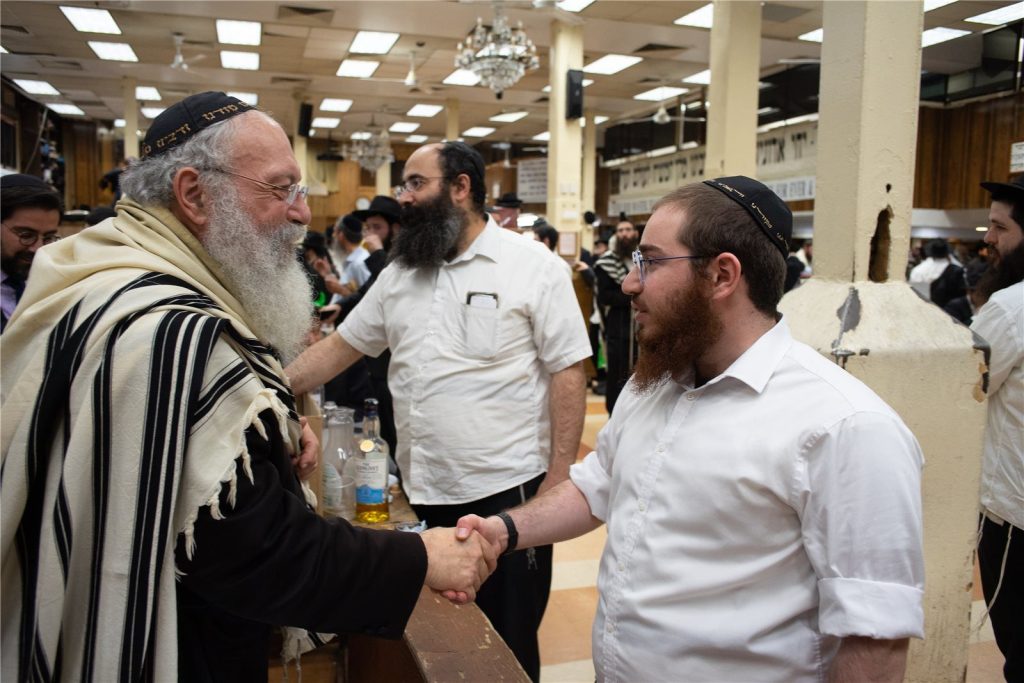
After consulting with his wife, R’ Reich accepted the offer. “We said, if the Rebbe said so, we must accept it. It doesn’t matter about the details.”
The revolution began immediately. The store started opening at set hours – from 8:00 AM to 6:00 PM, the shelves filled with books, and above all, it was organized and computerized. “We knew at every moment how many books we had, how many to order, how much money came in and how much went out.” He also renovated the store and made it beautiful.
The combination of proper management and his kind heart helped him recruit employees. Despite difficulties in paying salaries, he managed to hire good workers and told them: “I’ll pay you on time from my own pocket, and when the official salaries come in, you’ll pay me back.”
It was a time of flourishing in the printing of books. Rabbi Shneur Zalman Chanin, who had taken over the general management of the Kehot Publishing House at that time, published many new books in a short period, and the shelves were full. The payment procedures for the books were also refined.
Alongside his work with accounts and numbers, R’ Reich also paid attention to the neshamos along the way… For example, when he hired a young man who had left his homeland and family, and whose spiritual condition began to deteriorate, Rabbi Reich decided to take him under his wing. In addition to the work he gave him at Kehot, he would dedicate long hours to conversations with him. The investment bore amazing fruit—the young man became so strengthened that when he returned to his homeland, he became the shliach of the Rebbe in that country.
Later, the young man’s mother sent Rabbi Reich a heartfelt letter, thanking him sincerely for the spiritual salvation of her son.
The “Treasury Of Lubavitch Books” – A New Chapter In The Dissemination Of Torah
After Gimmel Tammuz, certain parties tried to undermine R’ Reich and remove him from his position. However, R’ Reich did not abandon his lifelong mission of disseminating sifrei Chassidus. Shortly after, under the guidance of Rabbi Sholom Mendel Simpson, he founded Otzar Sifrei Lubavitch.
In this framework, he published the Siddur and Tehillim in eye-catching print, and of course, with an English translation. Later, he also published the Chabad Machzor in both Hebrew and English, in clear and modern print. For a while, he even had a store on Kingston Avenue where he sold Chabad books in general, and especially Kehot books that were not available in other stores. He never asked for high prices and always tried to keep the price as low as possible so people could buy more books.
In time, the retail store closed, and R’ Reich transitioned to direct wholesale marketing – to bookstores, shluchim, and institution directors. He even launched a website where people could order the books.
The new venture focused particularly on publishing books in English, and its crowning achievement was the English edition of the Igros Kodesh, of which nine volumes were published, containing original letters the Rebbe sent. Just like the original Hebrew set, the letters were arranged in the order they were sent. R’ Reich was very careful that everyone involved in the work were Chassidish and yerei shomayim. The ninth and final volume of the English Igros Kodesh was the last one he managed to prepare before his passing.
When Mathematics Meets Faith
As a professor of mathematics specializing in probability, R’ Reich had a unique perspective on the miracles of the Rebbe, particularly through the answers in the Igros Kodesh. Beyond the Chassidic view that sees the G-dliness in the Torah and in the Rebbe’s miracles, when R’ Reich was asked to explain the topic to his colleagues, he “brought down” the divine wonder into mathematical terms.
“In independent experiments,” he would explain, “if the probability of my experiment succeeding is 50%, and the probability of your experiment succeeding is 50%, then the probability that both of us will succeed is 25%. When thousands of people are receiving accurate answers, the probability is virtually zero.”
He himself experienced many miracles. Once, when he was uncertain about a particular business deal and wrote to the Rebbe, he received the Rebbe’s answer in a letter addressed to someone with the same first and last name as the person he had intended to do business with.
Another fascinating incident occurred when a young woman from Paris consulted him about a shidduch, whether she should travel to New York to meet a young man suggested to her. R’ Reich said to her, “Why don’t you ask the Rebbe?” and explained how to receive answers from the Rebbe through the Igros Kodesh. She asked him to write on her behalf since she had no letters from the Rebbe and did not know Hebrew. Together, they wrote the letter to the Rebbe, and R’ Reich placed the letter in one of the volumes of Igros Kodesh.
The answer they opened to was in a letter to a woman in Paris, with a blessing for her upcoming meeting. In addition, the Rebbe gave specific instructions for her mother, who was experiencing marital problems (the young woman later said that her parents were facing relationship problems, and the Rebbe’s advice was very helpful). At the end of the letter, the Rebbe added the following line: “I haven’t heard from you in a long time. Know that I speak French, even though my secretaries do not.”
“A Heart Of Gold”
Beyond his involvement in the world of books, R’ Reich was a man of kindness in every fiber of his being. His home was always open to guests, his acquaintances say. No matter who arrived or when – they always had a place at the table, always a place to sleep.
Mrs. Reich recounts an episode that illustrates R’ Reich’s hospitality and humility: “One day, a guest sat next to my husband and began asking him questions: Where is he from? When did he arrive? When is he leaving? He just assumed my husband was also a guest…” She smiles. “My husband enjoyed the naturalness of the situation so much that he didn’t even bother to correct the mistake.”
R’ Reich supported worthy causes, including Chabad shluchim, mosdos chinuch and Chabad chessed projects. I, the writer of these lines, can attest that every time I approached him with a request to help Eshel Hachnosas Orchim, he always gave a generous contribution with a warm smile. “When someone needed help, he didn’t think twice,” his wife says. “He always said it was a privilege to help the Rebbe’s shluchim.”
“I was a little girl,” one of his daughters recalls, “and my father would regularly take us to visit Reb Shmiel, a Holocaust survivor who lived alone near their first apartment. I clearly remember how, before winter, my father would insulate all the windows in his old apartment with thick plastic so that he wouldn’t be cold and so the wind wouldn’t get in.”
These visits were an integral part of their routine. “Even after we moved to 1305,” she recalls, “from time to time, my father would drive to the old address to check on Reb Shmiel’s well-being and chat with him. We often went with him. Reb Shmiel, whose children perished in the Holocaust, would be filled with joy when he saw us. He would smile, laugh, and talk to us.”
She tells of a special sensitivity that her father taught them: “Sometimes, Reb Shmiel would give us candies that weren’t quite kosher enough – he simply didn’t know. My father, who was very strict about kosher, would guide us in advance: ‘Take the candy so you don’t hurt him, and then I’ll give you a kosher one afterward.’ It was a wonderful lesson in respecting others.”
R’ Reich didn’t stop at visits alone. “He would enter the kitchen,” his daughter says, “check what food he had, and make sure everything was okay. He always made sure he lacked nothing.
“The impact of this care for a lonely person was immense on us children,” she concludes. “It taught us what true kindness is – not only giving but giving in a way that respects the other, that gives him a sense of value and family.”
This was R’ Reich: a true man of kindness – not only in large financial donations but in personal, everyday care for every Jew, no matter who they were. He taught his children that kindness isn’t only in grand acts but in the small details – in regular visits to a lonely Jew, in a smile, in a kind word, and in true concern for others.
This past Cheshvan, R’ Yaakov Reich suffered a heart attack, and on the 4th of Kislev, he passed away at the age of 76.
R’ Yaakov Reich is survived by his wife Esther, and their children: Mrs. Efrat Edery, the Rebbe’s shliach to Japan, Rabbi Shmuel a’h, Rabbi Akiva, Rabbi Menachem Yosef, Rabbi Levi Yitzchok, Mrs. Chana Altman, and Rabbi Yehuda Baruch – along with a tremendous legacy of spreading Torah and Chassidus.
From Bris Mila to Kiddush Hashem: The Touching Encounter Between East and West
“I remember it as if it were yesterday,” Mrs. Reich says excitedly. “We had been in New York for a few years, and one day, Yaakov came home thrilled. He had a Japanese colleague in his department, a brilliant professor, who was married to a Jewish woman from Israel. They had just had a son.”
Since the baby born to a Jewish mother is considered Jewish according to halacha, Rabbi Reich spoke with the couple about arranging a bris for the newborn. The response was complicated. The Japanese husband was open to the idea, but the wife, surprisingly, firmly refused. Behind her refusal was a tragic story. In her family in Europe, a baby had died from bleeding after a bris. Since then, like an unbreakable decree, the entire family refrained from performing bris mila.
R’ Reich, instead of giving up, saw this as an opportunity. He knew that halachically, the bris needed to take place, despite the family’s distant history. But he also understood that a halachic argument wouldn’t convince them. So, he used his scientific background and explained in clear terms: “Today, there is a simple test to verify that the baby’s liver is developed enough and that he has enough vitamin K for proper blood clotting. This prevents any risk of bleeding.”
The simple, scientific words fell on attentive ears. Fear turned to hope. “How do we do the bris?” the mother asked eagerly.
The answer came quickly: In the Reich family’s minivan traveled the mohel along with bachurim from 770 who came to complete the minyan, and a full meal was prepared… And so, in the heart of bustling Manhattan, in the small apartment of a Japanese professor and his Israeli wife, a beautiful bris ceremony took place, with Rabbi Reich honored as the sandek. “It was an amazing sight,” she recalls. “The bachurim were dancing and singing, and the Japanese father stood excited, watching in awe this miracle called ‘circumcision.’”
The bris was a complete success, but its true success went far beyond the technical aspect. It was a moment when science and faith, East and West, fear and hope – all blended together into a wonderful kiddush Hashem. “This was Yaakov at his best,” Mrs. Reich concludes. “He knew how to take his scientific knowledge and use it as a tool for spreading Yiddishkeit. He understood that sometimes, to open hearts, you have to explain tradition in the language of the twentieth century.”
Beis Moshiach #1444 • pp. 10-19
© 2026 Beis Moshiach Magazine. All rights reserved.
This article originally appeared in Beis Moshiach #1444. You are welcome to share it with friends and family by email or in print, provided that you do not change, add to or omit any part of it, you credit the author and Beis Moshiach, and you include a link to archive.bmoshiach.org (written out in full in printed copies).
To republish this article in a newspaper, magazine, book or website, please request permission in advance at [email protected].