A Living Link in the Chain of Chabad Leadership
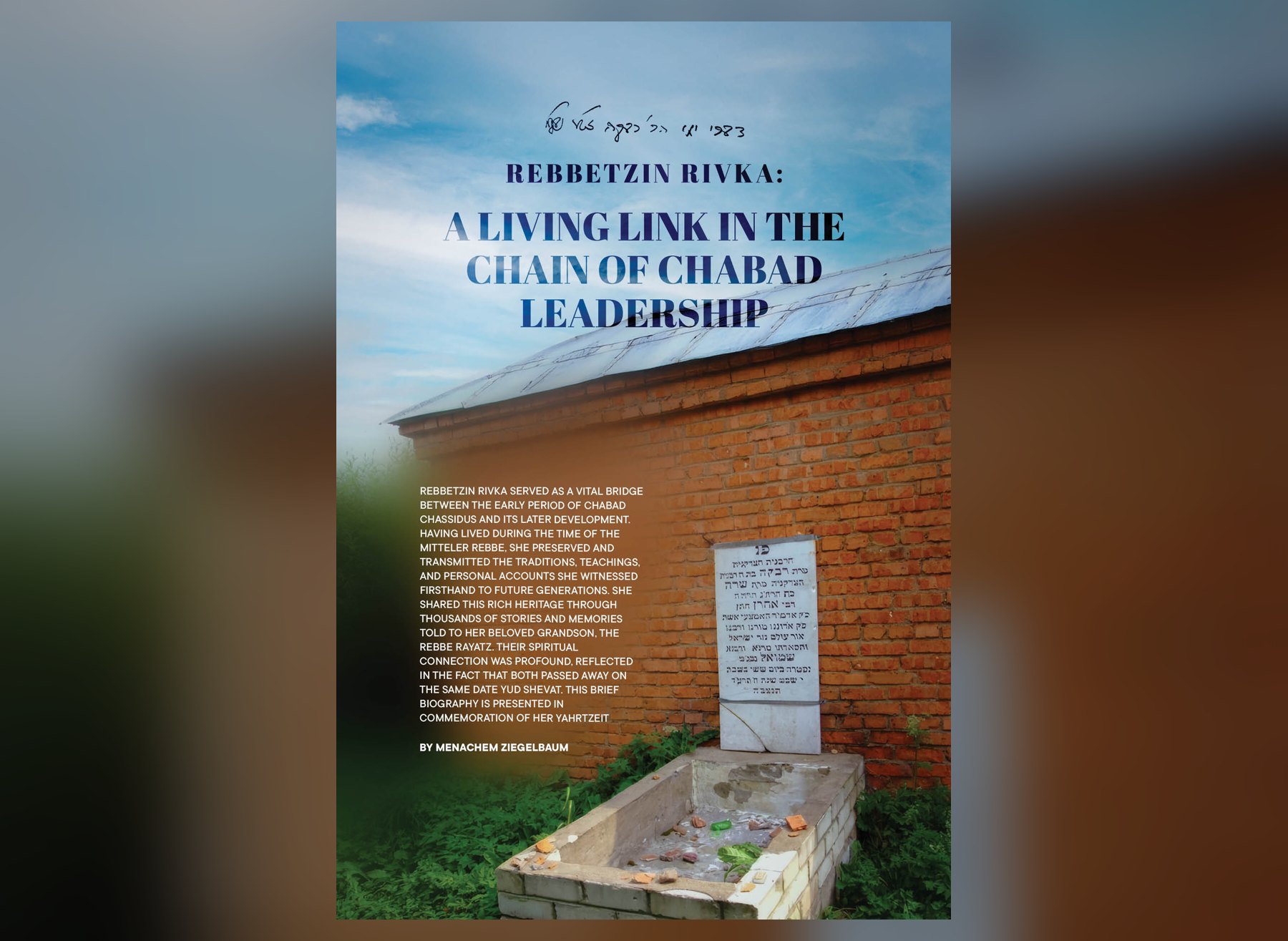
Rebbetzin Rivka served as a vital bridge between the early period of Chabad Chassidus and its later development. Having lived during the time of the Mitteler Rebbe, she preserved and transmitted the traditions, teachings, and personal accounts she witnessed firsthand to future generations. She shared this rich heritage through thousands of stories and memories told to her beloved grandson, the Rebbe Rayatz. Their spiritual connection was profound, reflected in the fact that both passed away on the same date Yud Shevat. This brief biography is presented in commemoration of her yahrtzeit
I
Thousands of girls who enter daily through the gates of “Beis Rivkah” schools worldwide don’t know much about the special person after whom these schools were named, the righteous Rebbetzin Rivka, wife of the Rebbe Maharash, and grandmother of the Rayatz Rebbe who established these institutions in memory of the one who played a major role in his upbringing and shaping his Chassidic personality.
Rebbetzin Rivka was a multifaceted figure, a woman of tremendous kindness, an extraordinary scholar, a walking book of memories, a role model of how a Chassidic personality should appear – and above all, an excellent administrator who knew how to manage and navigate the Chassidic court wisely during her father-in-law the Tzemach Tzedek’s lifetime, then during the time of her distinguished husband the Rebbe Maharash, and even held the scepter during her son the Rebbe Rashab’s tenure as the fifth leader of the Lubavitch dynasty.
She began her life with great difficulty, a childhood of hardship and deep pain that accompanied her for many long years, yet through her wisdom and big heart, she carved her path until she became an inspiring figure.
II
Rebbetzin Rivka was born in Lubavitch to her father Rabbi Aharon Alexandrov of Shklov, and her mother Rebbetzin Chaya Sarah, daughter of the Mitteler Rebbe.
When she was just two years old, her father passed away while her mother continued raising her with great love and dedication along with her siblings. Her mother spent many hours with her, telling stories about our Rebbeim – the Mitteler Rebbe and her grandfather the Alter Rebbe. She also gave her a book written in her father’s handwriting containing stories he had heard.
Several years later, her mother remarried, but the tranquility was short-lived as her mother fell ill. For a long time, her mother struggled with a severe illness amid great physical and emotional suffering. This period deeply affected young Rivka and her siblings. A cloud descended over their faces and their hearts were heavy. “Throughout her childhood… her complexion darkened, and her eyelashes showed her tribulations,” her grandson the Rayatz Rebbe recounts.
When she was only eleven years old, her mother passed away. She and her sisters were shuffled between relatives’ homes for six months until their grandmother Rebbetzin Sheina, wife of the Mitteler Rebbe, took her and her sister in, and she grew up in their home thereafter. Even there, life wasn’t easy for young Rivka; her older sister Tzivya Gittel, who was strict by nature, took charge of her education. She watched her younger sister’s every move and often scolded her when she thought something was said or done improperly. Years later, Rebbetzin Rivka told her grandson the Rayatz that her sister often made her cry real tears.
* * *
Shortly after the young wife of the Rebbe Maharash passed away, Rebbetzin Sheina sent a messenger to her son-in-law, the Tzemach Tzedek, proposing to match one of her two orphaned granddaughters – either young Rivka, a girl of about fifteen, or her older sister Tzivya Gittel, to his youngest son.
The Rebbe replied: “I’ve already been offered a shidduch from Liepoli with a dowry of twenty thousand silver rubles. Can you provide such a dowry?”
Rebbetzin Sheina responded magnanimously: “Indeed, I will provide a dowry. Though I don’t have such a vast sum, I’ll give as dowry forty years of eishes chaver (wife of a scholar) merits that have accrued to me.”
The Tzemach Tzedek smiled and said: “Indeed, this is an acceptable dowry.”
The Tzemach Tzedek didn’t rush to implement the shidduch proposal, and only began seriously considering it a year later. A special Beis Din was convened for the proposed match.
Reb Shmuel, the Maharash, the youngest son and intended chassan, was present at one discussion when he suddenly asked to say something. Everyone looked at him expectantly. “I remember,” he began calmly, “when I was just a three-year-old child, I played with her – referring to Rivka – as children do, and during play I told her I would take her as my wife. I recall everyone present laughed at my childish mischief, but now that scene comes before my eyes, and I think those words were not said without reason.”
Maharash remained silent and all waited for him to continue. After a moment, he went on quietly, “Although I am afraid to marry her because of the honor of her older sister.”
The Beis Din eventually ruled that both sisters were worthy to marry into the Rebbe’s family and that both suggestions should be explored. At this point, the Beis Din did not decide which of the two sisters should gain the royal crown. A few months later, the Beis Din reconvened and after much discussion decided that due to the childhood incident, Reb Shmuel and Rivka should marry.
When the decision was made, the Tzemach Tzedek called the eldest daughter Tzivya Gittel to his room. He asked for her consent to her younger sister’s match with his youngest son, requesting her forgiveness. He promised to care for her sister like a father. The elder sister, who worried greatly about her younger sister’s future, knew that with such an explicit promise from the Rebbe, she could rest assured, and gave her wholehearted consent.
The Rebbe later arranged her marriage to a respected wealthy man who provided for all her needs.
That evening, the engagement between Rebbetzin Rivka and the Maharash was celebrated with great splendor.
“On Thursday, the 11th of Nissan 5610 [In the shalsheles ha’yachas in HaYom Yom it says 5609 – Ed], was the wedding celebration of the Maharash… with his (true) soulmate, my grandmother the renowned righteous Rebbetzin Rivka… they were in their youth…” writes her grandson the Rebbe Rayatz with deep emotion.
Hours before her wedding, the young girl entered her father-in-law’s holy chamber to receive his bracha. After blessing her profusely and she was ready to leave the room, he surprisingly asked for her bracha in return. Though momentarily flustered, she considered his request as an order and she blessed him, and he responded, “Al tehi birkas kalla hedyot b’einecha” (a clever reversal of the statement of Chazal,“Al tehi birkas hedyot kalla b’einecha”).
The Tzemach Tzedek was overjoyed during those days, delivering numerous Chassidic maamarim. At the final Sheva Brachos, he delivered a deep maamar beginning with “Mashiach comes to return the righteous in repentance.” The outstanding Chassidim among them, the lions of the group such as Rabbi Yitzchok Isaac of Homil, Rabbi Nechemya of Dubrovna, Rabbi Yitzchok Isaac of Vitebsk, Rabbi Hillel of Paritch, Rabbi Peretz of Bieshenkovitz, Rabbi Pesach of Malastovka, and many other elder Chassidim, were thoroughly delighted and they farbrenged in great joy and excitement.
A special apartment was prepared for the young couple in the Rebbe’s courtyard, where they lived for eighteen years until the great fire in Lubavitch which destroyed large parts of the town, including the buildings of the Rebbe’s court. After the fire, the Maharash purchased land four times larger and built four large buildings, including a special house for the Rebbetzin from where she ran the court.
“The rose began to bloom, and after G-d helped her begin seeing a life of peace and honor, she emerged from her hardships. Her previously troubled soul, marked by tribulations visible on her beautiful face and pleasant eyes like a cloud of darkness, had found rest,” describes the Rayatz Rebbe.
III
Young Rebbetzin Rivka received special affection from her father-in-law, the Rebbe, and mother-in-law, Rebbetzin Chaya Mushka, even compared to the other daughters-in-law. Her noble actions and gentle soul drew them close. The Rebbetzin taught her the ways of the Lubavitch royal court and entrusted her with managing the household finances. The Tzemach Tzedek favored her with extra gifts, though he did so wisely and secretly to avoid jealousy.
It is therefore no surprise that after the passing of Rebbetzin Chaya Mushka, wife of the Tzemach Tzedek in the year 5621/1861, responsibility fell upon the young daughter-in-law. Following the passing of his wife, the Tzemach Tzedek withdrew into his holy room and refrained, as much as possible, from receiving visitors. The Rebbe was broken in spirit. His sons, great in their own right, were occupied with their spiritual matters, and with the consent of the rabbanim, the young Rebbetzin, the wife of the youngest son, Rebbetzin Rivka, entered to fill the void and began managing the affairs of the court effectively.
After the Tzemach Tzedek’s passing and her husband the Rebbe Maharash’s assumption of leadership, Rebbetzin Rivka continued managing court affairs. While little is known about her administration during her father-in-law’s time, it is known that she handled financial and administrative matters.
She was a woman of chessed, distributing bread to the poor. Though the Rebbe Maharash lived a life of wealth and provided substantial funds, she always needed more money for tzedaka. When unable to request more from her husband, she would pawn her jewelry to help the needy. Every six months, before holidays, the Rebbe Maharash would redeem her jewelry.
The Rebbe said in a sicha that Rebbetzin Rivka would secretly enter her husband’s room during his various outings, to copy his Chassidic manuscripts and maamarim. Thanks to her, we have many of his maamarim. The Rebbe Maharash often sent her to his father’s gravesite with his written requests, for her to read them and daven which showed that he relied on her and delegated to her many important matters.
IV
Many stories from the history of Chassidus, from the time of the Alter Rebbe and even earlier, from the lives of his parents and the Baal Shem Tov, are recorded in the golden annals of Chassidic history by the Rebbe Rayatz, who enriched Chassidic history with numerous stories—stories that enlighten and warm the heart and soul, opening a window of light and warmth of Chassidus.
A significant portion of these stories is credited to his grandmother, Rebbetzin Rivka, who was a central link between her grandson, the Rebbe Rayatz, on one hand, and the period of the Mitteler Rebbe and beyond, on the other. From her childhood, she heard many stories and was often present at many events in the Lubavitch court. It was she who skillfully transmitted these spiritual Chassidic treasures to her beloved grandson, the young Yosef Yitzchok.
“In my childhood, I loved to hear stories, as most children do,” the Rebbe Rayatz later recounted. “However, two additional reasons led to my developing a love for hearing stories.”
It all began on one winter Shabbos when his mother, Rebbetzin Shterna Sarah, was not in Lubavitch for Shabbos, and the young boy was left alone with his father. When Yosef Yitzchok became bored, he entered his father’s study while he was learning, and watched him intently as he diligently studied the holy books with a radiant face. The child felt envious of his father and approached the bookshelf, flipping through books here and there until he grew tired of this task. Finding nothing else to do, he sighed deeply – a sigh of a child. His father, noticing this, closed his books, instructed him to put on warm clothes, donned his own Shabbos winter coat, and took him in his arms to his grandmother, Rebbetzin Rivka’s house.
“My father said to her a few things I didn’t understand, and then he turned to me and said, ‘You will stay here with your grandmother and listen to whatever she tells you! Sit calmly and hear all that she will say!’”
The Rebbe Rashab left the house, and the young Yosef Yitzchok stayed with his grandmother. She opened the book Tzena U’Rena and began telling him the weekly parsha.
This marked the beginning. The child became enamored with his grandmother’s stories, and from then on, he would often visit her. Seeing his thirst for stories, she quenched it over the years with hundreds, even thousands, of stories from the lives of the revered Chabad leaders and their Chassidim.
“The Bubbe, Rebbetzin Rivka was a woman of great knowledge, and every story she told was precise—when and from whom she had heard it,” testified her grandson, who spent so many hours by her side. She didn’t simply recount stories but would add general descriptions about whom she had heard them from and when the event took place. “Every day, when I would return from cheder, I would go to the Bubbe, Rebbetzin Rivka to ask her to tell me a story. My visits to her continued throughout the years, until her passing,” the Rebbe Rayatz wrote with longing. “The stories of my grandmother hold a special place in my journals and memories.”
V
Erev Rosh Hashana 5643/1883
The Rebbe Maharash entered his wife’s room and spoke briefly with her, as was customary for the leaders of Chabad before Rosh Hashana each year. Rebbetzin Rivka, with her great insight, understood that her husband was hinting to her that he would pass away in the coming year. The Rebbe was still young and in the prime of his life.
With her great wisdom, she did not panic but quietly asked, “What will happen to the young children?”
The Rebbe did not answer her directly but said, “I will ascend thirty-two steps upward, and you will descend thirty-two steps downward,” hinting at the thirty-two years she would continue to live in this world after his passing, until the winter of 5674.
After his passing, Lubavitch was left bereft, broken, and sorrowful. It took about ten years before her son, the Rebbe Rashab, agreed to accept the mantle of leadership and continue the glorious lineage of the Lubavitch dynasty.
Even after her husband’s passing, Rebbetzin Rivka continued to live in their apartment in the Lubavitch courtyard and effectively continued managing the court’s affairs. Her son, the Rebbe Rashab, was very careful to honor her, visiting her daily. At every opportunity, whether on Shabbos or Yom Tov, and before leaving Lubavitch for extended periods, he would visit her, ask for her blessings, and seek her wise counsel. Many of the court’s affairs were conducted in her home, such as baking the matza for the Rebbe and his family, and the Kiddushes that took place every Shabbos or on Yomim Tovim.
When the Yeshiva Tomchei Tmimim was founded by her son, the Rebbe Rashab, in 1897, Rebbetzin Rivka immediately devoted herself to the yeshiva and its students, deeply concerned for their material well-being. She didn’t hide behind royal decorum but personally worked to establish the kitchen and organize the sleeping quarters, often inquiring about the situation and welfare of each student. She was the first to ensure the creation of the kitchen that would provide meals for the students and even allocated some of her private home’s rooms for this purpose.
Rebbetzin Rivka treated the students as her own children and would lovingly refer to them as “the children.” Many of the students who came from abroad were regular guests at her table, eating the meals she herself had prepared for them. This was a crucial aspect of her son’s decision to establish the yeshiva, as before its establishment, he was concerned about how to support the bachurim’s daily needs. His mother reassured him, saying, “Why are you worried? What we eat, they will eat too.”
VI
In her later years, Rebbetzin Rivka suffered from various illnesses, which led her to leave Lubavitch for rest and recuperation in health resorts. With her great spiritual insight, she knew the age at which she would pass from this world and explicitly said she would pass away at the age of eighty. When asked what she based this on, she replied with the bittul she had toward her father-in-law, the Tzemach Tzedek, in her youth: “My father-in-law once blessed me with long life, and since a tzaddik’s blessing for long life is until the age of eighty, that’s how long I will live—no more.”
Indeed, throughout her life, she remained spiritually connected to both her father-in-law, the Tzemach Tzedek, and her husband, the Rebbe Maharash, speaking about them often.
On Monday of parshas Beshalach, the 6th of Shevat, 5674/1914, Rebbetzin Rivka finished Shacharis with the minyan. She made her way home, but on the way, she stopped at the home of her grandson the Rebbe Rayatz. Lubavitch was covered in deep snow, but with the rise of the sun, the snow began to melt, and the ground became very muddy. The paths were difficult to traverse, yet nothing stopped her from continuing her daily routine.
Upon entering her grandson’s house, she handed him a draft of a letter she had written to a Rav for the benefit of a family member. Her grandson read the letter carefully and, at her request, offered suggestions to improve the content and style. She accepted his suggestions and took the letter with her. After a visit that lasted over an hour, she left to return home.
The next day, Rebbetzin Rivka did not feel well, and a doctor was called to examine her. He found only a slight cold. Since no one else was with her, her grandson remained by her side for several hours. To make use of the time, he brought with him the yeshiva’s financial books and continued working while deeply concerned for her.
Three days later, on Thursday, the 9th of Shevat, 1914, in the early morning, she read the letter that her sons, the Rebbe Rashab and R’ MM, had sent her. Afterward, she spoke warmly of her son, the Rebbe Rashab: “He is a very great person. Apparently my father-in-law recognized him for what he is. May Hashem grant him long life until the coming of Moshiach.”
For about a quarter of an hour, she spoke highly of her son, but eventually, she stopped speaking, even though it seemed she had more to say. That evening, she began speaking again, recounting many stories about her father-in-law and her husband.
That night, her grandson, the Rebbe Rayatz, who had been raised and nurtured by her for many years, took it upon himself to care for her. He immediately informed his father of her deteriorating condition.
In the morning, on the 10th of Shevat, 1914, Rebbetzin Rivka asked her grandson to hand her the siddur. She recited the Shema and davened Shemone Esrei with great devotion. Then, she placed her hands on her beloved grandson’s head and said graciously, “Thank you for your care.”
The Rebbe Rayatz turned to place the siddur in its proper place, and when he turned back to face her, he noticed that at that moment, her soul had departed for the higher realms, returning complete and pure to its Creator.
* * *
It was clear that her burial could not wait until her son, the Rebbe Rashab, returned from France. Her devoted grandson, the Rebbe Rayatz, took responsibility for the arrangements, deliberating where to bury her – whether near her father-in-law, the Tzemach Tzedek, or beside her husband, the Rebbe Maharash. After much thought, he decided to bury her behind the Tzemach Tzedek’s and Rebbe Maharash’s Ohel, close to her husband’s resting place. When his father returned to Lubavitch, he praised his son’s decision, saying, “You did well.”
A large and honorable funeral was held for her, attended by the Chassidim of Lubavitch, with the talmidim of the chadarim and the talmidei ha’tmimim leading the way. The Rebbe Rayatz, deeply grieving, cried bitterly during the procession, unable to calm himself. He repeated again and again, “The crown of our family’s glory has been taken.” He also said, “When people enter the Ohel of the Rebbeim, they should enter hers as well. She knew them all.”
After her passing, the Rebbe Rashab wrote a letter to his daughter-in-law and granddaughters, expressing his great sorrow: “There are no words to express our great loss. A great and holy light has been taken from our home.”
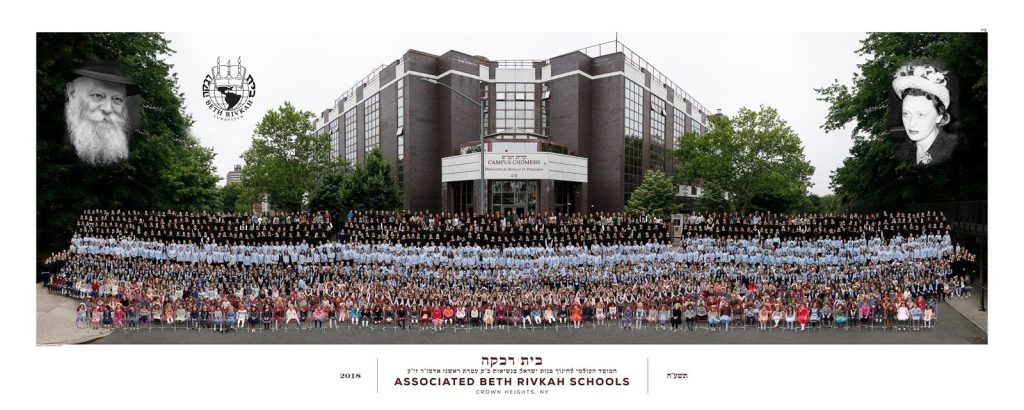
Many years later, in 1942, while living in the United States, the Rebbe Rayatz founded a series of educational institutions for girls, naming them “Beis Rivkah” in honor of his grandmother. The name was not merely symbolic but served as a guiding light for the thousands of girls who studied in these institutions, remembering and being inspired by her great influence.
On her yahrtzeit, the 10th of Shevat, 5710/1950, the Rebbe Rayatz published a special maamar to be taught on her yahrtzeit, entitled “Basi L’Gani.” Thirty-six years later, on the same day, the Rebbe Rayatz passed away, and their yahrtzeit became a shared day of remembrance.
Beis Moshiach #1446 • pp. 42-47, 48
© 2026 Beis Moshiach Magazine. All rights reserved.
This article originally appeared in Beis Moshiach #1446. You are welcome to share it with friends and family by email or in print, provided that you do not change, add to or omit any part of it, you credit the author and Beis Moshiach, and you include a link to archive.bmoshiach.org (written out in full in printed copies).
To republish this article in a newspaper, magazine, book or website, please request permission in advance at [email protected].