The Carlebach Twins in Yechidus by the Rebbe Rayatz
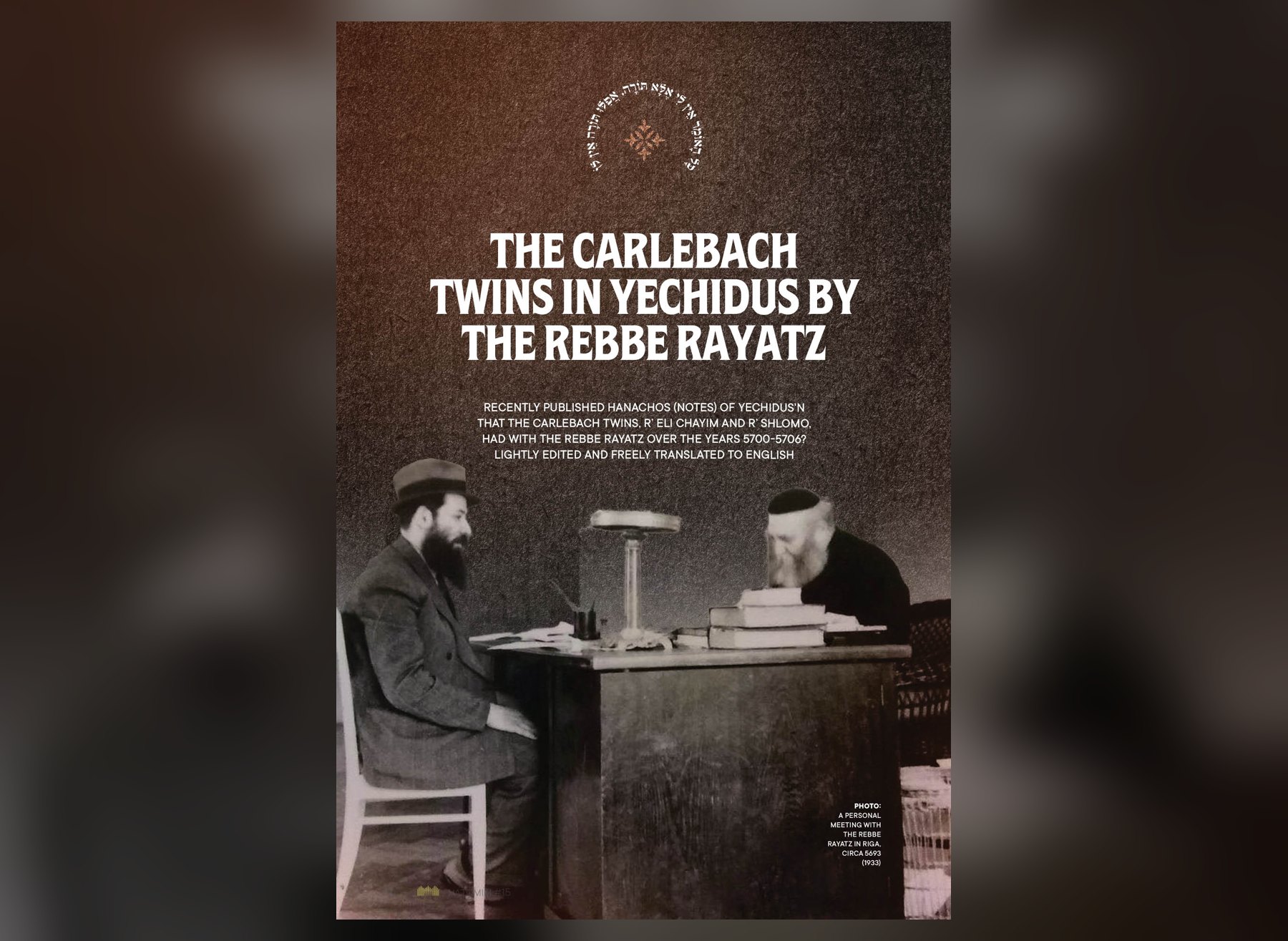
Recently published hanachos (notes) of yechidus’n that the Carlebach twins, R’ Eli Chayim and R’ Shlomo, had with the Rebbe Rayatz over the years 5700-5706, lightly edited and freely translated to English.
— 1 –
Off To Lakewood…
די רייד וואס כ”ק אדמו”ר שליט”א מליובאוויטש אמר להאחים החסידים שלמה ואליהו חיים קארליבך בליל ד’ חשון תש”ד בעת הפרדם מכ”ק לישיבת לייקוואוד.
The words that the Rebbe [Rayatz] shlita of Lubavitch said to the Chassidishe brothers Shlomo and Eliyahu Chaim Carlebach on the 4th of Cheshvan 5704 (1943) before departing from the Rebbe to the Lakewood yeshiva.
The Rebbe: What should I tell you?
Elye Chaim: The Rebbe is telling us that we should go to Lakewood [?]
The Rebbe: [smiling:] Your father [is telling you to. But] why not?
EC: Because we will not be by the Rebbe.
The Rebbe smiled and said:
The Rebbe: I wrote you a letter that you should always know that anywhere there is a shortcoming, you should look for it in yourself. If there is a question whether the shortcoming is in the yeshiva or in yourself, you need to know that it is in yourself.
If you will come to Lakewood with the same sulkiness that you went to Torah Vodaath, there will again be no progress.
You need to study diligently, then Hashem will give you success, and it will be successful.
How To Draw Another Closer to Chassidus?
What will be with Yiras Shamayim?
Anyone who says “I have nothing but Torah” – even Torah he doesn’t have. And it’s not bittul Torah [when one works on his Yiras Shamayim] because anyone who says “I have nothing but Torah” – even Torah he doesn’t have.
[Apparently, the conversation shifted on how to bring others closer to Chassidus:]
If one wants to do someone a favor because one likes them, there’s no benefit in being mevatel (nullifying) them, and in general this is not a way, not a Torah way. One needs to be mevatel himself. If one wants to bring someone closer, it’s not through nullification but only through drawing near.
You need to tell them: Your way is indeed a way, but my way is better. When one is mevatel oneself and has good middos, that’s an attractive force that draws the other person closer. (And if not, bringing someone closer once or twice certainly has an effect), especially with a ben Torah.
Ahavas Yisrael doesn’t mean that one needs to show that one likes the other person – rather it is an inner heartfelt feeling.
Davening Properly
Sometimes one needs to daven more than just with the pirush ha’milos (the meaning of the words), but this is only when es davent zich (=the prayer flows naturally), like the difference between Shabbos and weekday (once in two weeks) [-It’s unclear whose words these are – Ed.]
One also needs to say Tehillim. You need to become great lomdim [=scholars]. Simply sit down to study and know – to learn with good knowledge. One needs to know even Gemara thoroughly. One needs to know that the Gemara is dvar Havaya [=the word of G-d]. Abayei and Rava and Rabi Avahu (?) were indeed great geniuses and could say pshtelach [=novel insights], but these were souls that revealed dvar Havaya in this world.
Learning Chassidus “For Real”
The Rebbe: Do you study Chassidus?
EC: Yes
The Rebbe: You only have the “arum” [the “peripheral” general ideas] or do you actually study properly? (The Rebbe shook his head and remarked). In Chassidus, the main thing isn’t quantity, but rather when you learn three lines and live from it for days and weeks.
[Translation to English from the Yiddish text, written in a style appropriate for a frum (religious Jewish) crowd]:
EC: We didn’t have a mashpia [spiritual mentor].
The Rebbe: What do you mean you didn’t have a mashpia? What do you mean you didn’t have a mashpia? If one knows Lashon Hakodesh one can learn on their own. You shouldn’t waste your time on the “arum”, only for the essence.
I give you now a bracha: You should be yerei shamayaim, lomdim, and Chassidim.
Do you still remember when you were by me in Vienna?
EC: Yes.
The Rebbe smiled and said:
The Rebbe: at that time, I gave you a bracha: You should be bnei Torah. What was meant was not German boys, rather to be bnei Torah. And the bracha was successful, baruch Hashem (smiling). Until now it was just the arum. From now on, the bracha should illuminate your inner selves!
And the bracha I give you now (that you should be yerei shamayaim, lomdim, and Chassidim) will also be fulfilled with Hashem’s help and should have the same success.
About Kibbud Av V’eim
The mitzva of honoring your father and mother is a mitzvas asei d’Oraysa. One needs to have an entirely different level of derech eretz (respect). You should write to your parents often (and to relatives)! You should be yerei shamayaim, lomdim, and … Chassidim.
The Rebbe smiled heartily when saying the above…
The Rebbe: How many bachurim are in Lakewood?
Shlomo: About 15
The Rebbe: [Aha..] 15. Travel in good health.
– These are the words of the Rebbe, may he live many good years.
The Viennese Bracha: Not German Boys…
Around the year 5691 (1931), when the Rebbe Rayatz was in Vienna for medical treatment, Rabbi Naftali Carlebach brought his two children, the twins Shlomo and Eliyahu Chaim Carlebach, to receive a bracha from the Rebbe Rayatz. The Rebbe said to them “You should be Chassidishe Yidden and not be children in the German style. You should sleep with a tallis katan and serve Hashem with joy.” The Rebbe was standing at that time by the doorway.
— 2 —
In Galus
בס”ד. ר”ד מה שאמר כ”ק אדמו”ר שליט”א להתלמיד אלי’ חיים. בליל ד’ אייר תש”ד.
Transcript of the what the Rebbe shlita said [in yechidus] to the Talmid Elya Chaim on the night of the 4th of Iyar, 5704
The Rebbe: How are you? Have you truly accomplished in learning? You have not? [its unclear if the Rebbe said this or R’ Elya Chaim – Ed.]
The Rebbe: The truth is, you should have been learning here [in Tomchei Tmimim]. And just because of your mother, you must be there in galus. On Acharon shel Pesach, I gave you a bracha that you should leave from there with great wealth. [The Rebbe repeated himself and clarified:] With lots of Torah.
EC: When can we come here?
The Rebbe: Not without permission from your father. One must keep kibbud av v’eim.
The Rebbe: Which mesechta are you currently learning?
EC: Kiddushin
The Rebbe: Do you know it clearly?
EC: Almost
The Rebbe: Does Reb Aharon give shiurim?
EC: Twice a week
The Rebbe: Deep ones?
EC: Yes
The Rebbe: How many bachurim are there?
EC: 18
The Rebbe: Are they ehrliche?
EC: Misnagdim
The Rebbe: What does that mean?
EC: They are fooling themselves
The Rebbe pointed to himself:
The Rebbe: [Fooling] themselves?
EC: Yes
The Rebbe: Mussar is a necessity in Yiras Shamayim, Chassidus is a refined understanding. Is your father satisfied with you?
EC: As for the side of Nigleh yes, but not from the other side – Chassidus
The Rebbe: Why not?
EC: Because he doesn’t like Chassidus
The Rebbe nodded his head in response:
The Rebbe: One must be well-rested, keeping the times of eating and sleeping.
How Many Hours of Chassidus?
The Rebbe: Are you learning Chassidus?
EC: Three hours a week, but I am now making a strong resolution to fulfill the Rebbe’s letter.
The Rebbe: You shouldn’t fight with them, but also not be ashamed of your derech. You need to learn Chassidus for 10 hours [a week] in your own time and then no one is a baal deah over you. But besides that, you need to learn a lot of Nigleh.
The Rebbe: Do you daven?
EC: On Shabbos we want to daven b’arichus, but R’ Aharon already eats with the crowd at 10:30
The Rebbe: Why don’t you start then? [The meaning of this is unclear – Ed.]
EC: Because we then need to go in the mikva.
The Rebbe: When do you start to daven?
EC: 8:30
The Rebbe: To learn and daven?
EC: Yes
The Rebbe: Who davens by the amud (leads the prayers)?
EC: Sometimes my brother or someone else
The Rebbe: Which nusach do you use?
EC: I use Nusach Ari [the Rebbe smiled] and my brother uses Nusach Sefard
Talking in Learning
The Rebbe: Do you understand his [R’ Aharon’s] shiurim?
EC: Some of them
The Rebbe: Do you talk a lot with him in learning?
EC: A little
The Rebbe: Throughout the weeks you were here, you should have talked with Mentlick in learning so he could see where you hold in learning.
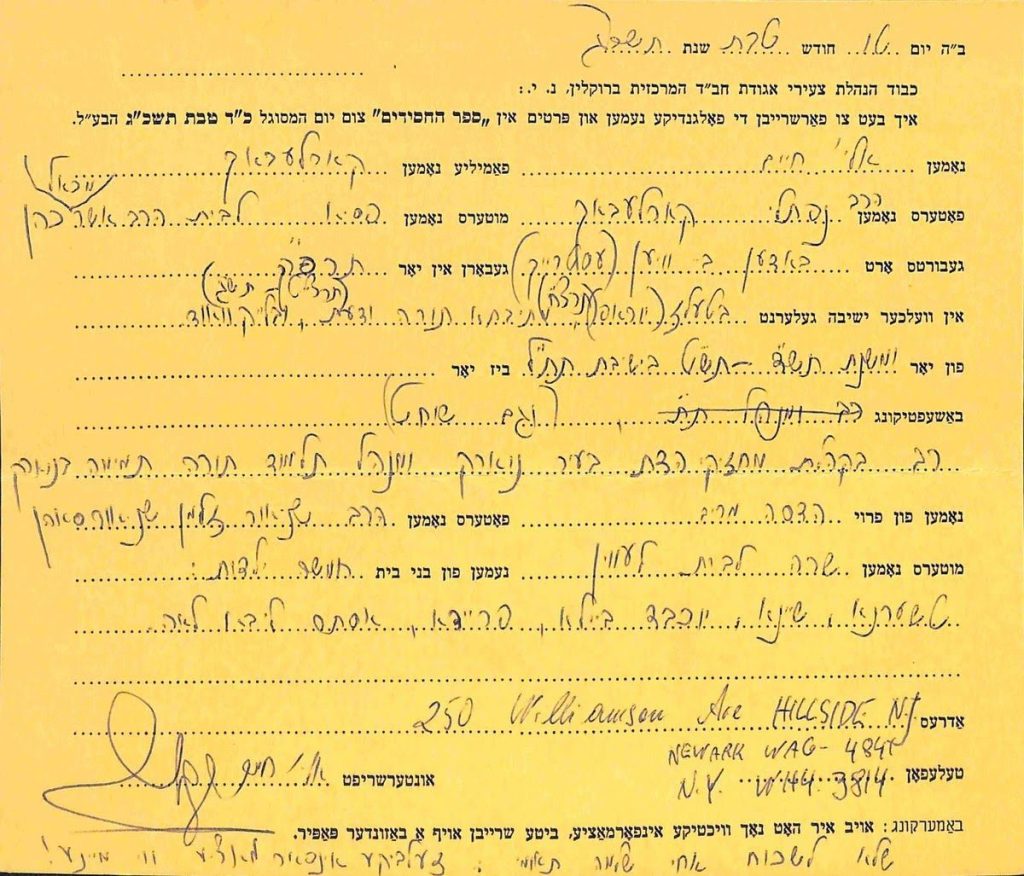
The Rebbe: How long have you been in America?
EC: 5 years
The Rebbe: Are you citizens yet?
EC: No
The Rebbe: Do you know the language of the country?
EC: We don’t know English at all
The Rebbe smiled
[…]
EC: Rebbe, what will be with us, we are really in exile there, when will we already come to Tomchei Tmimim?
The Rebbe: (b’dveikus) You need to really learn, simply, know [full] mesechtos, etc. (?) End of summer we will, G-d willing, see [about what you asked]. But [you must] learn well.
EC: Sometimes we miss [being here] so much that it gets so hard that we can’t learn
The Rebbe: No, no, one must learn.
EC: Will the Rebbe answer my letter from Nissan?
The Rebbe: There’s nothing to answer.
EC: What should I learn after Kuntres U’Maayan?
The Rebbe: Where are you holding there?
EC: About halfway through
The Rebbe: Review it again, know it well. After that learn Kuntres HaTefilla, but know [Kuntres] U’Maayan well.
EC: What should I learn leil shishi?
The Rebbe: Not the whole night! From twelve you should learn maamarim [wherever] you are holding for an hour, [but don’t stay up] later than two.* You should write to me from time to time what you are doing, may Hashem help!
– These are the holy words of the Rebbe, may he live for many good years.
– 3 –
Admittance To Tomchei Tmimim
בס”ד. ר”ד מה שאמר כ”ק אדמו”ר שליט”א להתמים אלי’ חיים. ביום ד תמוז תש”ד בשעה 8 בערב.
Transcript of what the Rebbe shlita said [in yechidus] to the tamim Elya Chaim on the 4th of Tammuz 5704, at 8 PM.
The Rebbe: Mazel tov, mazel tov for your sister’s engagement. What’s happening with you?
EC: I am here. May the Rebbe forgive me for being late to the Rebbe’s instruction.
The Rebbe signaled his forgiveness
The Rebbe: Where is Shlomo?
EC: He claims he won’t become a talmid chacham here
The Rebbe: Why doesn’t he claim he won’t become a yerei shamayim there?
EC: He says he means it l’shem shamayim.
Being Accepted to Tomchei Tmimim on 3 Conditions
The Rebbe: I am accepting you to the yeshiva on three conditions:
a. You should learn with great hasmada [=diligence].
b. You should guard your time – I will give you a special seder tomorrow in Nigleh and Chassidus.
c. Guarding your health – going to sleep on time and keeping the eating time.
You must strive [to grow] in learning, in middos tovos, and put in effort towards becoming [so].
EC: How does one become so?
The Rebbe: Before every word uttered, you should think whether you should say it or better remain silent… A Chassid must be clever, not a fool.
Whip Your Horses
I will tell you a story! The Alter Rebbe – when he was in… he studied Nigleh with the Malach – son of the Maggid of Mezritch – and the Malach would study nistar with the Rebbe. Once, when the Rebbe needed to return home, R’ Avrohom accompanied him out. When the Rebbe was sitting in the wagon, the Malach said to the wagon driver – “Whip the horses until they cease being horses.” The Rebbe said, “Until now I didn’t know of such a path in avoda. I only knew of the derech that one needs to whip the horses so they should know they are horses, but of this path I knew nothing.” So the Rebbe got down from the wagon and studied for another three months this new way in serving the Creator.
And just as it was with the Alter Rebbe at his level, so it is with you at your level. Your body and animal soul you need to whip so they should know that they are horses.
Tomchei Tmimim Has Everything!
You have progressed over there in learning. Here in Tomchei Tmimim you will progress incomparably more because regarding Tomchei Tmimim it states “a land where nothing is lacking,” everything is available here.
10 Cheshvan 5714 – [probably an indication that the following was added to the transcript from memory at a later time:]
EC: I don’t recall the details but in general the Rebbe detailed the good particulars of Yeshivas Tomchei Tmimim and said “You will yet surpass your brother in wisdom, middos, and learning.” And he continued to describe in detail what my schedule should be like etc.
– To be continued –
“I’m Demanding the Pay for My Bracha”
It’s interesting to note that in a letter written in Sivan 5704 (the same time as these yechidus’n) the Rebbe Rayatz writes to a unnamed Jew who, together with his sons, met the Rebbe Rayatz in Vienna, and later immigrated to the United States. The Rebbe demands from him and his wife to send their sons to Tomchei Tmimim. There’s no doubt now that this letter was written to Rabbi Dr. Naftali Carlebach:
“I am Hereby informing my friend that I am demanding from him and his wife, the Rebbetzin, tichye, my portion that is due to me according to the Torah.
“Namely, since the time when they brought their sons … shlita to me when I was near Vienna to bless them, and I blessed them that they should be diligent in learning and in the conduct of Yiras Shamayim, and to a certain extent Hashem yisbarech fulfilled my blessing, and thank G-d they are diligent in learning and in the conduct of Yiras Shamayim, and Hashem graced them with the sense to recognize the complete truth that true success in learning and in yiras Shamayim – with the kindness of the blessed G-d and in the merit of our holy Rebbeim, of blessed and holy memory – is acquired by the student who studies only in the Tomchei Tmimim yeshiva.
“[Therefore,] with all the force and might of the law of our holy Torah – in exchange for my blessing – I demand that the students that attached to my heart, Mr. … sheyichyu should study from now on in my yeshiva Tomchei Tmimim.”
(Igros Kodesh of the Rebbe Rayatz, Volume 8, page 310, Letter 2402)
HaTomim #15 • pp. 12-19
© 2026 Beis Moshiach Magazine. All rights reserved.
This article originally appeared in Beis Moshiach #1446. You are welcome to share it with friends and family by email or in print, provided that you do not change, add to or omit any part of it, you credit the author and Beis Moshiach, and you include a link to archive.bmoshiach.org (written out in full in printed copies).
To republish this article in a newspaper, magazine, book or website, please request permission in advance at [email protected].