The Inside Story of the Psak Din
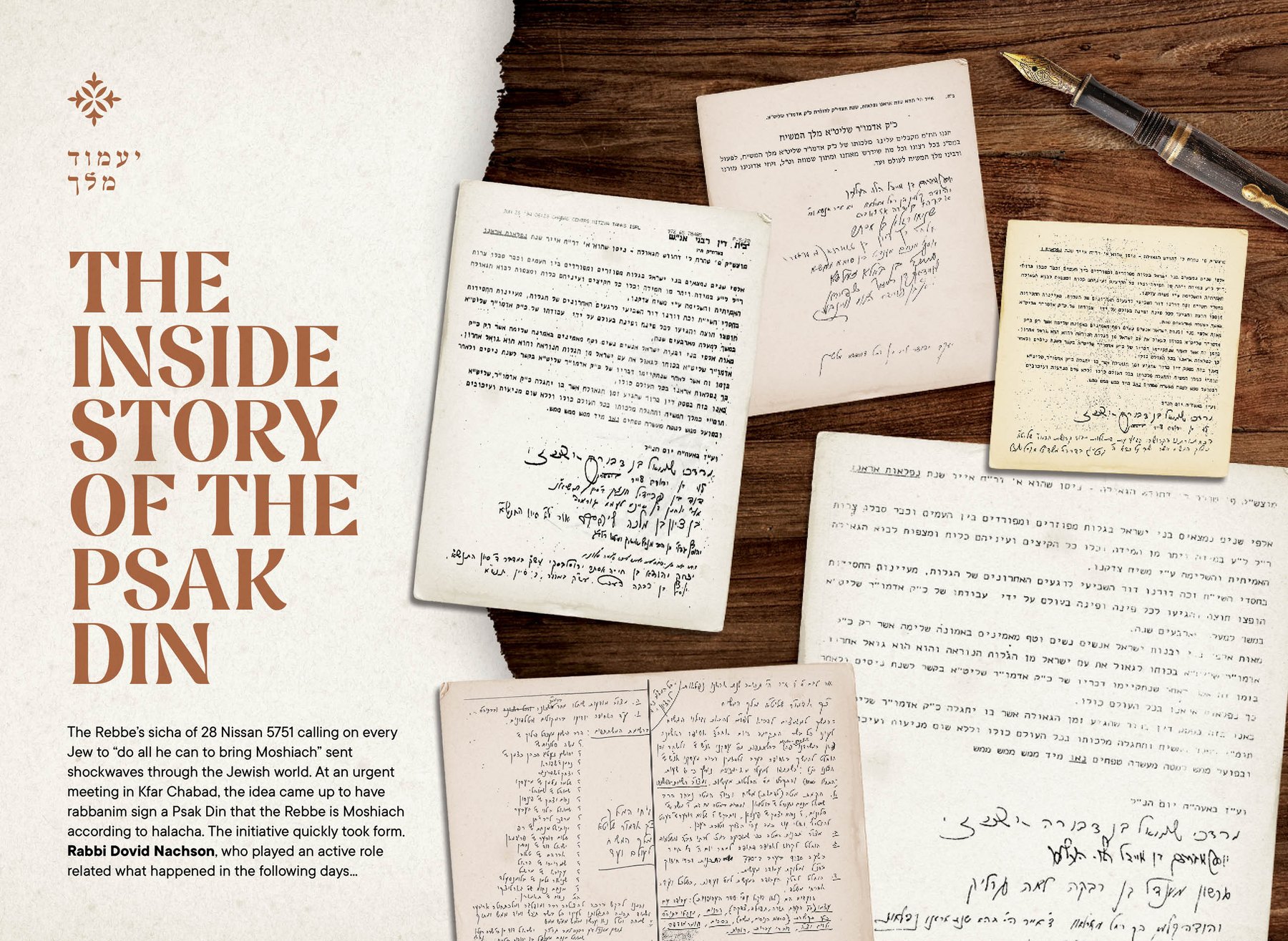
The Rebbe’s sicha of 28 Nissan 5751 calling on every Jew to “do all he can to bring Moshiach” sent shockwaves through the Jewish world. At an urgent meeting in Kfar Chabad, the idea came up to have rabbanim sign a Psak Din that the Rebbe is Moshiach according to halacha. The initiative quickly took form. Rabbi Dovid Nachson, who played an active role related what happened in the following days…
The Famous Sicha
The 28th of Nissan, 5751. The Rebbe dropped a bombshell: “How is it possible that after all these things, we have yet to bring about the coming of Moshiach Tzidkeinu in actual reality?”
“The only thing I can do from this moment on is to give the matter over to you. Do everything in your ability – in a manner of lights of Tohu in vessels of Tikkun – to bring about the coming of Moshiach Tzidkeinu.”
All of Lubavitch went into shock. Words such as these had never been heard before. All of Anash throughout Eretz Yisrael called one another and made the spontaneous decision to gather together in Kfar Chabad on Motzoei Shabbos (the sicha was on a Thursday night) to lay out a plan. We spent that Shabbos under great pressure. We understood that these were extremely crucial moments, where the whole matter might slip through our fingers, ch”v.
I want to say at the outset that there is no Lubavitcher Chassid in the world who doesn’t know that the Rebbe is Melech HaMoshiach. We had already tried during Chol HaMoed Pesach of that year to ask the Rebbe if we should engage in activities that publicized the fact that he is Melech HaMoshiach. We emphasized all the special dates that we had just passed during the month of Nissan, when the Jewish people were redeemed and will be redeemed in the future. This question of identifying the Rebbe as Melech HaMoshiach came after a lengthy period that saw a change in the Rebbe’s conduct and the terms with which he used to describe the imminence of the Redemption.
The Rebbe said regarding the Gulf War that this is one of the signs of the Redemption, “in the year that Melech HaMoshiach is revealed, he will stand on the roof of the Beis HaMikdash [which is his Beis Medrash, 770, as explained on another occasion], and announce to the Jewish people, ‘Humble ones, the time of your Redemption has arrived.’”
In this regard, we asked the Rebbe if we should do activities – in the newspapers and through the shluchim – to let the whole world know that everyone must accept the malchus of the Rebbe MH”M. As mentioned earlier, we received an answer on Chol HaMoed Pesach that it is not yet possible to do so. On the 28th of Nissan, the Rebbe came with the sicha and let everyone know that they have to do much more lofty things – not as was done until now, but as the start of a new era.
The Meeting in Kfar Chabad – the First Declaration
When we arrived in Kfar Chabad on that Motzoei Shabbos, the first night of Rosh Chodesh Iyar, we were engulfed by the feeling that the year’s moment of truth had arrived, and that it appeared from the Rebbe’s words that the hisgalus was about to happen.
Yet, it seemed that no one knew exactly what to do. Proposals were yelled out from the crowd, but nothing was certain other than the great tumult that prevailed. Then, in the midst of all this, Rabbi Shmuel Fromer formally raised the issue of a psak din. The point was mentioned that the Rebbe wants piskei din, and a motion was made that the rabbanim should officially issue a halachic ruling that the Rebbe is Moshiach. It was emphasized that, at the Rebbe’s initiative, hundreds of rabbinical authorities issued rulings that stated that the time of the redemption had arrived. Hundreds, maybe even thousands of rabbis signed them. However, there was no such ruling regarding the Rebbe himself. Then, Rabbi Dovid Chanzin took the opportunity presented by this special meeting to declare in the name of the Chabad rabbanim that the Rebbe is Melech HaMoshiach. It was only in verbal form then, not in writing and bearing no signatures.
As the meeting continued, the suggestion was made to ask three members of Anash to travel to the Rebbe and request that he reveal himself to the world. The proposal was to send R’ Tuvia Peles, R’ Zusha Rivkin, and myself in the name of the entire Chabad community. One of the participants at the meeting even came with an airline ticket for the Rebbe to ask him to come to Eretz Yisrael… I said that there was no reason to travel to the Rebbe in this manner. The only thing that would justify such a trip would be if there were an actual psak din or something else truly tangible in hand with which to go to the Rebbe and plead before him.
Rav Ashkenazi Composes and Signs the Psak Din
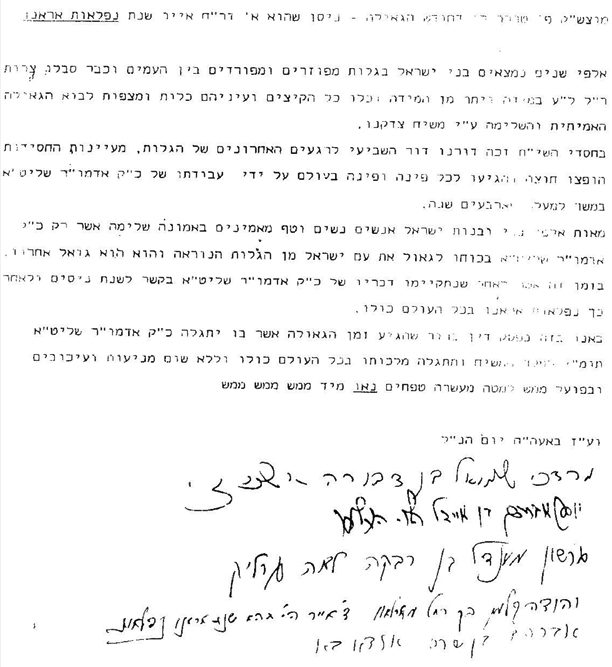
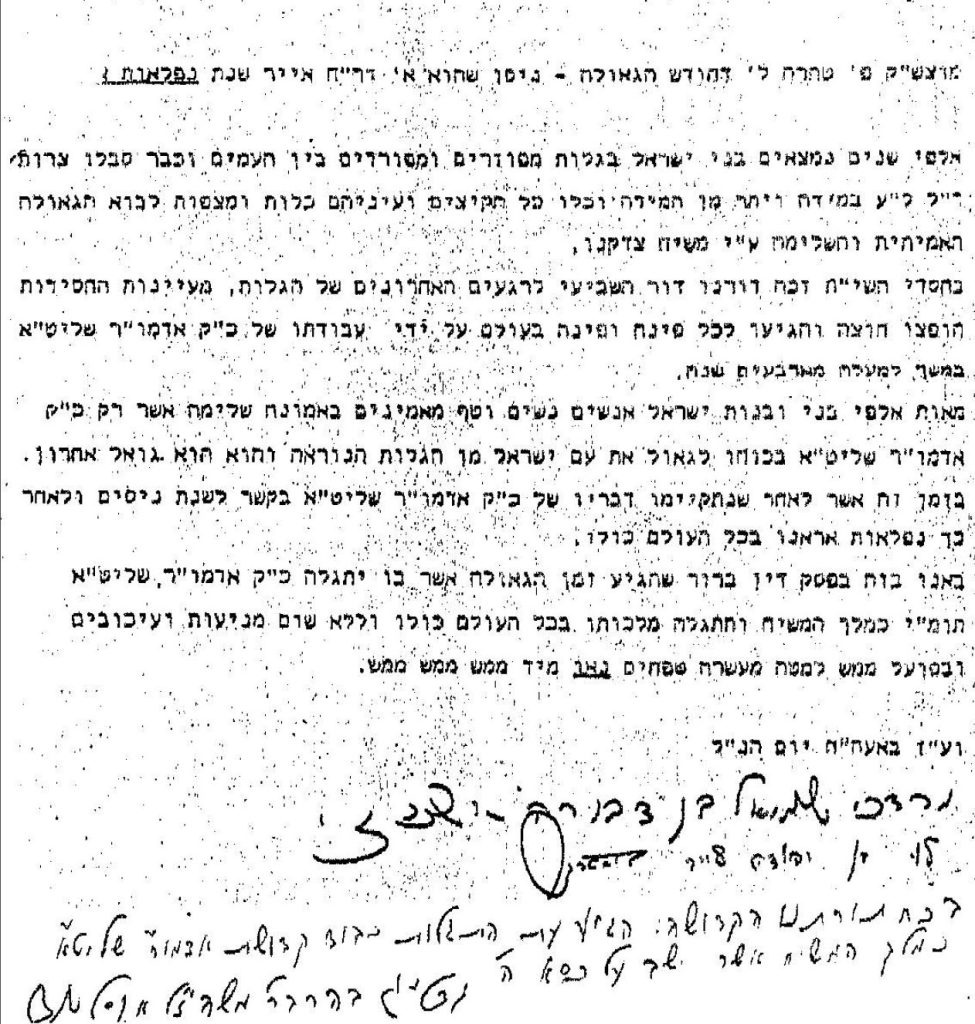
Immediately after the meeting, my friend like a brother R’ Avi Taub and I, went to Rav Mordechai Shmuel Ashkenazi, mara d’asra of Kfar Chabad. The Rav also felt this should be done, and he immediately sat down and started to write, even while we were still sitting and discussing the matter in the Beis Menachem Synagogue. Even though he had rested only briefly by that hour, when we came to him with our proposal, he sat down and began preparing the psak din right away. This first psak din was not well publicized. Yet, while many similar piskei din were written afterwards stating that the Rebbe is Melech HaMoshiach using different formats, this was the first of its kind.
This first psak din was written on the night of the 30th of Nissan, Motzoei Shabbos Parshas Tazria-Metzora, “Tahara” (in Eretz Yisrael). At this point, there began a series of amazing occurrences which remained for the most part unbeknownst to others. We sat that Motzoei Shabbos until very late at night, and the Rav tried to call other rabbanim. It was already one, two, three o’clock in the morning, and it was difficult to get through to them. Those with whom he did speak expressed concern that a psak din that commanded Hashem to reveal the Rebbe as Moshiach was too radical. However, we understood that there was a need here for things to be done “in a manner of lights of Tohu in vessels of Tikkun.” Even Rav Ashkenazi saw things this way. When rabbanim issue halachic rulings down in this world, it is fulfilled Above, thereby effecting change in the world.
Telephone Calls and Consultations Throughout the World
Afterwards, I called several friends all over the world who are prepared for mesirus nefesh, and we spoke about the need to do something that will impel the hisgalus. We talked about making a secret meeting, even before Beis Iyar, in order to finish the matter. We already had a signed psak din from one very important rav, the mara d’asra of Kfar Chabad. However, we were not satisfied with this. We needed at least three rabbanim to make it similar to an official Beis Din.
We set a time and place – five o’clock on the morning of Beis Iyar at the Chabad Mobile Centers office in Crown Heights – early enough so that no one would see us. One had to arrive from Italy – R’ Sholom Ber Friedman; another from Brazil – R’ Leibel Zajac; and R’ Moshe Slonim from New York. We also invited R’ Gershon Mendel Garelik, the rav of Milan, Italy, and R’ Yaakov Tilson.
These are people who have always been ready to go on the Rebbe’s shlichus. I mentioned one in particular who we will soon see at Techiyas HaMeisim, R’ Sholom Ber Friedman of Milan, who was a partisan throughout the war years in the Russian forests. I once spent an entire night hearing thrilling stories from him about what he endured in Russia, the likes of which I had never heard before. He was one of the strongest and most dedicated soldiers that the Rebbe ever had. He did much and invested everything he had on behalf of Russian immigrants who came to Eretz Yisrael via the camps in Italy.
When we spoke that night in Kfar Chabad, I thought that I would have the psak din in hand and be on my way immediately. I went home, took my passport, and then headed back. On the way, I passed via Netanya to go to the home of Avi Taub. I knocked on his door in the middle of the night, and told him, “Avi, what do you say? You want to join us? I am going to do this. We only have a psak din from one rav, and I don’t know if we’re coming back here at all. I don’t know what will be after what we are going to do now, but one thing is for certain: I’m going to do it.”
Avi told me, “Look, you know that I’m not big on understanding these things, but where you go, I go… All these years, we have gone together. Whatever you decide to do, I’ll do as well.”
When I reached Natzrat Illit, I spoke with R’ Shmarya Harel, activities coordinator and “mivtzaim officer” for Chabad Mobile Centers in Eretz HaKodesh. He asked to join us, and I told him, “All right, but just know that this is a most crucial trip that bears a great deal of responsibility.” On Monday night, an hour before the flight, we sent a fax to the Rebbe, informing him that we are coming in order to bring about the hisgalus, and we are requesting a bracha for success. Naturally, we didn’t wait for an answer, since when you are told, “Do everything in your ability,” you don’t ask, “Is it within my ability or not?” Rather, you act in accordance with your understanding “in a manner of lights of Tohu in vessels of Tikkun.” We saw that if we don’t make the trip, nothing will come of it. In addition, as mentioned earlier, Rav Ashkenazi said that if we presented the psak din to the Rebbe, he wanted there to be at least another two rabbanim.
We set out on our journey that night, the evening of Beis Iyar. As previously agreed, we met at five in the morning at the Chabad Mobile Centers in New York. Though we had traveled to the Rebbe hundreds of times in the past on a variety of missions, etc., there was a very strong feeling never experienced before that this was a mission of the highest order.
Rabbis Heller and Garelik Sign
Not everyone who was invited to the meeting made it. However, they all requested that we write a letter in their name that they will sign. We decided to write a letter of acceptance of the Rebbe’s malchus and a firm declaration of allegiance to the Rebbe. The letter concluded with a fervent request that the Rebbe reveal himself in actual deed.
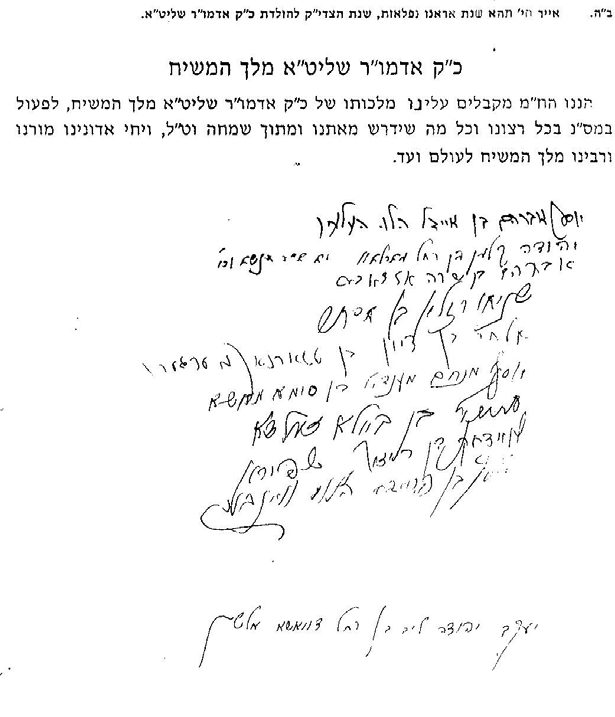
We decided to try and see if the local rabbanim would be willing to sign the psak din. We left the office with Rabbi Yitzchok Springer, one of those who signed the letter to the Rebbe. The group proceeded in the direction of the offices of the Crown Heights Beis Din, in the hope that we would meet one of the rabbanim there at that hour – shortly after five in the morning! We went upstairs and sure enough, we found Rav Yosef Avrohom HaLevi Heller there. He contemplated the matter, saw the text of the psak din, and eventually decided to sign it. However, at first, he was taken aback, as the text was rather daring and used extremely strong terms for that time. Nevertheless, he signed the psak din.
Immediately after the meeting, we went to R’ Gershon Mendel Garelik, the rav of Milan. He also felt this should be done, and he immediately sat down and signed. Afterwards, he told us that the previous day, he had gathered together the entire Milan community, and they signed a letter to the Rebbe, in which they ask for his hisgalus. They immediately received a lengthy and somewhat strong answer that their letter contains no response to what the Rebbe has demanded, etc. R’ Garelik was somewhat unnerved by this, however, when he saw the psak din, he understood that this was a most serious matter, and immediately signed.
There were now already three rabbanim – a Beis Din to some extent – who had signed the psak din, and so we began to calm down a bit. As previously agreed, since we did not want anyone to see us, and it was not easy to hide in such a place, we vanished back into the Mobile Center offices, where we broke out into dance. In Chassidic custom, we even started turning somersaults from all the excitement. I remember how R’ Sholom Ber Friedman, R’ Yitzchok Springer, R’ Leibel Zajac, R’ Yaakov Tilson, R’ Moshe Slonim, Shmarya, and myself were all in a state of over-exuberance.
We waited several hours, as we didn’t consider it appropriate to be in 770 yet. Such an appearance might make waves, and we wanted to keep things quiet for the time being. We decided that if we already have a psak din signed by a valid Beis Din of three rabbanim, there is no reason to go to the Ohel to read the psak. Instead, we should give it directly to the Rebbe MH”M himself. For this purpose, we attached the letter of acceptance of the Rebbe’s malchus and the declaration of allegiance signed by ten people. [NOTE: Not all of them were present when the psak din and the attached letters were presented to the Rebbe, however, they requested that the letter bear their signatures.]
The Rebbe later made reference to the text of the psak din in one of his sichos. We got the hint that the Rebbe wants us to do things as body and soul, not in the contradictory manner of “ratzo v’shov,” as it is called in Chassidus. However, we wrote that the excitement and desire for the Rebbe’s hisgalus was so great that we simply didn’t know what to do, so we were prepared to do whatever it took.
We decided to wait for the Rebbe near the mikva. We knew that if we would stand near 770, this would create a great tumult (which is why we decided to submit the psak din directly to the Rebbe and not via the secretariat). We wanted the matter to remain quiet, and to see for ourselves if the Rebbe would approve.
Near the Mikva: Signatures from Rabbis Bistritzky and Axelrod
The Rebbe always went to the mikva before going to the Ohel, and so it was on this day, Beis Iyar. We knew that the Rebbe goes to the mikva immediately after davening, and we rushed to be there before the Rebbe arrived. In the meantime, we sat and waited in the car so no passersby would notice us. We had a cellular telephone with us, something that was not so common in those days. In the event that another rabbi signed the psak din, we would get a message from the secretary in the Mobile Centers office, who was standing by to receive urgent calls. While we were sitting in the car near the mikva, we got a call that there was another signature. Rav Levi Bistritzky [OBM], rav of the Chabad community of Tzfas, had agreed to add his signature attesting that the Rebbe is Melech HaMoshiach and must reveal himself immediately mamash.
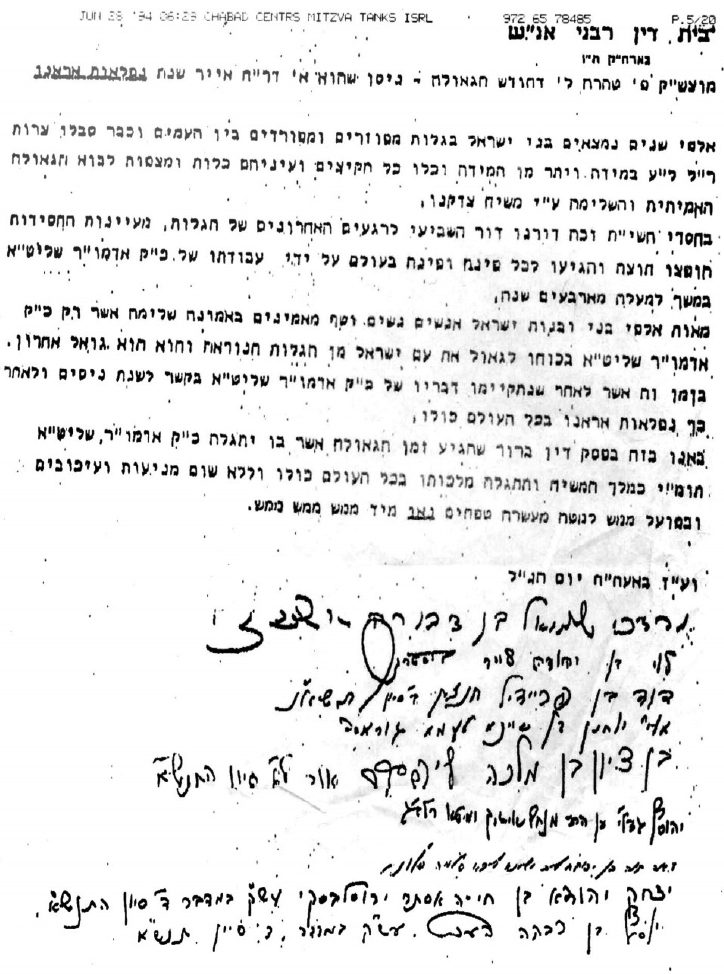
We were most happy that there were now four signatures. However, it was most important to us that if there were already two signatures from rabbanim in Eretz Yisrael, there should be another one so there would be enough rabbanim from Eretz Yisrael to constitute a Beis Din on its own.
Even before this, we had contacted the secretary of the Mobile Centers office in Natzrat Illit, R’ Avi Ben-Zacharia. I asked him to call Rav Gedalia Axelrod, the Av Beis Din of Haifa, send him the psak din, explain to him the situation, and ask him to send his signature immediately via fax to our office in New York. Ten minutes passed, then another ten minutes. The Rebbe, who usually arrives most promptly, was already delayed for forty-five minutes. After fifty minutes, we received an urgent call from Akiva Marshal, the secretary in the Mobile Centers office in New York. A fax with Rabbi Axelrod’s signature had just arrived, and he wanted to find us urgently, so he could hand it to us personally.
At that moment, we got word that the Rebbe had just left in the direction of the mikvz and would be there momentarily. We realized that we wouldn’t have enough time to bring Rabbi Axelrod’s signature. So we added to the psak din that a fax from Rabbi Axelrod had just arrived, in which he adds to the text that “the time has come that the Rebbe shlita will take the throne as Melech HaMoshiach” with his signature. We wrote that we would bring the signature afterwards.
There were now three rabbanim from Eretz Yisrael and another two local rabbanim – this was a major breakthrough. On Beis Iyar, “L’chatchila Ariber,” five rabbanim had signed this revolutionary psak din, along with our letter of acceptance of the Rebbe’s malchus and declaration of allegiance signed by another ten Jews. Now, we had something substantial in hand to give to the Rebbe in fulfillment of the directive, “Do everything in your ability…”
Beis Iyar 5751: the Rebbe Accepts the Psak Din That He Is Melech Ha’moshiach
As soon as we heard that the Rebbe was about to arrive at the mikva, we jumped out of the car and stood in place. The Rebbe got out of his car, as if he was waiting for what we had for him. He walked in the direction of the mikva, but then stopped for a split second, waiting for us to approach him. All the Rebbe’s movements are agile and nimble, yet here he stopped to look at us with a very bright expression. I went up to the Rebbe and presented him with the psak din and our letter of acceptance of the Rebbe’s malchus as Melech HaMoshiach and declaration of allegiance signed by a minyan of Jews.
The Rebbe looked at me, then at all of us, closely surveying the group. Then, with a beaming look, he smiled and said, “Yasher koach, Yasher koach!” and placed the envelopes in the breast pocket of his kapote.
We understood that we had met success and that we were on the right path. The feeling was simply indescribable and unprecedented.
We decided that this alone was not enough and that we must bring the Rebbe the fax with Rabbi Axelrod’s signature. In fact, while the Rebbe was still at the mikva, Akiva, the secretary, arrived with the fax from Rabbi Axelrod. R’ Binyomin Klein, who had accompanied the Rebbe, saw the warm and special attention that the Rebbe had given to what we had brought him. We brought him the fax from Rabbi Axelrod, and told him that we are requesting that he deliver it to the Rebbe as a follow up to what we had given him before.
Later, R’ Klein said that he handed it to the Rebbe after he left the mikva. The Rebbe took it and asked if this was part of what they had brought before. The Rebbe expressed deep satisfaction, and again placed the paper in the inner pocket of his coat.
Reading the Psak Din at the Ohel
After delivering the psak din, we decided to go immediately to the Ohel of the Rebbe Rayatz to read the psak din there and plead for the Redemption before the Rebbe arrived. We traveled as quickly as we could. We got to the Ohel, making all the necessary preparations. We knocked on the door, went in, and said we have come to bring the psak din that the Rebbe is Melech HaMoshiach and must reveal himself immediately. We recited the Rebbe’s kapittel [at that time, ch. 90], and pleaded for the Rebbe’s immediate revelation. We read the declaration of allegiance and then departed. As we were leaving, the driver came to check if someone was inside. At the moment we left, the Rebbe went in.
We then turned to the gravesites of the Rebbetzin Chaya Mushka and the Rebbe’s mother, the Rebbetzin Chana, pleading for a mother’s mercy upon her children. We asked her to intercede, along with her husband, Rav Levi Yitzchok, and with Yishai, father of Dovid HaMelech, to compel in Heaven the fulfillment of the mitzva of kibbud av v’eim so that the Rebbe MH”M will be revealed immediately without delay for all to see.
From there, we returned to 770. The first stage had now been completed.
The Rebbe’s Answer on Our Departure from Eretz Yisrael
That evening, the Rebbe distributed dollars and gave us an especially warm look at our turn. The following morning, we suddenly received an answer to the letter that we wrote right before leaving Eretz Yisrael. “Received. I will mention it at the Tziyun. The time is now and the matter [is at hand].” The issue of Melech HaMoshiach had apparently reached the proper time, and we understood that the Rebbe was most pleased that we had come.
That morning, one of our trio sang very loudly in 770 and then started singing at farbrengens, “Sisu v’simchu b’simchas ha’Geula hineh hineh Moshiach ba.” The Rebbe encouraged this song most forcefully with his hands, and Shmarya even began singing it before davening.
One of the shul regulars rebuked him, “What is this? Did you come here to make a new order?” etc. But after he saw the answers we received upon our arrival, he desisted.
People saw that the Rebbe considered this to be a shlichus of utmost importance, yet one that was to be fulfillied by us below (i.e., not through the Rebbe).
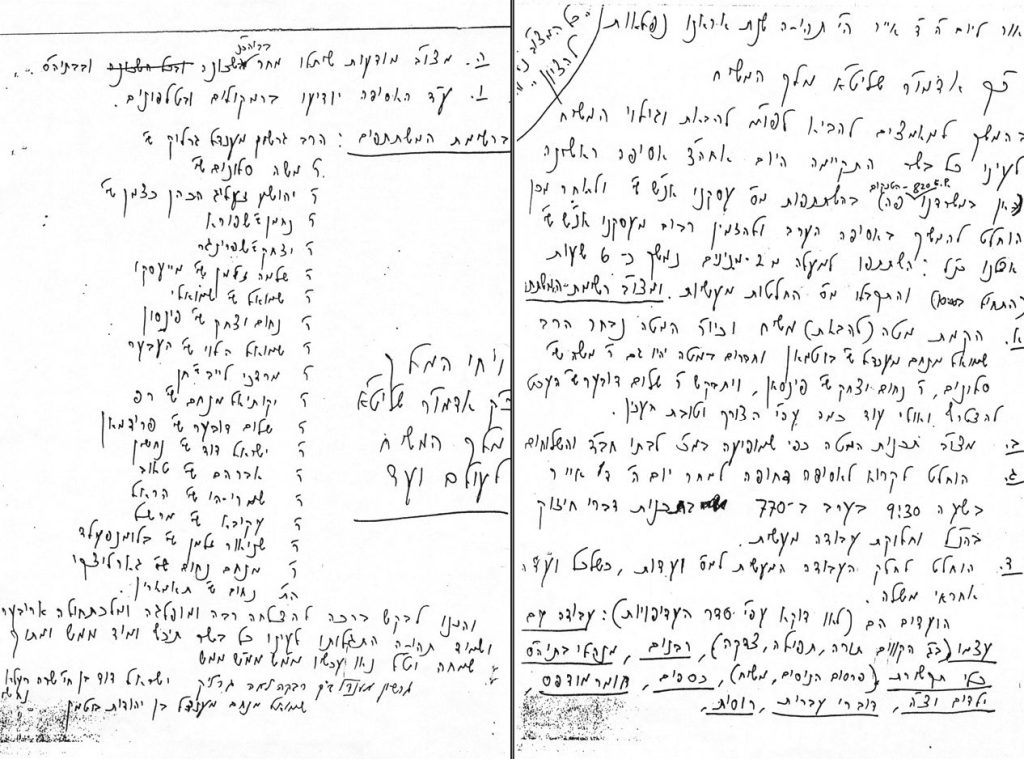
The Evening of the 3rd of Iyar – Matteh Moshiach Is Established
That night, we gathered together several askanim and mashpiim from Crown Heights – about twenty or thirty – in the Mobile Centers office, which had been transformed into a war room for Moshiach activities, and decided to establish a Matteh Moshiach. We divided the work into committees of mashpiim, fundraisers, educators, and public relations, led by the main Matteh. I wrote the protocol and everyone signed. Then, I wrote on the side, “Yechi Adoneinu Moreinu V’Rabbeinu Melech HaMoshiach L’olam Va’ed!” I don’t know why, but that’s how it came out in the presence of all. While we had used this declaration in Russia beforehand, this as something completely different. In addition, we wrote that it had been decided to hold a public meeting in 770 on behalfof Matteh Moshiach.
We had heard during these days that someone approached the Rebbe on Shabbos and said that there are people who are asking the Rebbe to reveal himself as Moshiach. Therefore, this person said, the Rebbe should decree that Moshiach must reveal himself, etc. The Rebbe’s face became serious, apparently displeased with what he heard, and said, “Why are you putting a new job upon me?”
Naturally, the Rebbe has no fear of extra work. However, a year later, we saw that if we are unwilling to do the job, then the “new job” of, “he bore our sicknesses and endured our pain,” begins… Perhaps the Rebbe wanted to prevent this, and to proceed in joy and gladness of heart, through our request that Melech HaMoshiach reveal himself that year, 5751.
We didn’t understand this so much at the time, and we tried to draw things out of the Rebbe’s sichos in order to understand things properly. We wrote about everything that we were doing, not to ask the Rebbe, but to notify him. The responses we received were so warm and positive that it surprised us.
As mentioned earlier, we submitted the announcement to the Rebbe of the large public meeting we had planned for that Thursday evening on the issue of “Do everything in your ability in a manner of lights of Tohu in vessels of Tikun.” We handed it in on Wednesday morning, and received an answer immediately. Our submission included several pages of proposals, the names of all the committee members, etc. The Rebbe wrote, “All this will be taken to the Tziyun, and I will mention it at the Tziyun.” We understood from this very special language that the Rebbe was most pleased by this. Notices regarding the meeting were hung up in 770 and all over Crown Heights.
The Rabbanim of Crown Heights Sign the Psak Din
On Wednesday afternoon we went to the two remaining members of the Crown Heights Beis Din, Rav Yehuda Kalman Marlow [OBM] and Rav Avrohom Osdoba [may he live many good and long years], to request their signatures on the psak din. They signed, and we wanted to bring them to the Rebbe. It is interesting to note that the Rebbe usually comes back from the Ohel about two hours after sundown. However, on that day, the Rebbe returned to 770 at the moment Rabbi Osdoba signed.
I called the secretariat and said that I wanted to submit the psak din. The secretary asked, “Which psak din?” I told him, “The one that says that the Rebbe has to reveal himself as Melech HaMoshiach.” He responded, “Nu, you know what? I’m just a mailman. Put it in a closed envelope, as if I don’t know what’s written, and I’ll give it in.” And so I did. When he called me in to give me the answer, the secretary asked with a smile, “Tell me, had the Rebbe already seen what was written in this psak din?” I said that I was prepared to answer him on the condition that he doesn’t get angry with me. He promised, and I told him that I had given it to the Rebbe yesterday near the mikva.
“And what did the Rebbe say then?” he asked. I told him, “Yasher koach, Yasher koach.”
It turns out that when the secretary handed the envelope to the Rebbe, he opened it, smiled broadly, and gave the same answer that he had given that morning: “All this will be taken to the Tziyun, and I will mention it at the Tziyun.” I understood that we were going in the right direction, and as they say, a major shift had begun.
The First Moshiach Conference in 770 – 250 Signatures on the Kabbolas Ha’malchus
The following day, the newly established Matteh Moshiach opened its first major conference in 770. The great Beis Medrash was filled from wall to wall. The rabbanim spoke very strongly, and everyone felt the importance of the hour in anticipation of the Rebbe’s hisgalus. R’ Garelik then read the answer that he received in Italy, and spoke about the need to work on signing up people on the Kabbolas HaMalchus that the Rebbe is Melech HaMoshiach. I composed its text to the Rebbe as follows: “We, the undersigned, accept upon ourselves the yoke of the malchus of the Rebbe MH”M, to do all that he wants and requests from us in every matter, and to do all this with self-sacrifice,” etc.
In the first version of the text, “Yechi Adoneinu” was not part of what was declared publicly. Instead, it stated that “we accept upon ourselves the malchus of the Rebbe MH”M, and that he should reveal himself.” Two hundred and fifty people signed this declaration at the conclusion of the meeting.
The next day, Erev Shabbos Kodesh Parshas Tazria-Metzora, the 6th of Iyar, I took four full pages of signatures, without any additional reports, as I wanted to see the Rebbe’s reaction to this alone. I gave them to the secretary, Rabbi Groner, on Friday afternoon after Mincha, for submission to the Rebbe, and then went to my room.
The Rebbe’s Answer on the Signatures
Suddenly, I received a telephone call from R’ Leibel Groner that I should come immediately. “You have an answer,” he said. I ran over quickly. He handed me the typewritten note, a general answer on the submitted reports over the past few days:
Received with much appreciation. It should be a continuing and increasing activity, as the time has come. As with the strength granted from our Sages, of blessed memory, and their blessing of “an increase to all those who increase,” and in particular the blessing of the Holy One, Blessed Be He, whose increase is great in quantity, etc.
And the time has come, as we are coming from the month of Nissan and its influence and into the month of Iyar (an acronym for the Avos and Rochel, the “fourth leg”), as is explained in numerous places.
In the year of “I will show miracles.” I will mention it at the Tziyun.
When this answer came in, all boundaries were broken. The bachurim ran and made enlarged copies (including the text of the declaration that we accept upon ourselves the yoke of the malchus of the Rebbe MH”M, and to do all that he wants with mesirus nefesh), and plastered them along with the Rebbe’s answer on all the walls of 770.
With much excitement, I sent someone to buy a big bottle of mashke. (It was customary to send in bottles of mashke to the Rebbe before Shabbos in connection with upcoming Chabad events. The Rebbe would call the organizers up at the Shabbos farbrengen to announce the activities and then pour from the bottle that would be taken to the event.) I sent the bottle to the secretariat, and I wrote that this mashke was in connection with the farbrengens that would be held in various locations regarding the acceptance of the Rebbe’s malchus by the people. However, the secretary immediately said that it was not entirely clear whether or not this bottle would be presented…
That Shabbos evening, 770 was all fired up, especially after everyone saw the notices that the Rebbe accepted the signatures with much appreciation, and that everyone must accept his malchus. The elders and all those who were not accustomed to “unconventional missiles” came a bit closer… The lights of Tohu began to approach the vessels of Tikkun.
In the next installment we will describe the events of the historic farbregen of Shabbos Tazria Metzora 5751
HaTomim #13 • pp. 34-45, 33
© 2026 Beis Moshiach Magazine. All rights reserved.
This article originally appeared in Beis Moshiach #1416. You are welcome to share it with friends and family by email or in print, provided that you do not change, add to or omit any part of it, you credit the author and Beis Moshiach, and you include a link to archive.bmoshiach.org (written out in full in printed copies).
To republish this article in a newspaper, magazine, book or website, please request permission in advance at [email protected].