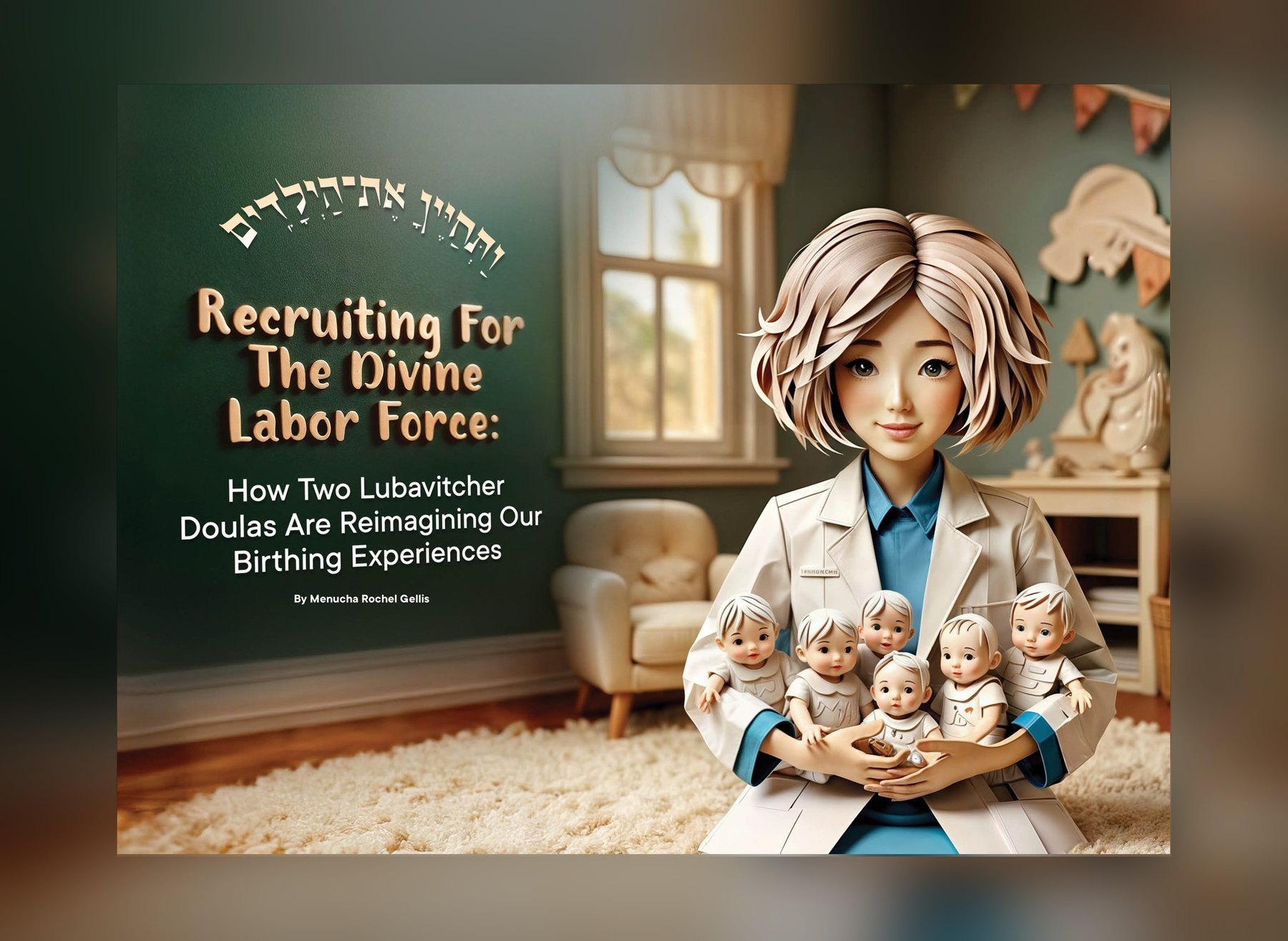
Recruiting For The Divine Labor Force
How Did You Come to Be a Doula?
Let’s open with the question of questions: why did you decide to work specifically in this field?
Rivky: Truth be told, this is a question to which I have no simple answer. I didn’t see this profession as the fulfillment of childhood dreams, nor did I have some inspirational or traumatic experience that led me here.
It came about through visible hashgacga pratis. After my fifth birth, I took a break from my work responsibilities. While at home, I noticed an advertisement for doula training at the Ohr HaGanuz Yishuv near Tzfas, where I was living and close to my husband’s workplace.
I checked the course outline and schedule and thought, “Wow! This looks perfect!” The timing fit my maternity leave, and the profession interested me deeply both as a wife and mother.
The studies energized me during my maternity leave in a most positive way. The course touched upon the deepest aspects of both giving birth and pain management, and it was a privilege to learn how I could offer assistance in such profound moments. As Chabad women, we naturally incorporate charity and giving into every profession unconditionally. Here, everything aligned perfectly for me in many ways. So I began this journey.
Nechami: I need to emphasize that I don’t view this as merely a job, but as a shlichus, a sacred mission. This vision motivated me to become involved in such a special, holy field!
I’m passionate about ensuring women have intensely positive birth experiences that leave them wanting more. Bringing a new soul into the world should connect every Jewish woman profoundly to the Creator, to herself, to her inner strengths, and to her newborn baby. Each of these connections matters deeply, both for the birth process and for life in general.
What drew me to this shlichus was, baruch Hashem, my own birth experiences. Twenty years ago, during my first pregnancy, I desperately wanted an easy birth. While the Torah states “In pain you shall bear children,” we’re now approaching the Geula—it’s so close we can almost taste it.
I wanted my birth to be positive and good—a perfectly natural desire. After all, who brings the next generation into the world? We women do! It’s clear to me that this greatest shlichus must be accompanied by brilliantly shining lights in the most revealed way possible.
I searched extensively and, baruch Hashem, found the answer: this shlichus can indeed be experienced positively! I researched thoroughly and providentially discovered materials from an organization promoting greater freedom in maternity choices. The knowledge I gained helped me make informed decisions, and with Hashem’s kindness, my first childbirth was natural and not excessively long.
Baruch Hashem, I’ve since had seven natural childbirths, and I feel an inner calling to share this knowledge and these tools with other women.
When my firstborn daughter was just a year old, I accompanied a friend during her birth. It was a good, natural experience, and afterward I continued offering my services as a heartfelt hobby. I felt I could help using my feminine knowledge and skills. I escorted more and more women through childbirth, while my dream of becoming a professional doula continued burning within me.
Baruch Hashem, after becoming a mother to four daughters, I completed my professional training, acquiring additional alternative healing methods: reflexology, homeopathy, shiatsu, aromatherapy, guided imagery, movement exercises, and more. Since then, I’ve accompanied over three hundred expectant mothers, and another seven hundred women have prepared for birth through my “It’s Natural To Give Birth” course. With Hashem’s help, these tools assist not only in natural births but in any birth method a woman might choose.
My youngest child is two years old, so I experienced birth quite recently myself. Whatever I’ve found helpful, I share in my birthing classes. Women later share their moving birth stories after practicing this approach, and baruch Hashem, they enjoy truly positive childbirth experiences.
The course covers three preparation areas: physical, emotional-mental, and spiritual.
Women receive practical tools for each stage of the process. Emotionally, they learn to approach birth with greater confidence and faith in their abilities, releasing the fears that naturally arise in uncertain situations. Spiritually, when they learn about the tremendous privilege of bringing a new Jewish soul into the world and connect to thoughts of holiness and thanksgiving, the process becomes much more profound and moving.
We make the effort, but Hashem produces the results. Let go and let Him work. It’s amazing to see how these tools help women emerge happy and satisfied from their birth experiences.
Why a Doula?
Why should you have a doula as a childbirth escort, and what assistance can she provide?
Rivky: During my preparatory courses, when I meet with expectant mothers or couples, an interesting question often arises, usually from the husband: “If you’re coming as a birth assistant… do I still need to be there?” I always reply that yes, he does—his wife needs him. There’s tremendous importance in having supportive people around an expectant mother (while, of course, observing the laws of tznius, with men remaining outside during medical examinations and the actual birth).
At the hospital, the laboring woman is the queen of the delivery room. Anyone accompanying her is there to provide assistance and strength—both physical and spiritual—and to help with necessary decisions. By “decisions,” I mean choices made from a place of authority and awareness—understanding what’s happening now, the baby’s condition, what comes next, and the best course of action at each moment.
After taking prenatal courses, women acquire the knowledge needed to make conscious, informed decisions according to their free choice.
Women learn that every action has both benefits and drawbacks. They know what questions to ask to manage things optimally, preventing feelings of failure or disappointment afterward. I want every woman to feel: “I am the queen; I understand what’s happening. I make the choices”—whether through professional advice, consulting a rav or mashpia, or with birth support.
I always tell women: “As a doula, I perform my job professionally. I’m not replacing anyone.” There’s certainly space for the husband’s help alongside mine. Sometimes I step back when I see they don’t need me. The woman knows that whenever she needs assistance, she can call out for me or motion, and I’ll be right there. Another point I emphasize: Sometimes neither the mother’s mother nor the husband can attend. If the woman feels alone, I do everything possible to provide the support she would have received from others.
I bring professional expertise and offer emotional, technical, and spiritual assistance through important techniques, exercises, decision-making help, reflexology, oils, and homeopathy.
Baruch Hashem, beyond my professional doula training, I also work as a counselor using the “Amit Leida” (“Birth Buddy”) approach. This method, developed by Amit Ben-Eliyahu, a frum woman, heightens awareness and includes physical exercises that significantly speed the birth process. This approach can reduce pain by up to 80%, and I incorporate it alongside my other professional tools.
Another advantage a doula brings is serving as an intermediary. Often, the mother experiences tension, pressure, sleep deprivation, weakness, and pain. Without prenatal education, this lack of knowledge can lead to unpleasant emotions and diminished confidence. Sometimes during birth, a woman needs private space. A doula can support her effectively through preliminary discussions about her preferences and needs.
Most importantly, we must pray and remember there is a G-d in Heaven who runs everything. There is one precise moment—no other—when each soul must descend into the world. We are there to support both the mother and the new Jewish soul, and with Hashem’s help, everything unfolds with great joy and good health.
Nechami: The concept is what we call “treatment continuum.”
This means the same woman who accompanies the expectant mother—who knows her dreams, wishes, concerns, and fears, who has prepared with her throughout the process—should be the one accompanying her during birth. They already have a relationship. The doula understands what matters to the woman and what she wants; she strengthens her faith and provides physical and emotional support throughout. Hospital staff simply cannot offer this level of personalized care. When you engage a doula, she’s with you 200%. The trust that develops and the mother’s resulting confidence are, with Hashem’s help, key to helping her realize her birth vision.
The knowledge a well-prepared mother brings allows her to make appropriate real-time choices when facing various suggestions and interventions. She knows when she can say “No, thank you” and address issues naturally with the doula’s help, and when the situation truly requires conventional medicine—which is also a gift from Hashem. All these are tools designed to assist the woman.
Research demonstrates the benefits of professional birth support. Statistics show that births with professional accompaniment improve women’s satisfaction, reduce interventions, and contribute to shorter labor and healthier natural births.
The Choice
How do we choose the right doula?
Rivky: There are many doulas, each with her own style, character, and approach. Every doula provides different support—some only accompany women at the hospital, others come to homes and remain throughout the entire process. Some professional midwives offer additional services like reflexology, birth induction, various exercises, or even post-birth massage treatments. Each doula brings her unique package of gifts. Every woman is unique, as is every doula.
When looking for a doula, it’s important to identify your needs and desires and match them with her professional qualities. Also, check for personal compatibility. Some doulas are older with considerable experience, while others connect specifically with younger, more energetic women.
To choose a suitable doula, arrange a preliminary face-to-face meeting. If that’s not possible, it’s reasonable to request a photo and have a phone conversation. It’s important to feel her energy, her presence, hear her tone, and determine if you connect with her style.
I remember someone telling me how, before one birth, she spoke with a doula by phone and arranged for her accompaniment. The expectant mother called this doula on her way to the hospital. When the doula arrived, the woman was deeply disappointed—the doula’s appearance differed completely from her expectations. Labor isn’t the appropriate time for getting acquainted over coffee. With considerable awkwardness, this mother apologized and sent the doula home.
Nechami: I should mention that some women feel they don’t need additional professional support, and I encourage each woman to pay attention to her needs and connect with what feels right for her!
As for how to choose? It’s straightforward: pick up the phone, align your expectations, ask relevant questions, listen to the doula, and if you sense a connection—go for it!
A Worthwhile Investment
How much does an expectant mother need to pay for a childbirth escort?
Rivky: The average fee ranges between two to three thousand shekels in Israel (and about $700-$1200 in the USA), though you should verify exactly what services are included. A less experienced doula will likely charge less.
As I became more involved, I realized we needed a contract—what I prefer to call a “letter of agreement.” This wasn’t a simple decision. As a Chabad woman, taking such a step felt difficult. I believe birthing women need help and support and were trained to help when and where we can. Even women who attended excellent preparatory courses need constant reminders, explanations, and clarifications when the moment of truth arrives. I initially wondered, “How can I possibly make a contract with an expectant mother?” Over time, I discovered that uncomfortable situations sometimes arise, and clear agreements help address them.

For instance, I make myself available to expectant mothers from the beginning of their ninth month until birth. This can span up to six weeks, including Shabbosim, Yomim Tovim, days and nights—all while managing my responsibilities as a mother to my own large family.
Another example: After a month of round-the-clock availability, sometimes a birth progresses extremely quickly—what we call a lightning birth. The mother barely has time to call. I organize myself quickly, but by the time I arrive, she has already delivered. This raises the question: How much do you charge in such cases? Having a contract prepared in advance prevents awkwardness.
When I commit to an expectant mother, I forgo many important personal commitments. If I have a scheduled event during the anticipated birth period (which can span several weeks) that requires my attendance, I always inform the mother in advance and obtain her permission to leave the city. I’ve missed numerous events and simchos because I was responsible for an expectant mother just beginning her labor.
Nechami: Regarding costs, there’s truly a range of prices between novice doulas and those with considerable experience and expertise. The simplest approach is to ask directly.
Wearing Other Hats
Do you specialize in other professions besides being a doula?
Rivky: Beyond my work as a doula and birth preparation counselor, I’ve been a sheitel-macher for over eighteen years, a kalla teacher, and a marriage counselor, providing support for depression and anxiety.
Nechami: I also offer personal training based on Tanya and Chassidus. I established the “Osot Chaim” club—a digital program teaching Tanya to women, designed to help overcome fear and anxiety while building a plan for survival and joyful living filled with confidence, as taught in Tanya. In my view, Jewish psychology through Chassidus forms the foundation for all emotional work.
In my preliminary courses, emotional and spiritual preparations are grounded in Tanya and Chassidus. It’s remarkable how profoundly this influences the physical body. When a woman approaches birth from a secure place with sincere trust in Hashem, she remains calmer and experiences less pain.
Pain comes from muscle cramps—and muscle cramps result from fear and stress. To break this pain cycle, fear must be replaced with trust. When a woman feels confident and tranquil, her muscles relax, reducing pain. Similarly, endorphins—natural pain relievers—are only released during moments of calm and relaxation.
I’m also a high school biology teacher with fifteen years of experience preparing students for their five-unit matriculation exams in biology. With Hashem’s help, with my master’s degree and accumulated knowledge in biology, anatomy, and physiology, I can help optimize the connection between body and soul. I’m a kalla teacher as well. I position myself at every developmental crossroads, from wedding to birth.
My Story
Do you have any special stories to share from your experience?
Rivky: One Shabbos, after the meal, I left for the hospital to escort a woman in labor. Baruch Hashem, a healthy child was born in good time, but I couldn’t return home. I waited at the hospital until Motzaei Shabbos when I could travel again. Suddenly, another woman who had arrived unaccompanied asked for my help.
“With pleasure,” I replied, and we quickly got acquainted. I assisted her through her birth, which went smoothly. Meanwhile, another woman in advanced labor was panicking so severely she couldn’t update her family about her impending delivery. I accompanied her too… In total, I concluded that Shabbos with three births! It was truly remarkable.
I should add that every birth offers me a new experience as a doula, just as it does for the new mother. It’s amazing! I’ve escorted dozens of births, and I always learn something new.
Nechami: In my teaching work, intimidating questions about childbirth occasionally arise. I always pause the class to address fears and foster awareness that birth can be a positive, empowering experience. I remind students that when the time comes, they can acquire additional helpful tools.
One day, I received a call: “Morah Nechami, you told us good birth experiences are possible—can you help me prepare?” I accompanied this former student, and afterward, the midwife asked about our connection. When my student simply replied, “This is my teacher,” the midwife looked at us in amazement: “What is a teacher doing in the delivery room?”
A Shlucha in the Delivery Room
How do you combine spreading Chassidus with your work?
Rivky: As a Chabad woman, I bring Torah and Chassidus into this special space. I share calming niggunim (there’s a great album online of Chabad melodies for infants), occasionally incorporate jokes and interesting Torah insights, and regularly check “HaYom Yom” for meaningful Chassidic teachings that might provide strength. I remain sensitive to other birthing women nearby, offering help when possible (without neglecting my primary responsibility).
I express abundant gratitude to hospital staff, acknowledging their tremendous privilege and mission in helping bring new Jewish souls into the world. I always say “Thank you” and typically bring wholesome snacks—homemade cakes, dates, almonds, or nuts—for the staff.
And most importantly, I encourage the use of “Shir HaMa’alos” cards, which has become increasingly popular among women after birth.
Nechami: Throughout this process, there’s no separation between my Chassidishe life and my work—they’re unified. This profession is inherently a shlichus, supporting women during birth at the most profound level.
Giving Birth in Wartime
With both of you being located in the North of Eretz Yisrael, how has the war since Simchas Torah last year affected your work?
Rivky: We’re facing a complex situation fraught with fear and uncertainty. These times demand considerable adaptability, spontaneity, and readiness for change. Now, at the beginning of each birth support process, we provide guidelines for expectant mothers with reminders about our current reality. We must flow with these changing circumstances. Sudden warning sirens or mortar attacks can’t be scheduled or anticipated. Some women choose to give birth in safer regions, away from the volatile northern areas—relocating to Laniado Hospital in Netanya or moving to their parents’ homes a week before their due dates. During this period, we’ve seen numerous home births.
Women today face unclear situations. At Sieff Medical Center in Tzfas, near Meron, they’ve relocated the maternity ward from the fourth floor to one level below the main entrance. Neither the nursery nor the ward remains in its usual location. Such changes can be unsettling, and we’re not always equipped to handle them. Additionally, women face more fears now, sometimes complicating their emotional state. Of course, these effects aren’t limited to the soul—they influence the body, often painfully.
When I encounter women in such circumstances, I refer them to appropriate treatment resources. Sometimes I counsel pregnant mothers myself, helping them process previous births to prepare for more positive, well-managed experiences. We have many discussions about past birth experiences, all aiming to approach the upcoming birth with greater calm and tranquility.
Nechami: War generally brings stress and anxiety, which affect the body’s physiology during pregnancy. Realizing that women can’t birth effectively while feeling pressured, I considered how I might help them fulfill this holy shlichus. I created an audio track with relaxation and guided imagery to implement helpful tools even before birth begins.
Every midwife tells laboring women to relax or breathe deeply. However, those who practice beforehand can enter deeper relaxation more quickly, enjoying tremendous benefits: pain relief, faster progress, and better oxygen supply for the baby.
I recorded this track in a professional studio with specially selected Chabad niggunim. The content is deeply moving and empowering. When the war began, I distributed the track to women free of charge. Hundreds have benefited, with results appearing quickly.
One woman told me that her blood pressure was measured three times at the hospital, consistently reading too high for discharge. She paused, put on headphones, played the audio track, and listened. Shortly afterward, her blood pressure normalized. It’s amazing to witness how positive relaxation and awareness bring healing and redemption to the body.
NOTE: Today, you can receive significant refunds for doula services from many health insurance companies, both in the USA and Eretz Yisrael.
The Father’s Presence in the Delivery Room
At a farbrengen in Kislev 5747 (1986), the Rebbe said that the “strange and peculiar” custom of allowing the husband or any other man, except for the doctor, to enter the delivery room at the time of birth should not be permitted. It runs in direct contradiction to Shulchan Aruch and it would be inconceivable that such an action against Jewish law is a good thing.
In light of the aforementioned, on the first day of Teves 5747, the N’shei Chabad administration asked the Rebbe Melech HaMoshiach about his statements against a husband, etc., entering the delivery room, whether this also meant the “labor room”:
The Rebbe’s answer was as follows:
It is not the concern [of the N’shei Chabad administration] to get into a lengthy debate.
In the two above stated instances, there is the opposite of tznius, etc. See Gemara Niddah 17a and in Shulchan Aruch.
If women always need to be meritorious, this is especially so when a woman is about to give birth (see Shabbos 31:2), and obviously one should not increase in the opposite – and on this point, they should make a tumult, etc.
Do they possibly not know that there is a printed letter from Rabbi Moshe Feinstein ruling on the matter!?
Birth in Chassidus
Birth in Chassidus serves as an example of the Geula. The birth process is the revelation of the child existing in the world, albeit in a concealed manner. His existence is hidden within the mother’s womb. The birth can reveal his appearance in a manner of Redemption as it exists in the world, although we don’t always notice its presence. The infant child is unfamiliar with the outside world, and in a moment, he reveals a completely new existence.
Thus, it will also be with us at the True and Complete Redemption. (For further explanation on this topic, see Likkutei Torah, Parshas Tazria.)
The Chassidishe Vibe #1455 • pp. 14-22
© 2026 Beis Moshiach Magazine. All rights reserved.
This article originally appeared in Beis Moshiach #1455. You are welcome to share it with friends and family by email or in print, provided that you do not change, add to or omit any part of it, you credit the author and Beis Moshiach, and you include a link to archive.bmoshiach.org (written out in full in printed copies).
To republish this article in a newspaper, magazine, book or website, please request permission in advance at [email protected].