If There’s a Will There’s a Place: My Six Stops on the Shlichus Train
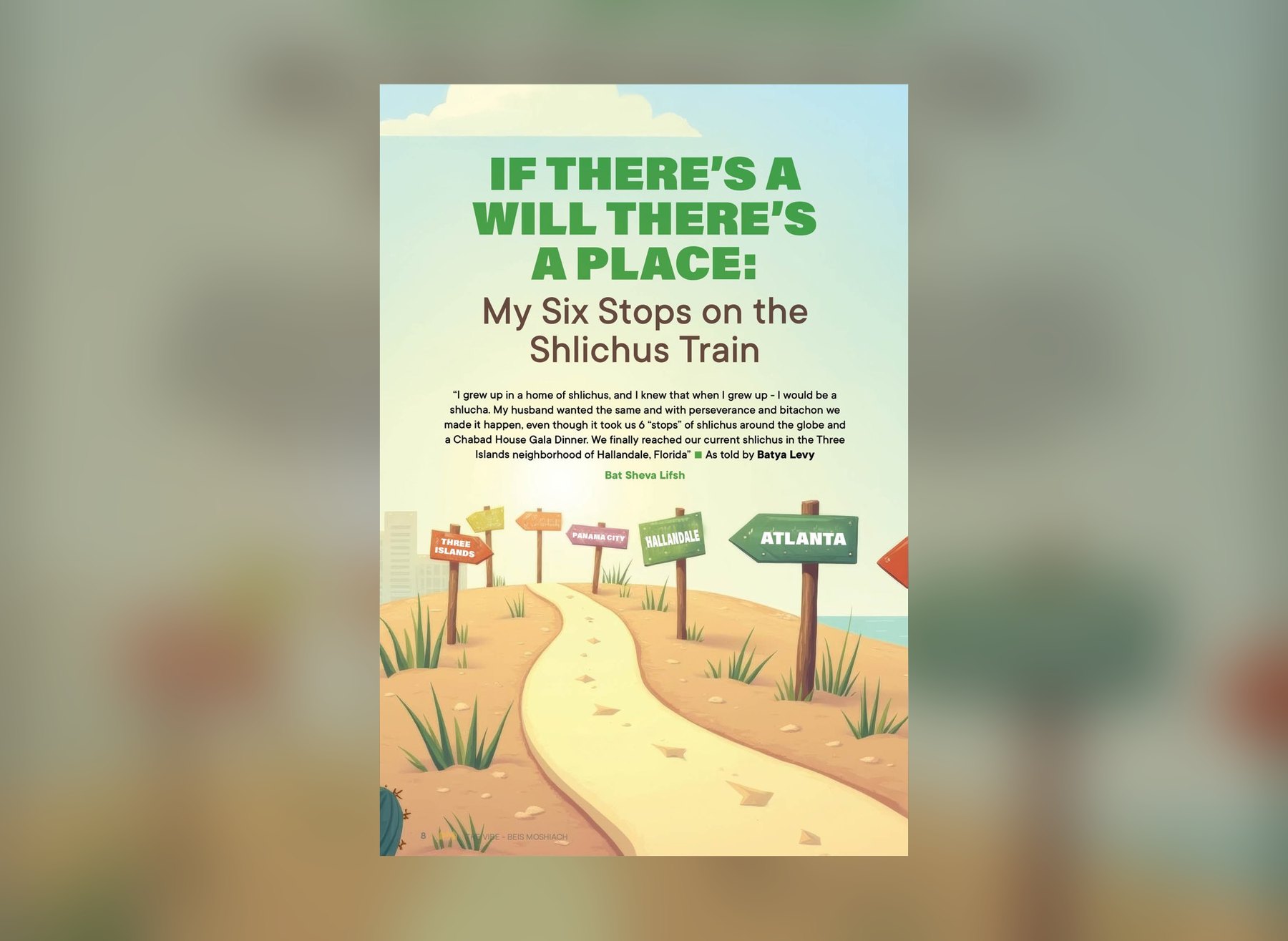
“I grew up in a home of shlichus, and I knew that when I grew up – I would be a shlucha. My husband wanted the same and with perseverance and bitachon we made it happen, even though it took us 6 ‘stops’ of shlichus around the globe and a Chabad House Gala Dinner. We finally reached our current shlichus in the Three Islands neighborhood of Hallandale, Florida.” As told by Batya Levy
First Station: Israel
“I grew up in a home of shlichus, and I knew that when I grew up – I would be a shlucha,” Batya Levy begins her story:
I married my husband, an American who was on shlichus at an American yeshiva, and together we decided to open a yeshiva for at-risk American boys. It requires a lot of courage and hard work, but we were motivated and ready to work hard.
We rented a large villa and started working. Boruch Hashem, we achieved great success. Bachurim came to learn and made real progress on all fronts. Everything looked promising. We opened for a second year with a sense of purpose, went through some significant steps, and from the outside everything looked very promising. However, since we were young and inexperienced, something had to fall between the cracks… and for us, it was the financial side. We started accumulating debts, and they grew. Not all parents paid tuition – obviously not with bad intentions, but in practice, the expenses were greater than the money we managed to raise.
In the middle of the second year, the situation became impossible. We needed to pay salaries, rent, ongoing bills, and more – and we couldn’t handle it. We informed the bachurim they had nowhere to return after the Pesach break and closed the yeshiva with hundreds of thousands of shekels in debt. We managed to organize one last very successful summer camp for them, something completely supernatural, and that was the end. We were then a couple with two children, with enormous debts, and didn’t know where to go next. But we weren’t worried for a very simple reason – we didn’t know how problematic it was to be deep in debt. Meanwhile, we tried to find our next shlichus.
Second Station: La Paz, Mexico
After a short period, my husband’s friend suggested rebuilding his yeshiva, but in a place called La Paz, in a remote area of Mexico. He knew a wealthy local donor who would provide the location and budget, and just needed an actual menahel for the yeshiva. It was quite a surprising offer, but as we felt we had nothing to do in Israel, we decided to go for it – or more accurately, to fly. We left with everything imaginable – clothes, books, food, toys for the children – everything! This was a place where missing items couldn’t be obtained. Even the flight there was very long, taking twenty-five hours, including two stopovers… Initially, it was supposed to be just a few months, a short shlichus. We thought we’d go, dedicate a year to establishing a yeshiva and return. We distributed some of our belongings but kept the rest in storage because we’d be back soon…
We arrived in Mexico on Thursday night, in the middle of the night. Our suitcases were lost en route. There were no batteries for phones and no chargers. Due to a mistake, no one was waiting for us at the airport, and we couldn’t even find anyone who spoke proper English. We rented a room for one night at a random “motel” near the hotel, and that was our “welcome…”
Not an ideal situation, we could have seen it as a low point, but we were filled with a sense of shlichus and motivation for new success, b’ezras Hashem, and saw it as an interesting experience.
In Mexico, two things happened to us: The first was that we realized we had left Israel just in time – we were one moment away from a travel ban, and if we had stayed, they would have started proceedings against us because of our enormous debts. So we escaped that, because we were in Mexico, but it meant we couldn’t return to Israel now.
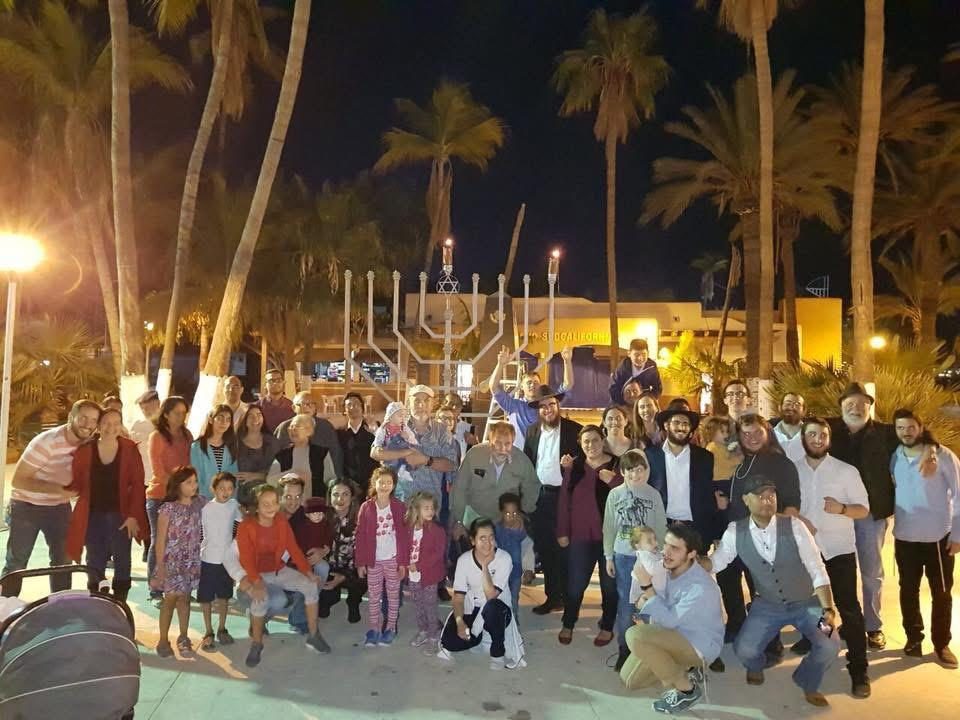
The second and perhaps more important thing is that, boruch Hashem, we experienced great success. My husband started teaching the boys in the yeshiva, I took on a role in the Chabad House, we organized a Chanuka event right when we arrived, we felt that Hashem had truly brought us to Geula in every which way.
Third Station: Atlanta
I was approaching my third birth and since hospitals in Mexico aren’t particularly advanced, to put it mildly, we decided I would go to my sister in Atlanta (3-4 hours flight away), stay there for a short period and return to La Paz, to the shlichus we had already started investing in. I went as planned, my husband came after me with our two daughters, and I gave birth. The day after the birth, my husband came to my room in the maternity ward and said he had received an email from the donor funding all our activities in Mexico. The donor wrote that he had decided to close all activities in the location… It turned out he had come and seen an empty place – just when we had left for a few days – and decided it wasn’t for him. In essence, this meant we had nowhere to return to. Right at the beginning of a new undertaking. Right when optimism was at its peak and, no less challenging, right after giving birth.
We had no choice. We couldn’t return to Eretz Yisrael, in La Paz we had nothing. We were forced to stay in Atlanta for now, and again we returned to square one. Actually, we were in a slightly lower place this time: a foreign country, almost no money, without work or shlichus.
At first, we stayed with my sister, but at some point she left Atlanta (she had come there for a short period), and we were left alone, caring for three little ones. Did we despair? No! Even in this place, we looked for opportunities to add to Yiddishkeit, Chassidus, and to influence others. My husband quickly found some people and established shiurim in Torah and Chassidus. Meanwhile, we checked where in the world we could go on shlichus (staying in Atlanta long-term wasn’t possible.) Our requirements were basic – we looked for a place where there would be shlichus with parnassa. We couldn’t find such a place.
Fourth Station: Hallandale, Miami
Meanwhile, on the advice of our mashpiim, we moved to Hallandale, Miami, with positive thinking and hope for improvement of course, although we didn’t know what we would do there.
In fact, throughout this period, we put ourselves in the position of “mashpia” with joy and confidence, and stayed away from any feeling of sadness and despair, even though we had nothing to hold onto. We were like a “pipeline” – nothing of our own, but trying to transmit the Rebbe and Torah everywhere.
We were left without a shekel or dollar. We arrived at a new and unfamiliar place, in a jalopy car that miraculously survived the journey. After twelve hours of driving, we stayed with an acquaintance of my husband’s family, knowing we couldn’t stay with her for long. Therefore, my husband focused on finding shlichus, holy work, chinuch, teaching – that’s what he knew how to do. And I also looked for myself, while moving from house to house, from friend to acquaintance and back again.
After a difficult period, we finally moved to “our own” apartment: two rooms on the fifth floor without an elevator, peeling walls in green paint and a smell of cats at a token price; there wasn’t even a kitchen there… We were there with the children and didn’t know anything about ourselves, except that we didn’t want to ask for help from anyone.
In this whirlwind, when no one knows what’s really happening with us – and we’re at a loss, a sister who knew the community there suggested we go to the dinner of the local Chabad House. There was a huge contrast between our experiences and the existential difficulty we were in, versus going to an elegant dinner, but she didn’t know our situation… and we decided to go. Why not, actually? We managed to find a babysitter, wore the most respectable clothes we could find in our suitcases and went out to breathe different air, to be different people for a moment. That was the feeling.
We sat on the side, experienced every moment – like in a bubble. There we were, sitting amid this splendor, as they presented projects and successes, impressive lessons and results. There was a nice guy there who talked to us and tried to encourage us. We were very impressed by the amazing shlichus that Rabbi and Rebbetzin Tennenhaus were doing there – we enjoyed every moment, and inside we knew that from there we were returning to the green apartment and the gray reality waiting for us. So gray that we got up in the morning to take care of the children and look for work. I couldn’t even cook…
A few more days of nothing passed. My husband looked for shlichus work, writing STa’M or chinuch, and I sent endless emails with resumes and looked for work as a teacher. We got nowhere.
Fifth Station: Panama City
At this discouraging stage, my husband providentially met a friend, who suggested he enter some business. Truth? We were skeptical. My husband had never dealt with business. All he knew and was familiar with was related to shlichus work and holy work. Nevertheless, on the advice of our mashpiim, he got involved in this business and started working. After about a month, there was a turn for the better, one that was written for us from Above long before the difficulties began.
A hurricane hit Miami with an intensity not seen in thirty years, and the business my husband had started dealing with became in demand at levels never seen before. Within a few days, we moved to the hurricane’s impact center (which was in a remote hole inside Panama City) where my husband had non-stop work, day and night, and the profits flowed.
At the same time, there too, like everywhere else, Jewish ground was waiting for us to cultivate – there were no shluchim there, and there was almost no Judaism. Within a week we opened a “Sunday School,” held a Chanuka party (again, a year later, but in a completely different place…), opened classes, hosted Shabbos meals and more. Although we weren’t there for a long period, in that short time we ran everything we saw was missing, from a Jewish perspective. It was a very good period in all aspects. But anyway, it wasn’t possible for us to stay there. A couple of shluchim from Israel came to continue to build on the foundation we had started, and we returned to Miami.
Another amazing detail in this series of hashgacha pratis; when my husband worked nonstop he earned very large sums of money and we started paying the debts we had in Israel. Just as it was always clear to us that we wouldn’t stay in this low state – that the debts were weighing on us and not allowing us to return to Israel, so it was clear to us that we wouldn’t go again to fundraise to cover the debts. We were completely broken by fundraising and wanted to pay everything from our own money. After all, we did something good, the yeshiva received many brachos from the Rebbe and accomplished good things with the boys. It was clear to us that this would be resolved in the best and most proper way. And indeed, in a miraculous way we couldn’t imagine in advance – in a relatively short period we managed to repay the enormous amounts we owed in Israel.
Sixth Station: Hallandale, Miami
We returned to Hallandale, and now we had everything except shlichus. We found a good apartment there, my husband continued with his business, the children were settled, but without shlichus we felt it wasn’t right enough. We hadn’t come all this way just to live here quietly. Even if we wanted to do shlichus work – there wasn’t a suitable audience… We lived in an area where many Chabad families lived, there wasn’t even anyone to host for Shabbos meals. Despite the low probabilities, we approached the local shliach, Rabbi Tennenhaus, and asked if there was an open area for shlichus work for us. And there was!
He had a place for us, and we received it without any protektzia, and it seemed to us – completely above nature. We moved to the Three Islands neighborhood. Many Jews live in this neighborhood, and there too, like everywhere, we started the shlichus with all our strength. We created connections with the Jews in the area, and engaged in all other things that shlichus entails. It’s not easy to start shlichus in a new and unfamiliar place, but with divine assistance and hard work we managed to gather the Jews into a large and united community. Today we have classes here, a shul, and a connection to everyone.
Seeds of Personal Redemption
And R’ Tennenhaus’s dinner, the one we visited as strangers and outsiders before we found ourselves? It turns out it’s held every year…
After five years we participated in it again, and this time we were the ones called to the stage to receive an award for our shlichus activities. For us it was an emotional closing of a circle, which taught us that already five years ago, in the green apartment, when we came to the dinner “unconnected,” the seeds of our Geula were planted even though it hadn’t yet been revealed to us when we were in such a low and difficult place.
In retrospect, we understand well the Chassidic saying “descent for the purpose of ascent,” and as the Rebbe says that “the descent itself is already the ascent.”
Focused on ‘What is Required of Me’
I think the secret during this difficult period was the understanding that Hashem is taking us through something. Nothing happens “just because.” I could have resisted the difficulties, refused the process and work required of me, said “no and enough.” Hashem could give me livelihood in Miami too, without us having to move to some remote hole… but the moment I understand that there’s a lesson here that I need to learn – I let go and allow Hashem’s will to pass through me.
And the more we learn our lessons quickly, without resisting, without dealing with the past or future – the faster and better we’ll reach the final and perfect point. On the other hand, when someone resists the lesson Hashem is trying to teach them, runs away and sinks into themselves and their difficulties, Hashem brings them back again and again to the same point, until they learn. We went through journeys that could have taken a long time, but in each place we were there for a short period, gave our maximum to those around us – and moved on to the next stage. We learned quickly.
As long as I’m in the position of “giver” and not “receiver,” focused on “what is needed from me” and not on “what I need,” I won’t sink into depression, no matter what happens around me!
The thought that “I’m here, what can I give?” doesn’t leave room for other thoughts – and especially when channeling it into concrete action.
There were so many opportunities to fall into despair during the two years full of upheavals that we went through until we stabilized, and only the thought about what was required of us and the activities in every possible place are what held us until now.
Reorienting Again Each Time
There are no lives without ups and downs, questions, challenges and dilemmas. To fine-tune myself from where I am, from time to time you need to conduct an internal check. Like a guitar that needs constant tuning.
I ask myself and Hashem if right now I’m doing what is required of me. It sounds like a very big question, and it doesn’t seem clear how one can answer it…
But the truth is that if we listen, and aren’t just busy with the goals we want to achieve – we’ll notice that we’re constantly receiving small and directing messages. This is true in shlichus work and it’s true in personal life – in every situation. Of course it’s important to consult with mashpiim and write to the Rebbe, to ensure we’re on the right path. But with attentiveness. To be reflective and not be afraid to give myself criticism.
A small example from my life: In the last two years I’ve been giving Tanya classes to Israeli women outside our community. This past Rosh Hashana I did some soul-searching regarding the Tanya classes, because I noticed I had received some messages, women from within the community who approached me and asked why I wasn’t teaching them Tanya… I felt that some change needed to be made here, to change my time allocation so I would dedicate more time to the American women in the community. I hadn’t done anything yet, just decided within myself to aim for that and wrote to the Rebbe.
Suddenly, unexpectedly, an amazing woman from the community who manages large high-tech projects approached me and offered to work with me with managing the Chabad House and give me tips for improvement, efficiency and better use of my time.
I had just understood the message within myself and felt ready to make a change, and wrote to the Rebbe of course – but still without knowing exactly what to do – and here Hashem sent me the guidance and how to do it in the best way. If I hadn’t received the message and directed myself – this simply couldn’t have happened…
Following what was said before, I made another revolutionary change. Until now we had taken several groups of Israeli women from the Tanya class to the Rebbe, and now we’re taking our a first group of American women who merit to travel to the Rebbe! I invest a lot in these trips, knowing that arriving at the Rebbe changes the essence.
Once I asked my mother how my father (Rabbi Motti Gal a’h) brought so many Jews closer – and she told me that he simply brought mekuravim to the Rebbe. So I took that on for myself too, and I see that a woman who returns from the Rebbe begins an avoda of teshuva from a much more internal and core place.
It’s very difficult to live in change. We reach a comfort zone and it’s easiest to stay there… but whether I’m an official shliach or not, in order to serve Hashem and not myself, and to truly always be on the Rebbe’s shlichus – we must do this avoda.
Good luck to us all.
The Chassidishe Vibe #1455 • pp. 8-13, 23
© 2026 Beis Moshiach Magazine. All rights reserved.
This article originally appeared in Beis Moshiach #1455. You are welcome to share it with friends and family by email or in print, provided that you do not change, add to or omit any part of it, you credit the author and Beis Moshiach, and you include a link to archive.bmoshiach.org (written out in full in printed copies).
To republish this article in a newspaper, magazine, book or website, please request permission in advance at [email protected].