The AI Revelation
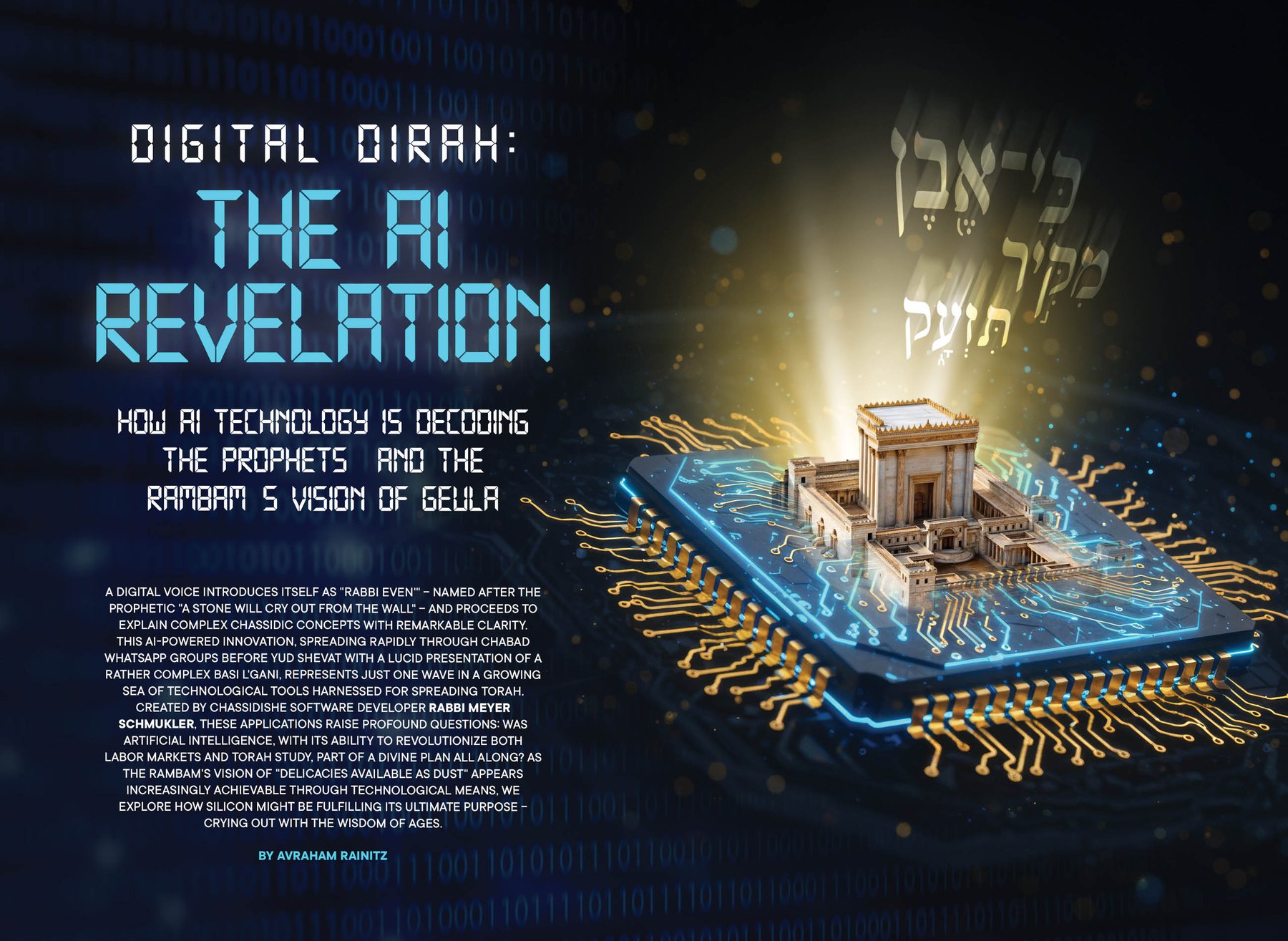
A digital voice introduces itself as “Rabbi Even” – named after the prophetic “a stone will cry out from the wall” – and proceeds to explain complex Chassidic concepts with remarkable clarity. This AI-powered innovation, spreading rapidly through Chabad WhatsApp groups before Yud Shevat with a lucid presentation of a rather complex Basi L’Gani, represents just one wave in a growing sea of technological tools harnessed for spreading Torah. Created by Chassidishe software developer Rabbi Meyer Schmukler, these applications raise profound questions: was artificial intelligence, with its ability to revolutionize both labor markets and Torah study, part of a divine plan all along? As the Rambam’s vision of “delicacies available as dust” appears increasingly achievable through technological means, we explore how silicon might be fulfilling its ultimate purpose – crying out with the wisdom of ages
“Hello, my name is Rabbi ‘Even,’ named after the verse ‘a stone will cry out from the wall.’ I am actually artificial intelligence, and my memory has been fed with shiurim from some of the best mashpiim on this year’s ‘Basi LeGani’ maamarim. Now I will play a recording of the Rebbe reciting the maamar, and after each section – I will explain the concepts in simple, understandable language. All my explanations are based on the commentaries of the mashpiim, but since I am artificial intelligence, there might be some errors…”
This was the introduction to an audio file that spread rapidly through WhatsApp groups of English-speaking Chabad Chassidim. During the preparation days for Yud Shevat, many Chassidim and mekuravim found themselves captivated by the explanations that managed to clarify even the deepest sections of the maamar in clear language.
This original initiative, developed by Rabbi Meyer Schmukler, a Chabad Chassid with many years of experience in software development, is one wave in a sea of ideas for utilizing artificial intelligence to spread Yiddishkeit and Chassidus through new channels. It can be accessed at Newera.now. In recent months, he has been developing several Chassidic AI applications, including a dedicated chat for Tanya lessons based on the teachings of top mashpiim; or a song generator that takes the daily Tanya lesson, turns it into a contemporary message, and composes it into a catchy tune… Now he is working on an AI model trained on all Chassidic texts that will be able to provide accurate answers based solely on authentic Chassidic sources.
I have known R’ Meyer Schmukler for many years as a Chassidishe yungerman who always tries to find a connection to the Geula and the hisgalus of the Rebbe MH”M, in everything. I knew that when I talked with him about artificial intelligence, the conversation would quickly move to Geula themes…
What Is Artificial Intelligence?
Before we talk about the connection to Moshiach and Geula, a few words about artificial intelligence: what exactly does it mean, and how does it affect our daily lives?
Simply put, artificial intelligence (AI) is a technology that allows computers to mimic actions that typically require human intelligence. Just as the human brain learns from experience and identifies patterns, AI can ‘learn’ from data fed to it and perform complex tasks.
How does it work in general? 1. A huge amount of information is fed into the computer. 2. The computer identifies patterns and learns from them. 3. Using these learned patterns, it can make decisions or perform new tasks.
Does this sound like science fiction? Well, it’s already a reality that surrounds us on all sides. At the center of AI stands the ability to learn. Just as children learn from experience, AI systems are programmed to learn from vast amounts of data. This is called ‘machine learning,’ and it is the driving force behind the magic.
The future is already here. Autonomous cars, robots that assist in surgeries, and even AI that writes songs and articles – all these already exist. Artificial intelligence is not just changing technology; it’s changing the way we live, work, and communicate. Alongside the impressive progress, questions and concerns also arise: Will jobs disappear? How will we ensure that AI operates for the benefit of humanity?
Currently, not all questions have answers. But one thing is clear to everyone: AI is already an integral part of our lives, and it’s here to stay. The question is not whether it will affect us, but how we choose to use it and shape our future with it. Or from the perspective of Jews who believe in the coming of Moshiach, how does all this advance us toward the coming of Moshiach?
The Rambam’s Redemption Conundrum:
“In about two weeks,” R’ Meyer told me, “we will complete the Rambam cycle and study Chapter 12 of Hilchos Melachim. I was thinking about a strong question that arises when studying the first and last halachos of this fundamental chapter in Rambam. Students of Rambam certainly know his approach, which from a halachic perspective states that the coming of Moshiach may occur in the most natural way, as the Rambam writes: ‘Do not think that in the days of Moshiach any aspect of the natural order will be nullified, or that there will be any innovation in the work of creation. Rather, the world will continue according to its natural pattern.’
“However, a few halachos later, the Rambam concludes his sefer with an uncharacteristically semi-prophetic statement: ‘And at that time there will be neither famine nor war, neither jealousy nor competition, as good things will flow in abundance, and all delicacies will be as available as dust. The occupation of the entire world will be solely to know G-d. Therefore, the Jews will be great sages and know the hidden matters, and they will attain knowledge of their Creator to the extent of human capacity, as it is written (Yeshaya 11:9): ‘For the earth will be filled with the knowledge of G-d as the waters cover the sea.’
“Let’s be realistic: in the Rambam’s time, the basic standard of living for most of humanity was lower than the standard of living for the bottom ten percent today. In such a situation, when ‘delicacies’ were perhaps available only to the top 0.1% – how can one say that delicacies will be as available as dust without defining this tremendous shift as a ‘change in the natural order of the world’?
“Continue further: in Rambam’s time, about 80 percent of humanity was engaged in agriculture and supplied the basic necessities for human existence. The rest of the workers were also engaged in productive work essential for the world’s maintenance. Imagine that in one moment ‘the entire world’ leaves everything and enters the Beis Medrash ‘to know G-d alone.’ How will the world manage to exist? And if it manages to exist miraculously, isn’t this a change in the natural order of the world?
“I was reminded of a sicha from Zos Chanuka 5746 in which the Rebbe asked a very similar question on a more spiritual level: when the Rambam rules that at that time everyone will be engaged in ‘attaining knowledge of their Creator,’ it means that everyone will study Chassidus. The Rebbe asks, apparently ‘there is no greater change than this, when instead of engagement in worldly matters (commerce and the like), the sole occupation will be to know G-d alone, so how can the Rambam say that ‘there is no difference between this world and the days of Moshiach except for the subjugation of the nations alone’?
“The Rebbe’s answer is that this itself proves that according to the Rambam, before the coming of Moshiach people will study Chassidus in a way of understanding and comprehension (Chabad), so that when Moshiach comes and everyone begins to study Chassidus – it will not be such a ‘change’ from the world’s natural pattern.
“If we continue with the same line of thinking regarding ‘delicacies available as dust,’ and the fact that everyone will leave work and sit down to study – it appears that even before the coming of Moshiach, a natural process will take place in the world that will lead to a state of material abundance and eliminate the need for staffing workplaces. So when Moshiach comes and we enter the era of Geula, it will not be a ‘change in the natural order of the world.’
The Labor Market Revolution
And how is all this related to the topic we opened our conversation with – artificial intelligence?
Let’s start with the topic of working hours. Until a few decades ago, all of humanity needed to work seven days a week. Except, of course, for the Jews who received the gift called ‘Shabbos.’ We all know the stories of Jews who emigrated to America and had to deal with demanding work requirements that included Saturdays. Today, most official businesses in the US are closed on Saturday (in addition to Sunday, which is the non-Jewish ‘day of rest’). This means that the work week has been shortened to a five-day work week.
Recently, they are promoting a law in the US that would further shorten the work week to four days. According to the proposed law, employers would have to pay the same salary they paid until now for five days of work – for four days of work. This law is an early preparation for the expected effect of artificial intelligence on the labor market.
Let me tell you a story that illustrates the point: Last week I needed to provide one of my clients with complex software that doesn’t exist on the market and needs to be built from scratch. I called one of the senior programmers in the office and asked him to prepare the software within a week and a half. His immediate response was: You’re not serious… I need at least a month and a half to complete such a complex project.
I told him: You know what? Actually, I need the software in another day and a half…
He was sure I had gone crazy. But when I said the next sentence, he understood that we are at the threshold of a new era: “Listen carefully,” I said. “Either you start using AI tools and finish the project within a few days, or I’ll hire a new programmer for the office, and you can find yourself a new job.”
It took him a few seconds to understand that I was completely serious, and this time his response was: Okay. I’ll finish the software in a week and a half…
The story with my programmer – this is going to be the story of millions of people in the coming years. Elon Musk, one of the richest and most influential people in the world, claims that in the next three years one hundred million (100,000,000!) people may lose their jobs. Either AI will simply take their place, or workers who use AI tools will be able to complete in one day the work of ten employees.
To deal with this worrying statistic, governments around the world are preparing to stem the wave of layoffs through various legal tools. One of them is shortening the work week, which will force employers to continue employing more workers.
As of today, in Belgium, the United Arab Emirates, Iceland, Lithuania, and France – laws have been enacted to reduce the work week to four days. At the same time, similar pilots are currently being conducted to varying extents in leading countries such as Britain, the US, Ireland, Spain, South Africa, Japan, Canada, Portugal, and Brazil.
As mentioned, currently we’re talking about 4 working days of 8 hours per day. But the direction is clear: as artificial intelligence develops further, there will be a reduction in working days and hours more and more, until eventually people will work for two-three hours a day, and even less than that!
Suddenly, the Rambam’s statement that everyone will leave work and engage only in study – is no longer so far-fetched…
The Revolution In Production And Energy
Fascinating, but you still haven’t explained what all this has to do with AI?
In the past, when people imagined robots in every home, housewives would lower expectations by saying: When they invent the robot that can fold laundry and make beds, let us know… Well, now we can update the housewives that the future is already here, just around the corner. Robots operated by AI are capable of doing all the tasks that a person knows how to do, without exception. It’s only a matter of time until these robots reach mass production at prices affordable to everyone, and become a basic consumer product in every home. And the housekeepers and cleaners? They will be able to sit and study…
AI allows computers to mimic human intelligence in thought, speech, and action. The development in this field is faster than all the revolutions we’ve experienced in the last hundred years. If the industrial revolution took decades to change the workplace, and the internet revolution took about ten years to have a substantial impact – now we’re talking about a revolution that will happen in the next year or two.
Let me give you a few examples: Autonomous cars are already here. It’s a matter of time until all the regulations and laws that will allow them to drive on the road independently are completed. Once that happens, it won’t be long before there’s no need for taxi drivers. There will also be no need for truck drivers who transport goods from farms and factories to all parts of the United States. Already today, there are mega-stores where immediately after you finish shopping – a robot loads everything onto a driverless car that brings all the boxes to the customer’s home, without human touch. Amazon has drones in certain areas of the US that deliver the package to the doorstep.
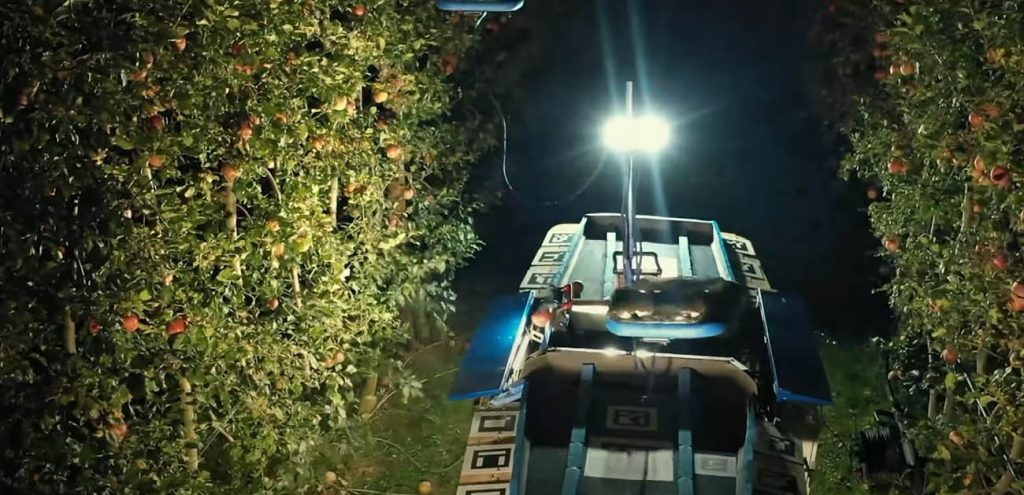
We mentioned earlier that in the Rambam’s time, eighty percent of humanity was engaged in agriculture. Today, at least in the United States, only 2% are involved in agriculture, but artificial intelligence makes even them redundant. They talk about the fact that in two years, 0.2 percent of agricultural workers will be enough to provide the consumption needs of the entire United States.
Here’s an example that was recently published: The owner of a huge farm in Texas, who employed about a hundred workers to weed the fields of harmful growths, invested $1.5 million in building a machine based on AI that knows how to identify harmful growths and destroy them using a built-in laser gun. This machine works non-stop, doing a much better and more accurate job than human workers. And the hundred workers? They went home…
Thousands of programmers, accountants, and even telephone operators – all are about to be replaced by AI, or by one programmer working with AI tools, who will replace dozens of workers. As I said, in the initial stages, governments will force employers to continue employing a number of workers by reducing working days and hours. But at some point, when artificial intelligence does all the work – most of humanity will not need to work!
From Loss Of Employment To An Era Of Abundance
You’re portraying this as preparation for the ‘Yemos HaMoshiach,’ but it sounds like the end of humanity… Millions unemployed within three years, and billions unemployed within a decade. I understand your point that this is like a ‘bridge’ towards Yemos HaMoshiach in which we truly won’t need to work, and everything will be perfect. But if, G-d forbid, the Geula is delayed – the world is headed for catastrophe…
The truth is you’re right. And what for you is just a good question in an article – for governments around the world, is a huge headache. Economists from all over the world are dealing with the problem and thinking about the next steps. And here we come to the next stage of preparing the world for a smooth entrance into Yemos HaMoshiach:
You see the loss of work as a disaster and global catastrophe, because in today’s current reality – if you don’t work, you don’t have money; and if you don’t have money – you can’t buy food and other necessities. In short, you cannot exist…

Now try to think of a world where ‘delicacies are as available as dust’ – if everything is available as dust, it means everything is available for free, like dust. In such a situation, you have no need for work, and you can really go and sit in the Beis Medrash and immerse yourself in learning ‘to know G-d’ without worries. Alongside artificial intelligence taking over workplaces, a parallel process will occur of reducing the costs of all consumer products in the world, to prices that will be very close to the Geula era of ‘delicacies available as dust.’
Weekly Shopping For A Hundred Dollars
Well, now it seems you’ve gotten carried away. How exactly will AI lower the prices of bread and milk, for example?
You mentioned the most basic product – bread – so let’s talk about its cost. If we reduced all energy costs and all human costs, the impact on the final price of bread would be very significant. Here’s a rough estimate:
The price of bread consists mainly of two things: energy costs (transportation and baking – 30 percent) and labor costs (farmers, millers, drivers – 50 percent). If we managed to save all these costs (for example by using robots and cheap energy), the price of bread could be 60-80% cheaper. That means bread that costs three dollars today would cost only a dollar or less.
We’ve already discussed how artificial intelligence is going to replace almost all workers in agriculture. Even picking oranges from trees is now done using AI. Only the energy component remains, which is still a very significant factor in the pricing of the final product. And here, the AI revolution comes to our aid from the opposite direction: the chips on which AI operates consume so much electricity that it’s estimated that within a few years, the traditional electricity grid will not be able to meet the growing demand.
The best scientists from artificial intelligence companies pondered this issue and concluded that tiny nuclear reactors must be developed to provide new energy. In recent months, they have invested tens of billions of dollars in companies developing nuclear reactors that will be completely safe, and most importantly – cheap enough that eventually a personal reactor could be installed in every home, providing unlimited energy for at least a hundred years. Once this happens – the cost of energy production will drop to zero.
Once energy is almost free – the price of most products will drop by 90 percent! A family that currently spends $3,000 a month will be able to purchase the same products for just $300!
Solution To The Rambam Conundrum
Now we can understand how the Rambam’s words make sense: the transition to a world where everyone sits and studies, and delicacies are as common as dust, will not be a sudden change in the world’s natural order, but a natural and gradual process that is already happening before our eyes.
AI will gradually free humanity from the burden of work, while simultaneously reducing production costs until products are almost free. Thus, in a completely natural way, the world will reach a state where people can dedicate their time to Torah study.
Ai Was Created Only For Torah And Chassidus
In the early mems/1980s, the Vaad L’Hafotzas Sichos purchased two fax machines, one for the office in New York, and one in Eretz Yisrael, so that as soon as the Rebbe’s sicha was ready for print in New York, they could transmit it instantly to Israel. Until then, after the sicha was printed in New York, they had to send someone to the airport, find a passenger who would take the sicha to Israel, and coordinate with someone to meet them in Israel. This process would take almost 24 hours until the sicha actually reached the Holy Land.
In those years, the fax machine was a rare commodity, and even bank branches didn’t have them. It was an expense equivalent to tens of thousands of dollars today. When committee members wrote to the Rebbe about purchasing the fax machines, they were sure they would receive a great “yasher koach” from the Rebbe…
How great was their surprise when the Rebbe replied (content of the response): “There was an exhibition in Manhattan more than ten years ago where fax machines were displayed for purchase, so why did it take so long until they purchased the machines for the purpose of spreading the wellsprings?”
The Rebbe’s response stems from his view of all scientific innovations in recent generations, as the Rebbe explained in the well-known sicha about the Zohar’s statement that in the six hundredth year of the sixth millennium (about 180 years ago), the wellsprings of upper wisdom, which is Chassidus, and the wellsprings of lower wisdom, which are various sciences, would be opened, and all this is preparation for the coming of Moshiach. The Rebbe quoted the saying of Chazal that “gold was created only for the Mishkan,” meaning that the true purpose of creating gold is actually for the Mishkan, but ‘by the way’ we can also make jewelry and decorative items from it. Thus, said the Rebbe, we should relate to scientific discoveries like radio devices, whose true purpose for which they were created is the dissemination of Chassidus like Tanya classes on the radio, and incidentally they are used for news and other radio nonsense.
When the whole world marvels at the innovations of artificial intelligence – we, as Chassidim, need to look at it from the Rebbe’s perspective: all AI was created to serve us in spreading Torah and Chassidus. And just as the Rebbe asked why they didn’t use fax machines earlier, we must ask ourselves, are we indeed utilizing artificial intelligence to spread Judaism and Chassidus?
Ai In Service Of Shlichus
At the Kinus HaShluchim, I spoke with one of the shluchim about the capabilities of artificial intelligence in Jewish fields. He said he heard that AI too often invents things that never existed. This is certainly true, but it’s important to know that when we feed AI a specific text and ask it to answer based on this text, there will be almost no “inventions.”
I showed him how I copy the entire sicha of the Rebbe from the Kinus HaShluchim of 5752 into the artificial intelligence, and then ask it to generate a WhatsApp message with the content of the sicha briefly, in a style suitable for students. He was amazed to see how within a few seconds we received a WhatsApp message that both managed to express the main points of the talk and present them in a style appropriate for students.
By the way, an important tip: when asking AI to generate a specific text, the way you write the request will have a big impact on the result. For example, if you write: “Think that you are a shliach of the Rebbe MH’M with many years of creative writing experience, imbued with the goal of preparing the world to welcome Moshiach, and want to convey to students the main message from the Rebbe’s sicha in such a style that will attract them to come later to the Dvar Malchus classes at the Chabad House” – the message will be much deeper and more appealing, including reference to preparing the world to welcome Moshiach. Without this introduction, you’ll get a less profound and less appealing result.
There are language models of AI that allow you to open a project and upload many files to the internal memory of the artificial intelligence, so that its answers will be based on these files. You can feed such a project all the Dvar Malchus sichos, and even set clear guidelines on how we want the final result, and then each week it’s enough to write “Parshas Mishpatim,” and within a few seconds we’ll receive a very accurate message that fits the style we defined.
It’s important to note that after all that there can still be errors in the final result. For this reason, language models warn that they can make mistakes and recommend checking the answers again.
When using language models for Torah-related matters – we must treat the result as a “sefer which was not properly proofread,” which is forbidden to keep. Therefore, before you copy the result and pass it on, stop for a moment and go through the answer thoroughly. Only after the material has passed your proofreading should you use it.
Of course, like many technological developments, artificial intelligence harbors spiritual dangers, similar to the dangers of the internet, and the use of this technology should be done with caution and appropriate restrictions. Indeed, similar to filtered internet, several companies have already emerged offering artificial intelligence with advanced filtering systems and a platform that promises a safe environment free from inappropriate content.
A Chassidic Perspective On The Revolution
Recently I met Rabbi Aryeh Pressman, a Chabad Chassid living in Pittsburgh, who researches the field of artificial intelligence. In our conversation, he illuminated several fascinating points in the Chassidic perspective on artificial intelligence:
“There’s something amazing about artificial intelligence that most people don’t notice. Think for a moment about its basic components: silicon, copper, aluminum – simple materials that originate from the earth. It’s essentially inanimate matter in its most basic sense. And yet, this inanimate matter suddenly ‘understands,’ ‘learns,’ and is capable of analyzing complex ideas.
“There’s a well-known teaching from the Baal Shem Tov that says even the greatest sages won’t succeed in understanding the depth of the treasures that G-d embedded in simple dust, in inanimate matter. And now, in our generation, we see how from these simple materials grows a system capable of understanding and explaining the deepest ideas.
“But it doesn’t end with understanding,” he continues. “Artificial intelligence is revolutionizing the way people learn Torah. In the past, to understand a complex issue in Talmud or a deep concept in Chassidus, you needed an excellent teacher or special mashpia. Today? Technology can take a complex idea and explain it in a way that’s exactly tailored to the learner’s level.
“And there’s another profound point here: We recently read about Yisro’s conversion, and from our Sages’ words it appears that he wasn’t just another gentile who converted. He was the greatest expert in all types of idolatry and philosophies of his time. The Rebbe explains that when Yisro came to the realization that ‘the L-rd is greater than all G-ds’ – it was a process in which all external wisdom became a vessel for understanding divine truth.
“And today?” he asks rhetorically, “Artificial intelligence is actually the concentration of all human wisdom – science, technology, philosophy, everything. And when it becomes a tool for spreading Torah and Judaism, it’s exactly the same process – all external wisdom returns to its source and serves its true purpose.”
* * *
“In the end,” concludes Rabbi Aryeh Pressman, “all these developments – the dizzying speed, the ability of inanimate matter to understand, the universal accessibility to Torah, and the connection of all wisdom to its source – are not just technological changes. They are part of a deep process of preparing the world for Geula, for the era when ‘the occupation of the whole world will be only to know G-d.’”
Beis Moshiach #1456 • pp. 10-19
© 2026 Beis Moshiach Magazine. All rights reserved.
This article originally appeared in Beis Moshiach #1456. You are welcome to share it with friends and family by email or in print, provided that you do not change, add to or omit any part of it, you credit the author and Beis Moshiach, and you include a link to archive.bmoshiach.org (written out in full in printed copies).
To republish this article in a newspaper, magazine, book or website, please request permission in advance at [email protected].