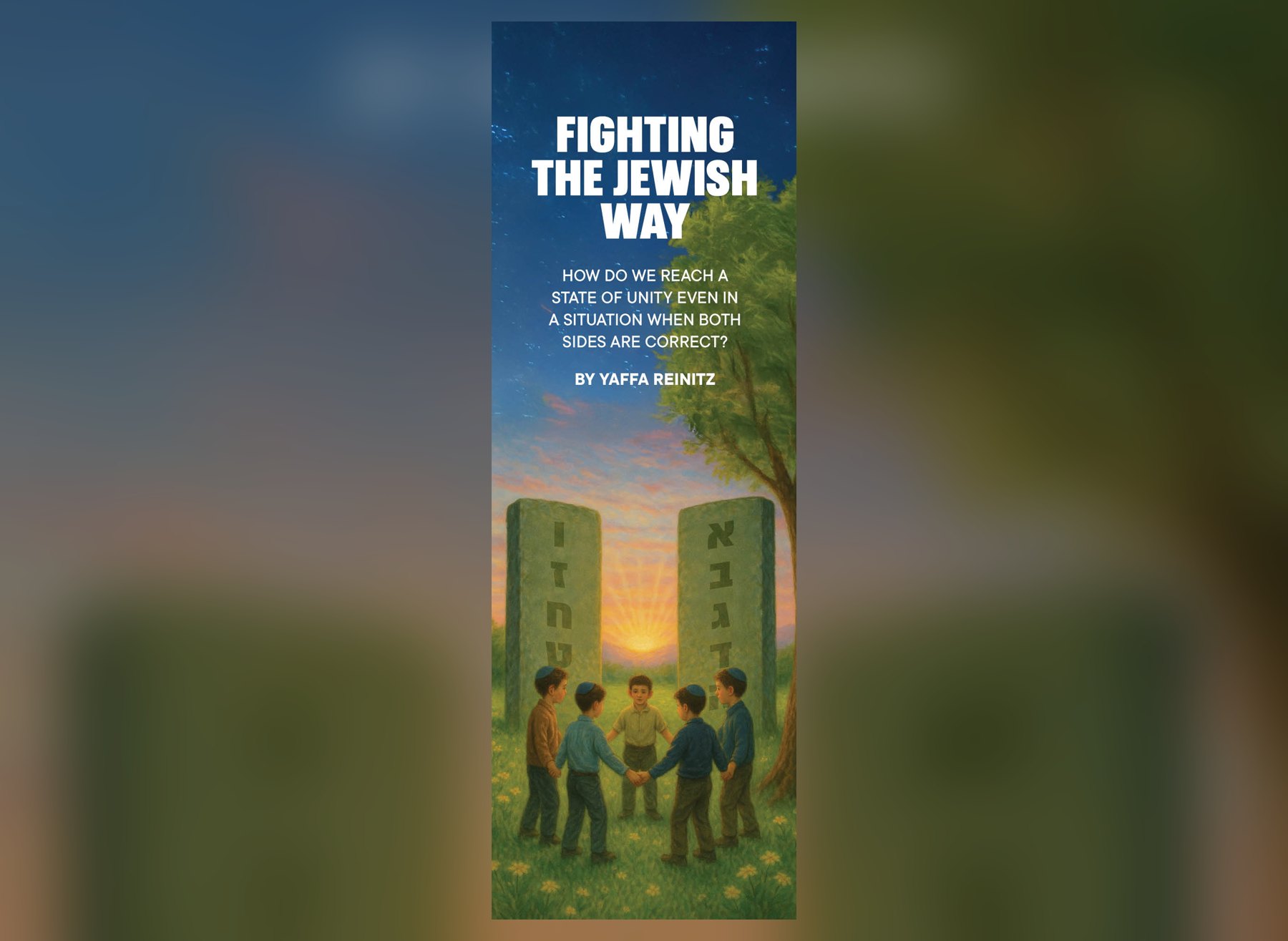
Fighting the Jewish Way
Shulamis is a mother of two growing children – Nechemia, age eleven, and Sheina, age thirteen. She tells how they constantly fight with one another. For example, Nechamia wants to make himself some fries in the kitchen, Sheina is responsible for cleanliness in the kitchen, and she also takes on this additional responsibility because she really cares that it should always be spotless clean. The last time this happened, thunder and lightning came out of the kitchen: “Mommy, look how much mess he’s making. I don’t want him frying here anymore.”
“Mommy,” Nechemia also cries out, “she’s not the boss here! I have every right to cook in the kitchen. This is my house too.”
And on it goes – from morning until night. Every day, they have something else to quarrel about. What am I supposed to do? Is it my job to interfere in their spat? Perhaps they should learn how to manage on their own?
Stop Being So Frightened By Arguments
The Torah says about when the Jews arrived at Mount Sinai before Mattan Torah, “And Yisrael (vayichan) encamped there.” This is stated in singular, in contrast to all the times when it says “And they traveled…and they encamped” in the plural. The Mechilta draws from this that all the previous times that the Children of Israel traveled and set up camp, they were in strife, whereas, this time, at the foot of Mount Sinai, they were “like one person with one heart.” No disagreements broke out among them. Rashi lingers on the word “there”, saying that at the encampment “there”, at Mount Sinai, the Jewish People were as one man with one heart. However, the other encampments were with complaints and discord.
The Mechilta speaks about natural disagreements, noting that “just as their faces are different, so their temperaments are different.” In contrast, Rashi speaks about complaints and discord, a state of fighting and dissension in its simplest sense.
In any case, it turns out that a state of fighting and dissension is quite normal. It happened to us even in the time of Moshe Rabbeinu, a great leader who guided us and was accepted by everyone. Even the great miracles and the collapse of the systems of nature at Yetzias Mitzrayim and Krias Yam Suf didn’t change this basic human nature.
So, who are we to complain? It is quite normal when this happens. It means that we have to stop getting so upset when there is fighting and disagreements, nor should we let this get us overly excited as this is a natural part of life on this planet and it’s part and parcel of children’s process of growing up and maturing. Instead of stressing that it happens, we can apply our strengths in learning how to handle this in a proper way.
What’s Better – One Or Three?
As you may have noticed, the only antidote to the normal quarreling was Mattan Torah. The unique quality of the Torah is how it brings an end to disputes and creates a sense of unity, even though the Torah itself has a wide variety of opinions and disagreements. This quality comes into expression with the pasuk: “G-d shall grant strength to His people” – when we are connected to the Torah, to its strength, its intensity, its might, we come to “G-d shall bless His people with peace.”
True unity doesn’t mean one single opinion for everyone. True unity is expressed specifically when there are contradictions and differing opinions between two sides, yet they still remain united. We see that in the arguments between Beis Hillel and Beis Shammai, the halacha almost always was determined according to Beis Hillel, despite the sharp mind that characterized the scholars of Beis Shammai. And why is that? “Because [Beis Hillel] was pleasant and forgiving.”
Cognitive flexibility doesn’t come merely because we understand things with our intellect, rather because our “ego” takes a back seat, made possible by being easy-going and humble.
Getting back to our story.
Nechemia says: “I’m a big boy now. I have no desire to make a mess, and I enjoy cooking.” Sheina says: “I’m the one who’s responsible for cleaning up, and after he cooks, the kitchen is turned completely upside down. I’m even willing to prepare things for him; the main thing is that there shouldn’t be such chaos and disorder.” Each side has its own logical reasoning for his/her request. So, how do we reach a decision?
First stage: Changing one’s opinion according to the need. These aren’t two egos struggling with one another to determine who’s right, rather observing each side’s different needs. One wants greater independence, the other needs more consideration.
Second stage: We listen to the needs of the other party and act responsibly. Nechemia shows consideration for his sister and cleans up after himself. Sheina respects his need to be more independent, not standing over him or being excessively precise and fussy that he doesn’t clean up the same way she does.
As to the main question: Yes, it is most definitely the job of parents to establish these connections between siblings, giving them the tools required to be more considerate and see the needs of others, even accepting some of the responsibility for their role. And above all, we must believe in them that they are able and willing to carry this out and manage on their own.
Summary:
Strength – When you aren’t upset by family squabbles, you’re free to handle the situation more properly.
Connection – When we connect ourselves to Torah values, we can show consideration for the needs of others.
Choice – The job of parents is to forge greater connections between siblings and show faith in their ability to manage on their own.
The clinical examples presented in this column have been completely changed in their details and content. – Yaffa Reinitz is a trainer and guide for individuals and couples, a counselor for parents in the “Connecting You to Yourself” method. She holds a Master of Arts degree in educational counseling and special education.
Beis Moshiach #1461 • pp. 42-43
© 2026 Beis Moshiach Magazine. All rights reserved.
This article originally appeared in Beis Moshiach #1461. You are welcome to share it with friends and family by email or in print, provided that you do not change, add to or omit any part of it, you credit the author and Beis Moshiach, and you include a link to archive.bmoshiach.org (written out in full in printed copies).
To republish this article in a newspaper, magazine, book or website, please request permission in advance at [email protected].