Shavuos? You Orthodox Made That Up!
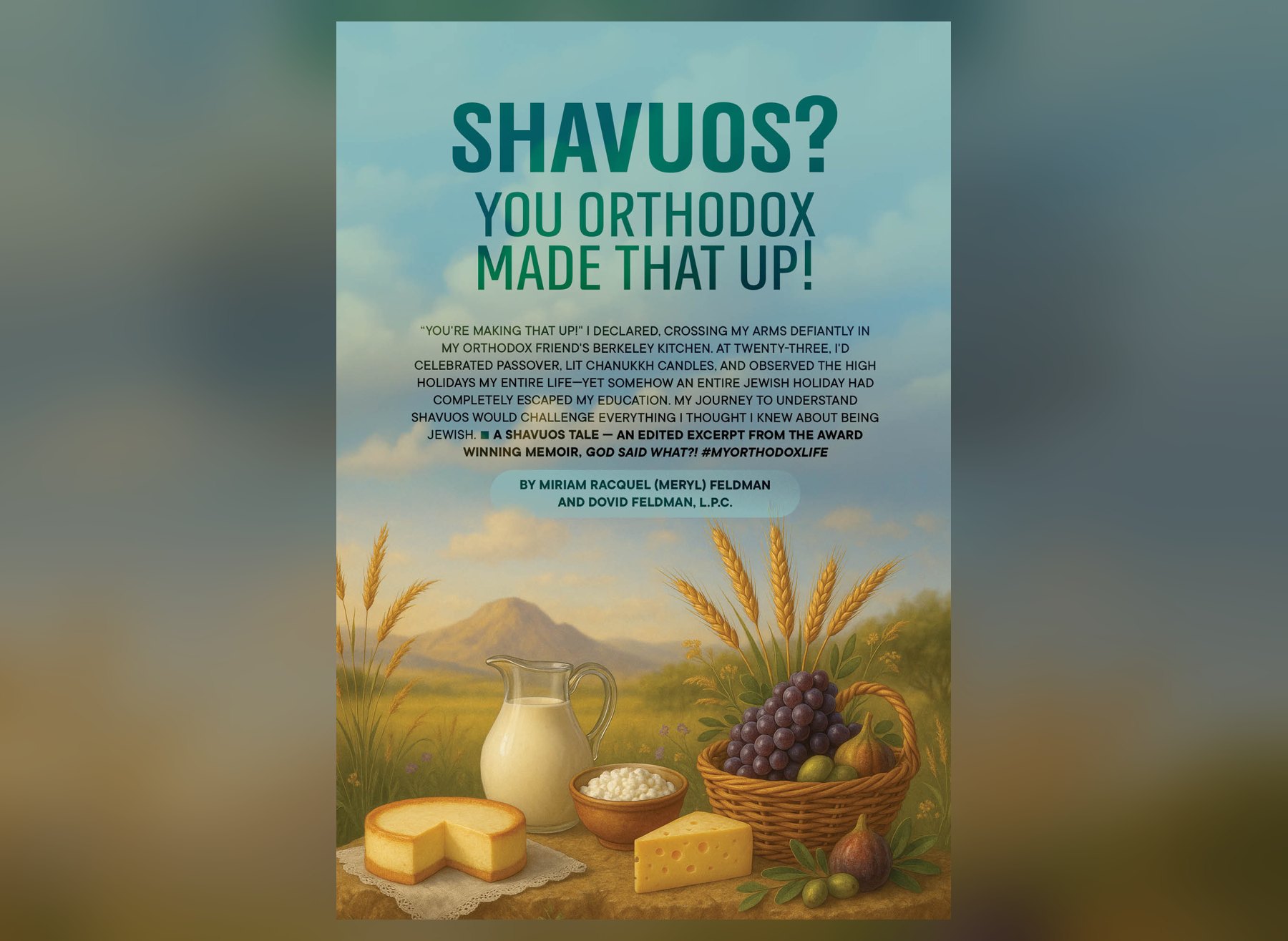
“You’re making that up!” I declared, crossing my arms defiantly in my Orthodox friend’s Berkeley kitchen. At twenty-three, I’d celebrated Passover, lit Chanukah candles, and observed the High Holidays my entire life – yet somehow an entire Jewish holiday had completely escaped my education. My journey to understand Shavuos would challenge everything I thought I knew about being Jewish * A Shavuos tale – an edited excerpt from the award winning memoir, God Said What?! #MyOrthodoxLife
“What do you mean Shavuos? What kind of holiday is that?” My eyes glared with disbelief. “You’re making that one up; there’s no way I can be twenty-three years old, raised in a Jewish home, and never even heard of a whole holiday before.” I crossed my arms defensively as I stood next to my Orthodox friend Julie in her cramped but quaint Berkeley kitchen.
The Shabbos had ended an hour ago, and I had stayed on to help clean up. I was responding to her very polite invitation to come to her family for the Shavuos holiday.
“It’s a Jewish holiday, Meryl.” She laughed and turned back to the soapy sink.
“No way! The Orthodox must have made that up.” I shook my head. Each time I heard a new Orthodox thing I was frustrated. How many paradigm shifts would I have to attempt to make? How many new ideas would I need to grapple with?
“Rosh Hashana, Yom Kippur, Passover, Hanukkah, even Sukkos I grew up hearing about, and even celebrated some of them with my family. We got together and ate a ton of food. But Shavuos? I’ve literally never heard of that one. Doesn’t ring any kind of bell. How could I have missed it?”
“Well, it’s definitely a real holiday, and no, the Orthodox didn’t make it up. It’s just that many secular Jews either don’t know of it or don’t practice it.” She handed me another plate to dry.
“Well, why not?” I rubbed the red cloth roughly around on the china.
“I don’t know why not.” She shrugged. “That’s a good question.”
“What’s it about? What are Jews supposed to do on that holiday?” I sighed and rolled my eyes. “Every holiday is so intense the Orthodox way. So many rules and regulations.”
“That’s true,” Julie said hesitantly. She was always careful with her words around me. I appreciated the gentle way that she would teach me about things in Judaism that were shocking to my system. I was able to tell her everything—from my hopes and dreams about David to my annoyed objections to the things I was reading in the Orthodox Jewish books I bought.
“Shavuos is like Passover, Rosh Hashana, and Sukkos, where you have to take days off from work, and you don’t drive, use the phones, or write. Like Shabbos, you eat a lot, but unlike Shabbos, you can cook.” Julie handed me a wet serving bowl to dry. “It’s a holiday that celebrates G-d giving the Torah to the Jews on the Mountain of Sinai and the Jews accepting it—all six hundred and thirteen mitzvas.”
“That’s a ton of things to do.”
“Well, if you look at mitzvas as ways to connect to G-d then it’s like our pipeline to the Infinite. It’s a privilege as well as a duty, an obligation to turning this world into a place of peace and holiness. Jews are considered a light to the nations and it is through doing mitzvas that G-d made us capable of bringing that light.”
Julie let out the drain of the sink. I watched the bubbles spiraling to meet their destiny to a place unknown.
“Why would a Jew eating kosher or not turning lights on and off on Shabbos make a difference to the world? I can’t believe that G-d, if there is one, said that. Seems so nitpicky and nonsensical. And teachers in Israel tried to explain this to me, but I’m still not getting it.”
“Well, the learning never stops, even for the most brilliant scholar,” she said and turned to me, her brown eyes sparkling. “I’ll try to explain it the best way I can, the way I understood it when I was first taught. You can look at each mitzva as a phone number with a direct dial connection to G-d. That’s why each is so exact, with so many details. If you replace one of the digits or dial a completely different number, it doesn’t connect. Like if you light Shabbos candles when it’s dark outside instead of before sunset, the number is different. It’s not the ‘Shabbos line’ to G-d and therefore doesn’t bring that Infinite holy Shabbos light into your soul and into the world. On that mountain, Jews said ‘Naaseh v’nishma’ and …”
I held my hand up. “Hey, I know what nishma means! It means ‘hear,’ umm… I think it means, ‘We will hear,’ like the root word in the Shema prayer—‘Shema Yisrael’—means ‘Hear Israel.’ I learned that at the Ulpan.”
“Great, Meryl! So that phrase, ‘Naaseh v’nishma’ means, ‘We will do and we will hear or understand.’ The Jews accepted to do the mitzvas before they understood them.”
“Well, they should have asked me first; then I wouldn’t be in the situation that I’m in.”
Julie laughed. “You actually were there, Meryl. You also said ‘Naaseh v’nishma.’”
I stepped back. “No way, did not!” And then I paused. “What are you talking about?”
“Jewish mysticism says that all Jewish souls were there, at that mountain, and agreed to accept the Torah and mitzvas—that contract with G-d.”
“How could my soul have been there?”
“It’s the concept of ‘gilgulim’—reincarnation. Souls get recycled. They keep coming back in other bodies and other lifetimes. Your soul was there.”
“I didn’t know that reincarnation was a Jewish concept. And what do you mean by contract? Why would anyone agree to a contract without understanding what they’re agreeing to?”
“The miracles the Jews experienced in leaving Mitzrayim—Egypt—gave them an awareness of the Infinite. Of something greater than themselves. Plus, they just heard G-d speak the first two mitzvas. They realized that they were binding themselves to the Infinite through this contract and commitment, like a marriage. I guess they felt it was a pretty good deal and trusted that the contract would be worth signing.”
We finished up the dishes and walked into the living room. I gathered up my backpack and hugged my friend. “Thank you, Julie. I appreciate your friendship and explanations so much. All this stuff is so new to me and feels overwhelming at times. My perspective has changed from the way I used to see the world. But to leap into that contract can be quite a jump.”
Julie sat down on the edge of the couch. “You’ll never fully understand all of it, Meryl. Not everything in the Torah is meant to be understood. Sometimes doing a mitzva or two, even if you don’t believe in it quite yet, helps bring a sense of connection. Keep exploring like you’re doing—slowly.” Her voice was gentle. “Would you like to come to us for Shavuos? It’s a nice holiday—we eat dairy instead of meat. I’ll be making cheesecake, cheese lasagna, and feta cheese salads.”
I smiled. “Sure, I’d like to come. Thank you.”
This was a real conversation that took place over 30+ years ago, in the summer of 1990. I was twenty-three years old and a recent graduate of Grinnell College, a small liberal arts school in Iowa.
Julie was used to my questions and even my defenses. I had only met her upon returning to Berkeley from Israel after trying to rescue my college boyfriend, David, from what was termed a “cult” by a local rabbi.
The intensity of this rabbi’s words made me drop my original plans to travel to Guatemala to rescue refugees, and had me hopping on a plane to Israel to save David instead. What I realized, as the rescue mission kept failing, was that David wasn’t in a cult but was learning in an Orthodox men’s yeshiva and observing the timeless traditions and halacha, or laws, of Judaism. Much of this inheritance that was ours felt very foreign to me as a woman who was raised Jewish but with very little understanding of the Judaism that had been passed down for centuries from Mount Sinai.
Sure, some of it sounded like concepts I grew up with, but the intricate details of carrying out the practices were falling short of my mental, emotional, and spiritual capacities at the time. I tiptoed forward with learning more about the practices from the Jewish women’s schools available in Israel. Eventually, I returned to the States, needing the familiar setting of home to integrate the teachings of Torah.
Julie was kind enough to have taken me under her wing during my year in California. She was one of my helpers as I tried to navigate the often precarious path of learning more about Torah and mitzvas. This included the holiday of Shavuos, which was unfamiliar to a Jew raised with little observance.
Shavuos in Julie’s home was my first Shavuos. I got to feast on delicious dairy dishes and other delicacies. The following Shavuos, I went to the synagogue to hear the Ten Commandments. I stood among the other Jewish congregants, one with them, receiving and reliving the heritage that was mine. Not only did that connection make a world of difference to me, but I understood that my connection and each mitzva I did made a world of difference to the world. That divine marriage contract between a Jew and the Infinite is precious.
BIO:
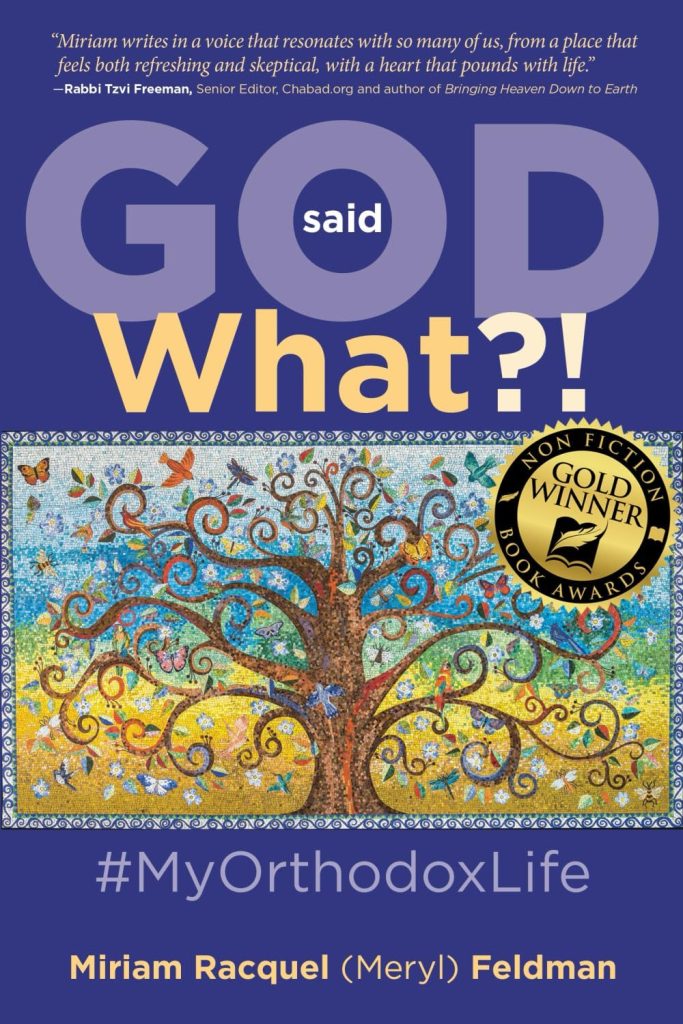
Miriam Racquel (Meryl) Feldman transforms women’s lives through somatic healing as an award-winning author, dating & marriage coach, and trauma/anxiety specialist. Her innovative somatic approaches have helped thousands of women heal relationships, resolve trauma, and rediscover their inner wisdom and joy. As an international coach, keynote speaker, and podcast guest, she specializes in marriage transformation, painful relationship recovery, career clarity, and embodied healing. Author of the acclaimed memoir God Said What?! #MyOrthodoxLife and Somatic Healing for the Modest Goddess.
More can be found at: MiriamRacquel.com or YourMarriageMagic.com
Miriam Racquel also offers marriage programs together with her husband Dovid Feldman, L.P.C., and author of 52 Tweets to a Great Marriage. DovidFeldman.com
Beis Moshiach #1461 • pp. 44-47
© 2026 Beis Moshiach Magazine. All rights reserved.
This article originally appeared in Beis Moshiach #1461. You are welcome to share it with friends and family by email or in print, provided that you do not change, add to or omit any part of it, you credit the author and Beis Moshiach, and you include a link to archive.bmoshiach.org (written out in full in printed copies).
To republish this article in a newspaper, magazine, book or website, please request permission in advance at [email protected].