Letters to Those I Missed
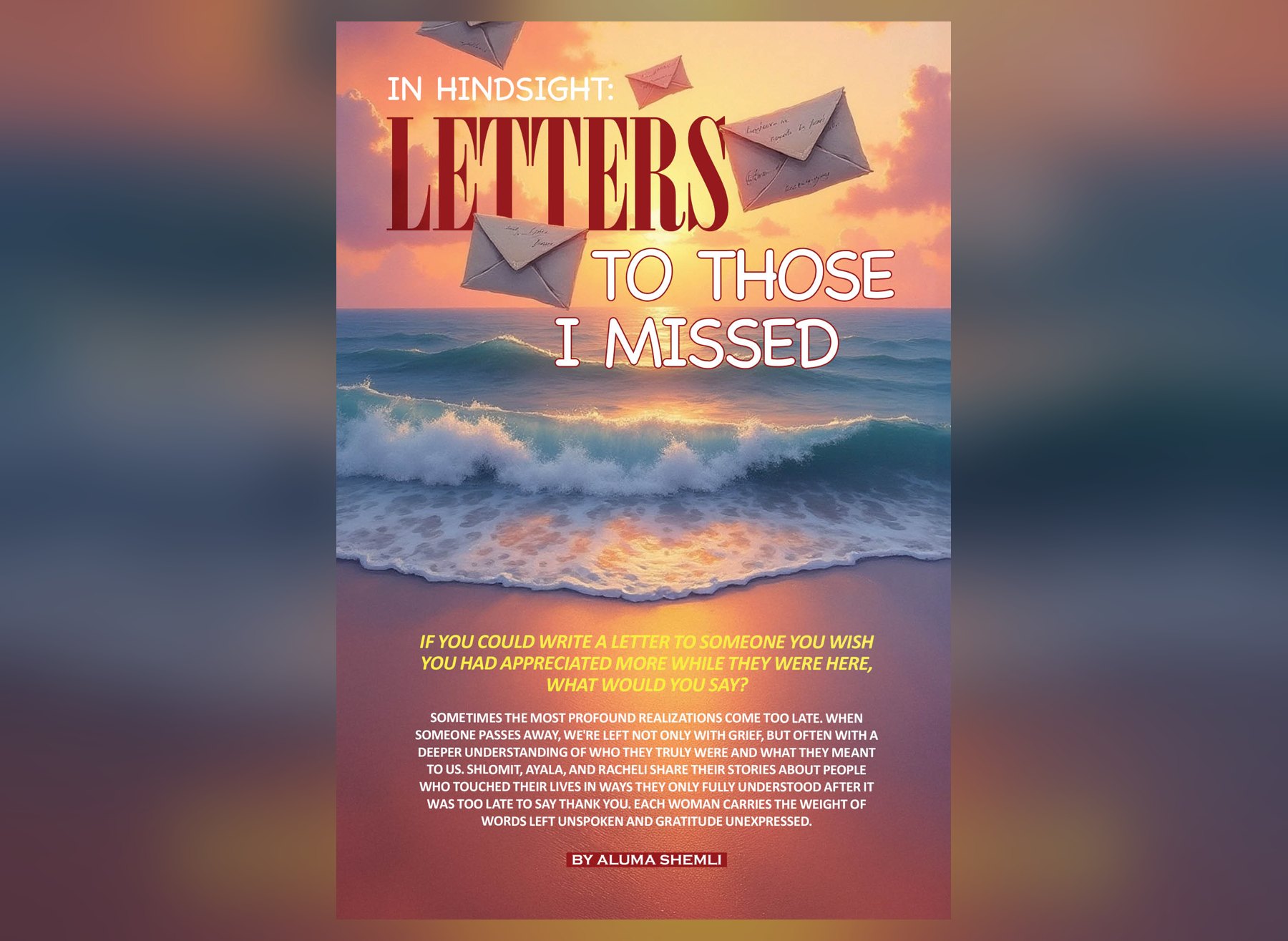
If you could write a letter to someone you wish you had appreciated more while they were here, what would you say? * Sometimes the most profound realizations come too late. When someone passes away, we’re left not only with grief, but often with a deeper understanding of who they truly were and what they meant to us. Shlomit, Ayala, and Racheli share their stories about people who touched their lives in ways they only fully understood after it was too late to say thank you. Each woman carries the weight of words left unspoken and gratitude unexpressed.
My name is Shlomit, and I’m now in the fifth decade of my life, managing a store and a mother to five amazing children. A grandmother to one stunning baby girl. If I could say a few words now to someone who is no longer here, I would choose Yocheved, my father’s second wife.
My parents separated when I was a twelve-year-old girl, the youngest of four siblings. It wasn’t a surprise to any of us, because for a long time before that they had lived almost without exchanging a word. We stayed with our mother, who on her part didn’t encourage any connection with my father. Seemingly, we could have lost him completely, but my father didn’t give up. He would come to pick us up like clockwork, every Tuesday at four. The next three hours he devoted solely to us. Sometimes we would go for an outing, pizza or an amusement park. Sometimes we would go to his house, enjoying preparing a tasty meal together or having a barbecue. We built tents in the living room or assembled huge puzzles that he left on the big table from week to week. It was fun with him. This was before the generation of mobile phones, but in my experience today, he would have put his phone on silent. What do you mean silent? Turn it off and put it in a drawer…
When I was in high school, my father told us that he intended to remarry. He promised that the new woman knew about us, would be happy to meet us, and had no intention, ch’v, of harming our good relationship. It was very difficult for me to hear this announcement. I felt betrayed. I couldn’t believe that my father could even think about starting a new family. Who is his family if not us?
My brothers were more forgiving; they didn’t care so much. The oldest was already a newlywed then, had his own home, and presumably also understood my father and his decision. The second one was in the army then, and his meetings with my father were already quite reduced anyway, because he had to divide his few leaves between my father and mother. The third was already in yeshiva and came twice a month. The only one who still met with my father every week was me.
I chose to ignore her, to keep her outside my life.
She was pleasant, and my father didn’t try to hide her. She opened the door for me on Tuesdays with a smile and served refreshments at the table. From that moment on, she would seemingly remove herself completely from the picture, letting my father and me enjoy our time alone. This arrangement worked as long as I was a student. When I started my studies at the seminary, I no longer came regularly. Many times I would drop by for Shabbos or just for dinner. On each of these occasions, I would answer her greeting, smile politely, and make sure to keep my father as much to myself as possible.
Once, when my father drove me to my classes, he remarked casually that Yocheved was a very wise woman, that I should get to know her, listen to what she had to say. I didn’t answer. Since then, my father made sure we would be together. She would join us for meals, and when we occasionally played chess or solved crossword puzzles, she would sit beside us, gently making her comments from time to time. I was too mature to ignore her, but apparently too young to listen to her and give her a place in my life.
When I got married, we would occasionally visit them on Shabbos, and my husband accepted her as his mother-in-law without problems. After all, he didn’t know her or my father. I still didn’t take her seriously. We also came with grandchildren, and she showered them with lots of love, gently daring to give me good advice or reassuring statements like: “No need to be alarmed by crying, that’s how they develop their lungs”…
The last months of my father’s life were not easy. He suffered from a serious illness, and his condition deteriorated rapidly. Yocheved was close to him and cared for him devotedly. I can say that this was the first time I understood how important she was to him.
After his passing, I didn’t keep in touch with her. Only once a year we would meet on his yahrtzeit. Her death was very sudden, without any preparation or possibility to say goodbye. At first I felt just a twinge in my heart, for a lonely woman who left the world without children. During the year, I made sure to recite Tehillim in her merit, and then all kinds of lines of hers, stories, reactions to things that happened around her. Suddenly I started to see her, a woman trying to accept her husband’s children. So enabling, so giving, never entering into a state of war with us over his heart or his attention. Her statements were so gentle. She really tried to help, encourage, or guide without any attempt at taking over. Suddenly every word of hers was important to me, became a light for me. I admired her character. So gentle and not looking for a place to stand out.
If only I could listen to her today, ask her about things that bother me, consult with her… If I could say one word to her, I would ask for forgiveness for not really seeing her. I promise myself not to miss more people around me, not to regret again.
So Significant!
My name is Ayala. My mother passed away when I was a young woman, a mother to several little ones. She fell ill with the “disease,” and less than a year after the diagnosis, we accompanied her to her eternal rest. My mother was everything to me, and during those months I made every effort to be by her side as much as possible.
I was with her during treatments, helped at home and with doctor visits, sat beside her a lot, and tried to fit in one more minute and then another. My husband understood my feelings and released me almost completely, taking care of our children that year with the help of his mother. A month after my mother passed away, we were blessed with a daughter who was named after her, and I felt a bit of comfort.
Years passed, and with time the pain dulled. I got used to returning home after giving birth, staying often at my wonderful mother-in-law’s, not meeting my mother at simchas.
That’s how it was until my children grew up. Suddenly I started to rub against them, in all kinds of misunderstandings, arguments, frustrations that every parent goes through with their children at some point in their lives.
In long nights of difficult thoughts and guilt, in conversations with my mashpia or summons from high school, I suddenly recognized myself. I was the classic teenager. Not easy at all. Boruch Hashem, I followed the path in which I was educated, but I believe it cost my mother many gray hairs…
I would argue a lot, never satisfied. Instigating quarrels left and right. Sometimes really without reason, just to feel that power, the ability to say “no,” to be independent, not to let anyone decide for me.
Even then, especially then, my mother was an especially impressive figure for me. In my heart of hearts, I admired her for her patience towards me, for her steadfast yet calm stance on everything Chassidish that was critical to her. I wanted so much to be like her, and I didn’t hide it. Among all the girls, everyone knew that Ayala was crazy about her mother, regardless of all the arguments and drama.
If I could say one more word to my mother today, I would whisper to her: “You were so significant to me, you were everything in my life, especially during those periods when I behaved so differently than I should have. I’m sorry I didn’t get to tell you that.”
A Figure to Lean On
My name is Racheli. Today I am a teacher, boruch Hashem. I know it’s an important and not easy role, and I try very hard to fulfill my shlichus faithfully.
When I was in one of the first grades in elementary school, my mechaneches, Morah Sarah, was a very elderly woman. Already when I was in high school, I heard that she had retired. That year was a very tumultuous year in our country, which can be said about most years in the last hundred years. There were many security incidents and shocking attacks then, and our parents, with all their desire to protect us, couldn’t really seal our little ears or avoid speaking when we were awake.
We heard concepts we weren’t supposed to hear, and saw many painful images of charred buses and lots of tears from significant adults in our lives. Pictures of smiling people filled the newspaper at the grocery store, and we understood without anyone bothering to explain to us that they were no longer.
We even already understood what the role of ZAKA was. The father of a friend from class volunteered there.
Terrible, existential fear accompanied us. I believe the adults too. We didn’t know what was better, to stay close to Mommy at home? To get on a bus? Not to get on?
Morah Sarah would greet us every morning with a smile, tired, nervous, frightened. She would tell us about hashgacha pratis, about the special protection that exists for every Jew. She taught us that no person dies just because they were in the wrong place. Only Hashem decides who will be harmed and who will not. Whoever is harmed is holy and beloved, and whoever is not, still has a task.
She would collect amazing stories for us about people or children who left a station or got off the bus just a moment before, escaping a shocking attack. Many times there was also a reason. Honoring parents or giving up a travel seat. As children, we listened to her stories eagerly, comforted, filling our blocked lungs with air.
When I walked in the street, I would strengthen myself. Only what is meant to happen to me will happen, and I have nothing to worry about.
A few years later, I heard quite by chance that Morah Sarah had passed away, surrounded by a loving and huge family and many students who kept in touch with her. I had a twinge in my heart, because I also remember her very fondly. I moved on.
At the beginning of last year, with the outbreak of the war, fear suddenly filled the classroom. Sirens, sometimes every night. Soldiers being killed, mourning tents, and again conversations that even adults can’t stop. Today the situation has become even worse. When I was a child, I peeked at newspapers in the grocery store, and today the horrors are in the phones of parents, older siblings, uncles.
The figure of Morah Sarah suddenly rose before my eyes, a calm pillar of cloud leading the class calmly and serenely through the shocking desert of my childhood. It was clear to me what my role was now, I started to recall those stories in my memory, to collect new ones. The main thing was to instill the truth in my students with passion and deep inner faith. Hashem watches over us all the time, especially during such difficult times.
Stories popped up in every corner. From soldiers, from civilians. Pictures of young people still appear on the front pages of newspapers, painful news is still heard at home, but the frightening feeling that we are alone in the face of chaos is gone. I hope the children have become stronger; I certainly have.
If I could say a word to Morah Sarah today, I would say to her: “Thank you for being an anchor of salvation for us in such difficult days when you yourself certainly struggled with fears. I’m sorry I saw you as something taken for granted, and never made contact, and never thanked you for the fact that thanks to you I got through my childhood years in peace and came out normal.
“I dedicate to you with love every girl in my class who will be calmer because of you, will grow up peacefully and with childlike innocence. With emuna shleima.”
Beis Moshiach #1462 • pp. 46-49
© 2026 Beis Moshiach Magazine. All rights reserved.
This article originally appeared in Beis Moshiach #1462. You are welcome to share it with friends and family by email or in print, provided that you do not change, add to or omit any part of it, you credit the author and Beis Moshiach, and you include a link to archive.bmoshiach.org (written out in full in printed copies).
To republish this article in a newspaper, magazine, book or website, please request permission in advance at [email protected].