I Learned To Walk Again in the Rebbe’s Room
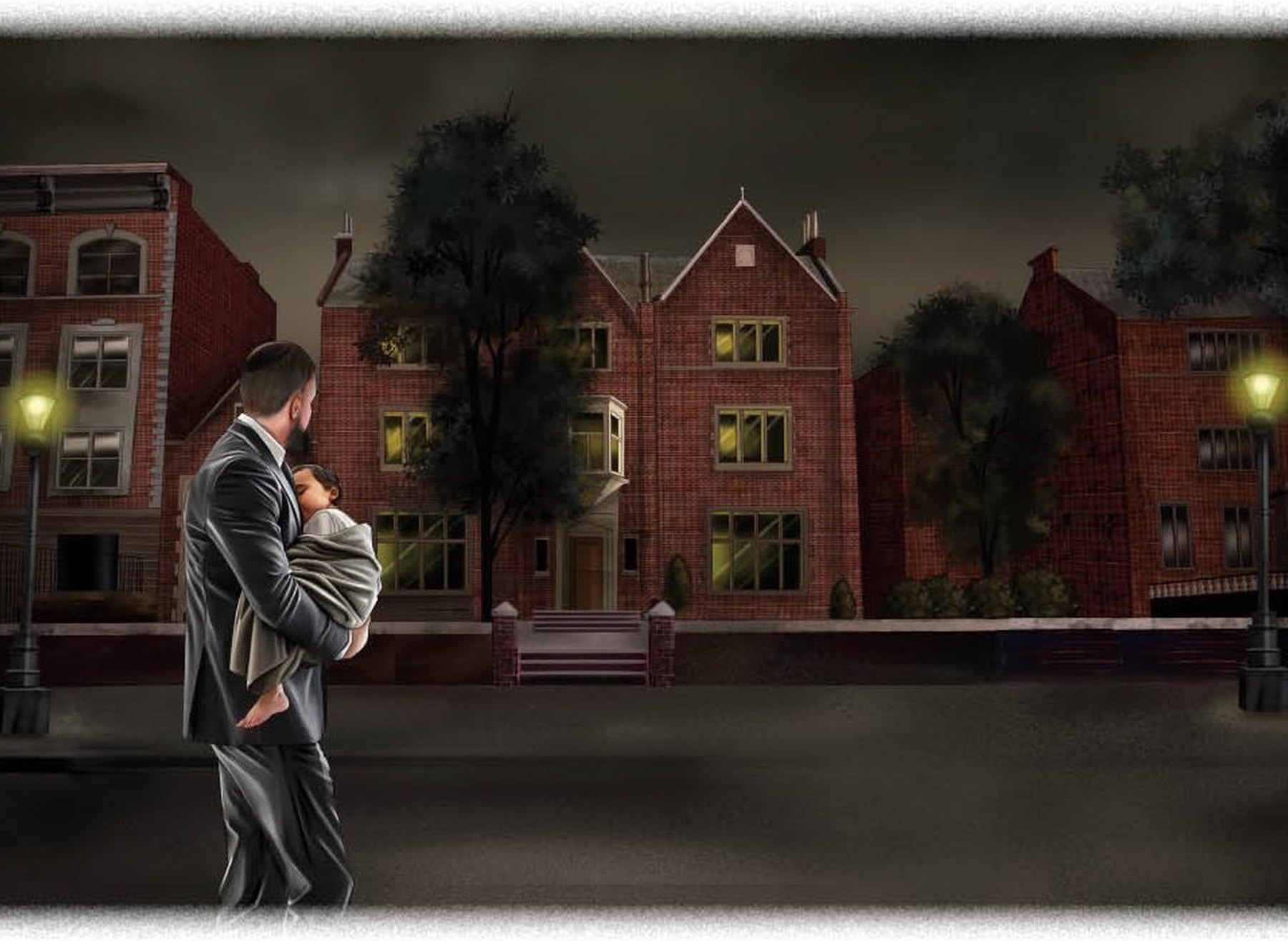
Previously: Little Yaacov Shmuel Orimland is injured in a devastating car accident. His father Reb Gimpel, calls the Rebbe who gives him three instructions: to add the name Bentzion, give $1800 to tzedaka, and to have the doctor call. The doctor listens to the Rebbe’s advice and the boy is alive, but he is still in a coma.
From the TzaddikStory.org collection
Little Bentzion Yaacov Shmuel’s eyes were still closed. He still didn’t move.
Four months… five months… six months.
Still nothing. The doctors didn’t have any more ideas.
Many people gave up hope, but his mother and father did not.
They sat by his bed every day. They watched the machines. They looked at his little face. They held his hands. They whispered Tehillim. They asked Hashem for help.
“He’s still alive,” they reminded each other. And if he was still alive… then anything was possible.
* * *
His mother never left his side. Seven months passed. Then eight. Then nine. Ten months… eleven months… still nothing changed.
Bentzion Yaacov Shmuel’s eyes were still closed. He didn’t move. He didn’t speak. Not a finger. Not a toe.
The hospital staff gently moved him to a different part of the building. It was called hospice.
Hospice was a place for patients who weren’t expected to get better.
The doctors and nurses were kind and gentle—but they didn’t think anyone in that section would ever go home again. People there were simply being kept comfortable until the end.
But his mother didn’t listen to what the doctors said.
She pulled her chair next to his bed. She whispered Shema in his ear. She held his tiny hand. She said Tehillim, even when it felt like no one was listening.
And every day, she stayed. No matter what anyone said, she stayed.
Because a mother’s heart always holds on to hope. Even after everyone else let’s go.
* * *
One day, something changed.
A new nurse came to work in the hospice section, where Bentzion Yaacov Shmuel had been for nearly a year:
She knew exactly where she was. This was the floor for patients who didn’t speak, move, or open their eyes. I hadn’t responded in eleven months.
But still, with a smile, she spoke to me like I could hear her.
She walked into the room, she smiled kindly and said, “Jacob, what would you like to drink tonight—milk or soda?”
His mother’s face turned red. She was hurt. Was this nurse trying to make fun of her son?
Didn’t she understand? He had been silent and still for almost a whole year.
Why would she talk to him like that—like he could answer?
But then…From the bed… came a quiet voice.
“Soda,” said Bentzion Yaacov Shmuel.
His mother’s eyes went wide. Her knees gave out. And right there next to his bed—
She fainted.
* * *
Now Bentzion Yaacov Shmuel had woken up.
Just like the Rebbe had said—it would take a long time until he got better.
And it did.
He stayed in the hospital for many more months.
Why?
Because his body had forgotten how to do almost everything.
He had been in a coma for eleven months. That’s almost a whole year. He had been just three and a half years old when the accident happened. Now, he was four and a half—still a little boy.
And at that age, a child is still learning new things all the time. But while other kids his age were running, jumping, and playing… Bentzion Yaacov Shmuel was lying in bed. Still. Quiet. Not moving.
When someone is in a coma for that long, their brain goes into a deep sleep. And sometimes, when they wake up, it’s like the brain forgets how to do things it used to know.
He had to relearn everything—just like a baby.
He had to learn how to talk again. How to eat. How to sit up. How to hold a spoon. How to turn his head.
And the hardest of all… he had to learn how to walk.
But after so many months in bed, his legs were too weak. The muscles didn’t remember how to work.
The doctors gave him two metal braces to help him stand. With help, he could stand. But walking? That was something he just couldn’t do.
* * *
One day, a Chabad Chassid named Rabbi Yosef Wineberg came to visit our town to fundraise. Back then, the area had a big enough Jewish community that people would often come through — collectors, speakers, and others passing through.
When Rabbi Wineberg saw my father, he asked, “Did you ever take your son to the Rebbe… to say thank you for the bracha?”
“I can’t,” Rabbi Gimpel replied. “He can’t leave the hospital.”
But Rabbi Wineberg didn’t give up.
“You could ask permission,” he said. “Just one night. Take him to New York. Take him to the Rebbe. If Hashem already gave you one miracle… maybe, you’ll get another.”
So they did. Bentzion Yaakov Shmuel and his father traveled to see the Lubavitcher Rebbe—for the first time in their lives.
They came to say thank you. To say thank you for the blessing that had kept him alive… That had helped him wake up. But they also came to ask… Would the Rebbe give another bracha? Could their son one day… walk again?
* * *
When they arrived, Rabbi Gimpel carried his son into the Rebbe’s office.
The boy still had two metal braces—special supports to help him stand. Without them, he couldn’t walk at all. The Rebbe looked up and said gently, “Let him walk in by himself.”
Rabbi Gimpel was confused.
“Rebbe… he can’t. The accident—he needs the braces. He can’t even stand.”
The Rebbe smiled softly. “Put him near me,” he said. “And please… step outside for a moment.”
So Rabbi Gimpel placed his son near the Rebbe… and left the room.
* * *
What happened during those twenty minutes?
I don’t really know.
To this day, no one knows exactly what happened in that room.
I was only four and a half years old. I don’t remember what was said. I don’t remember what was done.
But I know one thing for sure: I walked in being carried—because I couldn’t walk. And twenty minutes later, I walked out holding my father’s hand.
The room had been quiet. Still. But something happened. Something big. I wasn’t perfect. I was slow. But I was limping again with my father’s help.
The miracle had happened with the Rebbe.
* * *
Back at the hospital, even after the visit to the Rebbe, the doctors still didn’t believe.
They told my parents, “Your son will always need help. Lots of therapists. Special care. He may not ever be like other children. His brain was too damaged. You shouldn’t expect much.”
But my father didn’t give up hope. He began going to farbrengens, traveling from southern New Jersey all the way to New York. He wanted to soak up the warmth and emunah from the Rebbe and the Chassidim. And he wanted to be near the Rebbe again.
At one farbrengen, the Rebbe looked at him and said: “Now is a special time. You can ask Hashem for anything. Ask!”
My father closed his eyes right there in 770 and whispered a quiet, desperate tefillah.
“Please, Hashem,” he said. “Heal my little son. Make him strong. Help him grow. Let him learn.”
* * *
After that, I kept getting better—slowly. I still limped. My right side was weaker than the left.
But the hardest part for me… was learning.
When I turned six, my father took me back to see the Rebbe again. The Rebbe smiled kindly and asked me questions about the weekly Parsha. But for each one, I had to answer, “I don’t know. “Why don’t you know?” the Rebbe asked. I looked down. “Because of the accident,” I said quietly. “I have brain damage.”
The Rebbe’s face softened.
He reached over to a shelf and took out a siddur. He handed it to me and said gently, “Daven from this siddur—especially Shema. And you won’t have anything to worry about.”
So I did.
Every day, I said Shema from that siddur. Slowly. With kavana. And something began to change. I began to learn. I began to remember. I began to grow. Because when Hashem sends a bracha through the words of a tzaddik—it always reaches the right place.
Even if it takes time.
* * *
No one in the hospital ever thought I would survive. And they definitely didn’t think I would grow up to be like other children—healthy, happy, and strong. But my parents didn’t listen to the doctors. They listened to Hashem.
They believed in the Rebbe’s bracha. They held onto hope, even when things looked dark.
And my father, Rabbi Gimpel, made a promise to Hashem.
“Hashem,” he whispered, “if You heal my son and make him healthy and strong, I will make his bar mitzva like a wedding. Seven days of celebration—to say thank You.”
Slowly over time, I went back to school. I started to learn again. I played games with other kids. I made friends. And when I turned thirteen, my parents kept their promise.
They made me a bar mitzva that lasted for seven full days. Just like sheva brachos after a chasuna. So the whole community could celebrate and give thanks.
It wasn’t just a party. It was a neis. A bracha from the Rebbe. A miracle from Hashem.
Everyone came to see the boy the doctors said would never live… The boy who once couldn’t walk or talk or open his eyes… Now dancing, smiling, and reading from the Torah.
On the day of my bar mitzva, even the elder Chassidim came to celebrate. Famous Chassidim such as the Rebbe Rayatz’s son-in-law and the Rebbe’s brother-in-law Rashag. Reb Mendel Futerfas. Reb Zalman Taibel. Fetter Hendel Lieberman. They all came to the seudas mitzva.
Because they knew what everyone else had come to see— dem Rebbin’s kind, the Rebbe’s miracle boy.
* * *
When I turned fourteen, I was able to visit the Rebbe again for yechidus—a private meeting in his office. This time, I came with many things to ask for.
But most of all, I asked the Rebbe for strength in my right hand. Even after everything I had gone through, that hand was still weaker than it should have been. The Rebbe listened and gave me many brachos. He smiled. He encouraged me. But… he didn’t give a bracha for that last request.
I asked again—just one more time.
But instead of answering, the Rebbe gently changed the subject. He began asking me questions about my Torah learning. And then I understood. This was how Hashem wanted it. That part of the story would stay the way it was. It has until this day.
And that’s okay. I was alive. I could walk. I could learn. I had so much to be grateful for. And as the Rebbe taught me—sometimes, the greatest bracha of all is just knowing how to say thank you.
* * *
Years passed. I grew up, just like everyone hoped I would. I learned in Yeshiva for many years. And then, one day, I got married.
Later, I became a father.
When my first son was born, we had a shalom zachar at our home—a special celebration on the Friday night after a baby boy is born. Our family and friends filled the house. There was food and singing and lots of l’chaim. Everyone was in a good mood.
My father—Rabbi Gimpel—sat at the table, holding a small cup of wine. He smiled. He was glowing.And then, out of nowhere, he told a story that no one had ever heard before.
* * *
“No one ever asked,” he began, “why the Rebbe told us to add the name Bentzion to my son.”
Everyone at the table leaned in. “Most people add names like Chaim or Refoel when someone is very sick,” he said. “Names that bring life or healing. But Bentzion? What did that mean?”
He looked down at his cup. His voice grew quiet. “There’s something I’ve never told anyone,” he said. “Only my wife and I know it.” The room went still.
“My wife was expecting our first baby. And we decided that if it was a boy, we would name him Shmuel, after her father—and also Bentzion, after her grandfather, who was killed al kiddush Hashem in the Holocaust.”
“But before the baby was born, my own father passed away. His name was Yaakov. So, at the bris, we gave the baby two names: Yaakov Shmuel.”
Then my father’s voice changed.
“The night after the bris,” he said, “my wife woke up crying. She had a dream. A scary dream.”
In the dream, her grandfather, Zeide Bentzion, had appeared.
He was crying. He said, “Now no one will be named after me.”
Then… he hit her with a stick and said, “No good will come from this.”
She woke up in tears. But it was just a dream. Who changes a baby’s name because of a dream? So we forgot about it.
Until three years later… When little Yaakov Shmuel was in the hospital. Barely alive.
* * *
“The Rebbe never met us before,” my father said. “He didn’t know anything about the dream. Or about grandfather Bentzion. Or the names we almost used.”
“But when I called him in the middle of the night… what did he say?”
He looked around the room.
“‘Add the name Bentzion,’ the Rebbe told me.”
“How did he know?” No one answered. No one could. Because there was no other explanation.
The Rebbe had seen the gezeira in Shamayim. He had seen that something needed to be fixed. And he knew—without anyone telling him—exactly how to fix it.
Because when a tzaddik sees with the eyes of the soul… Even secrets from Heaven can become known.
And because of that…I’m here. Alive. Healthy. With my full name: Bentzion Yaakov Shmuel.
Beis Moshiach #1465 • pp. 55-59
© 2026 Beis Moshiach Magazine. All rights reserved.
This article originally appeared in Beis Moshiach #1465. You are welcome to share it with friends and family by email or in print, provided that you do not change, add to or omit any part of it, you credit the author and Beis Moshiach, and you include a link to archive.bmoshiach.org (written out in full in printed copies).
To republish this article in a newspaper, magazine, book or website, please request permission in advance at [email protected].