Lullabies for Moshiach
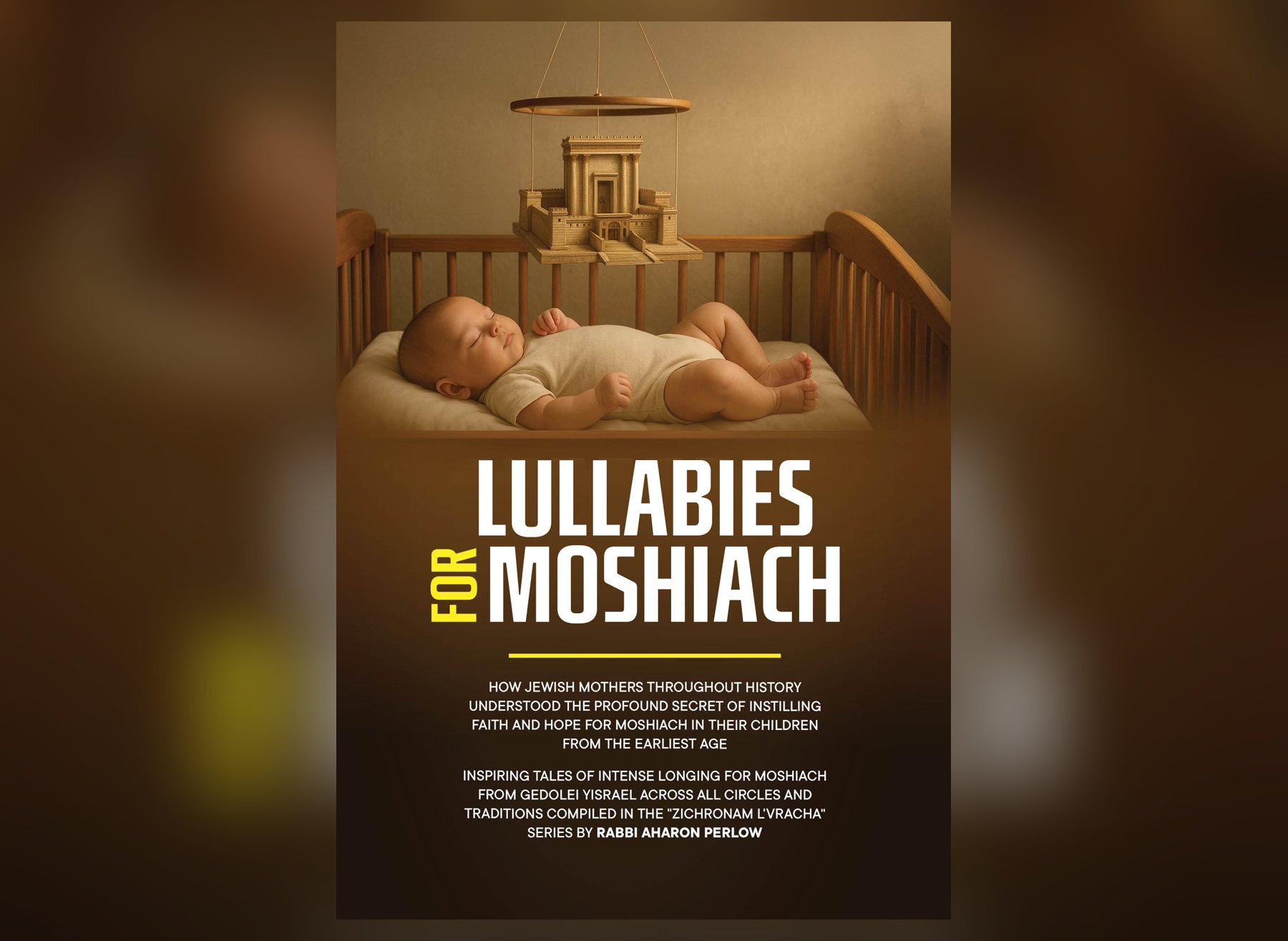
How Jewish mothers throughout history understood the profound secret of instilling faith and hope for Moshiach in their children from the earliest age * Inspiring tales of intense longing for Moshiach from gedolei Yisrael across all circles and traditions compiled in the “Zichronam L’vracha” series by Rabbi Aharon Perlow
I Will Wait for Him Every Day
There was an incident at a sheva brachos celebration at the wedding of Rabbi Meir shlita, held in Bnei Brak, the son of the Gaon, the Rav (Rabbi Yitzchok Zev Soloveitchik z’l of Brisk). The topic was emuna in the coming of Moshiach, as stated: “I will wait for him every day.” In his words, the (Brisker) Rav illuminated this idea and explained that it does not mean “every day” (once a day), but rather “all day long” I will wait for him.
Our Rebbi, (Rabbi Chaim Brim z’l), added: When Rabbi Yitzchok Zev expressed this idea of “all day,” all the attendees lowered their faces in shame and embarrassment before his unwavering faith in Hashem and His anointed one.
(“Shenos Chaim,” Jerusalem 2008, vol. 1, p. 86)
Why Was Rabbi Avrohom Called an Angel?
My grandfather from Bohush zt”l said: Why was Rabbi Avrohom the Malach called a “malach,” when in earlier generations all Jews were G-d-fearing and pious? It was because on Tisha B’Av, he would lay his head between his knees until the next day. When he awoke, he would ask: “So, Moshiach still hasn’t come?”
The second reason was the ascetic lifestyle he led. Because of these two things, he was called “the Malach.”
— The Rebbe of Bohush shlita
(From the kuntres “HaMasa l’Kivrei Raboseinu HaKedoshim”)
The Rainbow and the Release of the Alter Rebbe
Rabbi Meshulam Roth zt”l related in the name of his grandfather, the Chassid Rabbi Yosef Roth z”l – who at one point served as attendant to the Rebbe of Ruzhin zt”l – who said he heard from the holy mouth of the Ruzhiner Rebbe:
While the holy Rabbi Shneur Zalman zt”l, author of Shulchan Aruch HaRav and Tanya, was imprisoned, my father (the holy Rabbi Shalom of Prohobitsh) engaged in various spiritual efforts to hasten his release. On the day of Rabbi Shneur Zalman’s release, my father woke early and saw a rainbow. He said, “It is written in the Zohar (Bereishis 72): ‘Do not expect the footsteps of Moshiach until a rainbow appears in the world, adorned with radiant colors, lighting up the world. Then you may expect Moshiach.’ And behold, I see these radiant colors, yet Moshiach has not come. It must be that the holy Rabbi Shneur Zalman is being freed today.” And so it was.
Afterwards, my father wrote a letter to the holy Rav, telling him that he had a part in his release. As a sign, he wrote that before receiving news of the release, he had been reciting Tehillim. When he reached the pasuk, “He has redeemed my soul in peace” (perek 55), he accidentally reversed the words, saying: “In peace, He has redeemed my soul,” and then repeated it correctly. And at that very moment, the release occurred.
(“Ner Yisrael,” Bnei Brak 1994, vol. 4, p. 8)
All the Mikdash Vessels Are Ready
I once heard from the young Rebbe (Rabbi Shlomo Dovid Yehoshua of Slonim, H’yd) that after singing the traditional Slonim niggun to “Mimkomcha Malkeinu Sofi’a,” when singing the words “Mosai Timloch b’Tziyon?” he repeated them many times and said: “When will You reign—in Tziyon? When the midda of Tziyon is rectified, which is numerically equal to Yosef, which corresponds to the attribute of Yesod.”
He recounted that once the Maggid of Kozhnitz was shown from Heaven that all the vessels of the Mikdash were already prepared. Each vessel corresponds to a different midda in avodas Hashem. The tzaddikim of each generation had rectified all these middos, thereby preparing the keilim.
The Kozhnitzer Maggid asked: If all the keilim are ready, meaning all middos have been rectified, why has Moshiach still not come? He was told from Heaven: The shovel (machtah), which corresponds to the attribute of Yesod, is still missing. When that is rectified, Moshiach will come.
The Maggid said: “I am willing to take upon myself the yetzer hara of this midda from the entire world and, G-d willing, rectify it.” But he was told from Heaven that the tikkun must come from the collective Jewish people.
— Rabbi Yair Schwartzman z”l
(“Yehi Or,” p. 105, letter 179)
Do Not Divert Your Mind
Our teacher, the Turna Rav zt”l, often spoke with us about Moshiach and the suffering that will precede his arrival. His students once asked: “But didn’t Chazal say (Sanhedrin 97b) that Moshiach will come when people are not expecting him?”
He replied: “We already have enough distraction! Proof of this is that if people truly weren’t distracted from the Geula, they would study Seder Kodashim and Taharos. Judging by the tribulations around us, it is clear that the footsteps of Moshiach are very near.”
— Rabbi Avrohom Yaakov Teitelbaum zt”l – Nasi of Tzerei Agudath Israel, USA
(“Kol Yaakov,” p. 122)
There Will Be No Jews in Poland
My father zt”l (the “Shefa Chaim” of Sanz) said he heard in his youth that the Maggid of Kozhnitz once said: “One should not delouse his clothes (ein polin) [on Shabbos] by candlelight” – meaning that before the coming of Moshiach, there would be no Jews left in Poland. At the time, it sounded as improbable as saying such a thing about America today. But tragically, it came true.
[As a side note, the Lubavitcher Rebbe once said to philanthropist Mr. Ronald Lauder, who wanted to rebuild Jewish life in Poland: “If someone were to ask me whether to establish a new Jewish community in Poland today, I would say honestly that I see no benefit in it. Today, the future for Jews is in the USA, Israel, or England – but not in a country where Jewish life cannot realistically endure for two or three generations.” (Motzoei 20 Teves, 5750)]
— The Rebbe of Sanz shlita – London, 17 Teves 5766
(“B’tzila D’Mehemenusa,” Noach 5767, p. 18)
The Wagon Driver’s Unexpected Request
Even non-Jews, l’havdil, would occasionally approach the holy Rabbi Chaim of Atinia, zy’a and ask for a bracha from him.
On one such occasion, the request of a certain goy brought the tzaddik great satisfaction. The story goes as follows:
The non-Jewish wagon drivers who traveled the back roads of Bukovina had managed to earn substantial profits from transporting Jews in their wagons – but they were generally lazy and sluggish. At that time, there were many Rebbes who would travel from city to city and town to town, and the wagon drivers often tried to avoid taking them as passengers, offering various excuses for their refusals: “I’m tired,” “The horses are tired,” placing the blame on the poor animals. Sometimes they would claim they still needed to grease the wheels or feed the horses. It was not easy to convince a wagon driver in those days to set out on a journey, and even when they finally agreed to travel, they did so lethargically and reluctantly.
However, when the holy Rabbi Chaim of Atinia hired one particular wagon driver, this driver did his job properly: he drove the horses energetically and sped along the roads without delay. As they arrived at various locations, the wagon driver noticed large groups of Chassidim coming out to greet the tzaddik, and he realized that he had the honor of transporting a truly great and holy man.
When they returned to Atinia, the wagon driver went to the Rebbe to ask for a blessing as a reward for his dedication. It turned out that the goy had a heavy burden weighing on his heart. With a weeping voice, he told the Rebbe: “I have an old father,” he said angrily, “grumpy and irritable, causing me endless trouble. I can’t take it anymore!” he cried out. “Holy Rabbi – do me a favor… I ask that this old man be taken away, that he leave this world already…”
Several days after this incident, the holy Rabbi Chaim of Atinia was seen in a state of extraordinary joy. His close followers were puzzled by the special radiance on his beaming face, and they could not contain their curiosity: “What is the reason for your great joy?” they asked.
The tzaddik then recounted the goy’s request and exclaimed:
“Know this! All the pain and suffering we endure in this bitter galus stems from the kibud av that Esav ha’Rasha showed his father Yitzchok. But when we witness with our own eyes the kind of ‘honor’ a goy gives his father – this is already the beginning of the Geula (Ischalta d’Geula)! If only we had a few more goyim like this one – we would already be redeemed!”
(Bitaon Vizhnitz, Kislev 5764 [2003], p. 119)
Even a Simple Jew Has a Role in the Geula
Once, when I was visiting my relative, the holy Rebbe of Koloshitz zt”l, I noticed that he warmly welcomed a coarse, unsophisticated man. I asked him why he treated him so kindly. He replied with a story about the holy Rebbe of Apta, author of Oheiv Yisrael:
He too used to show affection to a coarse, often drunk peasant who would roll through the city streets. Why? Because, he explained, when Moshiach comes, he will destroy all the military forces of every nation. The world’s kings and nobles will try to resist but will have no general to fight him. In desperation, they will agree to surrender but won’t find anyone willing to go to Eretz Yisrael to deliver the message – out of fear.
So they will look for a drunk who doesn’t know that Moshiach has come and thinks he’s a gentile. They’ll investigate his roots, discover he is Jewish, and force him to deliver the message.
The holy Rebbe concluded: “Now you understand how important such a Jew may become in the future.”
— Rebbe of Sanz-Klausenburg zt”l
(“Sanz,” Kislev 5762, p. 8)
Faith in Young Children
Rabbi Yitzchok Waldman told me, as he heard from Rabbi Shraga Moshe Kalmanowitz zt”l (founder and Rosh Yeshiva of Mir in America) and student of Rabbi Boruch Ber Liebowitz zt”l:
Rabbi Boruch Ber once explained the lullaby that women used to sing to children before bed: “Tzigale, Migale, Katinke…” It actually comes from the words: “Tze’i Geula, Mi Geula, K’tnai”—“Go out, redemption; from redemption; like a condition.”
The point is to instill in children the concept of Geula. Some think these are matters to be taught only when children grow up, but in truth, the younger the child, the deeper these ideas are absorbed. As the pasuk says, “A simpleton believes everything” – meaning, the more innocent and simple one is, the more they are able to believe.
— Rabbi Shimon Yosef Meller
(“Stories and Practices from the House of Brisk,” Vol. 3, p. 134)
Beis Moshiach #1465 • pp. 26-29
© 2026 Beis Moshiach Magazine. All rights reserved.
This article originally appeared in Beis Moshiach #1465. You are welcome to share it with friends and family by email or in print, provided that you do not change, add to or omit any part of it, you credit the author and Beis Moshiach, and you include a link to archive.bmoshiach.org (written out in full in printed copies).
To republish this article in a newspaper, magazine, book or website, please request permission in advance at [email protected].