The Giant From Australia

Rabbi Yitzchok Dovid Groner a’h, the Rebbe’s shliach to Australia and the man responsible for the spiritual revolution that the continent experienced in the last generation, was a man of exceptional qualities. He was an outstanding talmid chacham, a shliach in every fiber of his being, astute and sharp-minded, yet above all a Chassid who devoted himself completely to the Rebbe with total bittul. His rare talents paved his way in the Rebbe’s mission as he touched thousands of souls.
There are thousands of successful, nice, and talented shluchim – but few are the shluchim who truly excelled in every field like the revered Rabbi Yitzchok Dovid Groner a’h, the shliach who coordinated activities throughout all of Australia for decades.
Rabbi Groner was an exceptional multi-faceted personality. He was a lamdan and distinguished talmid chacham, yet he also knew how to tell a story like one of the most talented orators, and even enjoy a good joke. He was a shliach who feared no man, possessing ‘breitkeit’ (boldness and breadth), ‘shpitz Chabad,’ yet he was also a rav full of compassion for thousands of Australian Jews. Additionally, he was gifted with rare oratory skills, was a baal menagen and baal tefilla alongside being an impressive fundraiser and efficient, skilled institutional administrator. He was a visionary with aspirations while also a realistic person with both feet planted firmly in reality.
But all these were only on the surface. What made him such an influential shliach was his inner core – the deep faith in the meshaleiach – the Rebbe, to whom he had absolute devotion in fulfilling his holy directives. His personality symbolized modesty and simplicity, and he never consented to take credit for his considerable achievements. “One person cannot do this alone,” he would repeatedly say while listing the names of the Lubavitch pioneers in Australia – the Serebryansky, Altheus, Gurevitch, Wilschansky, and Pliskin families who arrived in Australia before him. “All the success,” he claimed, “belongs to the Rebbe.”
What was undoubtedly the key to his wonderful influence was the genuine care he felt for every individual in the community. One could readily see how he truly rejoiced in every joy of others, and suffered deeply at every sorrow of a Jew.
“Community members used to say that Rabbi Groner especially loved their family, showing particular interest in them,” said his grandson Rabbi Levi Telsner. “This was true, but it was true for everyone… He didn’t just call the major donors – he genuinely cared for and worried about each person, with not just lip service.”
“Today,” said Michael Danby, a senior member of the Australian Labor Party, after his passing, “the Lubavitchers are the most vibrant force within Australian Jewry – and this is thanks to Rabbi Groner. He was a Torah scholar, a great orator, giant educator – and an inspiration to all who met him,” said Danby. “His influence extends beyond Chabad – to every corner of Jewish life here. And even I, a Jew who doesn’t exactly observe the mitzvos – felt his inspiration.”
In the following lines, we will try to trace the wonderful life journey of Rabbi Yitzchok Dovid Groner, from childhood in the shadow of the Rebbe Rayatz, through various shlichus missions in which he participated, to his main shlichus in distant Australia.
A Multi-faceted Activist
Rabbi Yitzchok Dovid Groner was born on 24 Nissan 5685 (1925) in Brooklyn, New York, to his father Rabbi Avrohom Yeshaya Groner and his mother Rebbetzin Menucha Rachel, who was a descendant of the Alter Rebbe and Rebbetzin Menucha Rachel.
Young Yitzchok Dovid absorbed in his childhood in his parents’ home an authentic Jewish-Chassidishe education without compromise, and in his youth studied at the Rabbeinu Chaim Berlin yeshiva. Already then he was known for his wonderful talents, his strong intellectual grasp, his extraordinary memory and extensive knowledge, and was considered one of the outstanding iluyim (prodigies) of the yeshiva.
When the Rebbe Rayatz came to the United States on 9 Adar II, 5700 (1940), the young Yitzchok Dovid was among the Chassidim who went to greet him at the port.
“I merited to be at the port among those greeting the Rebbe when he arrived in America on the 9th of Adar II, 5700,” he himself recounted years later. “I remember the thrilling ceremony when we saw the Rebbe for the first time, and especially the great impression made by his declaration at that ceremony, that he came to transform America into a place of Torah and instill the awareness that ‘America is not different.’ Two days later, Rabbi Yisroel Jacobson told us that the Rebbe had called him and said: ‘Yisroel! I’ve been here for 48 hours and there’s still no Tomchei Tmimim yeshiva here!’…”
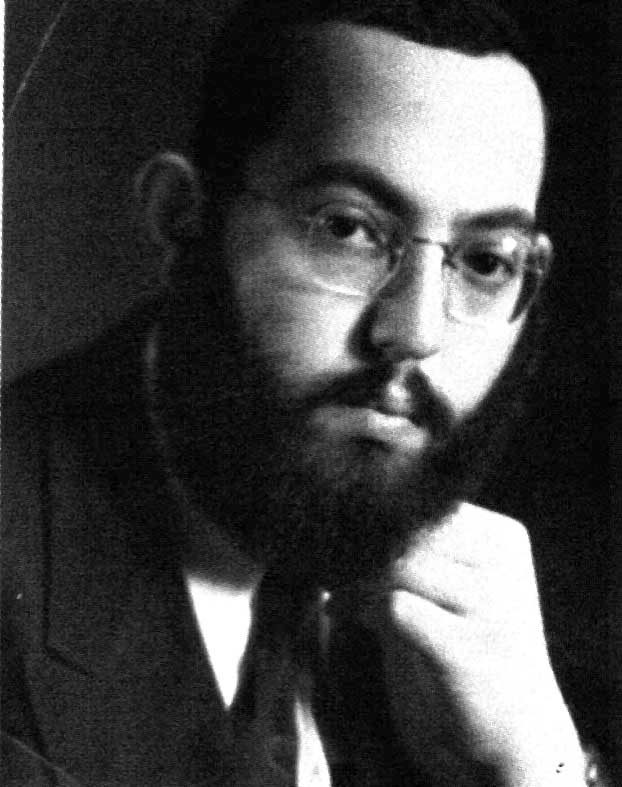
Time passed and Yitzchok Dovid transferred to learn at the new yeshiva. Since he was accustomed to a certain style of learning, he continued with it even in Tomchei Tmimim, until he interacted with the more veteran Tmimim students, those who had studied Chassidus with Rabbi Yisroel Jacobson, and learned to adapt his learning style to the special atmosphere of Tomchei Tmimim. In Beis Chayeinu, he met several of the older Chassidim, but especially loved to stay near his mentor of those days, Rabbi Shmuel Levitin, and was deeply influenced by his farbrengens, which in those years dealt mainly with the importance of hiskashrus to the Rebbe [Rayatz]. He was also very impressed by Rabbi Shmuel’s avodas ha’tefilla. “When he davened, I would often hear how he explained parts of the tefilla to himself in Yiddish,” Rabbi Groner later said.
In the following years, he tried to take advantage of every opportunity to spend time in the presence of the Rebbe Rayatz.
He was able to describe to this generation the holy voice of the Rebbe Rayatz and all his gestures, and of course – episodes and stories that are not well known. For example, he told that in 5702, after the passing of Rebbetzin Shterna Sarah, the mother of the Rebbe Rayatz, Reb Shmuel Levitin would lead the davening, and at first, the Rebbe Rayatz would be present at this minyan while wearing his tallis and tefillin. Among the bachurim, there was a rotation of who would merit to enter and daven in the minyan with the Rebbe, with different bachurim entering each day. Once, some students were late by a few minutes. The Rebbe Rayatz called Reb Shmuel, pointed to the clock and said: “We must begin davening at nine o’clock, and now it’s already three minutes past nine. Why are you stealing three minutes from me?!”
Yeshiva Principal at Age 18
Young Yitzchok Dovid also began to get to know the Ramash (the current Rebbe) in those years. He was present at 770 on 28 Sivan 5701 (1941), when the Rebbe and Rebbetzin arrived in the United States, and remembered the wonderful expressions that the Rebbe Rayatz said about Ramash then.
“On that night when the Rebbe arrived in America, the 28th of Sivan 5701, I merited to enter with my father for a private audience with the Rebbe Rayatz. I then formally entered Tomchei Tmimim, and in honor of this I had yechidus. I remember that we stood in the ‘lower Gan Eden’ and waited to enter his holy room. Suddenly, Reb Yisroel Jacobson came out of the Rebbe’s room, very excited. He called out loudly: ‘The Rebbe said that the entire yeshiva should come out to greet my son-in-law, who knows by heart all of Shas, all of Tosafos, all of the Rosh and all of the Ran and all the printed Chassidishe sefarim.’ Only then did we get a hint of understanding about the Rebbe.”
Later, while maintaining his learning schedule, Rabbi Groner also invested much time in outreach and hafatza activities that were managed by the Rebbe Rayatz’s son-in-law – the Rebbe-to-be. Under his guidance, Rabbi Groner helped organize a parade for children who attended ‘Mesibos Shabbos’ along Eastern Parkway in Brooklyn – opposite 770. Hundreds of children marched together while loudly singing Jewish songs. The Rebbe Rayatz commented on this procession, saying that the Alter Rebbe also participated in it…
His blessed talents are evidenced by the fact that already while he was a young bachur, in 5704 (1944), at only about 18 years old, he was appointed as principal of the ‘Achei Tmimim’ yeshiva in Rochester, and also in Philadelphia, and on 23 Menachem Av 5705, he was appointed as principal of the ‘Achei Tmimim’ yeshiva in Providence, immediately upon its founding. It is amazing to read the praise that the Rebbe Rayatz wrote about him then, in his letter from Marcheshvan 5704:
“For now, my honored son-in-law Rabbi Rashag shlita, principal and active manager of the central Tomchei Tmimim Lubavitch yeshiva, has sent my dear student-friend, the distinguished and excellent rabbi with the most noble talented qualities, of good character and G-d-fearing, the honorable Rabbi Yitzchok Groner, who was designated to travel to another place, but due to the necessity of the matter, they sent him for now…”
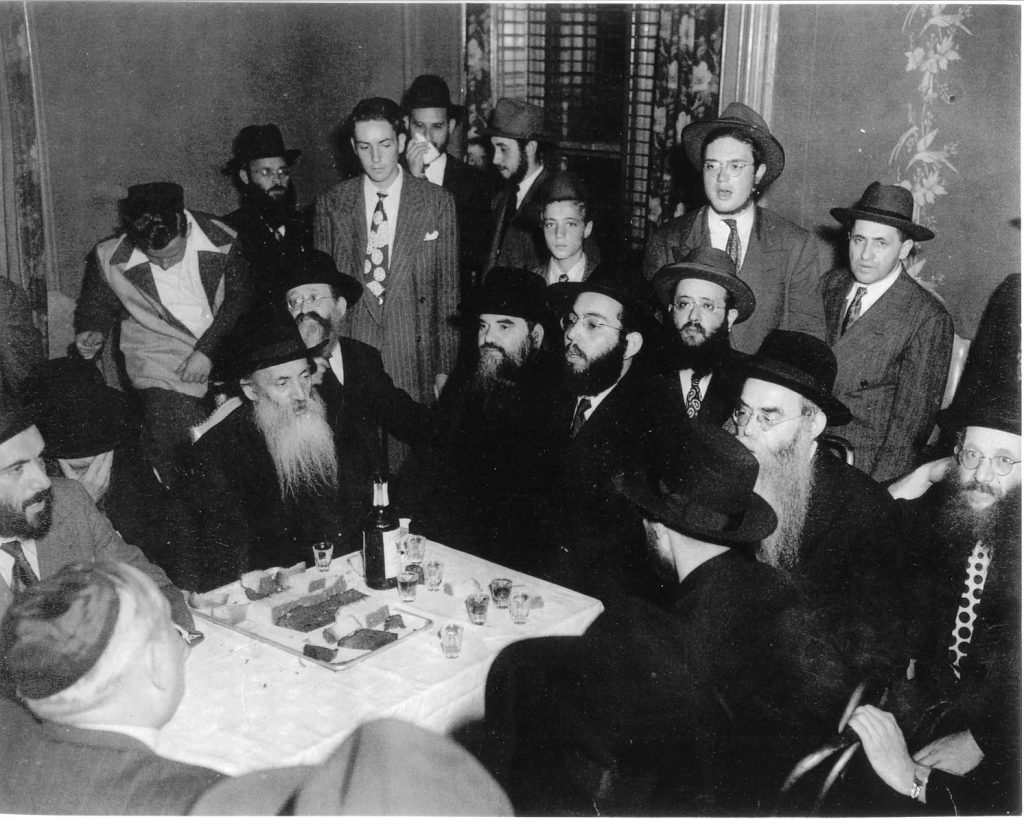
Later, the Rebbe told him that during that period he had entered to his father-in-law and argued: We have a bachur who can be hoped to grow into a Chassidishe rosh yeshiva – are we also taking him and sending him to deal with educating small children?! The Rebbe Rayatz answered him: “Eis laasos l’Hashem, heifeiru torasecha” (It is a time to act for God – they have violated Your Torah). There is no choice, we must save the children of Israel!”
Later, Rabbi Groner described with great vividness the urgency that prevailed in those years to open schools and place even young bachurim at their head: “One who was not then in America and is not familiar with what happened here – cannot imagine how far things had gone. One thing must be clear: not only was there nothing Jewish here, it simply never occurred to anyone – of all the rabbis who were here for generations – that it was necessary and possible at all to open Talmud Torahs, religious schools and yeshivos throughout America. This was simply absurd from the outset. Completely impossible. The Rebbe was the one who dared to fight against the current and break the ice. Initially, everyone tried to dissuade him. They explained to him that America is not Eastern Europe, that this whole idea had no chance of succeeding. But the Rebbe was steadfast in his opinion. He took us, young and inexperienced, and turned us into mashpiim and roshei yeshivos. He sent us to America’s outlying cities to open schools, yeshivos and Talmud Torahs to break the ice. Later, after many years, all the rest came…”
First Visit to Australia
When he reached marriageable age, he married Devorah, daughter of the Chassid Rabbi Chaim Zvi Konikov. The wedding took place on 7 Elul 5706, and he merited that the Rebbe was mesader kiddushin at his wedding.
About a year after their wedding, he was sent to Australia and New Zealand on a shlichus from the Rebbe Rayatz, where he served as a ‘shadar’ on a mission to strengthen Yiddishkeit and raise funds. The journey was supposed to last several months. It was a long and arduous trip of 55 hours of flight! This shlichus created the first connection between him and the community in Australia.
“The first time I entered the shul, I saw perhaps a hundred men,” he recounted years later. “I went to a corner and began to cry from overwhelming emotion over the very existence of the community. The next day I wrote to the Rebbe my impression of the community.”
Upon their arrival, the Melbourne community was considering whether to establish a Jewish day school. Rabbi Groner worked to open it immediately, as at that time he saw it as “the only thing that will preserve all the Yiddishkeit in this community,” in his words.
In a detailed and touching letter, the Rebbe Rayatz outlined for Rabbi Groner the course of his shlichus: “Certainly it is so that the work of a shliach is to obtain funds for Torah and educational institutions, but this is not its entire essence; the main emphasis must be on matters of avoda and hisorerus (spiritual awakening), for as mentioned – this hisorerus is the most essential” (Igros Kodesh Rayatz, vol. 9, p. 396).
During those few months he spent in the community, he encouraged the opening of the first Jewish school in Melbourne, a step that was not simple in relation to the conditions then. He also met with the pioneers of Judaism in Australia, including Rabbi Chaim Gutnick and Rabbi Moshe Feiglin.
Some time after he returned to New York, he moved with his family to Buffalo, where he ran the local Chabad school.
In 5714 (1954), Rabbi Groner again went to Australia for another fundraising trip. This time the trip lasted six months. The reason is not known, but in one of his letters to the Rebbe he wrote that he was asking to return home. In response, the Rebbe asked him: “Have they all put on tefillin there? And have they already emptied their pockets (meaning for tzedaka)? If so, there’s no need to hurry…”
At the end of his shlichus, he returned to live in Crown Heights, where he worked with Lubavitch’s central yeshiva as a fundraiser, traveling from city to city in the United States to oversee additional yeshivos and help them advance. His blessed and rare talents alongside his oratorical skills enabled him to operate on several fronts simultaneously.
He was later sent to head a community in Chicago, with the Rebbe guiding and accompanying him at every step. In a fascinating letter, the Rebbe instructs him how to use his strengths for investment both in the community and in his surroundings:
“How good it is that in a place that one visits and influences, one should observe the local people, in order to choose among them one who could continue things afterward,” the Rebbe guides him (Igros Kodesh – #5749). “And certainly one must find someone suitable for this, at least to an important degree – if not completely. But like in all matters, chinuch and habituation in this will be required, and therefore observation is needed well in advance, and so that he can persuade the one who will be found, so that he will agree with a happy heart and out of desire and will, and teach him the ways of how to do this. It is understood that my intention in this is not for one person to deal with all the places he visits, as this is something connected with great difficulties for several reasons, but that in each shul and place – a person from the local people should be found. And this is understood. And may the A-lmighty grant him success in this as well.”
The Rebbe Encourages Young Shluchim
After all the series of shlichus missions to which he was sent over the years, Rabbi Groner was sent to the main shlichus of his life – Australia. It was in early winter 5719 (1959) when the Rebbe sent him to the Australian continent. This shlichus began with many difficulties and ended with great success in establishing an empire of institutions and wide-ranging activity throughout the continent.
This shlichus came about based on his previous shlichus. The community leaders in Australia remembered his visit favorably, and over the years that followed, they urged both Rabbi Groner and the meshaleiach – that there should be a permanent rabbinic presence in Australia who knew English fluently (unlike other Anash immigrant families there).
In addition, a group of Lubavitch families sent to Melbourne over the years had founded a yeshiva, and claimed that Rabbi Groner was the suitable person to raise the institution to a higher level. He also knew how to connect with modern families without sacrificing the image and sense of the Chassidic Jew “of old.”
Going out on shlichus in those years was not taken for granted as it is today. Only a few went out on the Rebbe’s explicit instruction. Shlichus was an extremely difficult challenge.
For several reasons, Rabbi Groner was not eager to leave the Rebbe’s court and move to Australia. He presented to the Rebbe a host of reasons why he could not pack up and travel. Even when he finally agreed to the Rebbe’s request – he reserved for himself the option to return to New York one day.
“I wasn’t a good boy,” he later joked when recounting his shlichus story.
And so, in the summer of 5718 (1958), the first arrangements began for his trip to Australia. The Rebbe instructed him to travel for a period of three to five years to strengthen the local yeshiva, and then make a decision whether to stay permanently or return.
In a yechidus held before his trip, the Rebbe told him that Rabbi Zalman Aharon Serebryansky, from Anash in Australia, would serve as “menahel gashmi and menahel ruchni,” “and you,” the Rebbe added with a smile, “will already find yourself a title… what more do you need than shlucho shel adam k’moso ( ‘a person’s agent – is like himself’)!”
On 21 Kislev 5719, Rabbi Groner set out on his journey, while his wife and six children joined him later. His son Rabbi Chaim Tzvi, the Rebbe’s shliach to Melbourne, recounts: “Since I was born in the month of Cheshvan 5719, my mother couldn’t join my father, and therefore we joined him only after Pesach together with the other children. It was an exhausting and tiring journey. We flew by plane to Los Angeles, and from there went by ship to Sydney…”
It’s easy to understand that the permanent move to Australia was not easy for the couple. They understood the magnitude of the task, but the personal sacrifice required of them was not simple. During this period, the couple wrote many letters to the Rebbe in which they described the difficulties and successes they experienced. They also merited encouraging and strengthening responses.
“When a soldier goes to war,” the Rebbe wrote to Mrs. Devorah Groner (Igros Kodesh vol. 19, p. 108), “he goes by marching, which brings victory closer, enlarges it and hastens it. So too here, when you and all those engaged in the work go with joy and a sense of confidence in the success of the shlichus – the work will succeed more easily and quickly, and on a broader scale.”
An interesting episode is recounted by his grandson Rabbi Sholom Zirkind: “My grandfather Rabbi Groner told the Rebbe on one occasion that he had many thoughts in the mode of ‘mara shechora’ (melancholy). The Rebbe told him: ‘You are traveling by ship on the sea. On the way, do all your calculations and throw them into the sea together with the thoughts of mara shechora and troubles, and when you arrive at the place of shlichus – start everything anew’…”
The Rebbe wrote to them extensively about the enormous potential contained both in Australia and in Rabbi Groner himself… “The choice whether to continue the shlichus in Australia – is in your hands,” the Rebbe wrote (from Igros Kodesh vol. 19, p. 265) to Mrs. Groner. “But it’s important that you know, if you want the work to be done successfully – it must be done willingly and with joy. Not from compulsion, and not as if it were exile or punishment.” The Rebbe didn’t want the shlichus to be done from ‘acceptance of the yoke’ alone, but with joy and wholeheartedly…
The Rebbe further added and emphasized to her: “The intention of the shlichus is not only to bring Judaism to Australia, and not only that you are doing good for the Jews in Australia – but one of the main points is also that the result of this work is beneficial and good for you yourselves, in your personal matters.”
In a yechidus that Rabbi Groner had in Tishrei 5721, the issue of staying in Australia came up again. For almost an hour the Rebbe spoke about the importance of the shlichus – both for Australia and for Rabbi Groner himself.
About a month later, the Rebbe wrote a letter (in English – ‘Letters of the Rebbe’ vol. 1, p. 153) to Mrs. Groner, in which he detailed the central ideas that were said in that audience. The Rebbe explained extensively the difference between an employee who has fixed working hours and leaves his work at the office, and a manager who bears responsibility, is required to make decisions, and must be involved in every detail.
“One who has the ability to be a responsible manager of a meaningful shlichus,” the Rebbe explained, “if he chooses to function only as an employee, he does enormous injustice even to himself, not to mention the shlichus. He might say: ‘I don’t want to be at the higher level, to avoid the pain involved in it.’ But this is like a person who would say: ‘I don’t want to be human – I’d prefer to be like an animal, to be saved from the pain of human life.’”
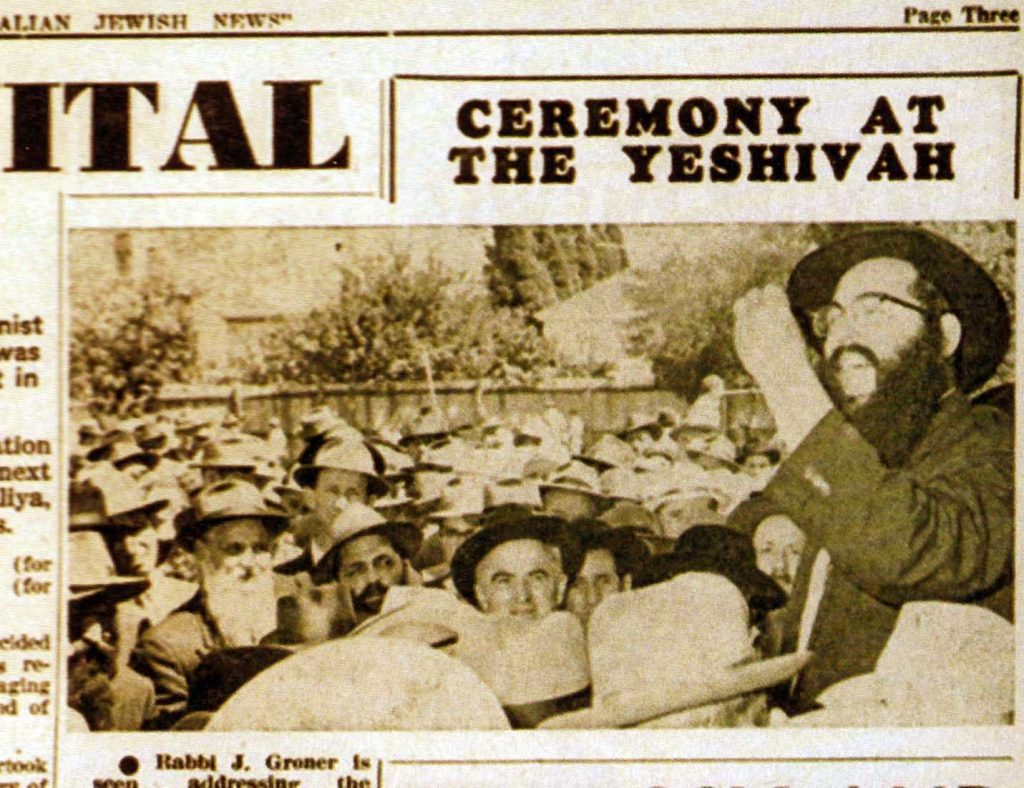
In light of such empowering and encouraging treatment from the Rebbe, the Groner family remained permanently in Australia. “The Rebbe sent me initially for three years,” Rabbi Groner would say with a smile, “and I stayed for life!”
From then on and throughout their lives, Rabbi and Rebbetzin Groner fulfilled the Rebbe’s shlichus with incomparable dedication. They navigated the growth of dozens of Chabad institutions and built a living and vibrant community whose influence is felt by the vast majority of the Jewish community in Australia to this very day.
Over time, Rabbi Yitzchok Dovid Groner became the Rebbe’s shliach not only in status and title, but in his very inner essence. Anyone who met him, conversed with him, or heard his drashos, immediately felt that the Rebbe’s shliach was before them: speaking without fear, standing courageously by his views, entirely infused with Chassidic vitality that did not dim over the years.
Above all, his midda of Chassidus stood out. Despite staying for decades in Australia, far from ‘Beis Chayeinu,’ he remained a Chassid of 770 in every fiber of his being, as if he had just emerged from the ‘oven’ of Tomchei Tmimim.
In his shlichus, he often encountered an environment distant from Torah, shallow Judaism at the level of ‘balebatishkeit,’ and a difficult spiritual climate. But none of these affected him at all. On the contrary, he was in a position of influence. In every conversation, in every action – a vital spirit of Lubavitch and its leader emanated from him. He did this not only as an external action required of him by virtue of his shlichus, but because this was his very essence – he lived the Rebbe and lived the shlichus truly and with a pnimiyus.
“i Am Always with You”
A wonderful and unique kiruv occurred in 5740, when Rabbi Groner entered for yechidus. The Rebbe asked him what was doing regarding his health, and he said his health was not so good. He used to travel to Australia through various Far Eastern countries, where he would stop on the Rebbe’s shlichus. Now, he told the Rebbe, it was difficult for him to travel to all those places.
The Rebbe answered him: “Reb Yitzchok, if I travel with you to all those places, will it be more pleasant for you?…”
Rabbi Groner was very moved and said: “Certainly!”
And the Rebbe said to him: “Physically I cannot, but spiritually, wherever you go – I travel with you!” When he heard this, Rabbi Groner burst into uncontrollable tears, and from overwhelming emotion, immediately left the Rebbe’s holy room in the middle of the yechidus!
His brother, the secretary Rabbi Leibel, who stood outside the room, asked him what had happened, and he told him what the Rebbe said, and added: “I couldn’t bear to stay by the Rebbe. I had never heard such an expression from him!…”
Similarly, Rabbi Leibel recounted: “My brother was once in a yechidus with the Rebbe before his return trip to Australia. At a certain point, the Rebbe told him to change his travel route and stop in Singapore to fulfill a certain somewhat complex shlichus there.
“When the Rebbe said this, my brother worried how he would succeed in fulfilling the Rebbe’s instruction. He, of course, said nothing to the Rebbe. However, at that very moment, the Rebbe turned to him – as if reading his thoughts – and said: ‘Yitzchok, what are you worried about? We are going with you. And when we go with you – there is nothing to fear’…”
His grandson adds: “On one occasion, my grandfather Rabbi Groner asked for a bracha that he not experience agmas nefesh (heartache), and the Rebbe responded: ‘And even heartache that is not unnecessary – also not’…”
The next episode will testify to the fatherly treatment that the Rebbe gave to Rabbi Groner and his wife. This was when Mrs. Groner packed her belongings in a car before a return trip from Crown Heights to Australia. She stood talking by the car without noticing that the Rebbe was standing and watching, waiting until her departure…
This special attention accompanied the couple throughout their entire shlichus. Thus, Rabbi Groner once asked the Rebbe to ‘keep a special eye’ on Melbourne. The Rebbe responded in wonder: “Do you need to ask for that at all?…”
When he went out on his shlichus, the Rebbe told him that his role was “to conquer all of Australia.”
The extent of his devotion to his shlichus can be learned from one sentence that the Rebbe once said about him to his brother, the secretary: “Activity that requires another shliach four full days – he manages to accomplish in one day!”
And so, during his approximately fifty years of shlichus in Australia, he transformed this continent, besides the special missions that the Rebbe assigned to him over the years regarding Jewish affairs in Far Eastern countries, where at that time permanent shluchim were not yet active.
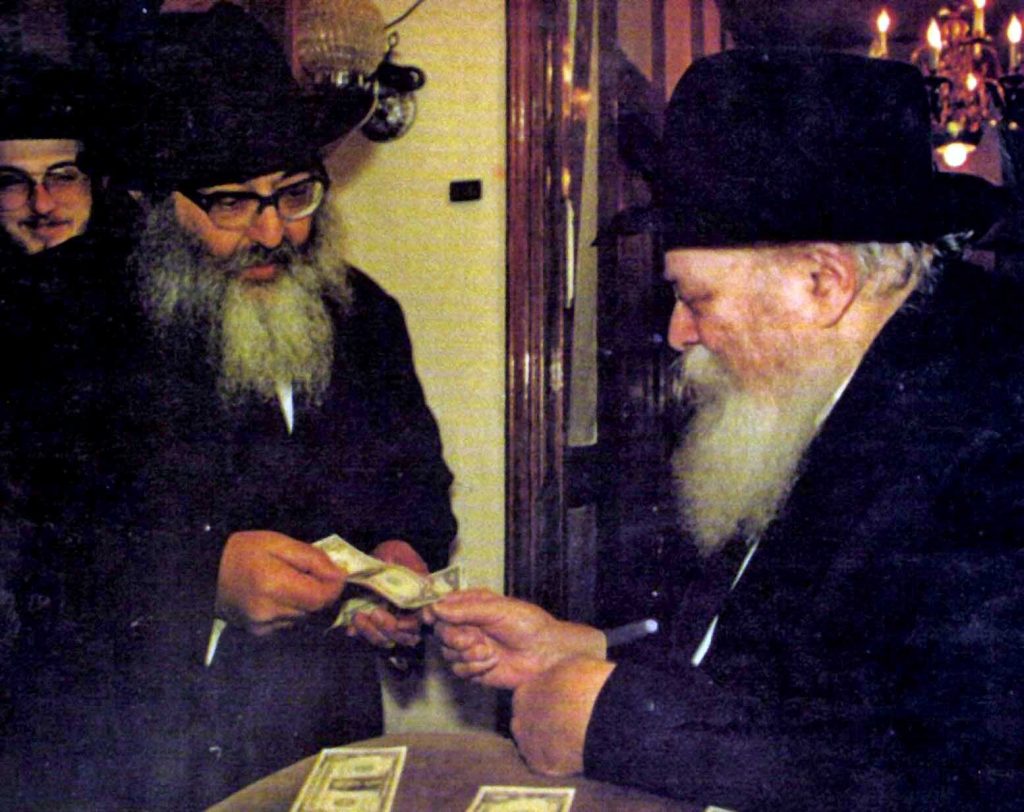
Many times, during the distribution of dollars, the Rebbe gave Rabbi Groner an additional dollar saying “for all of Australia.”
His brother, Reb Leibel, testified that even in the standard formula that the Rebbe said to him during the distribution of dollars, it was not “bracha v’hatzlacha” as usual for everyone, but bracha v’hatzlacha rabba (blessing and great success) …
Beis Moshiach #1470 • pp. 10-19, 20
© 2026 Beis Moshiach Magazine. All rights reserved.
This article originally appeared in Beis Moshiach #1470. You are welcome to share it with friends and family by email or in print, provided that you do not change, add to or omit any part of it, you credit the author and Beis Moshiach, and you include a link to archive.bmoshiach.org (written out in full in printed copies).
To republish this article in a newspaper, magazine, book or website, please request permission in advance at [email protected].