The Shochet Who Was Too Strict
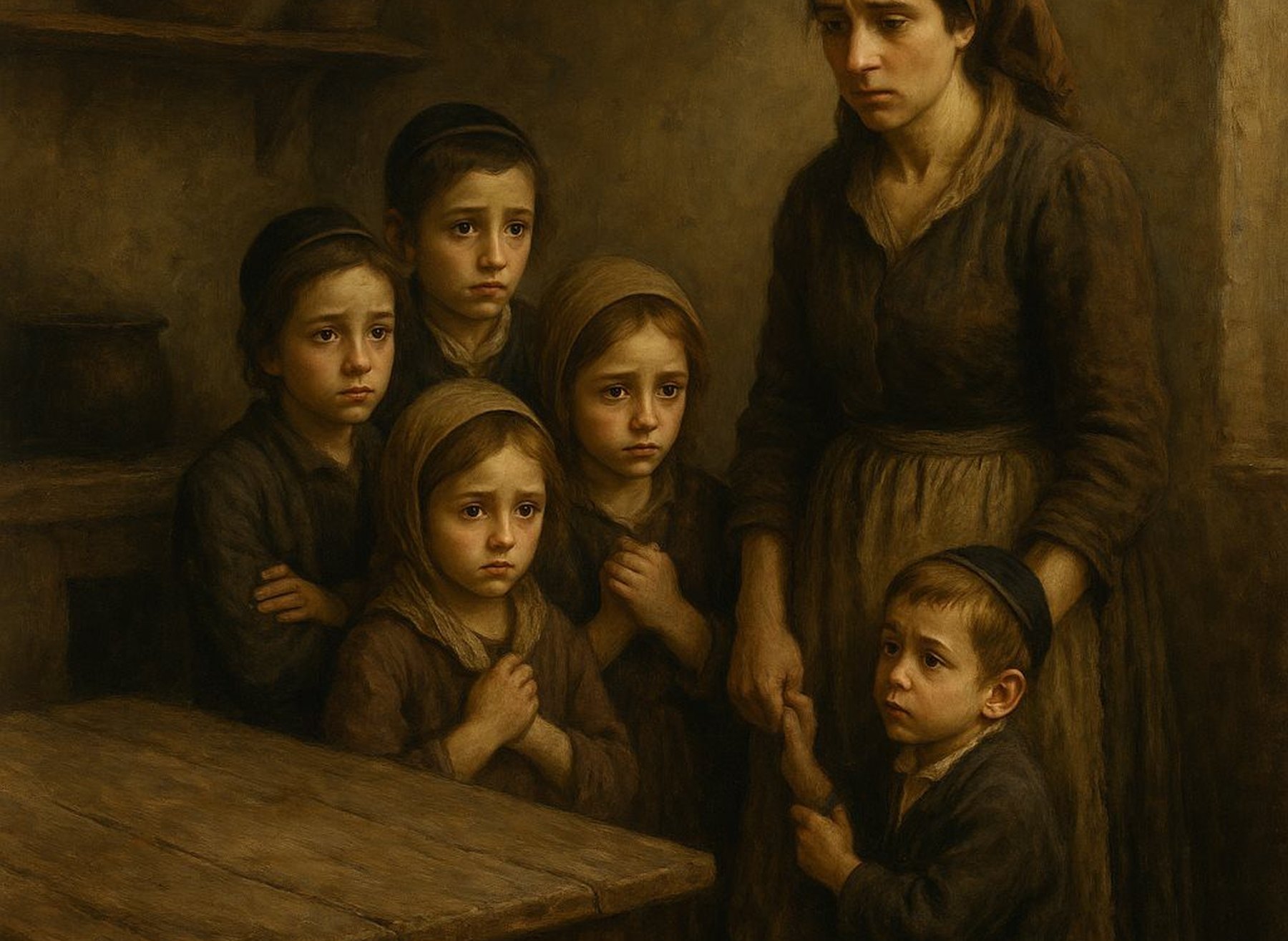
Previously: Yitzchok the Butcher passes away, leaving his widow in debt. Creditors threaten the family. The Maggid of Kozhnitz pays the debts. In Heaven, Yitzchok’s heroic past saves him from punishment, but Gan Eden’s gates remain closed.
From the TzaddikStory.org collection
Now, in Shamayim, Yitzchok saw it all clearly.
He wasn’t in debt because he was lazy. Or dishonest. Or careless. He had worked hard. Day and night. He had tried his best to support his family.
But there was something he hadn’t understood back then.
“I did the shechita,” he thought. “But I always brought every animal to the town’s shochet to double-check. He was an expert. The one trained in every detail. Everyone trusted his opinion.”
And that was the problem. The town’s shochet was too strict. Much too strict. Not just for himself – but at everyone else’s expense.
Day after day, he would inspect the animals and say, “Treif.”
“Treif!”
Again and again.
Yitzchok could still hear the words echoing through his shop. “Treif!” “Treif!” “Treif!”
Even when the animals looked perfectly fine, even when other shochtim would have called them kosher, the town’s shochet would shake his head. “No good.”
And that was that. There was nothing more he could do.
Yitzchok had no choice but to throw out the meat – or sell it to non-Jews for pennies. He couldn’t argue. He couldn’t overrule the shochet. That’s not how it worked! He wasn’t an expert. But it was so expensive, throwing out all that meat…
When customers came by, Yitzchok had nothing to give, and no money to show for it. His shelves were empty. His pockets were emptier.
That’s when he started borrowing. From the grocer. From the moneylender. From the carpenter.
He didn’t borrow to go on vacation or buy nice things. He borrowed just to survive. Just to feed his children. And now – because of all that – he couldn’t enter Gan Eden?!
“He’s the reason I couldn’t pay them back!” Yitzchok cried. “He should take responsibility! He caused this. Let him pay the debts!” But in Shamayim, the gates still didn’t open.
* * *
That night, the town shochet had a dream.
In the dream, Yitzchok the butcher stood before him, his eyes full of pain. “We need to go to the Rav,” he said. “We need a din Torah. I think you owe me a lot of money.”
The shochet blinked in surprise. Was this a dream…?
“All that meat was kosher,” Yitzchok continued. “I went to the Heavenly Court – they showed me. The animals you called treif? They were all kosher. Every last one!”
The shochet jolted awake, beads of sweat on his forehead. He washed negel vasser, rubbed his eyes… and tried to forget about it.
But the next night, the dream returned, exactly the same.
Yitzchok was there again, pleading: “Come to the Rav. Let us have a din Torah. I want justice.”
The shochet couldn’t ignore it anymore. He hurried to the holy Maggid of Kozhnitz and told him everything.
The Maggid nodded slowly. “This wasn’t just a dream,” he said. “If you see it again, agree to the meeting. And I will hold the din Torah in my office.”
That night, it happened once more. The shochet sat up in bed and whispered, “Fine. I agree. Let’s go to the Rav.” The next morning, the Maggid called for his shamash.
“Go to the beis ha’chayim,” he said. “Find Yitzchok the butcher’s kever. Knock three times. Call out to him. Tell him to come to the din Torah in the Beis Medrash of the Maggid of Kozhnitz.”
The shamash did as he was told. He ran to the cemetery, found the grave, and called out softly but firmly, “Come, Yitzchok. Come to the Rav’s office. It is time for your din Torah.”
The next day, the Maggid’s study was prepared. A screen was placed across the room. On one side sat the shochet and the judges. Behind the screen… silence.
Then the Maggid spoke.
“Yitzchok the butcher, why are you calling the shochet to a din Torah, to court?”
A voice answered. It was filled with tears. With grief. With years of quiet pain.
“Do you not see how my wife is suffering…? How are my children hungry?”
“He kept calling everything treif. He said my customers’ meat was no good – again and again. He was too strict. Too careful! He followed every chumra, every extreme opinion. But who says that should be the halacha for the whole town?
“I was just a butcher. I wasn’t trained in halacha! I just wanted to do the right thing. I brought him everything to double-check. I trusted him.”
His voice cracked.
“Because of him, I could never make a parnassa. I had no money. I had to borrow, just to buy bread for my children. And then… I died from the pressure. And now, even in the next world, I’m still locked out of Gan Eden… All because of him.”
The room was still. The judges said nothing. The air felt heavy.
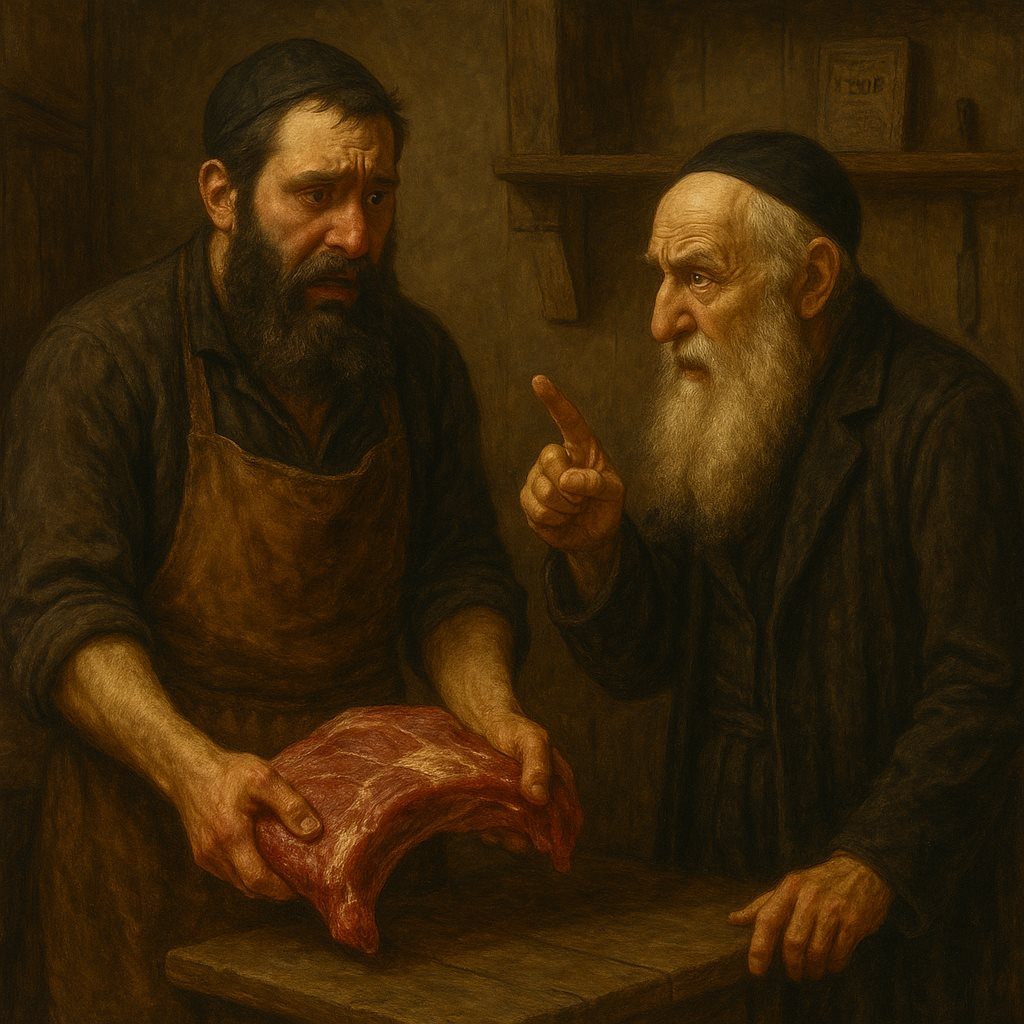
The shochet shrank in his seat. His face turned pale. He began to shake.
He knew Yitzchok was telling the truth. “I… I never meant to cause any harm,” he whispered. “I only wanted to be yerei Shamayim… to be extra careful. I thought I was protecting people from even the smallest mistake in kashrus.”
He looked up at the Maggid, eyes wide with fear.
“Rebbe… how do I fix what I’ve done?”
Maggid answered firmly. “You were too strict,” he said. “You decided the meat was unsellable for no valid reason. And because of that, this man’s family was left with nothing. You must repay the debts. You must support the widow. You must make it right.”
And so, he did.
From that day on, the butcher’s debts were paid in full. Every Thursday, the widow received an envelope with enough money to feed her children. Her home was filled with warmth again.
And for Yitzchok? The gates of Gan Eden swung open at last.
* * *
After the shochet left the room, still pale and trembling, the Maggid of Kozhnitz looked toward the other side of the screen.
He raised his hand gently. “Yitzchok’l… Yitzchok’l… come closer. I have a question.”
A quiet pause.
Then the Maggid asked, “You’ve already left this world. You’re no longer part of it. So why are you still so worried about money? With your family’s needs? Why is this the only thing stopping you from entering Gan Eden?”
Yitzchok’s voice returned, soft now, but clear.
“I was forgiven for everything,” he said. “The Heavenly Court reviewed my life. And when they remembered how I once saved those talmidei chachamim from the robbers, they erased all my mistakes. I was free.
“But,” he continued, “I still couldn’t enter Gan Eden. Because of the debts. Because people were still hurting because of me. Because my family was still suffering. And then I was shown the truth – that I wasn’t poor because of my own mistakes. It wasn’t because I didn’t try. It wasn’t laziness or dishonesty. It was the shochet’s strictness that caused it all.”
The Maggid nodded slowly. He had seen it too. And now, with quiet strength, he’d brought justice into the world. Without anyone knowing, he’d redirected the money where it belonged. The debts were paid. The children had food. The widow had hope.
There was silence for a moment.
Then, Yitzchok’s voice came, one last time.
“Ahh,” he said, with a sigh full of peace, “now I can go to Gan Eden.”
And he did.
* * *
Sometimes, people try so hard to do the right thing that they forget about the people around them. The shochet thought he was doing a great job by following the strictest halacha – but he didn’t realize how much harm it caused. It’s one thing to be strict with yourself. But when being strict hurts others or forces them into pain, it’s no longer holiness – it’s just pressure. We’re not doing our best work if it makes someone else’s life harder. That’s not what Hashem wants.
Yitzchok the butcher tried his best in life. He worked hard, trusted others, and never meant to hurt anyone. In this world, things don’t always seem fair. But Hashem sees everything. And in the end, every mitzva, every tear, and every honest effort is counted. We learn from this story to be kind, to be careful with others, and to do our best – with a soft heart and honest hands. When we do that, Hashem takes care of the rest, and everything turns out how it’s supposed to.
Beis Moshiach #1471 • pp. 56-59
© 2026 Beis Moshiach Magazine. All rights reserved.
This article originally appeared in Beis Moshiach #1471. You are welcome to share it with friends and family by email or in print, provided that you do not change, add to or omit any part of it, you credit the author and Beis Moshiach, and you include a link to archive.bmoshiach.org (written out in full in printed copies).
To republish this article in a newspaper, magazine, book or website, please request permission in advance at [email protected].