The Apartment on Rue Boulard
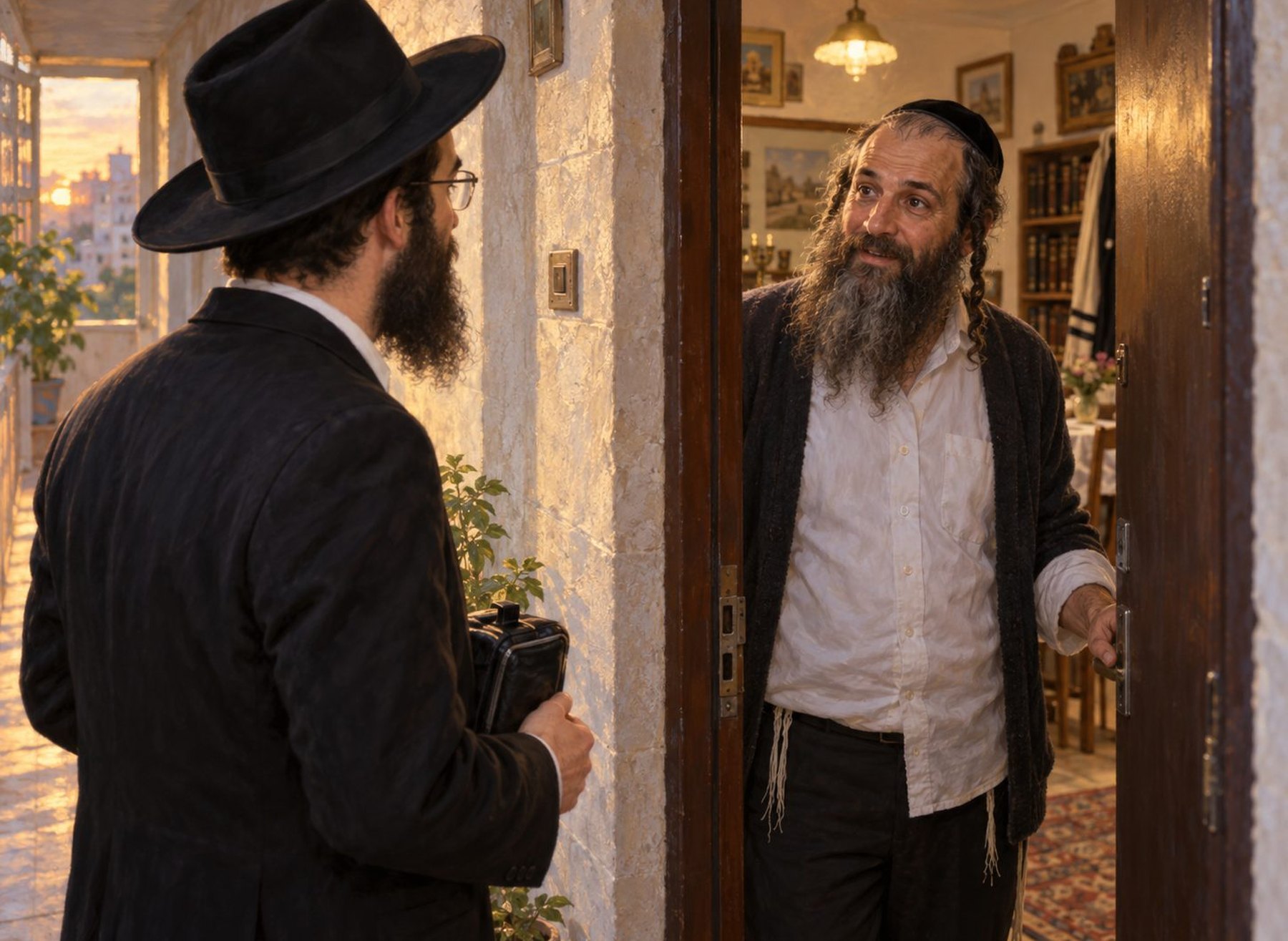
Rabbi Katan from Givat Shaul, a quiet Yerushalayim neigborhood, spent his afternoons the way he spent most afternoons: walking a street, one door at a time, looking for a Jew willing to put on tefillin.
Most people said yes. Some said no. That was mivtzaim - you never knew what waited on the other side of a door until you knocked.
That day he chose a street he didn’t usually cover, and partway down it, he knocked on a door he’d never knocked on before.
It opened, and Rabbi Katan found himself looking at a man he had never met - a local dentist, as it turned out. But there was no need to offer him anything. One glance was enough to see that this was already a Jew who kept Torah and mitzvos. A long beard, the unmistakable bearing of a Breslover Chassid. Whatever this man needed, it wasn’t tefillin.
Rabbi Katan thought for a moment, then tried something else.
“Would you like to set up a regular shiur? Tanya, maybe. It’s not just theory - it’s tremendously relevant to daily life.”
He watched the dentist’s face change. It wasn’t polite interest. Something underneath the question had been touched, and touched hard.
“Of course I’d like that,” the dentist said. “But first - sit down for a minute. I want to tell you why I’ve been waiting to learn Tanya for so long.”
Rabbi Katan sat. He had no idea what he was about to hear.
* * *
To understand it, we have to go back twenty-five years, to Paris.
The dentist had grown up in a home with barely any connection to Yiddishkeit - the kind of home where the calendar might have had a Yom Kippur written into it, but nobody thought to walk into a shul because of it. His father didn’t go. Nobody in the family did. Judaism was a fact about them, not a practice.
So when, in his twenties, he met a non-Jewish woman, and the two of them began talking about a life together, nothing in him objected. There was no inner voice yet. No hesitation. Just two young people, in a city full of young people building lives, doing what young people in Paris did - they found an apartment.
It sat on a quiet, unremarkable street in a residential corner of the city, the kind of street you’d walk past without a second look - Rue Boulard, first floor. A walk-up, a narrow stairwell, nothing special. They signed the lease. They planned the wedding. They were, by every measure that mattered to them at the time, happy.
He remembers, even now, exactly what it felt like to walk through that door for the first time. For a few minutes, nothing seemed different. Then something happened to him.
Not a thought. Not a decision. A feeling - sudden, forceful, and entirely unfamiliar - rose up from somewhere inside him that he didn’t know existed. It didn’t announce itself gently. It arrived the way a fever arrives, all at once, refusing to be reasoned with.
He turned to her. He didn’t plan the words; they came out before he understood why.
“Don’t come near me right now.”
She looked at him, confused, maybe a little hurt. “What’s wrong with you? Are you sick?”
“Maybe,” he said. It was the only honest thing he could offer her. He didn’t know what was happening to him. How could he explain it to her, when he couldn’t explain it to himself?
An hour passed. He sat with it, hoping it would loosen its grip. It didn’t. If anything, it grew heavier, more insistent, until sitting still became impossible. Something was pulling him out of that apartment, and he no longer had the will - or maybe the choice - to resist it.
He left. He didn’t tell her where he was going, because he didn’t know. He simply walked, out into the Paris streets, past shopfronts and cafés and strangers going about their evening, carried by a need he couldn’t name. Only after several minutes did he understand what he was looking for.
A shul.
It seems almost absurd, looking back - a man who had never in his life sought one out, suddenly certain that a shul was the only place that could hold whatever was happening inside him. But that was the truth of it. He needed one, the way a person needs air, without being able to say why.
He found one. The door, by no design of his own, happened to be standing open.
He walked in not knowing what a minyan was. Not knowing what Mincha was. Not knowing a single word of what was about to happen to him. He simply found the rabbi standing near the front and said the only sentence he had in him.
“I want to pray.”
The rabbi didn’t ask why, didn’t ask who he was or where he’d come from. He placed a siddur into the young man’s hands - one with a French translation, since Hebrew was totally unfamiliar to him - and gently showed him what to do. Where to stand. When to bow. What the words meant, roughly, in a language he could understand.
Something in him settled, for the first time all evening, as he stood there mouthing words he had never said before.
When he finished, he walked back to the apartment. There was no more confusion in him now, no more searching for the right way to explain it. He told her, plainly, that it was over. He gathered her belongings, set them outside the door, and turned the lock behind her.
He couldn’t sleep in that apartment again - not comfortably, not for one more night without something gnawing at him. He paid out what remained on the lease, and he left. In the months that followed, slowly and without any plan for how far it would take him, he found his way closer and closer to Yiddishkeit - until, almost without noticing the exact moment it happened, he had made aliyah and settled in Tzfas, where he became a Breslover Chassid.
* * *

Twenty-five years went by.
He built a life there. A family, a livelihood, a place in a community that had become, in every way that counted, his own. Paris receded into memory - a chapter he rarely returned to, and never fully explained, even to himself.
Then, one ordinary afternoon, walking down a street in Tzfas, a loose page came tumbling past his feet - just a stray sheet of paper caught by the wind, the kind of thing anyone else would have let blow past without a glance. He bent down and picked it up anyway.
It was covered in stories about the Lubavitcher Rebbe.
He read them standing right there on the street, one after another, until a single line stopped him cold. In the 1930s, while living in Paris, the Rebbe and Rebbetzin Chaya Mushka had lived at 9 Rue Boulard - one stop among the years they spent in that city after fleeing Berlin, before the war forced them out of France entirely.
The address sat there on the page, and something about it wouldn’t let him go. He read it again. He knew that street. He knew it the way you know the inside of your own hand.
And then it landed, all at once, the way the feeling in that apartment had landed twenty-five years earlier.
That was his building. His street. His apartment, first floor - a walk-up, a narrow stairwell, nothing special - the one he’d rented as a young man planning a wedding that never happened. The one where, for reasons he had never once been able to explain, his entire life had turned in a different direction.
Was this a coincidence?
He stood there on the street in Tzfas holding the page, and he could not make the question go away. For days it followed him - into his work, into his davening, into the quiet moments before sleep. Could the very apartment where his life had split cleanly in two, where an engagement had ended in a single evening and a return to Yiddishkeit had begun without warning, really be the same apartment where the Rebbe himself had once lived?
He needed an answer. But he was wary of asking a Lubavitcher Chassid - he assumed he already knew what he’d be told. He wanted someone with no stake in the answer, no reason to see a miracle where there wasn’t one.
So he traveled to Rabbi Dovid Abuchatzera, in Nahariya - a Rav and mekubal of real renown, someone hundreds of people traveled to see each week for guidance and brachos - and told him everything: the apartment, the woman, the feeling that had risen out of nowhere, the shul with its door standing open, the page blown down a street in Tzfas twenty-five years later.
Rabbi Abuchatzera listened without interrupting once. When the man finished, he was quiet for a moment. Then he spoke.
“Listen carefully. There are many rabbanim. There are many tzaddikim. There are many admorim. But there is only one Rebbe. Do you understand what that means? It means that back in the 1930s, when the Rebbe chose to live in that particular apartment, it wasn’t because he needed a quiet place to think, and it wasn’t because he needed room for his sefarim. From the very start, he chose that apartment because decades later, a Jew would come to live there - a Jew who would need, at exactly that moment, an awakening.
“That is what a Rebbe is. Rosh Bnei Yisroel - the head of the Jewish people. And a Rebbe cares about exactly one thing: the standing of every single Jew, wherever in the world he happens to find himself.
“This is what the Megillah tells us about Mordechai - ‘and Mordechai knew all that had been done, and he went out into the city and cried a great and bitter cry.’ That is the Rebbe. He knows what will happen to every Jew before it happens. He hears the cry of that Jew’s neshama - sometimes decades before the Jew himself knows he’s crying - and he reaches in, quietly, patiently, to pull him out of the mud.”
* * *
A Rebbe, Rabbi Abuchatzera explained, is not measured only by wisdom or piety. A Rebbe is Rosh Bnei Yisroel - a head that feels what happens to every limb of the body, no matter how far that limb has wandered, no matter how many oceans separate them. Decades before this man’s crisis existed - before the woman existed, before the apartment was even a line in a rental ledger - the Rebbe had already gone and stood inside those walls. Because he knew, the way a head knows what a hand is about to touch before the hand itself knows, that a Jew would one day need exactly that room, at exactly that hour, to hear his own neshama crying out beneath everything else it had been taught to ignore.
Mordechai knew all that had happened, and he went out and cried a great and bitter cry. The Rebbe knows all that will happen to every Jew, and he does not wait for the cry to reach him first. He goes out ahead of it - decades ahead of it, if that’s what it takes - and he is already standing there, holding the door open, long before the Jew even knows he is looking for it.
This story was said by Rabbi Zalman Notik a’h from Yerushalayim, a friend of Rabbi Katan. It was also related at a melava malka in Crown Heights for descendants of the Alter Rebbe by Rabbi Shlomo Besser who retold it after tracking down a recording of the man’s own account.
Beis Moshiach #1523 • ז׳ תשרי תשפ״ז • pp. 56-59
© 2026 Beis Moshiach Magazine. All rights reserved.
This article originally appeared in Beis Moshiach #1523. You are welcome to share it with friends and family by email or in print, provided that you do not change, add to or omit any part of it, you credit the author and Beis Moshiach, and you include a link to archive.bmoshiach.org (written out in full in printed copies).
To republish this article in a newspaper, magazine, book or website, please request permission in advance at [email protected].