Persistent & Consistent
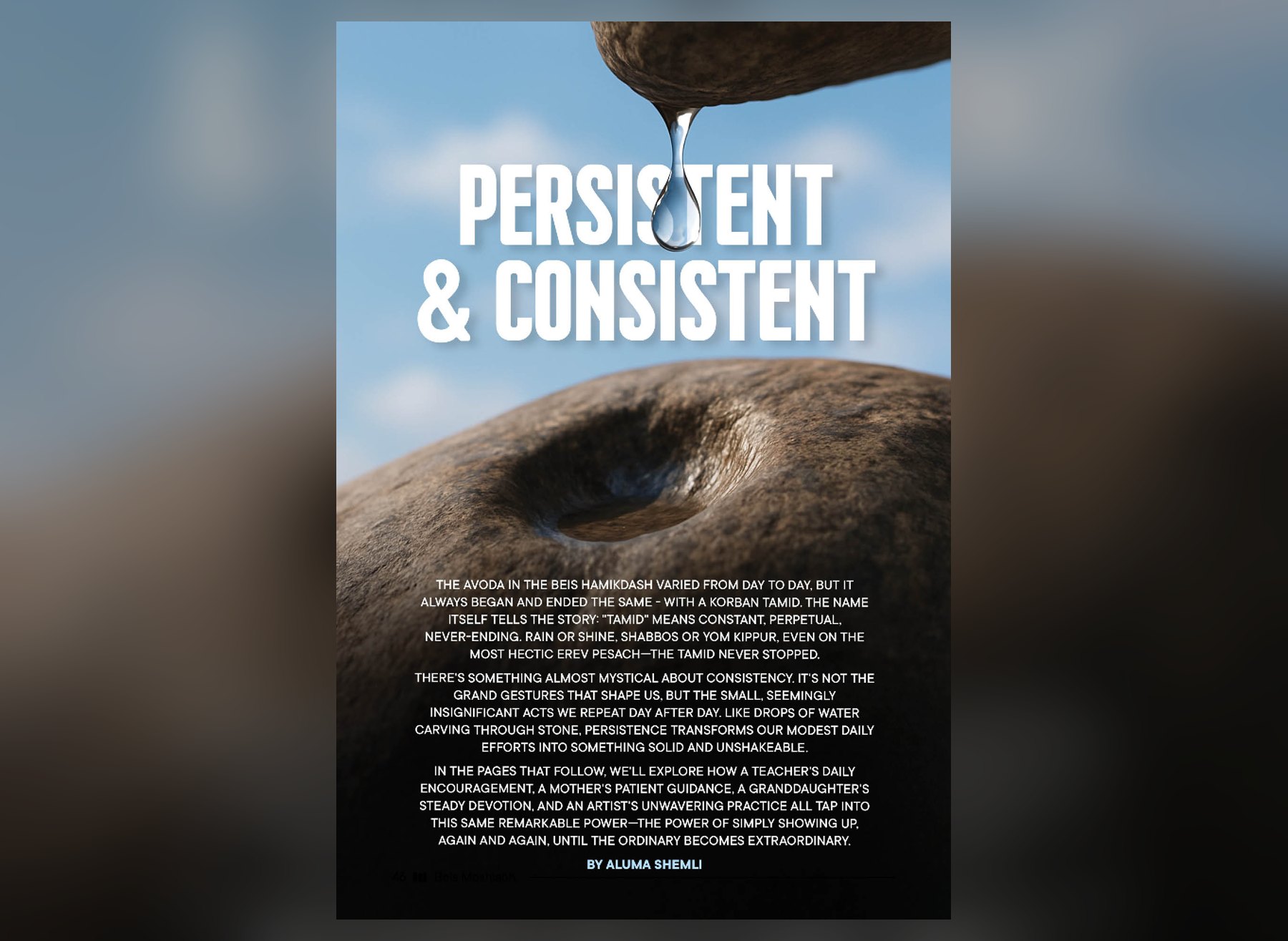
The avoda in the Beis HaMikdash varied from day to day, but it always began and ended the same – with a Korban Tamid. The name itself tells the story: “Tamid” means constant, perpetual, never-ending. Rain or shine, Shabbos or Yom Kippur, even on the most hectic Erev Pesach – the Tamid never stopped. There’s something almost mystical about consistency. It’s not the grand gestures that shape us, but the small, seemingly insignificant acts we repeat day after day. Like drops of water carving through stone, persistence transforms our modest daily efforts into something solid and unshakeable.
Every Single Day
Chaya: When I think about the Korban Tamid, I always think of my grandfather a’h. My grandfather, Rabbi Ezra HaCohen, had the zechus of serving as the rav of a shul for many years — over forty, I believe. The shul was small and warm, hosting two or three minyanim of simple, sincere Jews who worked hard to earn their daily bread.
My grandfather was everything to them. He was the rav who gave drashos on Shabbos and taught halacha during the week. They sought his advice on shalom bayis and raising children, gave him their maaser, and quietly turned to him for financial help during tough times.
Often, they also consulted with him on bureaucratic or medical issues. He did everything he could to offer sound advice, to contact those who could help, and enlist them on behalf of his congregants.
My grandfather was truly a genius. He authored sefarim that today grace the shelves of any self-respecting library and was even awarded an academic degree for his vast knowledge of Hebrew grammar. None of this kept him from dedicating all his time to his sweet little community.
What moved me most, as a teenage girl, was his early morning walk to shul. The shul davened very early, so everyone could get to work on time. My grandfather lived about a half-hour walk away and would get ready in the middle of the night to head out on foot, so he could arrive on time and open the shul.
The reason he walked was very simple — the buses hadn’t started running that early.
There was one bus driver who knew my grandfather. Every so often, as he began his first route of the day, he’d see my grandfather and his dignified face, open the door, and give him a ride close to his destination. In such cases, my grandfather never forgot to give that kind driver a Mi Shebeirach blessing.
And so it was, morning after morning — on weekdays and on Shabbos, in the sweltering summer and in the freezing winter nights. On Yom Kippur and on Tisha B’Av. Even snow couldn’t keep him home. Every day he was meant to open the shul, my grandfather got up and walked.
When I learned about the Korban Tamid, and realized that the preparations and the offering itself were done very early — just as the sun was rising — I immediately thought of my grandfather’s Korban Tamid.
Even at age ninety, he still walked there every morning. There were devoted people in the shul who wanted to drive him and were willing to be at his door very early. But my grandfather refused. He always asked: “Why do you want to rob me of the reward of walking?”
Even his doctor was pleased. If a man his age could and wanted to walk half an hour every day, the doctor encouraged it.
One day though, my grandfather was injured in an accident. A car driving that early in the morning carelessly, knocked him down and broke both his arms and one of his legs. My brave grandfather didn’t complain. He quietly bore the pain.
The congregants began organizing minyanim at his home, unwilling to give up the merit of being near him. My grandfather would sit in a wheelchair for the tefillos, and afterward, a line of people would form — each seeking his blessing or advice.
But his body was very old and couldn’t withstand the trauma. The fractures didn’t heal, and he suffered greatly. Then came heart problems, which he had never had before. He even underwent an operation before he left us in sorrow at the age of ninety-three.
For me, the moment my grandfather stopped going to the shul felt like the 17th of Tammuz — the moment the Korban Tamid ceased. From then on, everything spiraled until we lost him.
I so long to see him again at Techiyas HaMeisim — speaking to his beloved Jews, blessing them, loving them deeply, spreading only good.
I pray that the 17th of Tammuz turns into a day of joy and gladness and that we once again merit the Korban Tamid in all its forms. Amen!
A Bit Every Day
My name is Emuna, and I’m a creator, an artist. Art and painting are my life — my way to express myself and share a message with the world. Sometimes they fill me up, overflow me, until I take a brush and spill everything from my heart onto the canvas. It doesn’t matter if anyone ever sees it or understands what I meant.
Actually — it does matter. Of course, when someone receives it, appreciates it, understands, and is moved — it heals the soul.
I’ve been blessed that art is also my physical means of parnassa. That’s a privilege not everyone has, to make a living doing what you already love and enjoy. The only thing is, people order very specific works from me. They don’t wait for my heart to overflow and for me to pour it onto a canvas and then be excited to buy it. I have to paint or create things exactly as the client imagined — and meet deadlines, at least roughly.
There are days I walk into my studio full of excitement, lose myself there for hours, immersed in creation. I skip meals and drinks, not even noticing.
Then there are the dry days.
In the past, I used to spend them between dishes and laundry, chatting on the phone, or reading boring promotional flyers. On those days, nothing itched in my fingers, and the studio didn’t appeal to me. It’s a bit cramped, always messy, and smells like turpentine…
I wasn’t worried about those no-art days. I always reawakened eventually. But the clients were worried. Every project has a deadline, and usually a tight one, because clients tend to approach me at the last minute, assuming I’m like a taxi driver who can estimate how long a painting will take…
In the end, I never disappointed anyone. Sometimes I’d enter the studio the day before (or after…) the final moment, lock myself in until dawn, and complete what I promised. It took me longer and was less enjoyable than when I was inspired, but I always delivered.
About three years ago, I decided to stop working only when I felt inspired — or in crisis mode. My work, like any job, should not negatively impact my children or home. It needed to be confined to defined work hours.
I chose 8 a.m. The kids were already out, and I had davened. I’d walk into the studio and work for an hour — regardless of whether I felt inspired, whether I was in a good mood or not — as if I were punching a clock for a strict boss. I didn’t even care if there was a specific project due. I chose to create order for myself, to work every morning, no matter what.
Sometimes it’s really hard. I put on my work smock, open the paints, stretch a canvas, dip the brushes. Sometimes I get a lot done. Other times, nothing flows, and I end up throwing everything away. But I entered the studio. I created. That’s progress.
Often, once I start painting, the desire returns, and I stay until lunchtime, leaving just before the kids get home. On days with no special project, I start a new one — the kind I never would’ve gotten to without this set routine.
Since I started this ‘Tamid rule,’ I’ve begun meeting deadlines and living a more sane life. A client’s piece would move forward little by little every morning, so if the deadline came and it wasn’t finished — I just had to complete it, not start from scratch.
I’ve even managed to publish two cute children’s books I’d always dreamed of doing. Since no one had requested them and there was no deadline, I’d never gotten around to it — until now. Now I simply move forward with it each morning, little by little.
I believe there’s a special power in things that are done consistently — not just in moments of excitement, not just with passion. Even if they’re small. Step by step adds up to a long journey. Penny by penny makes a great savings.
To anyone dreaming of doing, learning, or creating something — don’t wait for a vacation or break or for three empty days to magically appear. That doesn’t happen!
Decide on a daily time — ten minutes or half an hour — in which you’ll make progress on your goal. After a year or two, you’ll be amazed by what you’ve accomplished.
To Be Seen Each Morning
Rivky: When I was in fourth grade, our teacher was Morah Sarah. She was a kind, older teacher — one from the old school. She taught complicated lessons from an old binder, without bringing in interesting gimmicks to the classroom. She wrote on the board, and we copied. A lot. Occasionally, she handed out worksheets, written in her small, dense handwriting. Those helped a bit — at least we didn’t have to copy the questions from the board, just answer them. Dozens of answers…
I liked her. She cared for us and loved us. She didn’t try to impress anyone — not the administration, not the parents.
For some reason, the thing I remember most clearly about her is the morning roll call. She would go name by name in her crowded attendance book, marking who was present. She never skipped it. Not on Rosh Chodesh, not on field trip days, not on the last day of the year. To this day, I can hear her voice in my mind, and I nearly remember the whole list of names by heart. Back then, we didn’t think much of it — unless we were late…
Today, I realize there was something very responsible in that ritual. She was in charge of educating thirty-six girls, and it mattered who showed up today, who was missing, how many, and why… right? In a class that size, there’s really no way to notice each girl without going through the names in the book.
When I became a teacher and had my own class for the first time, for some reason it was specifically Morah Sarah’s roll call that I remembered. I’m not sure why. My feelings about this daily ritual were mixed. On one hand, the consistency seemed important and responsible. On the other, it felt dry — almost prison-like. A roll call, like in the army. I would have preferred something more personal, something that really saw the girls, not just a list of names.
In my first year, I tried starting the morning with a light conversation: “How are you?” “How’s everyone doing?” I left the attendance for a moment when they were copying from the board or working on a task independently. That’s when I’d go from girl to girl and mark who was there. At the end of that year, I can say that the “Good morning” talk was nice, but the same girls always spoke up — the more talkative ones. I never heard from the quiet ones unless I addressed them directly. And, to be honest, attendance often didn’t happen. If you don’t do it right at the beginning, you forget or don’t get to it later.
The next year, I decided to adopt a new morning ritual. I read names from the book, just like Sarah did. But every time I call a student’s name, I look up and try to meet her eyes — as if to say: I see you, I see that you came, I’m checking in on you.

It takes a bit more time than a regular roll call where a girl just says “here.” But it’s worth it. I know I truly saw each one today. Not just checked her presence.
The girls got used to it. They know they need to make eye contact — maybe even smile. Shouting out “Morah, she’s here!” doesn’t help anymore.
I believe this is the minimum every student deserves — to be seen. Even if she’s quiet, even if she has nothing special to say today, even if she didn’t want to come to school at all. I believe that Morah Sarah did something similar in her heart — that she at least took a moment to think about each name. That’s probably why I loved her roll call so much, and why I remember her to this day…
My name was read out in attendance lists for many years — but hers is the one I remember.
It’s part of my shlichus: to know that I saw each one this morning.
A Mother Who Loves Always Gives
In a quiet house, everyone is already at school. Laundry waits, and dishes too.
The baby needs to be put down for a nap.
I open a book of Tehillim,
whisper a few perakim with love.
Perek Dalet for Mendel, Perek Alef for the little one,
Yud-Alef for Mussi, and Perek Zayin for Yonatan.
Each child gets their own personal perek.
Year after year, I send it daily — a gift from the heart.
Even when she gets married, and he’s in yeshiva,
they no longer need a sandwich wrapped with love,
she does her own laundry now,
and he doesn’t need a note saying he’ll be late…
But still, there’s something I can give —
a big hug, a guardian angel,
siyata d’shmaya in whatever they need.
A perek Tehillim from a mother’s loving heart,
day after day, weekday and Shabbos, like an olas tamid.
In the morning — or if not, then by evening —
I send them angels in the meantime,
to accompany and protect them,
to be with them in those places and events
where a mother can no longer arrange everything herself.
Thank You, Hashem. Thank You, holy Baal Shem Tov,
for the privilege of giving from afar, to guard in advance.
Every day, even when I’m busy, I don’t give up.
I say the personal perek for each of them,
send a spiritual, special kiss —
a message from a loving mother.
Beis Moshiach #1472 • pp. 46-49, 50
© 2026 Beis Moshiach Magazine. All rights reserved.
This article originally appeared in Beis Moshiach #1472. You are welcome to share it with friends and family by email or in print, provided that you do not change, add to or omit any part of it, you credit the author and Beis Moshiach, and you include a link to archive.bmoshiach.org (written out in full in printed copies).
To republish this article in a newspaper, magazine, book or website, please request permission in advance at [email protected].