The Rookie Rabbi Who Forgot His Shofar

From the TzaddikStory.org collection
If you met Rabbi Moshe Bryski, the first thing you’d notice would be his huge smile, peeking out happily from behind his long, white beard. Today, Rabbi Bryski is a popular author and a well-known speaker, a Shliach of the Rebbe in the Los Angeles area – but not all that long ago, he was just starting out. In his words, “I was a rookie rabbi.” What is a rookie, you ask? A rookie is someone who’s new to doing something, like starting a sport or learning a new skill. They’re just starting out, so they might not know all the tricks yet, but they’re working hard to get better!
Back in the early 5740s (the 1980s), Rabbi Bryski was just a little older than 20, leading his very first Rosh Hashana service in a small place called Westlake, California. Most of the people in his shul were only just learning about being Jewish and getting involved for the first time. The davening and the shofar blowing went great! At the end of the service, Rabbi Bryski invited everyone to join him for Tashlich, a special prayer by a nearby lake. He explained that the goal of Tashlich is to let go of our mistakes by pretending to throw them into the water. When we shake out our clothes, it’s like we’re shaking off our regrets, too. Just standing by the water doesn’t just fix everything, but if we truly apologize to Hashem, Tashlich helps us ask for forgiveness, so we can start the new year fresh.
About 10 people decided to join Rabbi Bryski for a walk to Tashlich, instead of heading straight home. Since Rabbi Bryski was a rookie to Westlake, a man by the name of Gary Katzman jumped in and offered to help, explaining he knew a shortcut.
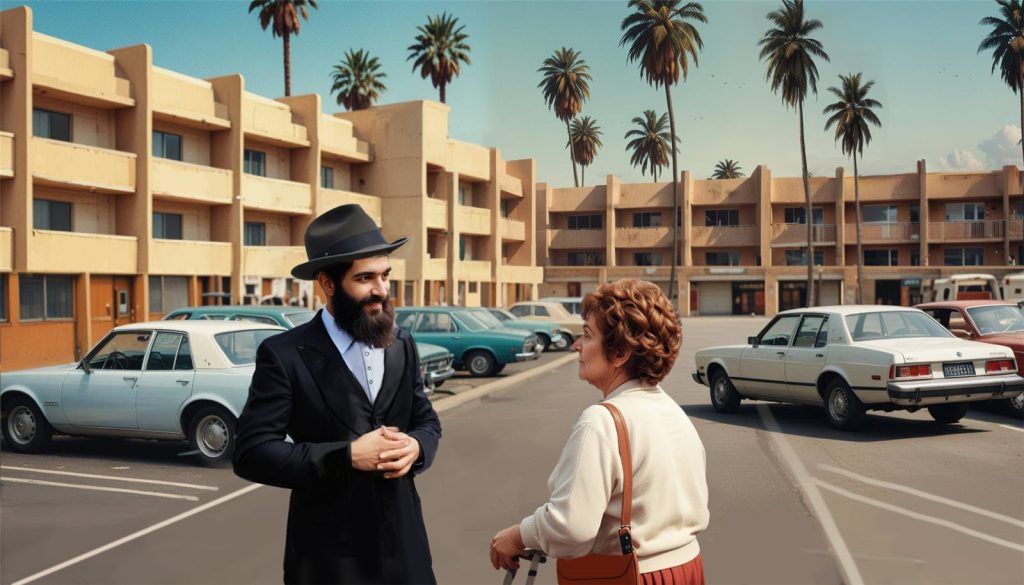
Rabbi Bryski was happy to let Gary lead the way, not wanting to get lost, and soon the entire group was making their way through a neighborhood of apartments towards the water. As they passed by one apartment complex, Rabbi Bryski noticed an old woman with a walker. When the woman looked up and saw him, she started to cry.
“Wow! Good Yom Tov – and shana tova!” Rabbi Bryski said brightly to the woman. “Tell me, why are you crying?”
The woman told Rabbi Bryski that her name was Florence, and that she hadn’t been able to go to shul because she’d just had surgery on her legs.
“It’s the first Rosh Hashana of my life that I wasn’t in shul,” explained Florence tearfully.
Drawing on his training, Rabbi Bryski said all the things he knew he was supposed to say. He told Florence that Hashem would send her a refuah shleima, that she’d be walking on her own feet again soon, and that next year, with Hashem’s help, she’d be in shul again on Rosh Hashana. As he turned to leave, he waved goodbye at Florence as she wiped her tears into a smile.
As he led the group in Tashlich at the lake, Rabbi Bryski started wondering if he’d said the right thing, like an experienced rabbi would have done. After all, he knew he was a rookie. His swirling thoughts went something like this…
Rosh Hashana is obviously a very busy day for Hashem. People around the globe are blowing shofar and crowning Him as their king, but even with all of that, all over the world, what is Hashem paying attention to? One old woman in Westlake, California, who is crying right now, because she couldn’t be in shul on Rosh Hashana. Look at how perfectly Hashem arranged things, just to bring Florence a little hope and joy… He sent me right by her.
Gary Katzman’s shortcut to the lake really wasn’t any faster, but it took us through the parking lot of Florence’s apartment building. He made Florence to gather up her strength and go out for some fresh air, right when we were passing through. He had me stop and ask her why she was feeling so sad… and after hearing how her worries, I was able to offer Florence a few kind words. I was going to make her Yom Tov truly joyous by pulling a shofar out of my pocket and blowing shofar for her, but…
There was only one problem, realized Rabbi Bryski, his heart growing heavier by the moment.
He hadn’t taken a shofar with him.
You see, more than 70 years ago, the Lubavitcher Rebbe started a special project called the Shofar Campaign. Before Rosh Hashana in 1953, he asked people to go out and blow the shofar in places like hospitals, old age homes, and even prisons, so every Jewish person could hear it, even if they couldn’t go to shul. This idea was new at the time, and it helped bring Yiddishkeit wherever people were. The Rebbe wanted to make sure everyone got the chance to hear the shofar, and this became the start of many other Chabad mitzva projects.
Rabbi Bryski felt horrible, realizing no good, experienced shliach of the Lubavitcher Rebbe would go out on Rosh Hashana without a shofar in his hand – you just never know when you might come across a Jew who hadn’t been in shul that day!
So while Hashem had crafted the perfect plan to heal the pain in Florence’s heart, Rabbi Bryski realized that he’d failed to live up to his part. The rookie rabbi, in his own opinion, wasn’t doing very well at his new job – like a baseball player new on the field, he’d struck out with the bases loaded, and had disappointed everyone.
As Rabbi Bryski headed home from Tashlich with his shul-goers, he asked Gary to take him back through the apartment complex. But Florence wasn’t there, and no one he met in the parking lot knew a woman by that name, and none of them could remember a woman using a walker, either – which made sense, because Florence had only been using the walker for the past three days.
The more Rabbi Bryski thought about Florence, the worse he felt. It seemed he’d let Hashem down. He’d let the Rebbe down. And, of course, he had let Florence down.
He knew he had to fix it. He went home and tried to enjoy his Yom Tov seuda, but everything he ate tasted the same – like disappointment.
Afterwards, he spent hours preparing his speech for the second day of Yom Tov.
This speech was personal. It was all about how he’d failed Florence, and how the first thing he should have known, as a Chabad rabbi, was to carry his shofar with him everywhere on Rosh Hashana, so more people could complete the mitzva of hearing the shofar.
“Hashem set up the perfect opportunity, and Florence still didn’t hear the shofar because I didn’t do my job properly,” Rabbi Bryski told the people in his shul. “But I want to right that wrong today. I am asking anyone who’s available to join me today. I’m going on a mission to find Florence. Mark my words, she will hear the shofar on Rosh Hashana.”
When shul was over, Rabbi Bryski and his volunteers went back to the same apartments and started knocking on doors, asking if anyone knew of an elderly woman who’d recently had leg surgery. After many disappointments, Rabbi Bryski finally found someone who pointed him towards a nearby apartment, and for the first time in 24 hours, our rookie rabbi felt a little hope.
There was a mezuza on the door. He was so excited; completely confident that he’d finally found Florence and could blow shofar for her.
Knock knock knock…
The door opened, and he found himself facing an old man, who looked him up and down, from his black shoes to his beard and hat, stared into his eyes, and then closed the door in his face.
But Rabbi Bryski wasn’t willing to give up so easily, and he knocked again on the door.
The same man answered.
“Um, excuse me – I think you might have shut the door by accident?”
“Go away.”
“I need to ask you a question,” Rabbi Bryski said quickly, before he could slam the door again. “Did your wife have surgery a few days ago?”
“Yes,” replied the man. “Why do you want to know…?”
“I met her in the parking lot yesterday,” explained Rabbi Bryski. “And she was so upset that she’d missed synagogue that she was crying –”
“Get away from my door,” said the man in a low, angry voice.
“I just want to blow shofar for her,” said Rabbi Bryski. “I promise, I’ll leave right after – I’m not looking to bother anyone – please.”
But the man was having none of it, answering, “You’re standing on private property. Get away from my door, or I’m going to call the police. You’re not welcome here.”
As the door slammed a second time, Rabbi Bryski looked up at the sky and had a heart to heart with G-d.
“Hashem, are you that upset with me?” said Rabbi Bryski. “Are you really not going to let me fix this? I know I messed up yesterday, and I want to do the right thing, but this guy is ready to call the police and have me arrested – just because I want to blow a ram’s horn in his house!”
Feeling he had no other choice, Rabbi Bryski started walking away from Florence’s apartment, but as he approached the back patio, he heard a voice calling to him from behind him.
“Rabbi, is that you?” asked Florence.
Rabbi Bryski couldn’t see Florence from where he was, but it was clear she could see him, and he quickly explained what had happened.
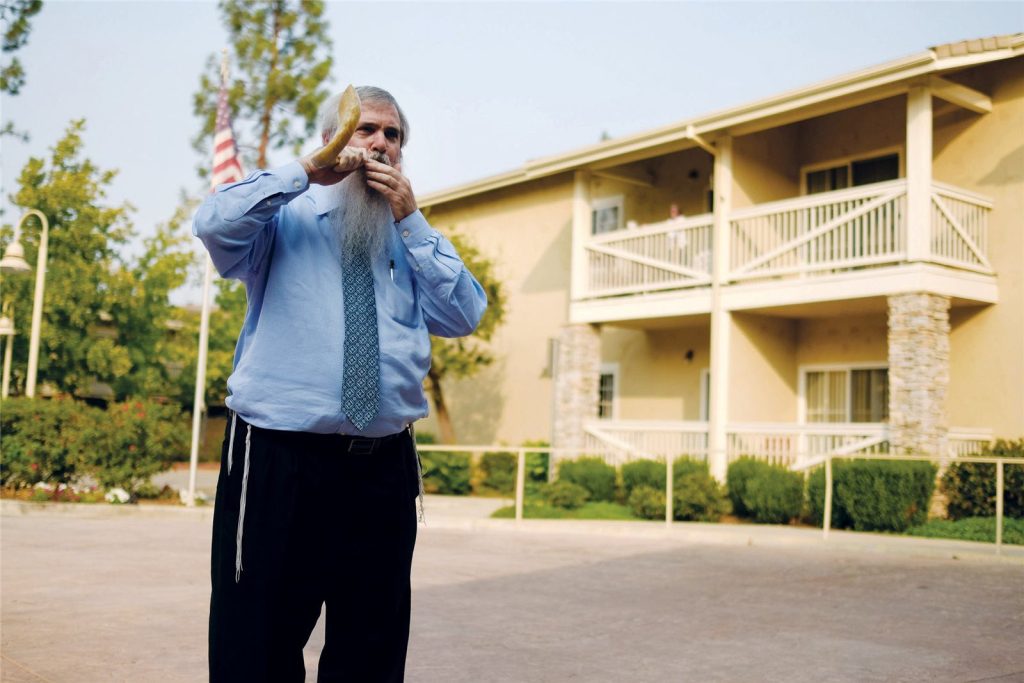
“I know G-d heard your prayers and that He arranged for us to meet yesterday,” Rabbi Bryski said. “I felt so bad that I forgot to bring my shofar, I couldn’t sleep last night – I had to come back. I’m here now, to blow the shofar for you.”
Florence quickly invited Rabbi Bryski in, but she explained that her husband was clearly very much against Yiddishkeit.
“Just ignore him,” said Florence. “I’ll tell him to open the door.”
Within seconds, Florence’s husband, Dave, was at the door with an angry look on his face. He let Rabbi Bryski in before racing into his bedroom and tightly shutting the door behind him.
Florence and Rabbi Bryski chatted for a few moments, and as the rookie rabbi pulled out his shofar, another thought flashed through his brain. If Florence hadn’t gone to shul or heard the shofar, had Dave…?
“Florence, did Dave go to the synagogue on Rosh Hashana…?” asked Rabbi Bryski.
“No… as you can see, he really doesn’t like Jewish stuff,” said Florence. “I didn’t go, so he didn’t go either.”
Realizing he had the opportunity for two people to fulfill the mitzva of hearing the shofar, Rabbi Bryski went over to Dave’s door.
Knock knock…!
Rabbi Bryski slowly opened the door, meeting face to face with a furious-looking Dave.
“Dave, what are you so angry about…?” asked Rabbi Bryski. “I’m not selling anything… or doing anything mean that should upset anyone, so… where is all this anger coming from?”
It took a moment before Dave was ready to share his story with the rookie rabbi, but slowly, it all came out. Dave explained that his son, Michael, had become more involved with Yiddishkeit recently, and now, he wouldn’t even eat in their home anymore.
“Michael should be sitting at the dinner table with us, eating what we’re eating,” said Dave, the fire in his voice covering the pain in his eyes.
“You know,” said Rabbi Bryski softly, “you could make this work. Everyone would have to give in a little, but if Michael kept a small microwave in your house, he could bring kosher meals with him and heat them up in the microwave. He might not be eating the same food as you, but you could still sit at the table together and be with one another. You give me his number, and I’ll happily call him, right after Rosh Hashana. Yiddishkeit should bring families together, not push them apart.”
He was quiet for a long moment, but Rabbi Bryski could see Dave’s anger starting to melt away. With a small, tired smile, Dave went out to the patio — but just as Rabbi Bryski was about to blow shofar for the second time, he was stopped yet again.
“Wait, Rabbi,” said Dave, patting his bare head. “I can’t hear shofar without a yarmulka on my head, right? Wait just one more second…”
Dave ran inside for a short minute, coming back out in a yarmulka, a much wider smile on his face. Rabbi Bryski picked up his shofar, but Dave stopped him again, this time explaining that his brother lived a mile away and that he hadn’t gone to the synagogue today, either.
“I’m sure he would want to hear the shofar, too,” said Dave. “I’m going to call him right now and ask him to come over.”
Rabbi Bryski froze for a split second, trying to figure out how to stop Dave from making the call.
Oh boy,- I don’t want him getting upset if I start setting a bunch of rules… Rabbi Bryski thought, nervously.
“Dave,” said Rabbi Bryski softly. “You know, on Rosh Hashana…”
“I’m not asking you to use the phone, Rabbi,” replied Dave. “In this house, we do use the phone on Rosh Hashana, and I’m going to call my brother. ”
Rabbi Bryski explained, as softly as he could manage, that he also couldn’t be the reason that Dave was making a phone call on Rosh Hashana.
“I have a great idea,” said Rabbi Bryski. “Give me your brother’s address, and as soon as I finish here, I’ll walk over to his house and blow the shofar for him too.”
“Better yet,” answered Dave. “I’ll walk with you to his house, and he can bring his whole family here to hear the shofar on Rosh Hashana.”
Rabbi Bryski couldn’t believe how everything had turned around. Not more than 15 minutes after Dave had been ready to have him arrested, they were walking together to make sure that his brother, his sister-in-law, and his nieces and nephews all had a chance to hear shofar together. To put it in baseball terms, the rookie rabbi had just hit a grand slam home run, winning the whole game for his team that afternoon.
That Rosh Hashana was the first of many times Rabbi Bryski visited Florence and Dave, and that was a turning point for them. Michael agreed to keep a kosher microwave in his parents’ house and had dinner with them every week. Rabbi Bryski stopped by Florence and Dave’s house every year on Rosh Hashana for the rest of their lives, blowing shofar not just for them, but for their friends too.
And the young rabbi learned an important lesson that he’d never forget, as he grew into a more experienced rabbi.
Every single Jew, deep down, wants to connect with Hashem – even those who seem upset or say they’re not interested in being Jewish. That anger isn’t who they really are – it’s usually because they’ve been hurt or disappointed in the past. It’s our job to help them make better memories to invite them to become a proud member of “Team Hashem,” the light of Torah and mitzvos making their life brighter. Let’s go, team!
Beis Moshiach #1477 • pp. 70-75
© 2026 Beis Moshiach Magazine. All rights reserved.
This article originally appeared in Beis Moshiach #1477. You are welcome to share it with friends and family by email or in print, provided that you do not change, add to or omit any part of it, you credit the author and Beis Moshiach, and you include a link to archive.bmoshiach.org (written out in full in printed copies).
To republish this article in a newspaper, magazine, book or website, please request permission in advance at [email protected].