Paintings With a Neshama
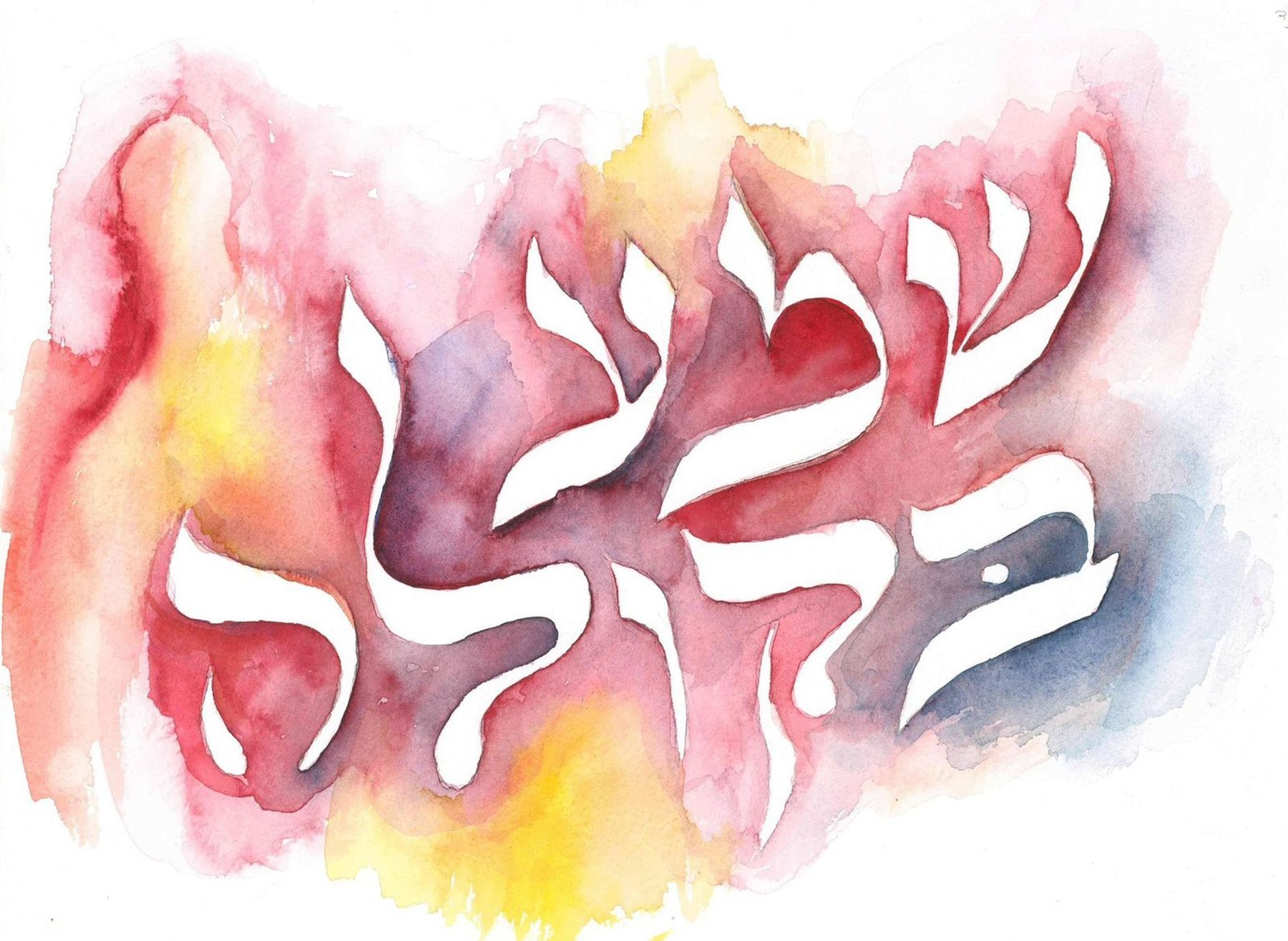
As I walked into Esther Rosen’s home, every painting on her wall captured my attention and touched my soul. Each piece was its own world. There were one-of-a-kind portraits of the Rebbe MH’M, a colorful painting of Hakhel in the Bais HaMikdash, and framed popular sayings written with lofty Hebrew letters. There was also a very delicately painted, glowing ‘portrait’ of Avrohom Avinu and Sarah Imeinu. Everything was breathtaking!
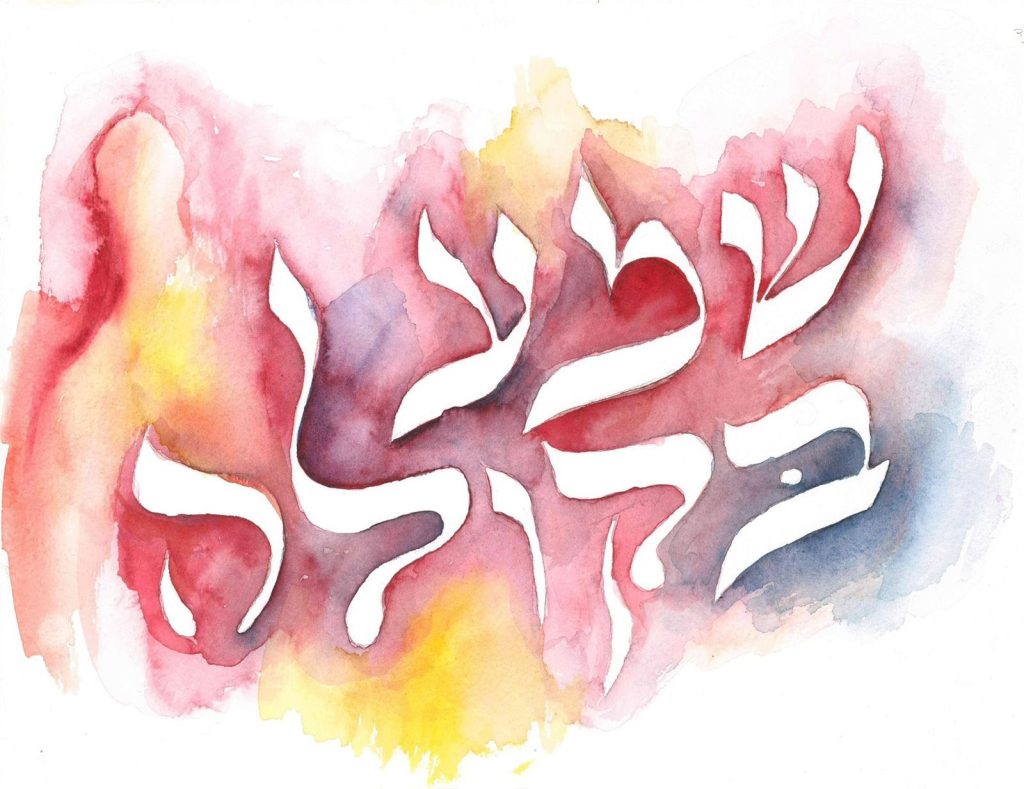
What especially affected me was Esther’s painting of the kiyor, the wash basin, by the entrance of her home. “Every Jewish home is a mikdash me’at, therefore every Jewish home needs a kiyor at the entrance! 🙂
“In all seriousness, there’s a beautiful sicha from the Rebbe about the kiyor: The Kohanim used the kiyor to wash off the filth and dust from outside before beginning their avoda in the Bais HaMikdash.
“A ‘kiyor’ is an absolute necessity in every Jewish home. It symbolizes the role of the Akeres Habayis to ensure, regarding herself, her husband, and her children, that nothing impure or not good comes into her home.” (The Crown Heights Women’s Circle 10th Anniversary Teshura p. 27)
Discovering the Fire of Chassidus
“I was born in Yerushalayim, then we moved to Maale Adumim,” Esther begins. “My mother grew up in Virginia and went to a small Jewish day school there, and my father grew up in Missouri and went to Epstein Hebrew Academy. As young adults, they both studied in Litvish learning programs in Eretz Yisrael.
“There was a Chassid who used to distribute sichos and leave them in the shuls. My father found them and learned them, and saw that he related to the Rebbe’s approach. My mother began to feel more connected to Lubavitch years later, after attending a Moshiach event in the Jacob Javits Center in Manhattan.
“I’m the oldest of four children. We moved back to the States, to Baltimore, when I entered second grade, and I went to Bais Yaakov. My first taste of learning Chassidus was in tenth grade. Rebbetzin Rivka Hurwitz ob’m, a devoted shlucha of the Rebbe, gathered a few of us girls together, told us Baal Shem Tov stories, and taught us Chassidus. Her fire and enthusiasm for Lubavitch and Chassidus was contagious.
“Bais Yaakov of Baltimore was a wonderful school that imparted foundational aspects of Yiddishkeit, middos tovos and yiras shomayim, but was missing the depth of Chassidus. Therefore, I transferred to the Lubavitch Girls High School in Chicago for the last two years of high school. I loved it! It was inclusive and not cliquey, taught Chassidus in a deep and relevant way, and had a very special, ruchniyusdik and happy atmosphere. After seminary, I returned to Chicago and ended up as the dorm counselor there for two years.
“Those were very good years, and I enjoyed working with the girls, who were full of life and energy. Over twenty years have passed and it’s a joy when we meet. It was a very special experience.”
Art from Keyboards Lacks the Soul
“Ever since I was a little girl, I’ve always loved drawing. One of my earliest memories is of taking three crayons, light blue, yellow and pink, and drawing a colorful picture. My father is very creative, has good, skilled hands, loves to build things, and is also talented in art. I loved looking at his sketchbook of drawings. He’d decorate our birthday cakes with happy and silly faces, carve out pesukim or names on wood, and once even built us a rocking horse! My mother appreciates art and hand-embroidered a picture of the Bais HaMikdash that was hung on our wall.
“When I was in tenth grade, I took a class in oil painting. That year, I was part of the group painting the scenery for our high school play. In those days, it was done from scratch, spreading out the canvas, planning it out, and sketching it. It was tremendous work, but we had lots of fun collaborating, and the results were rewarding. Now scenery is purchased ready-made, and it’s not the same.”
After a moment of contemplation, Esther continues, “This might sound a little floaty, but it seems that there is the ‘body’ of the art, the technical part of the art, with color and all of the necessary fine details, and it can be perfect. Then there is the ‘neshama’ of the art, the feeling you get when you look at it, the ‘life’ of the painting. Ideally, art has both a strong ‘body’ and a strong ‘neshama.’
“Sometimes the work is more on the technical aspect, and sometimes on allowing the ‘neshama’ to shine through. AI is an interesting tool. It often has a strong, technical part, creating a strong ‘body,’ but the results lack a certain ‘neshama.’
“Once a woman came to my home and was moved to tears when she saw a painting of the Bais HaMikdash that I’d been working on. It was eye-opening and encouraging to see how even an unfinished or imperfect picture, having a weak ‘body,’ can have such a powerful impact.”
Focusing on the Essence
“There is a letter from the Rebbe about the ability of an artist to look beyond the object and see its essence,” Esther says. “So, too, it’s worthwhile to make an effort not to get distracted by the chitzoniyus of life, and to focus on the pnimiyus.
“Our external circumstances and qualities are not what define ourselves or others. For example, status or the opposite, wealth or the opposite, intelligence or the opposite etc. When we make an effort to see past externals, whether they are intimidating or elicit feelings of sympathy, we get to know a more essential dimension of a person or a situation. The treasures within them become revealed.”
Strength “Locked” in a Box
After our interview, Esther sent me a fascinating clip from JEM in which the Rebbe discusses the concept of ‘strength locked in a box.’ It’s part of the story shared by Yossi Ben-Hanan, a former IDF officer. In this yechidus, the Rebbe emphasizes that strength must be utilized, not hidden or unused. The Rebbe says, “When strength is ‘sitting in a box,’ so carefully guarded that no one even knows it exists, then it defeats its entire purpose.”
In Esther’s words, “Everyone has talents and abilities; the ability to connect, or to teach, are talents. To me, it sounds like this clip is saying that it can weaken us if we don’t use the talents that Hashem has blessed us with, as we are not fulfilling the mission for which our neshama came here.”
She emphasizes, “Even if there are people who don’t appreciate what you do, there are also people out there who will connect with your particular style, whether it’s in art, writing, teaching or hosting… You’ll touch their soul and Iy’H they’ll think a little deeper than the surface.
“Isn’t that the idea of Geula? Revealing the inner dimension. The essence of everything is Hashem, the avoda is to look past the externalities of people and circumstances and to reveal Him from within.”
The Chassidishe Vibe #1478 • pp. 30-32
© 2026 Beis Moshiach Magazine. All rights reserved.
This article originally appeared in Beis Moshiach #1478. You are welcome to share it with friends and family by email or in print, provided that you do not change, add to or omit any part of it, you credit the author and Beis Moshiach, and you include a link to archive.bmoshiach.org (written out in full in printed copies).
To republish this article in a newspaper, magazine, book or website, please request permission in advance at [email protected].