The Soul’s Soundtrack: What Your Teen’s Music Does to Their Soul
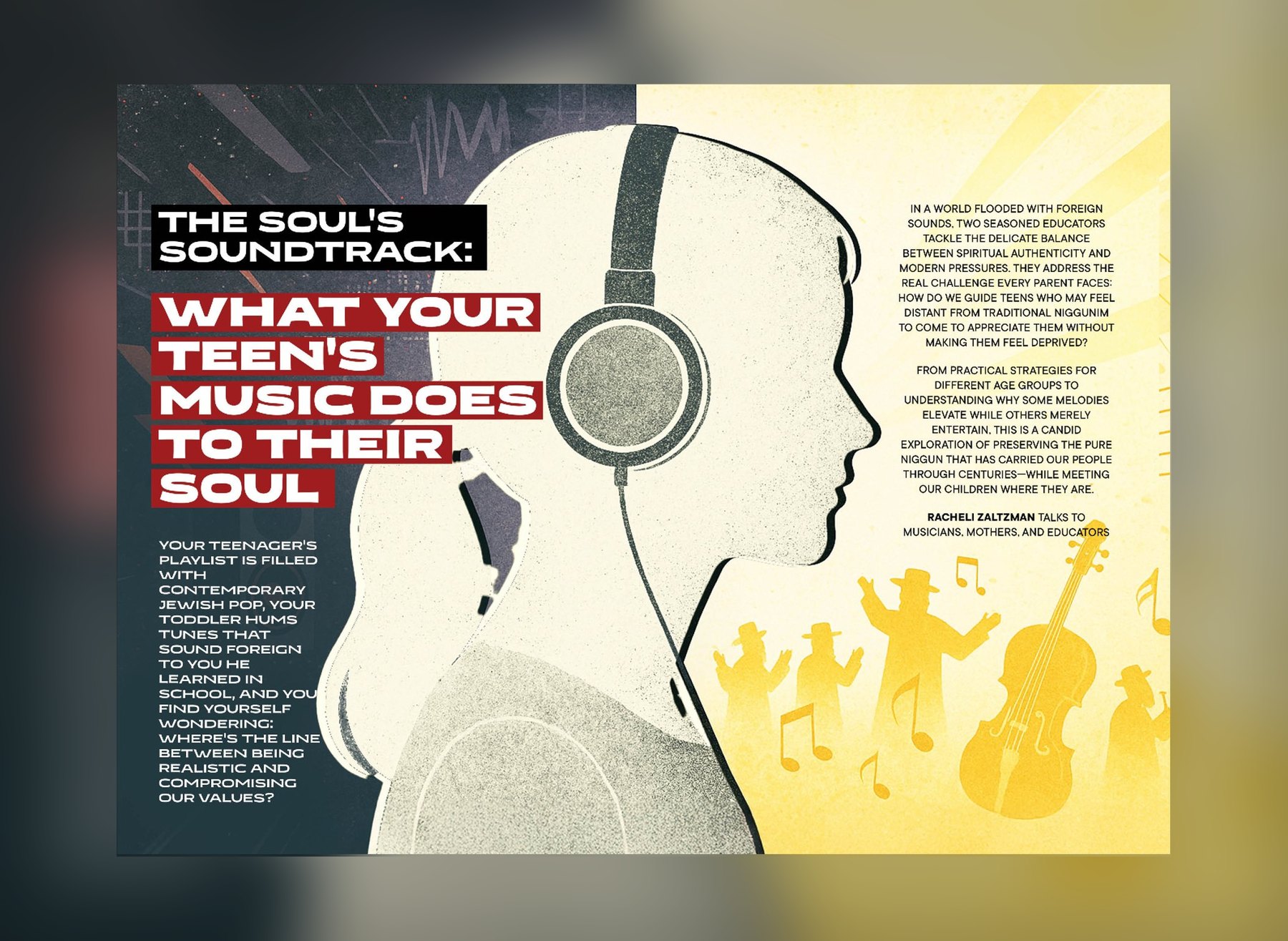
In a world flooded with foreign sounds, two seasoned educators tackle the delicate balance between spiritual authenticity and modern pressures. They address the real challenge every parent faces: How do we guide teens who may feel distant from traditional niggunim to come to appreciate them without making them feel deprived? From practical strategies for different age groups to understanding why some melodies elevate while others merely entertain, this is a candid exploration of preserving the pure niggun that has carried our people through centuries – while meeting our children where they are.
A trembling, wordless voice expresses a deep yearning. This is the Jewish melody — the Chabad soul melody, the quill of the soul, breaking through all the barriers of the heart.
Sometimes it is heard in a child’s room, late at night, when half the world is asleep, and a mother gently strokes the hair of her sleeping daughter, closes her eyes for a moment, and lets go of all the day’s worries — of yesterday and tomorrow. She may not always hum aloud; sometimes she only plays the tune in her heart. Sometimes with tears, and sometimes in silence — a silence that echoes louder than any clamor.
Jewish music was not born on a stage. It was born mainly on the journey — a long journey, in galus, between the walls of the Beis Medrash, in a rickety wagon, at a farbrengen of Chassidim, or when the heart overflowed in prayer. It was intertwined with avodas Hashem, connected to emuna, and accompanied our people even through the darkest times — in the concentration camps and on death marches. It is a slightly dusty music, full of hope, rooted in the songs of the Leviyim in the Beis HaMikdash, walking with us from generation to generation, as we fell and rose up.
The niggun was not written in ink, but in layers upon layers of memory — on Yomim Tovim, on Shabbosos around the table, when all the children join in singing a melody finely woven by a master. This is music that is not only heard — but felt. It does not come to impress, but to remind — remind us who we are, where we came from, and what light we can bring into the world.
For the Chassidic Jewish niggun is not just a pleasant collection of sounds. It is a neshama seeking to rise upward — and bring back some light to the here and now.
But new times have come, and the pure, clear niggun begins to be pushed aside in favor of foreign tunes that try to impress. We drift away from simplicity, from kavana, from a tear. The new songs, now heard in our communities, may be beautiful on the outside — but they are empty within, lacking content and heart. Holy songs and pure innocence have been replaced by modern Chassidic tunes in pop and jazz styles.
Where is the boundary? What is appropriate and worthy to hear — and what should we avoid like fire?
Let us embark on a fascinating journey into the world of song, a journey into the heart and soul, with educator Mrs. Devorah Leah Rothschild and violinist and mechaneches Mrs. Rivka M.
Only Chabad Niggunim
Rivka M. says:
“I think the niggun is a great gift that Hashem created. It adds a spiritual, emotional, and deeply meaningful dimension. I remember the Shabbos table from childhood as a family time rich with singing together.”
Devorah Leah adds:
“I grew up in a very Chassidishe home, and we were careful to listen only to Chabad niggunim. When I got married, it wasn’t common to play Chabad niggunim at weddings. We decided to combine Chabad niggunim and traditional wedding songs — of course, we didn’t include any songs of non-Jewish origin, which are completely inappropriate to listen to. The Rebbe Rayatz said such songs defile the soul and harm one’s yiras shomayim. Over time, the awareness of these niggunim grew, and by the time my sister got married, it was already a given that the wedding would include only Chabad niggunim.”
How do you think the awareness grew?
Devorah Leah:
“It all started with the production in ‘Beis Rivkah.’ At first, the songs were based on songs sung by Chassidic singers like Avraham Fried and Mordechai Ben David. After Gimmel Tammuz, in the 1995 production, it was unanimously decided to include only Chabad niggunim — and it became a tradition.
That’s how the girls started bringing these niggunim into their homes, and gradually families connected to the idea and incorporated the niggunim into their lives.”
(As a side note: I once brought home a niggun from a school event, and my father, Rabbi Chaim Levi Yitzchok Ginsberg a’h — who knew hundreds of Chabad niggunim — didn’t recognize it. Since then, we’ve sung it at every Shabbos meal — R.Z.)
How to Tell the Difference?
How can one distinguish between a song that is “beautiful but empty” and one that uplifts and awakens the neshama?
Rivka M. reflects and says:
“You need to pay attention to the effect the niggun has on the soul. When listening to a niggun mechuvan — especially one composed by a Rebbe and without words — the heart connects, the mind expands, and you can reach the deep insights intended by the composer. Before I go to my mashpia, I play and contemplate a niggun — and answers to essential questions about my shlichus at that time arise within me.
“The Rebbe says a niggun leads to teshuva and to asking, ‘Where am I?’ (‘Ayeka’). With this kind of inner reflection, deep insights are born that can then be translated into action.”
Devorah Leah adds:
“I once saw an interesting chart — I don’t know who made it — an upside-down pyramid. At the top is a niggun mechuvan by a Rebbe. Every part is significant The middle is for niggunim composed by Chassidim. At the bottom is what’s called a niggun shoteh (‘foolish tune’) — just composed by just anyone. Songs in this category should be listened to less.
Of course, the more yiras shomayim and ahavas Hashem the composer has, the better the niggun. And some songs don’t even belong on the pyramid — they come from a non-Jewish source, from the three impure kelipos, and cannot be ‘converted’.
One mashpia once said, you can tell if a niggun is a quality song by the dance it inspires. A niggun from a holy source — or at least composed with the intent to elevate and connect — will lead to an aidel dance with pure simcha as opposed to other songs.”
Foreign Sounds
Little by little, as generations decline, music becomes less about essence and more about outward show — and younger people often pursue this type of music. How should we deal with it?
Rivka M. responds in two words: “Personal example.” Then elaborates:
“Our shlichus is to make sure niggun is present in our homes, as much as possible. We’ll do everything in our power. Let’s get excited about a niggun, play it out loud, and listen to it ourselves. We should also remember, a composer puts himself into the music. Anyone who wants to be confused can listen to a niggun shoteh composed by a confused person. We don’t control our children’s free will, but we can give them a foundation, a girsa d’yankusa, and make sure to only listen to music that befits Chassidim. Our children learn more from our actions than from our words.”
Devorah Leah adds:
“Each of us needs to know, ‘aliba d’nafshei’ — where we are spiritually, and where we can realistically be. Don’t try to leap to a level you’re not ready for. If you’re used to listening to a certain style, it might be hard to change everything at once. But consider: What can you remove completely, or at least partially? What holy songs can you add to your playlist?
“To youth groups and schools that write lyrics to Chabad tunes, she says: ‘These songs help our daughters so much. The lyrics add meaning. I see how this uplifts and strengthens my own girls. Keep going — it’s a blessing.’”
What about religious [i.e. not Chassidic] or semi-religious singers, how should we treat these songs?
Devorah Leah answers:
“There’s a difference between public and private spaces. In public — schools, classes, events, weddings, bar mitzvas — we must draw very clear lines of what’s acceptable and what’s not. No compromising.
“But in the private space, things are more sensitive and complex. There are songs performed by religious singers that seek to uplift — maybe for some of our youth, who feel distant from niggunim, these are better than listening to secular songs.
“We should each find ways to spiritually elevate our environment by listening to and playing only niggunim and songs al taharas ha’kodesh.”
Rivka M. agrees:
“We need to see our children. Understand that they’re facing many challenges. Let’s talk to them about what songs inspire them, what they enjoy. Let’s show interest, listen, find something to learn from — whether it’s the lyrics, the composition, or the accompaniment. And give them lots of Chassidishe warmth and personal example — because that’s the most powerful influence.”
Niggun in Education
How can we help our children love Chassidishe niggunim and stick to the good, while avoiding the bad?
Rivka M.:
“Sing a niggun with them before bedtime, from a very young age. Give gifts that include niggunim, suited to their age. And on Shabbos, give plenty of time for niggunim: during the meals and during seder niggunim.
“Also, when reciting the bracha in Shemone Esrei, ‘Atah chonen l’adam daas’ (‘You graciously bestow knowledge upon man’), have the intention to receive the right understanding and wisdom to educate each child ‘according to his way’ — so that ‘even when he grows old, he will not turn away from it.’”
Devorah Leah concludes:
“The only way to instill love of niggun in children is by loving it ourselves. When we love it — the children will connect, too. It’s important to be particular about Chabad niggunim at home.
“Today there are very beautiful arrangements of niggunim — and boruch Hashem, we see that youth are connecting even to more authentic niggunim. When you raise them with this soundtrack — it becomes their childhood. It’s what they heard in the womb, it’s what they know, and it’s what they are drawn to.
With Hashem’s help, may we all be connected and deeply attached to the sources.”
My Niggun
Do you remember a specific niggun from your childhood that made a deep impact on you?
Devorah Leah:
“It’s impossible to describe the effect and holiness that a niggun has on the soul — the Rebbe writes this in the HaYom Yom. A niggun that is very dear to me from childhood, and deeply engraved in me, is ‘HaNeiros Halalu’ — a niggun composed by the Chassidim of the Rebbe Maharash.
“Due to his poor health, the Rebbe Maharash rarely came out to see the Chassidim. So when Chanuka came, the Chassidim knew this was a rare opportunity to see the Rebbe. They composed a niggun that was as long as possible, so they could look at the Rebbe for longer during the lighting ceremony.
“I had the zechus to be with the Rebbe during Chanuka several times — in the years 5748 and 5751. I clearly saw how the Rebbe was in the ‘upper worlds’ during that niggun. He leaned on the shtender — half toward the menorah and half toward the crowd. His face was flushed red, and he barely encouraged the singing during that niggun.
“We understood this was an ‘exalted moment,’ when the Rebbe was doing things that are entirely beyond our comprehension. We waited so long for those moments — and just for that, it was worth traveling to see the Rebbe, Melech HaMoshiach.
“I’ll add another story — about niggunim that moved me later in life, as a mother. My son Levi was born after many miracles — during both the pregnancy and the birth. He underwent an hour and a half of resuscitation, which succeeded beyond all expectations. From the moment he came out of it, he grew and developed with no trace of what had happened.
As a result, we traveled for his upsherin on Rosh Chodesh Shevat, to thank the Rebbe for the great miracles. Every year, a special niggun is sung during Nakdishach. That year, the niggun was one attributed to Reb Hillel of Paritch. It was a sublime, powerful moment.
It had been very difficult for me to travel to the Rebbe after Gimmel Tammuz — having merited to see the Rebbe in person before. Even though we gain strength by seeing the miracles, the intensity, and the Chassidim who believe the Rebbe is about to be revealed at any moment — it’s still not easy.
But when we reached the verse in Hallel — ‘Me’eis Hashem haysa zos, hi niflas b’eineinu’ (This is from Hashem; it is wondrous in our eyes) — I suddenly had a moment of clarity. I realized: this was from Hashem, and the Rebbe knew about the concealment that would occur. He had planned it. And it is ‘niflas b’eineinu’ — not only wondrous, but from the word peleh — a wonder, something we cannot understand.
And we must cling to that, and be strengthened. That is a moment I will remember forever.”
* * *
And within every niggun that seeks truth, there echoes a single prayer: That we merit to hear once again the singing of the Leviyim in the third Beis Ha’Mikdash — even today. Amen, kein yehi ratzon.
The Chassidishe Vibe #1478 • pp. 8-13
© 2026 Beis Moshiach Magazine. All rights reserved.
This article originally appeared in Beis Moshiach #1478. You are welcome to share it with friends and family by email or in print, provided that you do not change, add to or omit any part of it, you credit the author and Beis Moshiach, and you include a link to archive.bmoshiach.org (written out in full in printed copies).
To republish this article in a newspaper, magazine, book or website, please request permission in advance at [email protected].