The Taxi Driver Named Derbarmdiker

From the TzaddikStory.org collection
About sixty years ago, in the late 5710s (1950s or early 1960s), when the Bobover Rebbe, Rabbi Shlomo Halberstam, was still leading his community in Manhattan, a man named Leibel Stempel, originally from London but by then living in Israel, shared a remarkable story.
* * *
Every year for Sukkos, Leibel would travel to New York to spend the Yom Tov with the Bobover Rebbe. He was young and full of energy, and he made a personal resolution: he would never eat or drink outside of a sukka, no matter what. Even though halacha (Jewish law) says that in certain situations, someone traveling doesn’t have to eat in a sukka, Leibel pushed himself to keep the mitzva in every situation.
That meant when he traveled from Israel to America, he wouldn’t eat or drink for the entire trip unless he found a sukka. The flight from Tel Aviv to New York was more than eleven hours, and with all the time getting to and from the airport, it took over thirteen hours without food or water! He knew it wasn’t easy, but his love for the mitzva gave him strength.
In Israel’s Lod Airport, there was already a sukka set up for travelers. But when the plane landed in New York, things were different. Back then, there were no sukkas at the airport, and it wasn’t simple to find one in Manhattan either.
So before leaving Israel, Leibel had asked his daughter in America to order him a taxi. The plan was that as soon as he landed, he could rush straight to her home, where a beautiful kosher sukka was waiting, and finally eat.
But when he came out of the airport, something went wrong. The taxi never showed up. Another driver had gotten confused and ended up far away. Leibel, tired and weak, had to look for a new ride.
One taxi driver shook his head. “Manhattan? I am not going there!” Another waved him away. Frustrated, hungry, and still holding fast to his promise, Leibel whispered to himself, “What does a Yid do now? He davens. Kol ma de’avid Rachmana, l’tav avid—everything Hashem does is for the best.”
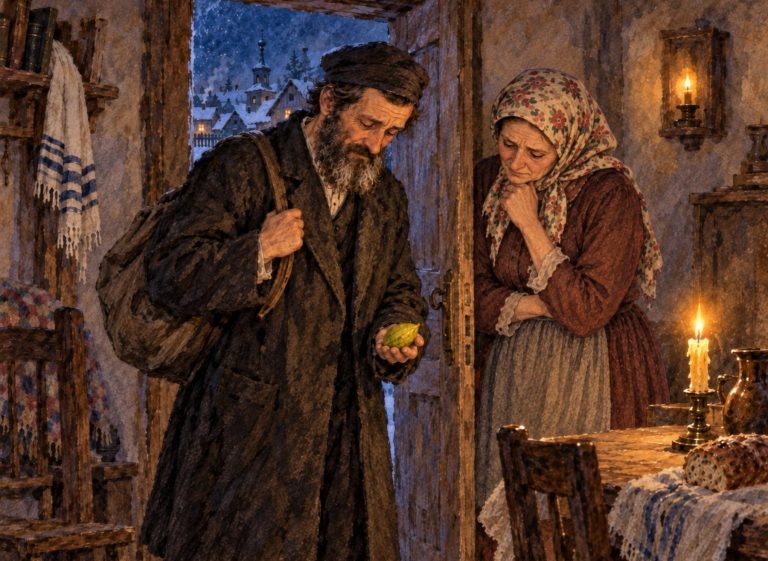
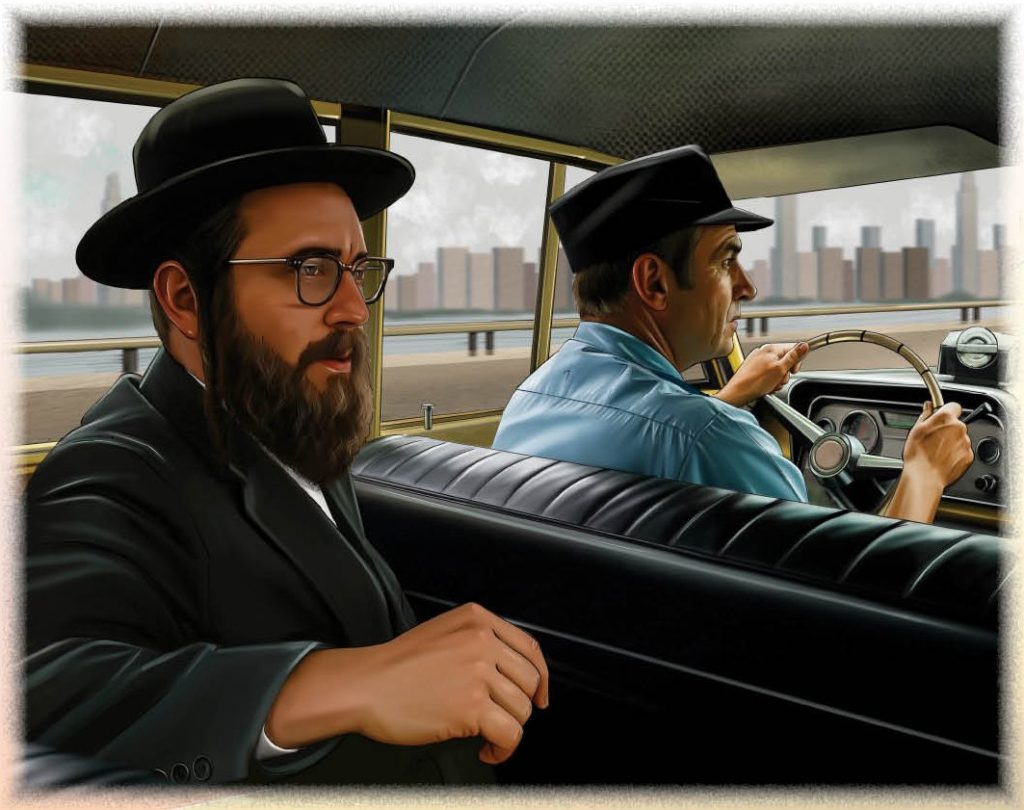
Just then, another cab screeched to a stop. The driver leaned out with a thick Russian accent. “You vant Manhattan? Get in, I take you.” Happily, Leibel climbed in. As the car pulled away, he glanced at the driver’s ID card on the dashboard. His eyes widened. The driver’s last name was written in big letters: Derbarmdiker—which in Yiddish means the Merciful One.
Leibel smiled. “Derbarmdiker… the Merciful One. Hashem Himself is showing me mercy.”
* * *
Inside the cab, Leibel leaned forward. “First of all, thank you for being maskim, for agreeing to take me. Tell me—are you Jewish?”
The driver looked at him through the mirror and chuckled in broken English, “You… you Jewish? Ha! Maybe I also Jewish, eh?”
Leibel tapped the ID tag. “Your name is Derbarmdiker. Do you know what that means? You must be a descendant of the Kedushas Levi, the holy Rebbe Levi Yitzchok of Berditchev!”
The driver’s eyes lit up. “Da, da… my grandfather, he told me, ve come from big rabbi. Holy man. But me? I am only taxi driver now.”
Leibel’s heart ached. “Such yichus! Such a holy family lineage, and here you are, driving a cab. Do you put on tefillin? Do you keep Yiddishkeit?”
The driver shook his head. “Nyet. Nothing. I grow up in communist Russia. No Torah, no mitzvas. Even bris—I never had.”
“You’re not in Russia anymore,” Leibel urged. “Here in America, you can make a bris milah!”
The man gripped the wheel tightly, his words thick with a Russian accent. “Eh… too old! Too much surgery, too much pain… I already have enough troubles. No childrens… no family… vat for I need more pain?”
Leibel’s voice grew stronger, almost like a rabbi giving a fiery drasha. “Listen to me. You are a descendant of kedoshim, of holy tzaddikim! How can it be that you don’t have a bris? You must do it. And I promise you—if you go through with a bris, b’ezras Hashem, you will be blessed with children!”
The driver’s lips trembled. “I… I cannot talk. Too much.” He turned up the radio to end the conversation. But Leibel leaned back, thinking, Now I understand. This is why Hashem made me miss all those taxis—so I would meet this man.
* * *
“I realized Hashem had sent me as a shliach to this driver. I asked him for his address and phone number, and he gave them to me. Baruch Hashem, I finally sat in my daughter’s sukkh, made the bracha of leishev ba’sukka, and broke my fast. But my mind was turning: how could I help this man go through with a bris milah?”
He decided to call Chabad. “Who else?” he laughed. “They know how to help Russian Jews, and they have experience with bris milahs for adults.” He connected the driver with a Lubavitch Chassid, who spoke to him gently.
* * *
“Reb Yid,” the Chabad Chassid said with a warm sing-song voice, swaying slightly as he spoke, “you are a descendant of the Kedushas Levi! Don’t you see? Hashem is calling you back.”
The driver frowned. “Eh… too hard. Too late for me.”
The Chassid leaned closer, his voice rising like in a farbrengen. “Too late? Never! A Yid is never too far, never too late. The Rebbe of Berditchev himself is pleading for you in Shamayim. You make a bris, you become whole, you draw down brachos!”
The Russian man shook his head. “But pain… I fear pain. And no family… vat for?”
The Chabad Chossid smiled warmly. “Reb Yid, trust in Hashem. You take one step, He carries you the rest of the way. Do the mitzva, and you will see yeshuos, salvations. You are not alone. We will be with you.”
Slowly, the man began taking steps in Yiddishkeit. The bris was the hardest—he resisted for a year—but at last, he agreed. A hospital was arranged, and at the end of Tishrei the following year, Leibel got a phone call: he was invited to be the sandek at the bris.
* * *
It was set for the 25th of Tishrei—exactly the yahrtzeit of the holy Berditchever. In a small Chabad shul, a few devoted Chassidim gathered quietly. There were no big crowds—just a handful of Yidden who knew the story. They whispered to one another: “Can you believe it? A descendant of the Kedushas Levi… finally making his bris!”
The Russian driver sat nervously, his hands shaking. A Chabad Chassid leaned over and whispered in his ear, “Reb Yid, today you become new. Today you carry the zechus of your holy grandfather.” The man’s eyes filled with tears. “Too much pain… but also, too much joy,”.
When the mohel finished, the room rang softly with “Mazel tov, mazel tov.” One of the Russian Chassidim smiled through tears, pulled out a small bottle, and whispered in his thick accent, “A l’chaim, yes? For courage, for joy.” Tiny cups of vodka were poured, and the men raised them high—“L’chaim! To new beginnings!” Leibel himself held the man, honored to be sandek, his heart pounding with awe. He thought, This is why Hashem sent me to the airport—so this neshama could come home. In that quiet moment, Leibel whispered a thank-you. “Ribbono Shel Olam, thank You for choosing me as a shliach. Thank You for letting me see how one mitzva can change a whole life.”
Not long after, the impossible happened. One evening the driver called Leibel on the phone, his voice thick with excitement and his Russian accent even stronger than usual. “Reb Leibel! My vife—she is expecting!” After all these years… finally!” Leibel grabbed his hands, tears in his eyes. “See? Hashem keeps His promises.”
Months later, the man and his wife were blessed with a baby boy. At the bris, the father proudly whispered in his Russian accent, “Ve call him Levi Yitzchok Derbarmdiker, after his great-great-grandfather, the Kedushas Levi himself.”
“All of it,” Leibel said, his voice breaking with emotion, “came from one small thing—I refused to eat outside a sukka. And from that small decision, Hashem built an entire chain of miracles: a bris on the yahrtzeit of the Kedushas Levi, a Jewish child born after years of waiting, and a family’s return to Torah. Never think one mitzva is small—it can change the world.”
Based on the true story recorded in האמנתי ואברכה (p. 355), retold here with added dialogue and detail.
Salute #1478 • pp. 4-7
© 2026 Beis Moshiach Magazine. All rights reserved.
This article originally appeared in Beis Moshiach #1478. You are welcome to share it with friends and family by email or in print, provided that you do not change, add to or omit any part of it, you credit the author and Beis Moshiach, and you include a link to archive.bmoshiach.org (written out in full in printed copies).
To republish this article in a newspaper, magazine, book or website, please request permission in advance at [email protected].