The Revolutionary
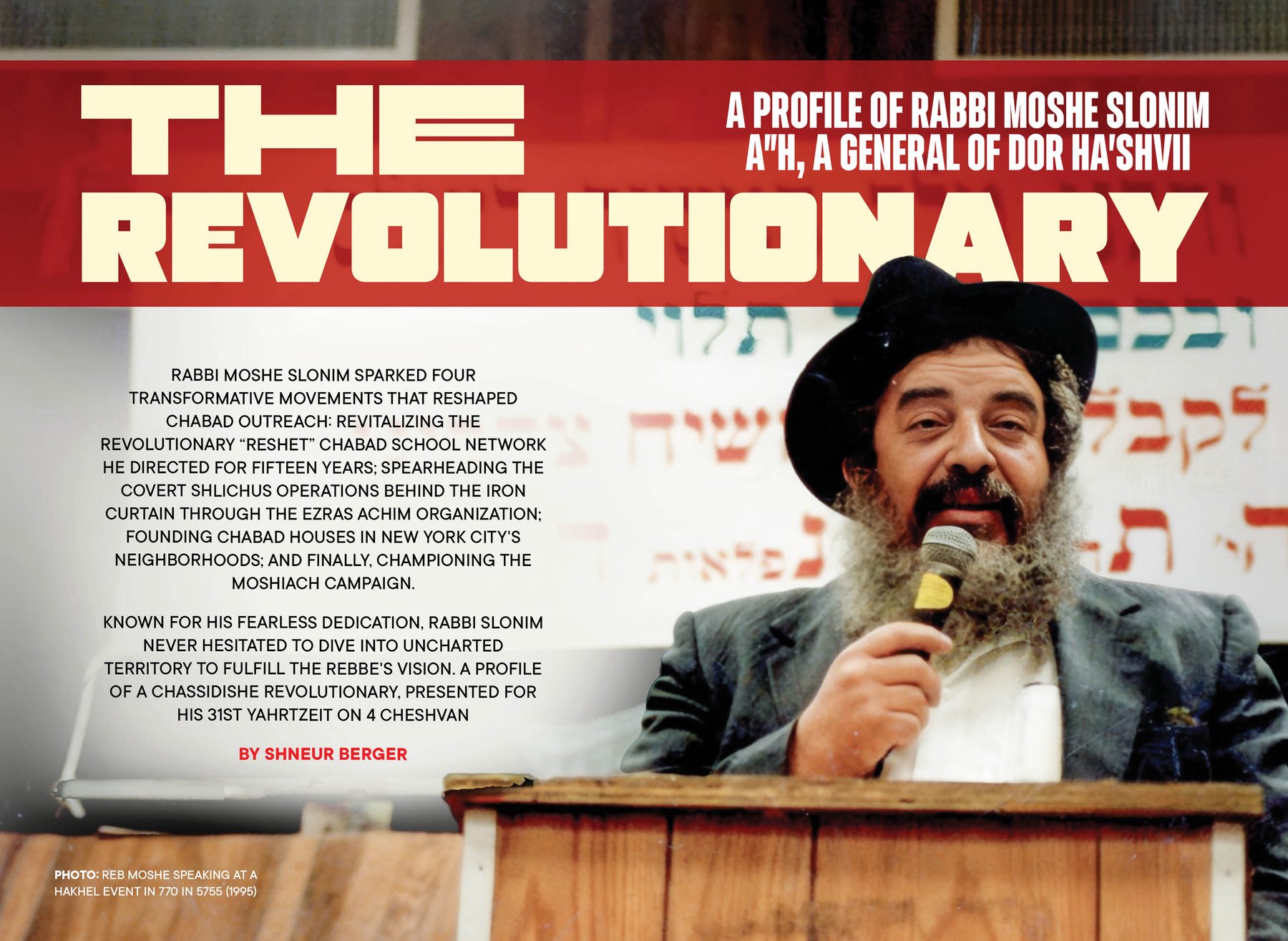
Rabbi Moshe Slonim sparked four transformative movements that reshaped Chabad outreach: revitalizing the revolutionary “Reshet” Chabad school network he directed for fifteen years; spearheading the covert shlichus operations behind the Iron Curtain through the Ezras Achim organization; founding Chabad Houses in New York City’s neighborhoods; and finally, championing the Moshiach campaign. Known for his fearless dedication, Rabbi Slonim never hesitated to dive into uncharted territory to fulfill the Rebbe’s vision. A profile of a Chassidishe revolutionary, presented for his 31st yahrtzeit on 4 Cheshvan.
You could meet Rabbi Moshe Slonim a’h in one of the schools he ran, or in 770, and perhaps in the office from which he ran the “Ezras Achim” organization in the crumbling Union of Soviet Socialist Republics. His suit was faded, his hat which had seen better days slouched on his forehead. The impression dissipated immediately when you entered into conversation with him; then you would discover a sharp Chassid, learned, ‘polished’ and knowledgeable – and above all: a Chassid completely devoted to the Rebbe with all his might and soul.
Nearly thirty years have passed since his petira, and still his mark is felt in so many areas of Chabad activity in Eretz Yisrael and worldwide, while the younger generation is not even aware of this. The initiatives and projects he initiated and ran – sometimes with mesirus nefesh – continue to operate to this very day. You can see them every morning in one of the dozens of schools of “Reshet Oholei Yosef Yitzchok” throughout the country. You will find them in of one of thousands of Chassidic baalei teshuva found in each of the cities of the former Soviet Union, not to mention the “Moshiach revolution” that has not left the agenda to this day, which he ran, innovated and intensified with the determination of a stubborn soldier.
Indeed, R’ Moshe Slonim was a symbol and concrete example of a true soldier of the Rebbe, being truly mekushar to the Rebbe. He dedicated dozens of years for the Rebbe, from morning until night. He knew no rest in everything related to the senior positions he undertook in running the mosdos and activities in Eretz Yisrael or in the Soviet Union. Alongside being a trailblazer and visionary initiator, one could meet him on city streets doing mivtzaim like an ordinary Chassid.
For some time now I have been working to research the chronicles of his life and work, at the request of his son, the shliach, Rabbi Chaim Slonim. Alongside memories of his friends and family members, I was handed treasures from his archive filled with documentation of endless activity which he managed with Chassidic simplicity. I merited to dive into memories, testimonies, documents and reports as well as letters and responses he received from the Rebbe over the years. Thus I was exposed to hidden personal aspects from letters he wrote to the Rebbe, alongside developments and challenges in the mosdos.
Over time I became acquainted with a Chassid who had nothing in his world except the desire to fulfill the Rebbe’s ratzon and bring him nachas ruach. This was the essence of the Chassidic worldview of R’ Moshe – who ended up becoming a true revolutionary in service of the Rebbe.
Yerushalmi jesters would ask: Are there more uphills or more downhills in Yerushalayim? The answer is simple, of course: every uphill is also a downhill, and vice versa. R’ Moshe Slonim, a Yerushalmi by birth, experienced countless descents in his life, but every descent was also a real ascent. Not for naught, when he experienced the greatest descent in his public service work, he merited to receive countless encouragements from the Rebbe, when the Rebbe clarified that there is no comparison between his work and the work of other Chabad organizations…
Born for Action
R’ Moshe was born into a life of action and activity in service of the Rebbe.
His father, Rabbi Ezriel Zelig Slonim, was among the distinguished Chabad askanim in Eretz Yisrael, active with all his might for our Rebbeim. In this home he grew up and was educated with an ideal – to do as much as possible in Lubavitch inyanim, in order to fulfill the instructions of our Rebbeim.
At all times and in all places, R’ Moshe demanded from all around him to mobilize for the realization of the Rebbe’s ratzon. For dozens of years in his life he engaged in the pure education of Jewish children, and dedicated all his strength and energy to expanding the Chabad educational institutions. When R’ Moshe “went to work” on someone, he would not let go until that person was fully mobilized to the cause.
Parallel to his work in the Reshet, he engaged with chayus and on a regular basis in the Rebbe’s mivtzaim, and especially in the last horaos that came from the Rebbe at any given time. He set times for Torah study, and on many Shabbosos he davened at length, and also participated in farbrengens and was among the leading speakers who demanded that we dedicate ourselves to the Rebbe’s inyanim.
R’ Moshe was a true polymath. He never ‘made do’ with his lot; he did not agree to limit himself to just one vista. In his vibrant and revolutionary energy, he took part in every inyan of spreading the wellsprings and carrying out the Rebbe’s directives in every field. Not only did he take part in them, but he also spurred, activated, established and initiated countless projects.
Among other things, he engaged greatly in activities to bring Jews closer through the “Evenings with Chabad” project in kibbutzim and moshavim, organizing seminars on Judaism, “Mivtza Mezuza” and more. Many shluchim and Chassidim owe him their kiruv to Yiddishkeit and even their going out on shlichus. Many baalei teshuva became frum and interested in Chassidus as a result of Friday night meals in his home, where he always hosted many guests who came to imbibe the atmosphere of a Chassidishe Shabbos.
Legacy to the ‘Reshet’
The main work of R’ Moshe was within the educational network established by the Rebbe – “Oholei Yosef Yitzchok.”
At the beginning of 1972, he undertook to manage the Reshet, under chairman Rabbi Dovid Chanzin. R’ Moshe, who worked intensively for the success of the Reshet even before his official appointment, knew well that in this position he would not make money to support his family. The great challenge was to maintain a long list of schools and kindergartens, when some of them were not budgeted by the Ministry of Education. Large sums needed to be raised in order to continue maintaining the educational frameworks that provided chinuch al taharas ha’kodesh.
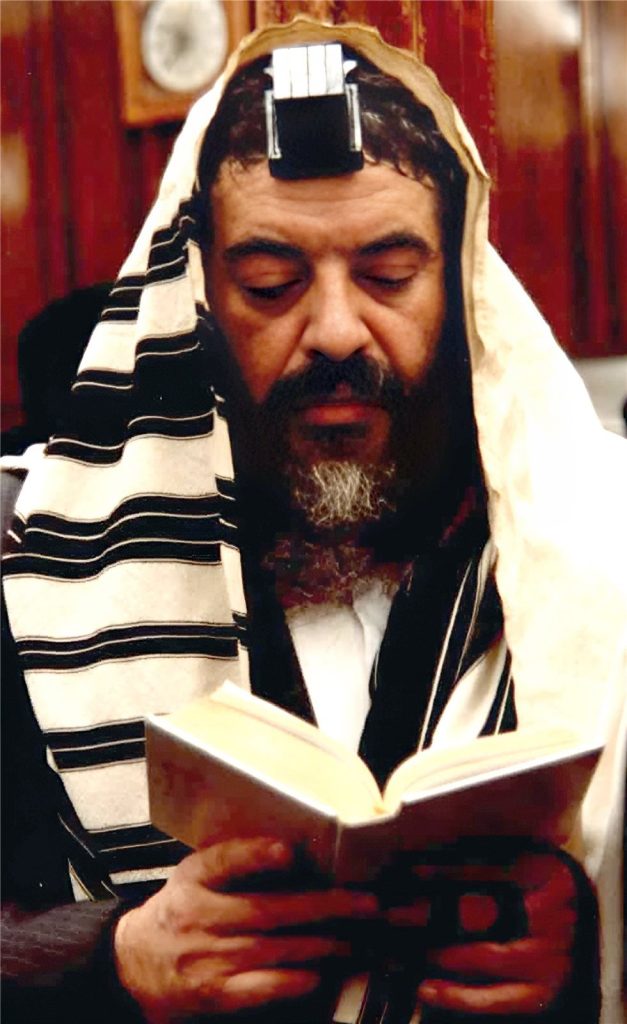
The following case is characteristic: In the period when he was appointed as menahel, he received his father’s inheritance. His father, who passed away in Tishrei 5732, who as mentioned was a devoted askan to our Rabbeim, left nothing for himself; the yerusha thus amounted to the apartment he left behind in Shikun Chabad in Yerushalayim.
R’ Moshe understood that the needs of the Reshet came before his own personal benefit from the inheritance. He hurried to sell the apartment and transferred the money to the Reshet – part for covering debts and deficits, and part for establishing a fund for additional Torah hours in the schools.
However, the money pit is never filled, and when the financial situation worsened, he decided to travel to the United States and raise funds there. He paid for the plane ticket from his own money.
When his wife asked him why he needed to pay for the ticket, since he was going on behalf of the Reshet, R’ Moshe smiled and said: “After all, I want to see the Rebbe, isn’t it proper for me to pay for the travel expenses myself for this purpose?…”
Such was R’ Moshe – in his extensive activity, there were no personal ‘angles.’
Together with his complete dedication that consumed his days and nights, he had fixed times and in-depth shiurim in Nigleh and Chassidus, and he did not give up on them. One of the Reshet employees who used to travel with R’ Moshe many hours every day said: “R’ Moshe, being loaded with countless tasks, was equipped with a small voice recorder, and every time he remembered things he needed to do, he would record himself. Later, when he was in the office or at home, he would carry out the tasks according to the recordings. More than once I heard him recording into the tape: ‘To study maamar such-and-such where there is apparently a certain difficulty,’ and things like that…”
Thus he combined public activism together with the study of Chassidus and delving into it deeply.
Commander and Soldier
Despite his official work being menahel of the Reshet and being preoccupied with avodas ha’kodesh in the field of education, he did not limit himself when it came to being involved in additional areas that were important to the Rebbe. He took care to establish a considerable number of “Tzach” branches – later called by the familiar name “Chabad Houses” and sent young couples there to operate the branch. More than once he brought young couples to a city or to small yishuvim to open a Chabad House there, while he personally took care of their salary for a full year!
Despite holding an important and senior position in the Rebbe’s army, he felt like a simple soldier of the Rebbe. Thus he found himself standing at a tefillin stand on a city street, putting tefillin on people, or working with individuals and persuading them to add in Torah and mitzvos.
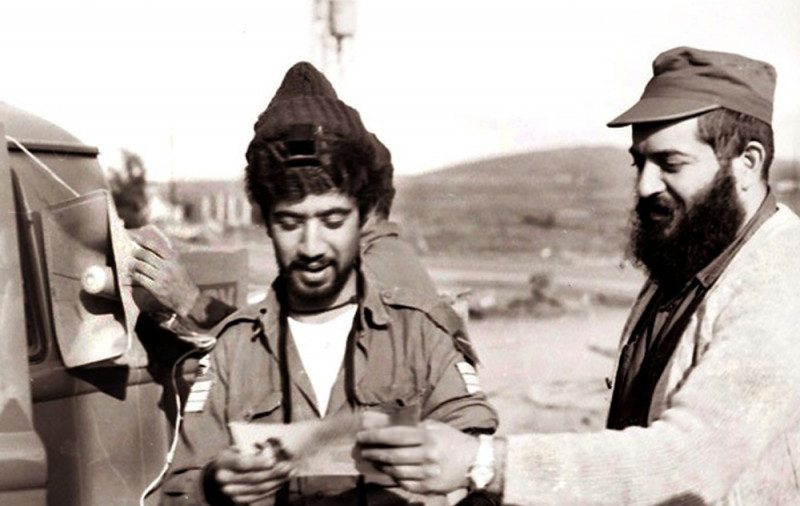
“At noon I went out on mivtzaim to Rishon Letziyon,” he wrote in one of his letters to the Rebbe. “[The mashpia] Rabbi Zev Kesselman who travels with me regularly, joined; my son Chaim, my wife and the neighbors Mrs. Lifshitz and Bracha Tevardovitz. We distributed candles, spoke about Neshek and registered 22 children for the Sefer Torah.”
In another letter he tells: “On Simchas Torah night we went to Assaf HaRofeh hospital [about half an hour walk from Kfar Chabad], we took out the Sefer Torah from the shul and went through the departments from one patient to another, and all kissed the Torah.”
And here is another letter testifying to his personal work:
“In light of the instruction to increase the spreading of the wellsprings outward, I took upon myself as follows bli neder until after Chanuka:
With my body [i.e. physically]: to travel at least four times in the evening for home visits – [signing up children in the] Sefer Torah. To work on publishing a booklet on the topic of ‘Rebbe’ in my free time. To participate in Chabad evenings that we will organize in schools.
With my money: to send to my brothers-in-law and their sons-in-law [who were not Chabad Chassidim] Teshuvos u’Biurim and other sefarim of the Rebbe. To make sheva brachos for… and bring him closer to Torah and mitzvos.
With my neshama: to prepare in the inyan of hafatza, to really sense this and do it from time to time with consistency.”
And here is a rare personal letter testifying to his work behind the scenes, from which one can learn how much R’ Moshe cared about every Chassid, and every action in the Rebbe’s work:
“I learned yesterday that Zimroni Tzik [has financial difficulties and therefore] decided to close the yeshiva [for baalei teshuva]. I traveled with Rabbi Zusha Wilyamowsky to him and we tried to encourage him. We spoke with him and it became clear that the debt situation oppresses him greatly, and wrecked his energy.
“We don’t have many more young men like him, and he excels in that he gave himself completely to the inyanim of the Rebbe and engages in this with all his might, and was a pioneer in several matters like establishing a Chabad House, establishing a yeshiva for baalei teshuva and more. And therefore, by all accounts he needs to reach expansion in material things, literally after the years of suffering he went through… I request from the Rebbe that he say to his troubles ‘enough!’ and he will be able to work his work from within expansion, joy and gladness of heart.
“We advised him that as far as the yeshiva he should do according to the instruction he had, and turn to the administration of yeshivas Tomchei Tmimim; and even though in the past they did not help him, it is possible that now they will want to help, and even if it will be decided to close the yeshiva ch’v, this will be by them or with their knowledge.”
Writing to the Rebbe Regularly
It is easy to understand how much his feeling of hiskashrus to the Rebbe was absorbed in his bones. He did not have a moment without action in service of the Rebbe. When he was successful, he continued with full energy, but even when he saw before him mountains of obstacles, complex challenges and fortified walls, he did not retreat. With typical Chassidic stubbornness he advanced without fear.
From the letters preserved in his archive it appears that he decided to write to the Rebbe everything, every step he took, every deliberation and every future plan. Copies of many letters he sent remained in his archive and reveal multi-faceted activity for the Reshet, for the mivtzaim and ‘chutza’ activity, and in many other fields.
One of the letters he sent to the Rebbe was written on the 1st of Nissan 5741, which he began with a short introduction:
“To C’K Admor shlita … I have a feeling that there is no satisfaction with me since I am not receiving any response to all that I have written until now. In connection with this I consulted with Rabbi Zusha Wilyamowsky and Rabbi Zalman Abelsky. Rabbi Zusha suggested to me to renew writing letters regularly to the Rebbe, and according to his suggestion I am beginning bli neder to write frequently, for now during the coming month and then we will see…”
Those who walked alongside him with advice and action were the Chassidim Rabbi Zusha the Partisan and Rabbi Mendel Futerfas. He did all this along with the personal avoda he dedicated to studying Chassidus, inside and by heart. He also invested greatly in his avodas ha’middos, doing everything with Ahavas Yisrael and joy – not a simple challenge in a complex and complicated administrative position…
“He is Literally the Only One”
Over the years R’ Moshe literally was moser nefesh, and did great and mighty things for the development of the Reshet and its secure grounding. As mentioned, he had to raise funds to fill “budgetary holes,” but he was not always successful.
Fifteen years of administration brought him down, and due to a complex financial entanglement that was great even for him, he was forced to leave Eretz Yisarel and his official position as menahel [due to Israel’s harsh debtor laws held over from the British Mandate]. Not everyone viewed this favorably, but he had no choice.
R’ Moshe was shattered at that time, and his state of mind was affected accordingly. In a letter to the Rebbe he described his gloomy state of mind. The Rebbe’s response to him highlights his great activity in Eretz Yisrael, and speaks for itself:
“…Were it not for him being literally the only one, what would have happened to the Reshet r’l,- what happened to the hundreds of Chabad shuls that were in Tel Aviv and Yerushalayim, to Colel Chabad, to Agudas Chassidei Chabad in the Holy Land, etc. And Anshei Chabad and their rabbanim at their head in the Holy Land have not yet come to the conclusion that perhaps it would only be natural for them to give a sigh about this.”
This was a rare, sharp and complimentary response all in one. If not for R’ Moshe and his work, the Reshet would have closed like hundreds of other Chabad shuls in Yerushalayim and Tel Aviv that were abandoned over the years and passed to “foreign hands…”
How apropos were the words he himself wrote to his father Rabbi Ezriel Zelig Slonim after the passing of his mother the Rebbetzin, when he showered comfort on his father; the words are so heartwarming:
“We Chassidim believe with complete faith in the role of the Jewish man on earth, good and happy days of the Jew – meaning: full days, utilized for good purposes and completing the Supreme Intention in the descent of the neshama into the body…”
The Shlichus Revolution in the Soviet Union
But even when he was forced to leave Eretz Yisrael and arrived in the United States, broken in spirit and soul – his soul and the flame of hiskashrus in him continued to burn. There is no place or time to break down; one must continue and dedicate oneself to the work of Jewish education.
First he worked as a menahel in a Talmud Torah in Morristown, New Jersey. Later he served as a mashpia in the yeshiva on Ocean Parkway. As was his way, he soon found additional fields to engage in, besides his official work. He engaged in establishing Chabad Houses in New York, publishing articles on topics pertaining to the Rebbe and hiskashrus.
Above all hovered an inner sense and true aspiration to go on shlichus. His spirit was not at rest.
In 1989 the communist government in the Soviet Union began a series of far-reaching reforms. The oppression against Jews and against Judaism gradually eased. Then, with the Rebbe’s blessing and encouragement, R’ Moshe mobilized and joined forces with the Ezras Achim organization. This organization had already been operating for many years on behalf of Soviet Jews. When the government began to crumble, R’ Moshe and the people of Ezras Achim began a second revolution – the revolution of Judaism in the former Soviet Union. Even before the communist government fell, R’ Moshe organized the sending of shluchim couples to the large and central cities in the Soviet Union.
Like every trailblazer, here too his path was not strewn with roses. The governmental-political-economic situation in the Soviet Union was extremely unclear, and no one knew what tomorrow would bring. Today everyone knows and is used to the enormous shlichus enterprise throughout the former Soviet Union, but in those days, the decision to send a young Chassid with children to the Soviet Union, when concerns about the communist government still remained, was most daring; there were even those who claimed it was dangerous. At the same time, many problems were also created due to the Soviet Union being a primitive country that did not have kosher food products.
The solution found at the beginning of the process was to send young couples after their wedding, or even with a small baby, when there were as yet no chinuch problems. Alternatively, older shluchim were sent whose children had all married, most of whom spoke Russian. Over time tmimim were also sent to open points of Jewish life in various cities.
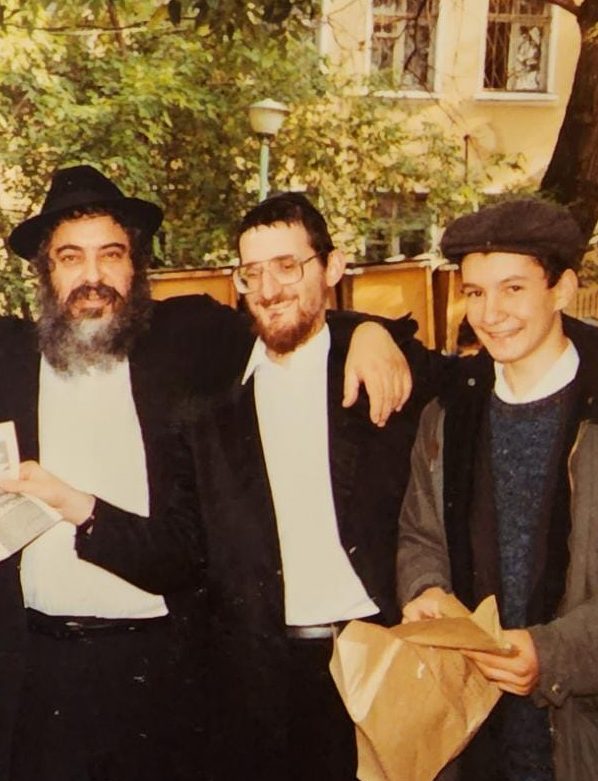
At the same time, enormous containers were sent to them containing tons of kosher food, which was a complex and complicated project in those days when Russia was ruled by gangs of criminals.
R’ Moshe and together with him the members and employees of Ezras Achim, did everything to establish from zero the shlichus empire in those countries. Only in the coming years did the philanthropist Levi Leviev show up and continue the shlichus enterprise that was established with much toil and blood.
This enormous enterprise is greatly credited to the revolutionary R’ Moshe Slonim.
Into the Fire of Moshiach
The third revolution that R’ Moshe choreographed was the Moshiach revolution.
Like in everything, revolutionaries are those who break the walls, open the paths and pave roads so that those coming after them will enjoy an easy and smooth path.
With the Moshiach revolution too, R’ Moshe was among the first who jumped into the deep waters, and led the charge of ‘telling it like it is’ without compromise in the pure faith of Geula and the Rebbe as Moshiach.
Despite being sharp-minded, his faith was simple and innocent. He did not let intellect replace the faith that pulsed in him. R’ Moshe harnessed himself with all 248 limbs and 365 sinews – especially since the call of “do all that is in your power” – to lead the Geula revolution. He instilled a spirit of emuna and bitachon in the Chassidim, and served as a light to illuminate the way especially for the youth, the tmimim, in hiskashrus to the Rebbe and in spreading the message of Geula.
With his blessed talents he began writing articles, and speaking everywhere about pure faith. With sharp analytical ability he conveyed the Rebbe’s message in a way that would be accepted by the listener. He even published many articles in Beis Moshiach in its early years. In these articles he would offer chizuk, hisorerus, another point of discussion, all of which infused the reader with greater clarity and the inner strength to navigate the momentary darkness with complete faith in the words of the Rebbe.
His entire being became one great flame of publicizing Moshiach and the identity of the goel.
R’ Moshe Slonim is on the “honor roll” of the leading Chassidim in the ‘seventh generation,’ those who dedicated their lives to the Rebbe’s inyanim, without leaving themselves even a modicum of personal space. The essence of his life was hiskashrus and devotion to the Rebbe.
On 23 Marcheshvan 5756, at the beginning of the Kinus HaShluchim in New York, he suddenly had a heart attack in the middle of a meal with his family members, and returned his soul to his Maker.
R’ Moshe merited that all the shluchim from all corners of the world walked after the aron of the Chassidic revolutionary of the ‘seventh generation.’
(From a book to be published soon about Rabbi Moshe Slonim a’h, edited by the writer of these lines and published by his son Rabbi Chaim Slonim, the Rebbe’s shliach in Dijon, France.)
Anyone who has information or photos about him is invited to email: [email protected]
LETTER FROM THE BABA SALI
When the Sefer Torah for Jewish Children campaign began, Reb Moshe mobilized fully for this campaign on top of all of his other responsibilities. On every trip for the Reshet, he made sure to work intensively for registration to buy a letter in the Sefer Torah.
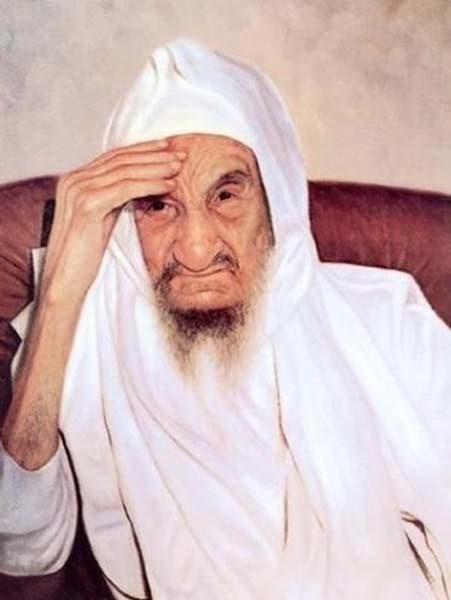
He once traveled With Reb Zushe Wilyamowsky to Netivot to meet with Chabad Chassidim in Netivot and Brosh in connection with the local school there. The two of them took the opportunity to see Rabbi Yisrael Abuchatzeira zt’l, known as the Baba Sali, and upon their request he wrote a letter requesting to register children for a letter in the Sefer Torah. Reb Moshe quickly reported about this to the Rebbe.
B’H
10 Iyar 5741
C’K Admor shlita,
This week, R’ Zushe Wilyamowsky and I went to Netivot and there we met Anash of Netivot and Brosh, and R’ Yaakov Minsky [menahel of the school in Brosh] also came. We spoke about saving [the school in] Brosh.
… On this occasion we received a nice letter from Rabbi Abuchatzeira…”
***
This is the letter that Baba Sali wrote on the stationery of his mosdos in Netivot, which made waves.
BSD
8 Iyar 5741
To all our Jewish brethren
wherever they may be
Hashem be upon them, yichyu
Shalom u’veracha!
We are all waiting and anticipating the Geula shleima that it come immediately through Moshiach Tzidkeinu and for this purpose we need to be unified and unify all Am Yisrael.
C’K Admor shlita of Lubavitch has turned in recent days to unifying all Jewish children by writing a special Sefer Torah for Jewish children who are the Tzivos Hashem.
It is a great zechus for every single Jewish child to buy a letter in this Sefer Torah and for parents to do everything so that their children buy and merit a letter in the Sefer Torah.
My personal blessing is sent to every boy and girl who registers for the Sefer Torah of Tzivos Hashem.
Surely we will all immediately merit the coming of Melech HaMoshiach, who will come and redeem us and lead us upright to our holy land.
Signed by one who anticipates the imminent redemption
Admor Yisrael Abuchatzeira shlita
Beis Moshiach #1480 • pp. 20-29
© 2026 Beis Moshiach Magazine. All rights reserved.
This article originally appeared in Beis Moshiach #1480. You are welcome to share it with friends and family by email or in print, provided that you do not change, add to or omit any part of it, you credit the author and Beis Moshiach, and you include a link to archive.bmoshiach.org (written out in full in printed copies).
To republish this article in a newspaper, magazine, book or website, please request permission in advance at [email protected].