The Wall of Silence Came Tumbling Down
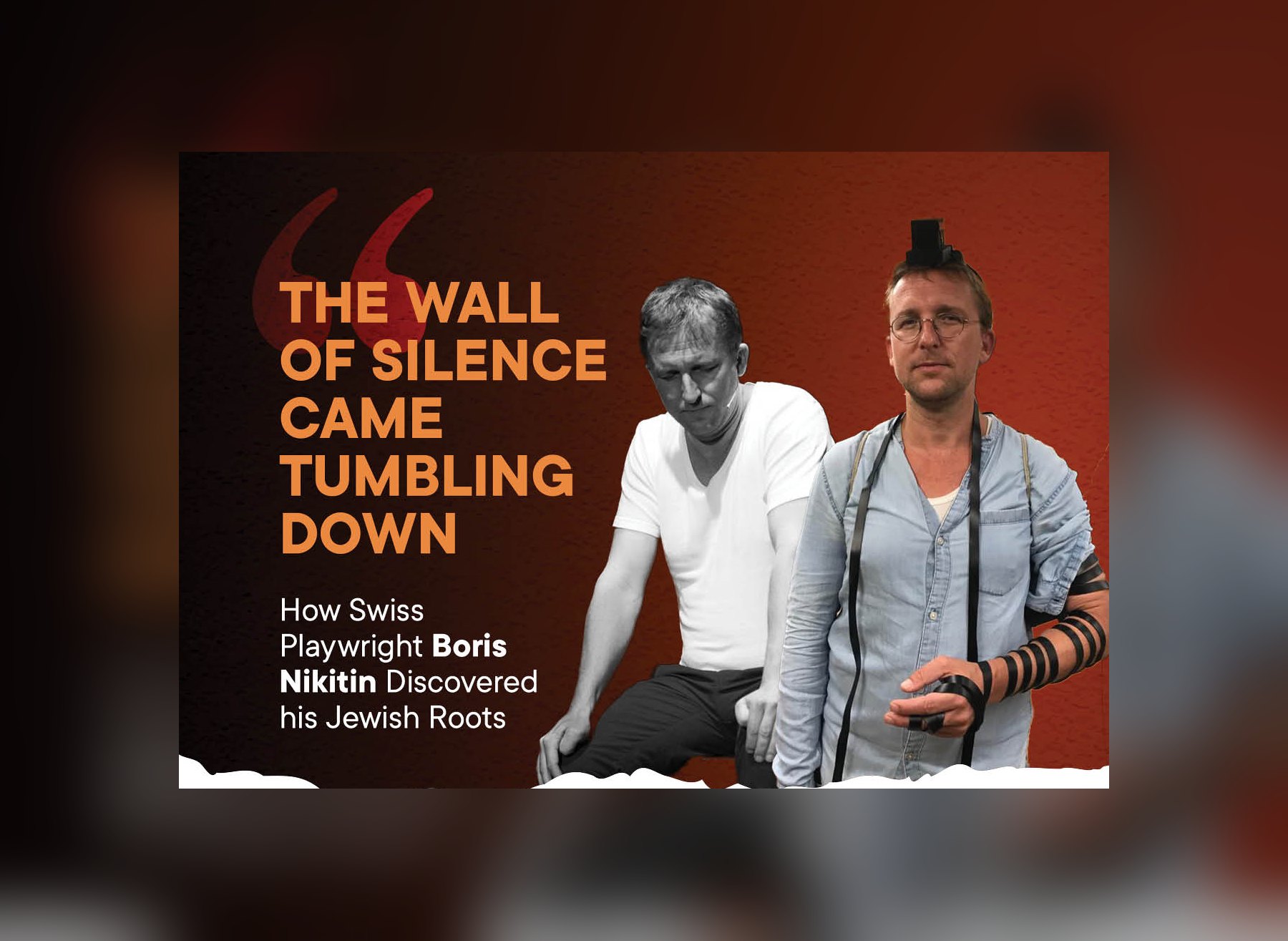
On a Friday morning, just before Rosh Hashana two years ago, Boris Nikitin came to Crown Heights for the first time, at the suggestion of his cousin in San Francisco. After absorbing the kedusha of Beis Chayeinu, Boris stood outside, observing everything that was happening. Mendel Raices, a yungerman from Crown Heights (whose parents are Shluchim in Charkov, Ukraine) noticed him, and asked him if he was Jewish and wanted to put on tefillin. After some explanation, it became clear that he was referring to an act that Boris had just performed several minutes ago with another caring Chassid.“Having learned that this was Boris’s first time putting on Teffilin, I wished him a hearty Mazal Tov, explaining to him that this was his Bar Mitzva” says Mendel.
Boris, who Mendel discovered to be a knowledgeable and discerning fellow, was a bit confused. “Isn’t a Torah scroll used at a Bar Mitzva?” he asked. “I confirmed that he was indeed right and suggested that Boris have his first aliya to the Torah on the following Monday, as the day we met wasn’t a yom ha’kriah.”
“We exchanged phone numbers,” Mendel shares, “and he came back early on Monday morning in order to properly prepare, and I told him how to do the aliya and to say the brachos. It worked out very well, and the aliya was a very special moment for him, and for me too. I thank Hashem for giving me the opportunity to connect a Yid to the Torah.”
This was Boris’s last day in New York before returning home to Switzerland. Mendel walked with him to Kehos, the local seforim store, in the hope that Boris would find Jewish reading material in German. It was hashgacha pratis that Kehos had just received an edition of Sichos of the Rebbe in German, and Boris was the first one to purchase it! When Melech HaMoshiach calls out for a Jew to come to Beis Chayeinu, the “matches” intended to ignite his soul are all ready beforehand.
Mendel is keeping in touch with Boris, helping him to learn and grow in his Yiddishkeit. Boris happily agreed to share his story in a long-distance interview with Beis Moshiach’s editor Levi Liberow. I watched this video, which is best described as “mindblowing.” This article is Boris’s firsthand account of discovering his Jewish identity, after a century of silence and secrets.
“Magda Toffler or an Essay on Silence”
Boris is a playwright, and his most recent production is a documentary about his maternal grandmother, Magda Toffler ob”m. It’s a unique play. The staging is reduced to just a few elements: a chair, a manuscript and Nikitin himself. Its simplicity and silent strength are its very secret of success. “Magda Toffler or an essay on silence” premiered in October 2022 and was invited to the “Impulse” festival as one of the ten outstanding independent theater works of 2022. The play’s description is this:
October 1943: Heinrich Himmler gathers all the Gauleiters of the Reich in the Polish city of Poznan to inform them of the regime’s decision to completely exterminate the Jewish population of Europe. Before he does so, however, Himmler has two phonographs set up in front of everyone in order to record the speech on two guard records. However, contrary to what most people assume, it is not Himmler’s words that are to be recorded, but the silence in the hall.
Silence was the theme of Magda’s life. She had lived her entire life without a religious identity. “But it’s also about myself,” Boris says as he opens the interview. “Firstly, I’d like to explain that theatre is different than cinema, which is more like entertainment. But in the theatre the actors are sharing the same time and space with the audience, and therefore much more must be invested into the production in order to have depth. The playwright gives a certain ‘shape’ to his inner world, he can’t just let everything out. There has to be a certain balance so that the audience can take it in, and benefit. A playwright authoring his personal story becomes very vulnerable. But, despite this fragility, it’s much more exciting for him, and for his audience too.”
Silence and Secrets
Boris speaks of his background, which is an interesting mixture, “My father, who passed away six years ago, was half French and half Ukranian. My mother was born in Bratislava, which is in Slovakia. I live in Switzerland, where I was born and grew up.
“We often visited my mother’s parents, Paul and Magda Toffler, at their home in Czechoslovakia, in the summer and on holidays. As far as I knew, they were Christians. After my grandfather passed away, when I was fifteen, I got even closer with my grandmother. She was an eloquent woman, a professor in chemistry, who spoke six languages. Even though she always liked to talk, there was one topic that she never discussed – the war, and the period of her life immediately afterwards. The only thing that she ever revealed to me was that her father had been arrested by the SS in 1944 when he was caught supplying medicine to the partisans. He was taken away to Buchenwald and died in a death march shortly before the end of the war.”
Redefining Myself
Since he was a child, Boris was always writing his thoughts down in notebooks. He is wistful as he reminisces about his family, and describes the sights and scenes of his childhood, without any idea of the truths buried underneath the facade.
“In the summer of 2009, while in the middle of rehearsing a play that I wrote, my mother called to tell me that my grandmother passed away. I was aware that her health had deteriorated. I’d been spending a lot of time with her in the rehabilitation center where she lived in the last years of her life, trying to ease her pain.
“One day, several weeks later, my mother called to tell me that she received a letter from Magda Korach, my grandmother’s cousin, who was ninety-four, and lived in Israel. I had no idea who she was, but my mother did, because they had exchanged a few letters with each other in the past, when my mother tried to find out about family background, about which she still had no clue. The letter, which was most probably written in my grandmother’s native tongue, was as follows:
“On the death of your mother, I wish to offer my condolences.
“I very much regret that we have had no contact since we exchanged letters four years ago. You wanted to know more about your family at the time. I told you then that both of your grandparents came from a Jewish family before becoming Christians. It is very sad that Magda suppressed her roots, which is the only way to explain why she avoided contact with her family. Was she perhaps ashamed?
“As you know, according to Jewish tradition, religious affiliation goes through the mother. And so, I can answer your question from back then again: Your grandmother was Jewish, your mother was Jewish, and so you and your children are Jewish as well. I didn’t really want to write to you at first, but it’s important that you don’t forget this.”
Boris pauses, and breaks into a smile as he says, “And that makes us Jews!
“Until then my identity was half Czechoslovakian, a quarter French and a quarter Ukrainian, and I’d stutter whenever I tried to define myself. But now I was redefined as a Jew! My first reaction was to laugh. This discovery did not add to my confusion, but was a great relief, because I finally understood why I’d been so confused all these years. After our family secret was out in the open, I had new hope for my future. Now everything would fall into place.”
Discovering the Whole Truth
“One year after my grandmother passed away I came to Israel. I was meeting new people, seeing the sights, and writing down all of my thoughts in a notebook. I met Magda in her small apartment in Ramat Hasharon, together with her daughter Ruth, who gave me a warm welcome. She also made sure that her mother wouldn’t get overly anxious during the visit.
“Magda had never been close to my grandmother, other than writing to her a few times in order to find out the details of what happened to my grandmother’s father, and how she had survived the war. She said that her contact with me was triggering all kinds of memories, and that she was afraid, because I was the descendant of the one who had betrayed her father. It turned out that, after initially agreeing to meet with me, Magda had changed her mind and sent me another letter telling me not to come. But I never received that letter! It was returned, and when Magda showed it to me, I saw that there were two small mistakes in the address.” Boris pauses, adding, “The journey of that letter must have been manipulated by a higher power.
“Magda told me that her father was one of ten children, living in a small town in Czechoslovakia, and their family name was Toffler, which I knew was my grandmother’s maiden name. In 1916 my great grandfather, her father’s brother, and grandmother converted to Christianity. But when the Nazis yemach shemam rose to power they were redefined as Jews. Magda was referring to the Nuremberg Race Laws, enacted in 1935. How ironic it is that my documentary on my grandmother’s lifelong identity crisis premiered in Nuremberg!
“According to Magda, on the evening before her father was deported, he had begged my great grandfather to ‘pull some strings’ and save him, but he made some excuse. The next day her entire family was sent to their death in the camps. Magda survived, as well as two of her sisters.
“Perhaps my great grandfather could have done something to prevent the deportation, but who can know for sure? He was fearing for his own life, which the Nazis brutally ended. My grandmother had only told me half the truth, her father died as a Jew.
“I began coming to Israel on a regular basis, and, from the very beginning, my newfound Jewish relatives embraced me warmly. All of a sudden I had a big Jewish family! I’ve gotten very close with some of them. We organize family reunions of the ‘Toffler clan,’ which is about fifty people. The religious cousin in San Fransisco who suggested I visit 770, is one of the members of our clan,” Boris points out. “Had Magda not breached the wall of silence, I would not have known any of them! She was blessed with a long life, and passed away, seven years ago, at the age of 102!”
A Lifetime of Hiding
Towards the end of the interview Boris says, “In my documentary I can only speculate why my grandmother kept her Jewish ancestry a secret. I feel very sorry for her that she had to do that. Her parents had converted to Christianity before she was born, were redefined as Jews by the Nazis, branded with a number, and persecuted. After the war my grandmother lived in Czecheslovkia, a communist country that forbade any public manifestation of Judaism. The Jews hid their religious identity. If you can’t celebrate your religion with others, it degenerates. This is one way that Jews suddenly ‘disappear.’ Victims can also be collaborators, because their silence is what keeps the anti-Semitism going.
“In her youth my grandmother witnessed how an entire society, friends, neighbors, and other people close to her, suddenly opened its doors to the violence and bloodshed that destroyed everyone’s lives. She had to hide in a barn for months, fearing for her life. It seems that part of her remained a refugee, never coming out of hiding.
“While writing this text I became more aware of how mistrustful my grandmother must have been, as well as all of those who conceal their true identity from others, even from their own family. For them, reality is not an ally, but a threat, in whatever guise it may appear. They are always afraid.” Boris pauses, and adds, “It’s interesting, but I do remember my grandmother telling me that she’d really like to take a trip to Israel, but she never did. I still recall the tone of her voice when she told me how much she regretted it.”
As the interview concludes, Boris shares his views on anti-Semitism. “Many of the greatest, most accomplished, people are Jewish. I think that anti-Semitism has a lot to do with envy. When people get annoyed with each other, their first reaction is to ask, ‘What makes you think that you’re so special?’ Envy is one of the deepest insecurities that people have, and people cannot cope with this, other than turning against each other. I believe that by giving people platforms in which there is open dialogue it will build a bridge of mutual understanding between them. The goal is not to convince each other who is right and who is wrong, but only to listen. As someone in the arts, it enables me to investigate all kinds of things that arouse my curiosity, and the exposure makes me more tolerant of others.”
Transforming Vulnerability into Ability
At the end of the interview, Levi asked Boris how he identifies himself today, by his nationality, or as a Jew. His emotions escalate as he responds, “Nationalities are a concept that came later on, but the Jewish people are rooted in ancient history. It’s a privilege, and a gift that was given to me, to be a part of them.
“Throughout history, Jews were always persecuted as the scapegoats. But running away from Judaism, like my grandmother did, is to live the life of a coward. I would never want to live such an unlivable life, it’s not worth it! What others think of us is not in our control! It’s time to free ourselves, to speak up, and to transform our vulnerability into ability.
“Don’t abandon Judaism – embrace it!”
Beis Moshiach #1433 • pp. 30-33
© 2026 Beis Moshiach Magazine. All rights reserved.
This article originally appeared in Beis Moshiach #1433. You are welcome to share it with friends and family by email or in print, provided that you do not change, add to or omit any part of it, you credit the author and Beis Moshiach, and you include a link to archive.bmoshiach.org (written out in full in printed copies).
To republish this article in a newspaper, magazine, book or website, please request permission in advance at [email protected].