S.A.D. But Not Alone
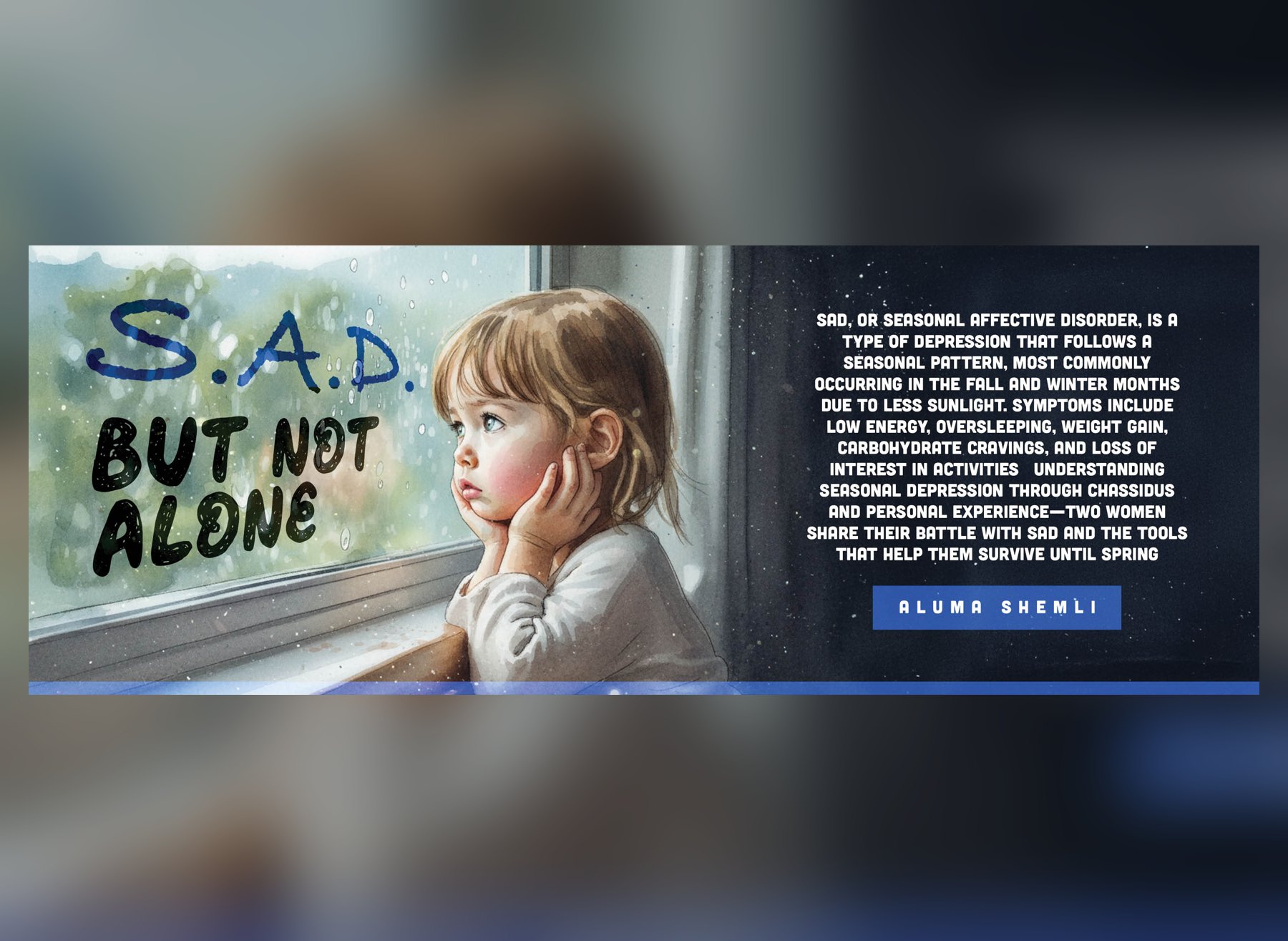
SAD, or Seasonal Affective Disorder, is a type of depression that follows a seasonal pattern, most commonly occurring in the fall and winter months due to less sunlight. Symptoms include low energy, oversleeping, weight gain, carbohydrate cravings, and loss of interest in activities. Understanding seasonal depression through Chassidus and personal experience – two women share their battle with SAD and the tools that help them survive until spring.
“Here come the days when I wish I had velvety fur,” says Leah, “so I could curl up into myself and sleep for hours on a pile of laundry fresh from the dryer, or on the windowsill just before the last ray of sunshine disappears. But, fortunately for me, I’m a woman who even on the darkest and coldest day needs to get out of bed, get dressed, shower, prepare food, eat the food I prepared, do dishes, go to work or school… Who has the energy for all this? Especially when I have to do all this when it’s cold and rainy and windy outside.
“I’m certainly not alone in this feeling. Winter causes many people, even those ‘winter people’ who always prefer a bit of cold over the heat of summer, to feel some sort of sadness. That feeling can also be pleasant, a kind of comforting melancholy. When I drive in winter and see the ground green and flowering, and the skies gray and full of clouds, something in my heart expands, breathes and calms down. But alongside this, there’s also dejection, a decrease in energy and motivation to do things. And sometimes, it’s really winter depression,” Leah concludes her monologue.
And again winter arrives, kindergartens are decorated with pictures of colorful umbrellas and cute children dancing between raindrops or snowflakes. Winter clothes and winter accessories fill the stores and beckon from display windows – gloves and hats of all kinds and even heaters, radiators and electric blankets. All so we won’t be cold and can receive the blessing of rain and snow with joy and warmth.
But within all the joyful and colorful atmosphere hides a not-at-all-pleasant phenomenon – winter depression. For some, and this phenomenon is far more common among women than among men, the moving prayer for rain on Shemini Atzeres and the transition to winter don’t evoke excitement but rather the opposite – dejection and depression.
Sarah, a mother of ten cute children, and Nechama, who has already married off most of her children, share with us some of the very unpleasant feelings of those whom winter brings down.
Winter time brings night upon us early (Shabbos at four o’clock…), and we ask in prayer “and grant dew and rain for blessing” and boruch Hashem, it has rained already. What does winter evoke in you?
Sarah: What does winter say to me? Darkness.
First of all, technically. I barely return from work, serve lunch to the children, put my head down for half an hour and wake up when it’s already night, regardless of the light and darkness outside, since the lights in the house are sometimes on until one in the morning. Winter makes it dark for me, really.
Something is heavy in me, doesn’t move. I feel like a baby being dressed in two pairs of pants, two sweaters and a coat over everything. He can’t manage to move, bring his hands together or roll over. Completely wrapped up. That’s me. The house is warm, and I walk around in one comfortable layer, but my head thinks slowly or doesn’t think at all. Not creative. Barely functioning at minimum. I’m constantly pulled downward. If I’m standing, I sit down immediately when I can. When I’m sitting, my sitting turns into half-lying. I sometimes think I identify too much with bears. It’s obvious to me that I’m actually supposed to sleep all winter, I don’t understand why they wake me up every morning again to drag through another day and wait to sink into the down comforter.
My mood is also pulled down. Every little thing brings me to tears, nothing manages to make me happy. Sad.
Nechama: Winter for me is a not-easy struggle at all. Sometimes it seems to me as if I’m entering a long, long dark tunnel that you exit from in the end, but the end seems so far away… There are days when it’s really hard for me to get out of bed, and I’m not talking about just loving the quilt and fearing the cold but a real difficulty, even if a good friend or an excellent meal is waiting for me outside the room. When I finally start my day, I get irritated easily by everything, I’m not focused and I snack a lot. And the most frustrating is the night. By the time I finally return to the bed that was so hard for me to leave in the morning, I don’t fall asleep for long hours.
How do you know it’s winter depression (SAD Seasonal Affective Disorder ) and not another depressive state? Nowadays, at the end of exile, there’s no shortage of reasons for depression…
Sarah: To tell the truth, I didn’t realize it right away. Every year anew I had a different explanation for the sadness that fell upon me. Once it was financial difficulty we were dealing with and I was sure that was the reason I was down. Once I was pregnant and thought that was surely the reason for the mood. There’s no shortage of problems. Only after several such times did I notice that the sadness spreads after Sukkos and the clock change. I suddenly understood that this always happens to me in winter. It scared me.
Nechama: I was diagnosed in my teens when I was in high school. My mother caught on immediately because she has a sister who suffers from winter depression. Since then I’ve been regularly monitored and when necessary I also take medication.
How do you cope? Flee like birds to warm climes?
Sarah: I wish…
For me, boruch Hashem, it’s not actually winter depression but winter dejection; nothing clinical. I went to a few sessions with a psychologist to clarify that this is indeed it. I received some tools. When winter comes it’s not easy for me, but at least I know what the reason is, and also know how to help myself.
To recover from such dejection I, first of all, call it by name. The dejection doesn’t stem from the children not helping or the teenager “making a face.” It’s simply winter. Besides that, I make sure I eat healthy and satisfying meals so as not to fall into endless snacking, I do physical activity, the hardest thing in my condition, but also the most effective. Really like a cold shower for high fever. I go out for a brisk walk, dance to music at home or even do a big mopping up. Moving the body does good for the soul.
Another important thing for me is companionship. I call my sister, a good friend, anyone who would do me good to meet with or talk to. Just not to stay with myself and my mud (mood).
Nechama: First, that’s indeed what I did. I was born in one of the northern European countries, an area where the percentage of those suffering from winter depression sometimes reaches ten percent of the population. Second, because I recognize my problem, I already know how to identify the preliminary signs and go to my regular doctor. It usually takes a week and a half, two weeks, until the dosage is adjusted and takes effect, and then everything looks better. I’m still not dancing in the streets and not waiting for rain, but I function, sleep well and control my eating. Usually I also give myself a few sessions with an emotional therapist that do me good.
Another thing, I try to take advantage of every minute of sunshine that exists. Depression, some experts believe, also stems from not having enough exposure to sunlight. Their proof is the percentage of sufferers in countries where the sun barely shines in winter. Every time there’s a nice sunny day, and in our country, boruch Hashem, there are many even in winter, I make an effort to go out. Sometimes for errands or shopping, and sometimes just to walk or sit on a bench on the street, the main thing is to drink in some warm and bright rays of sunshine.
In recent years the main beneficiaries are my married children and grandchildren. The sun comes out and I immediately volunteer to take grandchildren with me to the park…
Why not just wait for spring and that’s it? After all, there’s an end date…
Sarah: Why wait for spring? Why suffer if you can get through this period better and in peace?
Nechama: Winter depression, like any depression – if you don’t treat it properly and in time, can lead to negative situations.
A few words to the readers…
Sarah: We have winter periods in life. Not-easy periods. Both in our private lives and in the life of this nation. When we’re in our winter, it sometimes seems as if it will never end. We must remind ourselves that after winter always comes spring. And even if it doesn’t look that way now, one day the sun will break through and shine for us. Again it will be warm and pleasant and we’ll be able to remove layers upon layers of coverings and defenses we gathered in the cold, to free ourselves, to bloom and discover the good in our lives.
Nechama: Never neglect depression! Don’t say it’s temporary, it will pass. Generally, when someone suffers from a low mood, we don’t dismiss their feeling, even if we know exactly what the cause is. I remember I would cry during pregnancies or get offended (even in summer…), and they would tell me: “It’s the hormones, you’re in a sensitive state”…
Maybe, but that’s still no reason to dismiss my tears or smile indulgently.
A bad mood, even when it has a cause, obligates us to relate to it and treat it.
Waiting for Winter… Racheli P.
Winter depression? Depression when it isn’t winter!
There’s nothing like winter, it’s my favorite season.
There’s something clean about winter; bright, airy, breathing. As soon as the first rain comes and washes away all the dust, heat and sweat of summer. It clears away the stifling air that rises from the ground, so exhausting.
When the first drops begin to patter, I feel like a thirsty flower opening its leaves with excitement, blooming, opening up, ready to give all my colors to the whole world.
Winter is the homey season. Everyone huddles together in the warm, loving, welcoming home. Cups of tea and cocoa, sitting in the evening on the couches while having pleasant conversations and reminiscing, while in summer, at that exact same time (five? six?) the day is still young and busy, and everyone is still moving around and going out and working.
The cold awakens, refreshes, keeps us alive and active, unlike the exhausting and numbing heat. You can deal with the cold. You can always snuggle up indulgently in another sweater or another blanket. But the heat? Even after we’ve peeled off every possible layer, it’s still oppressive. Sometimes it seems to me as if we’re condemned to continue our lives under the shower or simply melt into a puddle.
When I was young, and argued with any and all about the virtues of winter, my mother would sigh knowingly. “Wait until you have small children, you’ll discover that you love summer…”
There is something calming about it, really. Convenient. Dressing in just one layer and also removing it easily in the shower, hanging clothes on the line and discovering that by the time you finished the last ones, the first ones were almost already dry. And still, there’s nothing like winter. I enjoy bundling up children in adorable coats and putting wool hats on them. Dressing them in warm tights that match the dress and a sweater lovingly knitted by my mother. Going to the toddler at night and arranging the warm blanket around him, so that he looks as if he’s nestled in a soft cloud.
By now I have a clothes dryer. But even in the early years, with a few little ones, when I would dry urgent clothes on the radiator in the living room, the smell of fabric softener that spread through the house only made me love winter more…
Because someone who loves winter loves winter, no matter how challenging it is.
Winter is Harder
According to Chassidus, rain, which is associated with winter, depends on the avoda of created beings and they must pray for rain, whereas dew, which is associated with summer, comes through an “awakening from above.” Since rain depends on the avoda of created beings – it involves greater difficulty.
Another difference between summer days and winter days: In summer, “the L-rd G-d is a sun and shield” shines openly, the illumination of the Shechina in the world, and therefore the physical sun also shines strongly, whereas in winter it is not so; winter’s essence is more concealment and hiddenness.
The Rebbe Rayatz once said that in summer, avodas Hashem is easier than in winter.
(Adapted from Likkutei Sichos, Volume 1, p. 3)
Beis Moshiach #1481 • pp. 40-43, 47
© 2026 Beis Moshiach Magazine. All rights reserved.
This article originally appeared in Beis Moshiach #1481. You are welcome to share it with friends and family by email or in print, provided that you do not change, add to or omit any part of it, you credit the author and Beis Moshiach, and you include a link to archive.bmoshiach.org (written out in full in printed copies).
To republish this article in a newspaper, magazine, book or website, please request permission in advance at [email protected].