He Gets Exactly What My Problem Is

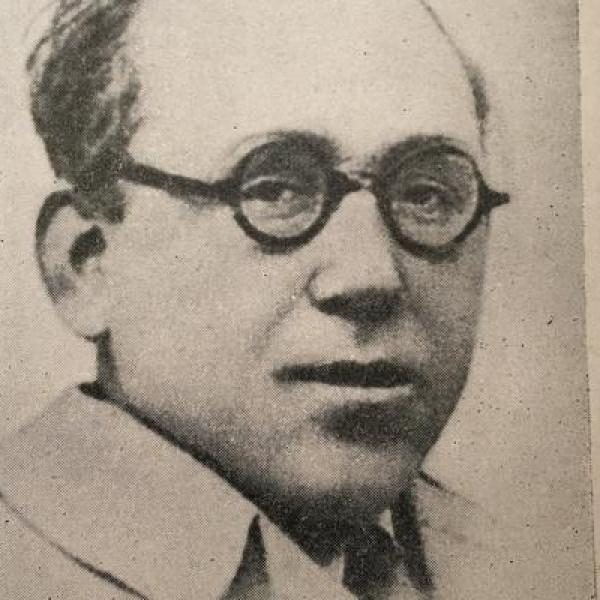
A celebrated Yiddish writer’s tormented spirit finds solace in an unlikely correspondence. Chaim Grade was a Yiddish writer who captured pre-war Jewish life with piercing intensity. Yet his own soul knew no peace – particularly after being scorned by his former colleagues at the Vilna yeshiva. Over time, Grade found unexpected sanctuary in the guidance of the Lubavitcher Rebbe. “He is an intelligent and very refined person,” Grade noted, “and he discerns exactly what my problem is.” A remarkable correspondence emerged between them – letters that unveil the profound spiritual bond between writer and Rebbe, and reveal how one fractured soul found its way home.
It was in the month of Av 5726 (1966), when President Zalman Shazar visited New York as part of his first official visit to the United States. He then planned to continue to Washington to meet with his counterpart, President Johnson.
One evening he called his friend Mr. Chaim Grade (pronounced Grah-deh), one of the greatest Yiddish writers of the twentieth century, and asked him to come to his hotel.
That evening, Shazar planned to meet with the Rebbe, but he was under heavy pressure from various politicians who tried to dissuade him from visiting the Rebbe, claiming it was not proper for him to visit the Rebbe, but rather the Rebbe should come and visit him.
Being unsure about what to do, he invited his friend Grade, with whom he maintained extensive correspondence, hoping he would understand hm. When Grade arrived at Shazar’s hotel, the latter unburdened his doubts and wanted to hear his opinion.
“You must go,” Grade told Shazar. “If you go, there will be a storm in Eretz Yisrael that will eventually subside. But if you don’t go – there will be an internal storm within you that will never subside!”
“Now I see two things,” Shazar replied with emotion. “You are both a poet and a friend!”
At Shazar’s request, Grade was included in the president’s entourage. “I had a great influence on the report in the Times,” he later admitted. “They seated me especially next to the Times reporter so I could work with him on the way there and back.” As for the Rebbe himself, Grade noted: “He is an intelligent and very refined person, and he discerns exactly what my problem is…”
A Life of Turmoil
Chaim Grade was born in Vilna in 1910. His father was a maskil, an adherent of the Haskala movement. The poverty that prevailed following World War I forced him to work as a night watchman, and he died at a young age, leaving his wife to support herself and her son Chaim by selling fruit. She sent him to yeshiva, mainly because she could afford it, but also because she was observant and was a great maamin. Grade studied at central yeshivas of the Mussar movement in Vilna, and then in Bielsk, Volkovysk, and Bialystok. These were Novarodoker yeshivas and there he received his education.
Despite his Torah education, Grade was drawn to the world of secular literature, and during his youth began to write poetry and stories, a field that did not align with the strict Mussar values on which he was educated. As a result, he suffered harsh rejection from his many friends as well as his teachers who began to ostracize him. This rejection, which hurt him deeply, led him to withdraw from the Mussar world. At age 22, Grade left the yeshiva and joined the group “Yung Vilne” (Young Vilna), a group of Yiddish writers and poets.
In 1932, he began publishing poems and stories in Yiddish. His works immediately drew attention from readers and the literary world in Vilna. He was among the founders of the group and literary movement “Yung Vilne,” which included leading Yiddish creators in Vilna before World War II.
With the outbreak of World War II, he fled to the Soviet Union and stayed there until the end of the war. During this period, he lost his entire family. After the war, he went to France and from there immigrated to the United States in 1948.
Before traveling to America, he returned to Vilna, which had been a center for the cultural, intellectual, and religious life of Eastern European Jewry – “the Jerusalem of Lithuania.” In his memoirs My Mother’s Sabbath Days, he describes what he found there, in the difficult experience of walking through the empty streets of an uprooted civilization. His mother’s house remained intact, he writes, but cobwebs blocked its entrance, “like the angels with flaming swords who prevented Adam and Eve from returning to the Garden of Eden.”
When he arrived in the United States, he began writing his prose, which focused on elevating and reviving the rich and unique Vilna Jewish world that was cut off with the Holocaust, about which he wrote with deep longing. His work is characterized by particularly exacting descriptions, which, according to Grade himself, constitute art mixed with actual documentation.
During this period of his life, Grade tried to find solace in his Torah knowledge and to find connection with people who shared his past, but encountered rejection again and again; in the eyes of his surviving friends he was considered a “kofer.” This recurring experience of alienation deepened his sense of loneliness and frustration.
The loss and rejection he experienced caused him to seek different ways to connect to the Jewish world. He did not find his place in the Judaism familiar to him, and sought a spiritual connection that would be more inclusive. Throughout his life, he was torn between the yiras shomayim that had penetrated his very bones and the aspiration for artistic freedom and self-expression. Therefore, although he lived in America and adopted a secular lifestyle, he did not abandon his language and culture.
This tormenting internal conflict is what drew Grade to the Rebbe, in whom he finally found a Torah figure who did not reject him; he saw in him someone who understood well the deepest longing in his soul.
A True Impression
After accepting Grade’s suggestion, Shazar set out to the Rebbe accompanied by an honorable entourage, including the writer Grade.
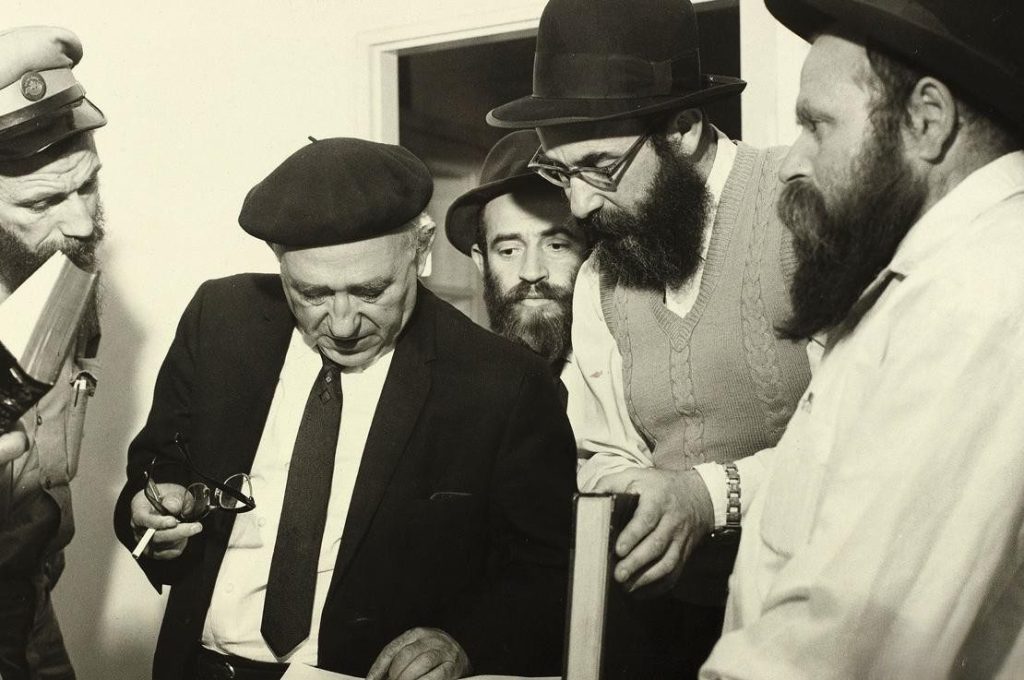
When they arrived at 770, the entire delegation entered for an official visit in the Rebbe’s room, and then Shazar remained in yechidus with the Rebbe while all those present were asked to leave. Grade found himself walking to the adjacent hall, where he met several Chassidim who, at the Rebbe’s instruction, were present and hosted the entourage members. When Rabbi Zalman Duchman saw the Yiddish writer, he introduced himself and said that he was familiar with his books.
About a month later, Grade wrote to Shazar: “I was privileged to sit together with the veteran Chassidim and warm myself with their faith. The Chabadniks were disappointed that they couldn’t push into the room where you sat with the Rebbe and didn’t hear what the Rebbe was saying. I was also a bit disappointed when you forgot that I was supposed to be at the meeting of the two ‘nesiim,’ to stand there, before all the officials…”
The extensive media coverage surrounding Shazar’s meeting with the Rebbe caused Grade to appreciate American Jewry differently. He couldn’t believe that the meeting generated such enthusiastic responses, incomparable to Shazar’s meeting with the US President. This left a deep impression on him, and his old hope for traditional life in the United States began to blossom again.
“I came to the conclusion,” he wrote to Shazar, “that if the Lubavitcher Rebbe had come to you, it wouldn’t have made any impression. What chiddush would that have been from Israel’s point of view? Your turning to the Rebbe, from everyone’s perspective, contributed much more.” Grade proceeded to write this position to several Israeli authorities as well. His letter passed from hand to hand and drew much attention.
The Rebbe did not give up on Grade. Already during the Selichos days that year, he established contact with him and sent him a letter with Shana Tova wishes, adding in the margin: “With respect and blessing and thanks for our friend’s encouragement before the deed [with his advice at the hotel] – and even more – after the deed [in his letter to Israel] – and for a speedy recovery.”
An Initial Experience
In 1971, Inna Grade, his wife, left a message at the secretariat that her husband Chaim was in the hospital recovering from a heart attack.
Inna Grade, born in Yekaterinoslav to assimilated parents, always believed in Divine Providence, and immediately upon her husband’s illness rushed to write to the Rebbe, believing with all her heart that his blessing would be fulfilled [on one occasion when Shazar fell ill, she told her husband that he would surely be healthy because he had the Rebbe’s blessing].
The Rebbe sent Grade a letter on 5 Menachem Av 5731, noting that he hopes that “as of the writing of my letter, there has already been an improvement in your health condition which will continue to improve until you return home, with G-d’s help, and can continue your activities as usual… especially since the ‘Zin un Techter,’ [a weekly column that Grade wrote in the newspaper Der Tog] are waiting for the author’s continuation…”
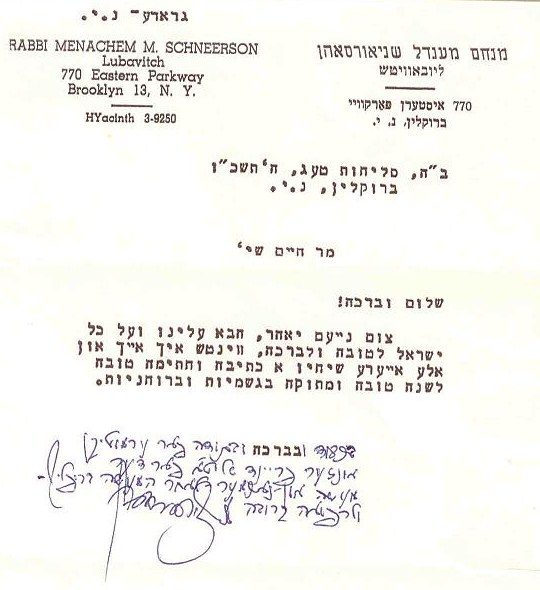
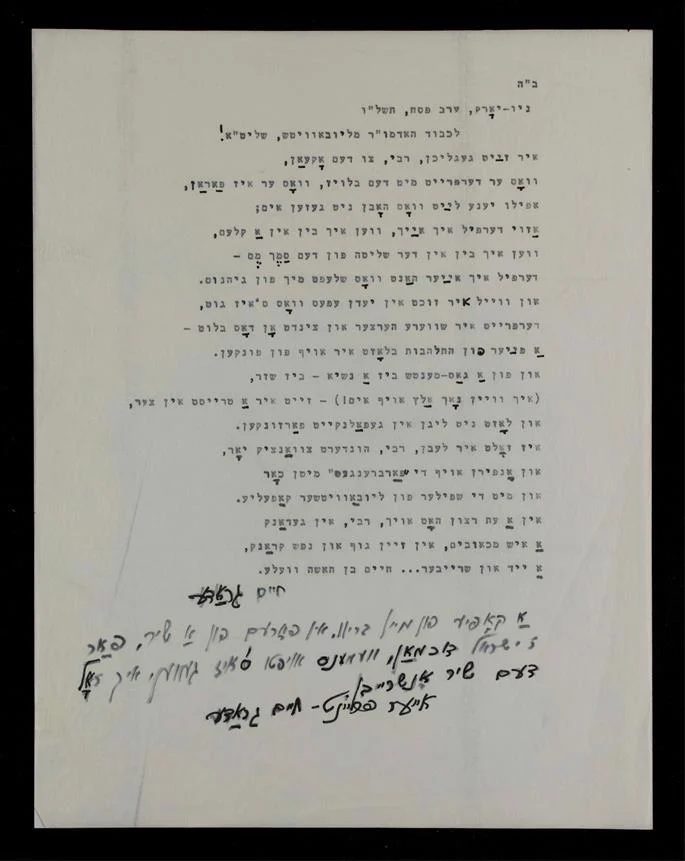
The Rebbe’s initiative in writing the letter to him and his blessings deeply moved Grade. On Erev Rosh Hashana, he sat down to write a long letter to the Rebbe while simultaneously recording another letter to Shazar with a copy of his letter to the Rebbe. He described his impression of the Rebbe’s familiarity even with his columns in the newspapers.
“The letter with the blessings of Kevod Kedushaso, which my wife brought me to the hospital, was the source for a great experience for me,” he wrote to the Rebbe. “Such an experience that calms the suffering patient with his broken heart and strengthens him in his health.”
At that time, Grade read in the newspaper the Rebbe’s michtav klali for the new year, in which the Rebbe encouraged all Jews, regardless of their religious level, to celebrate Rosh Hashana. After all the years in which he was persecuted by the Mussar system that refused to forgive the “crimes” he committed, the letter struck him with shock and emotion, and he added in his letter to the Rebbe: “I read in the newspaper your wonderful ‘message’ to all of Israel. I say wonderful, because in your current letter one can see in a concise form the most important points in Chassidic philosophy.
“Herein lies your greatness, dear Rebbe, and the greatness of Chabad, which has brought you so much praise, because you can accept every person as they are and bring them closer.
“I also know that for you this is not a strategy to win back those who have disconnected and are lost, but this is based on one of the greatest truths in Chassidus. The belief that in every Jew the sparks continue to burn and only need to be fanned.”
Grade concludes his letter to the Rebbe: “I need to write to you everything I think… but this would require too much of your time.”
It is easier to understand Grade’s excitement and admiration for the Rebbe’s letter after examining the works he wrote. One can see concretely the motif of a Jewish boy who strayed from the path and comes to pray at the shul receives severe insults from the congregants and the rabbi. These things were not mere examples, but events that Grade experienced firsthand. His great excitement was expressed, among other things, in that Grade signed his letter with the words: “With great respect and love” – an opening to an inner and deep connection with the Rebbe.
In the summer of that year, 13 Menachem Av 5732, the Rebbe wrote to him: “I still follow what is printed by you in the Forverts. In addition to the content, this is of course a sign for me that your health is in order, and you continue to describe the Jewish past.”
Here the Rebbe continues and writes about the virtue of tradition, that regardless of the heir’s identity and virtues, he inherits all the qualities of his ancestors until the end of all generations. With this, the Rebbe continued with Grade what he experienced in his Rosh Hashana letter, and added that Judaism is not limited to specific events on Sunday or Monday, but “for Jews, Judaism is an art of living, day-to-day life that continues without interruption. And in a humorous vein – chaim in a graden [= life in ascent].”
Misnaged? Chassid!
Nearly a year passed and no further contact is known between the Rebbe and Grade during this period. It seems the Rebbe was careful not to write to Grade unless he initiated correspondence himself.
In the summer of 5732, the Rebbe received another letter from Inna Grade, who yearned for a good relationship between the Rebbe and her husband. In her letter to the Rebbe, she noted that her husband is a modern Jew with a tradition of Misnagdim (opponents of Chassidim).
In response to this letter, the Rebbe replied to Grade at the beginning of the month of Sivan 5733: “A long time has passed since I heard from you directly, but I searched for and received greetings from you through mutual friends. Additionally, when one wants greetings from someone gifted with literary talent, one solution is to glance at what has recently been published from his pen. But, of course, this cannot be compared to direct and personal greetings.
“Therefore, I was especially happy that a letter from your wife reached my secretariat. This gives me the opportunity to write you these lines, and also to ask you to convey my thanks to your wife for the greetings and for creating this opportunity for me.
“I want to address an expression in your wife’s letter and respond to it, and you will surely convey this to your wife as well. I rely on what your wife writes, that you are a ‘modern Jew with a Misnagdic-Litvishe tradition.’” The Rebbe explained that a person’s identity is not determined by outdated external definitions, but by his internal connection. The Rebbe clarified that one can be connected to the essence of Chassidus and Jewish warmth – even from a different tradition. A Jew’s pride is in the relevance of his Torah, and this is how his modernization is expressed.
Continuing this, the Rebbe spoke personally: “From our meetings at Chassidic farbrengens and from what I’ve heard about you, and also from your correspondence and literary works, I have no doubt that despite the supposedly ‘Misnagdic tradition,’ the warmth with which your works are imbued is in complete harmony with Chassidic feeling. I believe you yourself feel this, and more importantly, your readers also feel this, seeing that your ‘Misnaged’ descriptions instill in them feelings drawn from Chassidic sources.”
At that time, when the Rebbe was improving his relations with him and setting him straight about the principles of Toras HaChassidus, Grade wrote to one of his friends: “The writer in me is completely an old Jew, and the person in me wants to feel at home in the modern world. This is simply a personal tragedy, a battle I cannot win…” In his own words, he tells of the soul torments he is experiencing.
Grade was incapable of lying to himself. He once expressed about one of the writers who maintained contact with the Rebbe that he does so only because he needs to write literature about Chassidim, but he really has no interest in Chassidus.
In contrast, Grade was torn for years between two worlds – between the harsh yeshiva education he received in his youth and the secular life he chose to live as an adult. And yet, Grade, who was expelled from the yeshiva for disobedience to the rules, cultivated a burning love for Judaism and always yearned to be accepted back into the community of observant Jews.
The Rebbe did not give up on Grade. Being a witness to the writer’s internal storm, the Rebbe continued to instill in him Chassidic principles while regularly touching on their implications for Grade’s personal life as a person and as a writer.
The Change Begins
Grade stayed in Miami for the winter of 5735. Yisroel, the son of Rabbi Zalman Duchman, received instructions from Rabbi Chodakov to contact Grade and visit him. Duchman called the hotel where Grade was staying, identified himself as “the son of the Chassid you met at Chabad world headquarters,” and asked if he could drop by to visit him together with Rabbi Lipskar, the director of the Chabad school in Miami.
Grade asked them to come immediately.
And so, the two stood with him for a friendly conversation. During the conversation, Grade told them that all he needs now is peace of mind. Rabbi Lipskar responded that if he wants peace, he should start putting on tefillin.
“I am an old man,” Grade responded. “I haven’t put on tefillin for so many years. Do you think I don’t put on tefillin by accident? I don’t put on tefillin because I don’t want to put on tefillin!”
R’ Lipskar was not moved by his words and repeated his suggestion that if he returns to putting on tefillin, perhaps he will begin to feel differently. Grade did not respond, but at the end of the conversation, just before they left, R’ Lipskar tried again and urged him to start putting them on. Grade responded: “Don’t drive me crazy, but if you come tomorrow with a pair, I’ll put them on.”
The next morning, R’ Lipskar arrived at the writer’s room with a bag of tefillin. Grade opened the door just a crack, extended his hand and took the tefillin. “Come in the afternoon,” he ordered from behind the door.
As R’ Lipskar was on his way to the elevator on the floor, he still managed to hear Grade shouting after him: “Why did you bring me Mickey Mouse tefillin?…” R’ Lipskar therefore brought him larger tefillin, and when he returned later in the afternoon, Grade was still wrapped in a tallis and wearing tefillin. “I had a long conversation with G-d,” he told him.
R’ Lipskar seized the opportunity to invite Grade to visit the Chabad school in Miami. The visit that took place was very impressive, and at its conclusion Grade requested that they purchase for him large and beautiful tefillin, adding that he would pay for them himself.
Not much time passed, and the Rebbe sent him a special letter in which he thanked him for the visit and the great impression he left at the school:
“It was a pleasant surprise for me to receive greetings from you through our mutual friends in Miami. Especially because it was accompanied by a report about your visit to our institutions there, your conversations with the students, etc. Certainly, as someone who has lived so many years in America and also comes into contact with youth, there is no need to explain to you how important such a meeting is for youth.
“Of course, they also updated me about your health condition, and especially about your state of peace of mind. I hope that by the time you receive my letter, there has already been a significant improvement in this.”
As always, the Rebbe directed his words to private matters in Grade’s life:
“I allow myself to add that the visit that was mentioned, and the conversations with the students, and seeing the way they are educated in the spirit of ‘Yisroel Saba’ – also in the simple sense, that is, in the spirit of their grandfather and grandmother – certainly provided you with internal satisfaction and also contributed to your peace of mind. For among Jews, peace of mind is connected to our spiritual treasures, and an obstacle to this is when a person specifically wants to seek new happiness in foreign worlds, while – as expressed in famous parables and stories – ‘the treasure can be found and dug in your own private courtyard.’”
In this context, the Rebbe added and referred to Grade’s impressive request to obtain for him large and beautiful tefillin:
“Your request to purchase tefillin in a larger format instead of the tefillin in the smaller format made a special impression on our friends there, and also on me. In addition to the fact that unfortunately many of the small tefillin are of doubtful kashrus, it [their replacement from small to large] testifies to a special feeling for the matter, which shows that you want to do it in a more perfect way.”
The Rebbe concluded the letter with the words: “With respect and blessings for the fulfillment of their heart’s desires for good and for good news in all matters,” and in his own handwriting added: “With menuchas ha’nefesh v’haguf” [tranquility of mind and body].
The letter included a pocket siddur for the personal use of Grade and his wife “for long and good days and years.”
A short time after Grade received the new tefillin, he called Rabbi Yisroel Duchman enthusiastically and told him that he puts them on every day. He then said that every time he travels, he takes the tallis and tefillin with him.
Grade’s putting on tefillin was not a simple matter. One of his friends who saw him praying reacted with shock: “Chaim, is that you?” Grade replied with pride: “Yes, it’s me…” Once Grade even expressed that if his friends knew he was putting on tefillin, they would wipe the floor with him… However, the connection with the Rebbe did its work, and Chaim Grade slowly began returning to his roots.
How Can There Still Be ‘Wandering in the Mist’?
Along with his concern for Grade’s private life, the Rebbe pushed him to write not only about the Jewish past, but about the present. In this, it seems the Rebbe sought to make him part of daily Jewish existence.
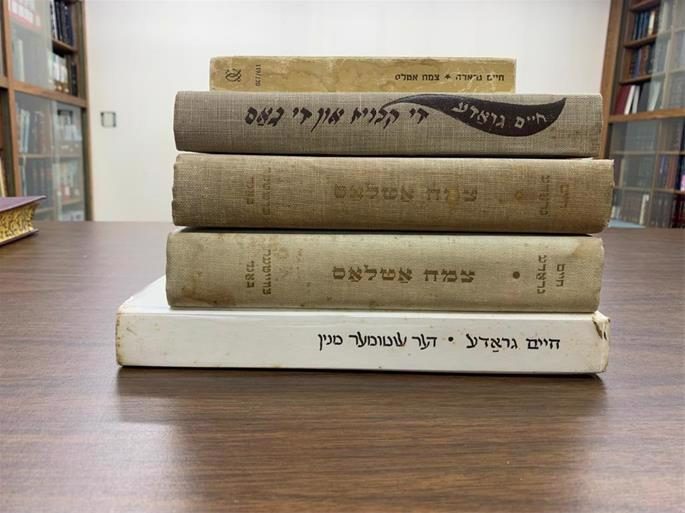
Grade for his part would send his books to the Rebbe from time to time and wait to receive his responses. On his book Di Kloyz un di Gass [= The Synagogue and the Street], which he sent to the Rebbe, Grade wrote a dedication: “To the honor of the Admor of Lubavitch shlita, the dear Rebbe who stands before my eyes, and also raises my sparks, which wander in the mist and are drawn to his light.”
The Rebbe responded to Grade about his letter in thanks for receiving the book, but at the same time directed him on what he should focus on in his writing: “Special thanks for your book Di Kloyz un di Gass. Despite the brevity of time, I immediately began to read, at least the first stories, and I hope that you will describe with the same love also the Jewish youth of the current generation, and especially in New York, who have re-grasped the ‘golden thread’ of Jewish continuity.”
The Rebbe referred not only to the book’s content but also to the dedication Grade wrote to him. In a few words, the Rebbe directs sharp questions to him about how he defined himself day-to-day, despite his dreams for a flourishing Jewish life. The words are phrased as a question about his books and their accessibility, but are also precisely targeted to him:
“I must take a position, at least in brief words, in connection with the dedication. I thank you for the warmth you expressed in the dedication, but at the same time, according to Jewish custom, I want to immediately ask a question: How is it possible that there can still be, as you express it, ‘blondzshen in nepl’ [= wandering in the mist], at the same time that old Vilna, the real Vilna, has remained so alive for you?
“And as written previously, there is great hope that through today’s youth it will be possible to plant its soul [of Vilna] even in American soil, where it will flourish and prosper. However, the external form can be different [meaning that things will not happen externally as they happened in Vilna], and although one cannot be sure even about the language, but this, as mentioned, is ultimately only external, and perhaps the external of the external.
“I hope you will agree that the time has come to replace the expression ‘wandering in the mist’ with another formulation, happier and more appropriate: ‘casting off the foreign garments from yourself,’ and immediately there will appear on every Jew – for each one is a member of the ‘kingdom of priests’ – the priestly garments ‘for honor and glory.’”
And the Rebbe concludes: “As we are in the days of the counting [the Omer], where the counting emphasizes the preciousness of time, yehi ratzon that each of us within all of Israel will act in the aforementioned direction in the manner of ‘better one hour earlier.’”
The heavy hints that the Rebbe wrote throughout the letter about Grade’s conduct were not open to different interpretation in his eyes. The matters were clear. The Rebbe said his piece.
The Rebbe Analyzes the Depression Found Among Writers
This was not the only book that Grade sent to the Rebbe. In 1979, the Rebbe wrote to Grade, “The booklets Di Goldene Keit were received, and thank you thank you.” And on another occasion that year: “Special thanks for his book Tsemach Atlas that he attached to his blessing, as well as copies of his poems that were printed in the press. And surely he will continue to do so in the future, and thanks in advance.”
Grade sent his writings to the Rebbe several times, and the Rebbe felt the common thread running through all his works – the internal murmur about the lost world, and the sadness that his only expertise as a writer is to write about this world, without any ability to write about other things. As a result, Grade was depressed and had difficulty continuing as usual.
Since the subject was sensitive, the Rebbe chose to write about it to Grade indirectly. In one of his letters to him, he wrote: “Yehi ratzon that you lengthen days and good years – good in all senses, including first and foremost that you utilize your talent, the talent of a swift writer’s pen, for the spreading of Judaism with joy and gladness of heart, and it is an explicit verse ‘serve G-d with joy.’ And after all, the Holy One Blessed be He asks only according to a person’s capacity, that is, according to the capacities He gives a person in advance to fulfill G-d’s commandments fully, and as mentioned, with joy.”
In the margin of the letter, the Rebbe added: “I allow myself also to attach here a copy of my letter to a writer, also in Yiddish. And surely you will not take offense that I add that to a significant degree the words are also directed at you, although I did not dare to write them to you directly, and waited for a suitable opportunity, such an opportunity. And it will be – if you are offended, it was written to someone else, and only a copy was sent to you. And if you are not offended, then surely it will have an effect, and certainly it is worthwhile.”
The letter that the Rebbe attached was written to the writer Kalman Segal. Segal felt, like Grade, that his writing had no current usefulness and that he only writes according to moods.
The Rebbe began the letter with a description of the controversy surrounding the definition of the goal of the creative artist:
“There exists an approach of ‘art for art’s sake.’ The same applies to poetry and literature, that is, the creation is created independently of what is happening around and is not always connected to reality.
“On the other hand, there are those who believe that everything a person creates must bring benefit (to humanity), especially in the world of art, since an artistic creation by its nature leaves a deep, beautiful and lasting impression.
“As I see from your letter and from your poems, you hold (more) to the second system, as can also be seen from the themes of your poems, which are connected to our time and to personal experiences and the like.”
The Rebbe continues in his letter and analyzes: “One of the central problems of our generation is confusion and lack of bitachon, and consequently also lack of stability in day-to-day life. And since only rarely does a person feel completely satisfied – as our Sages say that even ‘half his desire’ he does not achieve – this often leads to sadness and sometimes even to despair, G-d forbid.
“This may be less noticeable among older people, who are still anchored in the distant past and draw their strength from there. However, among the young, this phenomenon, unfortunately, is quite common, although some hide their internal feelings for understandable reasons.
“It is unnecessary to emphasize that sadness and despair are the opposite of our faith, and are not consistent with the Torah and commandments, which emphasize specifically bitachon and joy. The correct advice and remedy for the mentioned ailments is complete disregard of them, to the extent that a person is protected in advance from the ‘disease.’”
Toward the end of the letter, the Rebbe draws the conclusion from what was written to Segal (addressing it directly to Grade): “In certain circles, much can be achieved through poetry and literature and the like, when the poet and writer emphasize the positive moments with strength and vitality… Unfortunately, I did not find all these expressed in your train of thought (within the poems I managed to review)… but, as mentioned, you are in the middle of the road, and surely you will still write and create, and hopefully you will complete what I did not find in your poetry… and I am sure you will find this not only in relation to the future, but also in relation to the present and even the past.”
‘Bring This Matza to Chaim Grade Today’
As is known, ahead of Erev Pesach, the Rebbe distributed shmura matza. R’ Yisroel Duchman had a custom to request from the Rebbe each year an additional matza for Grade. Despite it being erev the chag and the late hour, Rabbi Duchman would take the time to travel to Grade’s home in the Bronx to personally deliver the matza to him.
It seemed that the matza from the Rebbe was very precious to Grade, and he was filled with admiration each time anew at the effort Rabbi Duchman made to bring him the matza. One could sense how much he truly anticipated his arrival, and each year the doubt gnawed at him that perhaps R’ Yisroel would not come this time and he would be left without matza from the Rebbe.
In 1978, after the Rebbe’s heart attack, the Rebbe stopped distributing the matza himself and began distributing it through kollel members. That year, Duchman received matza for Grade and again traveled to deliver it.
In 1979, however, Grade had not heard from him, and called to ask what happened. Rabbi Duchman told him that those who distributed the matza that year did not give him any, so he had nothing to bring… The disappointed Grade replied that if he were to say that he could live without the matza, and that he doesn’t expect it, “I would speak untruthfully. And this is a greater sin than not eating the matza…” and told Duchman not to bother coming.
On Erev Shevii shel Pesach, Grade received a phone call from Duchman: The Rebbe brought to his office a wrapped piece of matza and said to his secretary: “This matza must be brought to Chaim Grade today, before candle lighting.”
From the secretariat, they frantically searched for Rabbi Duchman, and when they found him, he left everything and traveled to the Bronx. “Do you know what kind of zechus you have,” Duchman said to the writer, “that the Rebbe chose you as the single individual who received matza on this day?!”
Grade was very happy. “The Lubavitcher Rebbe sent his personal shliach to bring me these matzas,” he said emotionally. Another time the Rebbe sent a box of matches with Duchman for Grade’s wife and said: “Give her this for Shabbos candle lighting.” And added: “The matches are not for cigarettes…”
Chaim Requests a Tanya
A short time before Pesach 5742, in honor of his 80th birthday, the Rebbe distributed Tanyas to those who were present at the farbrengen. Duchman called Grade before coming with the matza and excitedly told how the Rebbe distributed the Tanya for many hours, to women, men, and children.
Grade listened until the end and then said: “Tell the Rebbe that Chaim requests a Tanya.”
Duchman knew that the Rebbe distributed the Tanyas only to those who participated in the farbrengen, and that those who requested later did not receive. Nevertheless, he decided to write to the Rebbe and convey Grade’s request. The Rebbe answered that he would give Grade a Tanya, but it must be kept secret.
A short time after Pesach 5742 (1982), Grade passed away, and requested to be buried according to Jewish law, wrapped in his own tallis.
Conclusion
“Chassidus searches for the holy sparks even in the lowly, earthly and sinful person,” Grade understood. In one of his letters, he revealed what he felt after the process of outreach from the Rebbe: “I always envy everyone who knows Chabad people well; I envy observant Jews because I know what depths they feel, and how much happiness they have, because, after all, who is truly happy?…”
On one Erev Pesach, approaching the Rebbe’s birthday, Grade wrote a poem and sent it to the Rebbe:
Rebbe, you are compared to an ocean that radiates joy just from its existence,
Even to those who have never seen it
So I feel you, when I am in distress, under the control of the ‘samech-mem’ [Angel of Evil].
I feel your hand pulling me from Gehinnom
And you seek in each person something good and gladden heavy hearts,
Fanning fire of enthusiasm from sparks and from a simple man to a president – until Shazar (I still cry for him!)
You are a comfort in trouble and do not let one sink into downfall
So may you live, Rebbe, one hundred and twenty years
And lead the ‘farbrengen’ with the choir and with the musicians of the Lubavitcher kapelye.
Grade concludes the poem with a special request:
“At a time of favor, Rebbe, may there also be in your mind a man of sorrows, sick in body and soul, a Jew and writer… Chaim son of the woman Vele.”
Note: All quotes in this article were originally said or written in Yiddish and are presented in this article in free translation.
Sources: Chaim Grade’s archive at the YIVO Institute, Shazar’s archive at the State Archive, and the book “Dear Rebbe.”
Beis Moshiach #1484 • pp. 24-37
© 2026 Beis Moshiach Magazine. All rights reserved.
This article originally appeared in Beis Moshiach #1484. You are welcome to share it with friends and family by email or in print, provided that you do not change, add to or omit any part of it, you credit the author and Beis Moshiach, and you include a link to archive.bmoshiach.org (written out in full in printed copies).
To republish this article in a newspaper, magazine, book or website, please request permission in advance at [email protected].