Share the Mitzva

When a place is truly holy, the yetzer hara tries to sneak in. That’s what it felt like when the local church started building a new chapel, right next to the town’s Shul and Beis Medrash – where Yidden learned Torah, day and night.
“How could they?!” Mendel the tailor snapped, staring out the shul window on a quiet street in Hamburg, Germany.
“A shandeh…” the Rav said, shaking his head.
Reb Shimon, who learned every day with the young Rav Yonasan Eibshutz, tried a different approach. He closed the shutters. “We don’t have to look at it,” he thought. But the church kept rising, and on top, they placed a heavy wooden cross. Everyone could see it. And it hurt. Couldn’t they have built it anywhere else…?
Rav Yonasan glanced at his chavrusa. “You look so upset. Can you let it go?” he asked softly.
“How can I?” Reb Shimon said, sweat on his forehead. “A Yid shouldn’t have to pass by avoda zara — idol worship — on their way to shul. It’s not right.” His voice was tight with sadness and anger. Then he fell quiet. Deep down, he was sure the church had done this to bother the Jews on purpose, and there was nothing they could do to stop it.
Rav Yonasan was in his twenties – young, but already a big Talmid Chacham whom many people looked to for advice. He thought that was the end of the conversation. The two opened their Gemaras and dove back into learning.
After an hour, Rav Yonasan glanced up. Reb Shimon’s finger sat on the line, but his eyes were far away. “You’re still thinking about our new neighbors,” Rav Yonasan said quietly.
Reb Shimon pressed his lips together. He didn’t answer.
* * *
The night came exactly when Reb Shimon expected it – the quiet hour he had picked on purpose. He wasn’t awake because he couldn’t sleep; he was awake because he had a plan.
That first week had been hard. Priests stood by the market and laughed at Jews who passed. A boy from cheder was shoved into the mud. A shopkeeper was fined for “blocking the street,” though nothing was there. And that tall cross faced the shul windows like a dare.
They want to scare us, Reb Shimon thought. They want us to feel small.
He told himself, I would never hurt a person. But I won’t let them stamp us out, either.
He slipped outside in a black cloak with a hood, so no one would know it was him. In his pocket, he carried a small saw, a piece of string, and a little candle stub. He walked quickly over the cobblestones and stayed close to the walls, where the shadows were darkest. At each turn, he stopped to listen, then moved again.
The new building seemed like it was made to bother the Jews. Reb Shimon wanted to do something – carefully and quietly.
A tall iron gate blocked the way. Reb Shimon grabbed the cold bars, climbed up, and swung over, landing softly on the other side.
For a moment, the moon lit the yard. Then clouds covered it, and everything turned dark. Reb Shimon hid behind a stone statue and held his breath. He watched the guard walking by the front door. The guard’s keys jingled. His boots scraped the ground. Reb Shimon counted the steps. When the guard walked far enough away, he raced to a tall tree at the back.
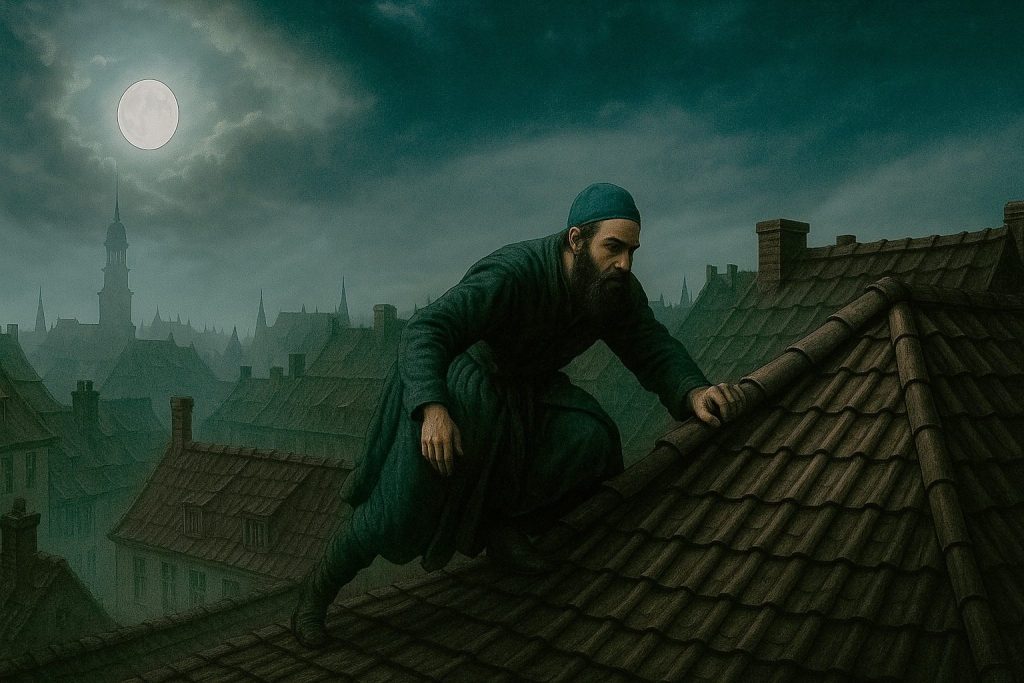
The bark was rough on his hands as he climbed. He reached the top, took a deep breath, and carefully dropped onto the roof.
The roof tiles were slippery. The air smelled like tar. A gust of wind made the big wooden cross creak. Reb Shimon lay flat by the edge and listened. His heart was pounding. He whispered a short kapitel of Tehillim and crawled forward, careful not to move a single shingle.
Reb Shimon crawled forward until he reached the big wooden cross. He stayed low. He listened. Quiet.
He took out his small saw. Back and forth. Back and forth. Slow and steady. He breathed through his nose, so he wouldn’t make a sound. “Be smart,” he told himself. “No noise.”
The wood was tough to cut. His hands shook. He knew this was a very dangerous idea. If they caught him, he could be punished – even with his life. But he kept going. Back and forth. Back and forth.
A faint crack. Then a bigger one. The cross shifted. Reb Shimon squeezed his eyes shut and held the roof tight.
Crash.
The cross fell to the yard below.
A shout came. The guard ran toward the noise. His keys rattled. Candles were lit in the windows.
Reb Shimon slid to the tree, climbed down fast, and ran for the gate. His heart pounded in his ears. He jumped from the last branch and hit the ground running.
“Halt! Who goes there?!” the guard yelled.
Reb Shimon reached the iron bars. He grabbed the gate and started to climb. Boots pounded behind him. Hands grabbed his cloak.
Reb Shimon did not go home that night.
* * *
“Gut morgen, Reb Yonasan,” the Rav said. “Where is your chavrusa, Reb Shimon? He’s never late.”
“I don’t know,” said Rav Yonasan.
The hours went by. Reb Shimon did not come.
Rav Yonasan thought about yesterday. Did he do something risky…? Is he hurt? He told the Rav and the leaders. “We have to look for him.”
Everyone searched. They went down every street. They checked alleys and yards. They knocked on doors. His wife said he left at night, but no one knew where he went.
Later, everyone came back to the shul. They stood together, worried.
* * *
Out of the shadows near the church, a tall, thin man stepped forward. His eyes looked glad – but greedy. “I know where he is,” he said.
“If you want to find your little friend, I can help.”
“Who are you…?” the Rav asked.
“I’m the night guard at the church next door,” the man said. “My name is Thomas. I was doing my rounds, when I heard a crash. I ran to the front and saw the big wooden cross on the ground. It did not fall. It was cut.
“Then, I saw a man climbing over the fence. I called for him to stop, but he ran. I chased him and caught him a few streets away. I dragged him back, locked him in a small cell under the church, and called the priests.”
Thomas pointed toward the church. “Your friend is the one. He climbed on the roof. He cut it down. There is no doubt.”
The Rav spoke softly. “This man you caught – do you know his name?”
“Name?” Thomas laughed. “We don’t care about his name. He’s about this tall, not thin and not fat, with a short beard and side hairs, like yours.”
The people looked at one another. There was no doubt – it was their friend, Reb Shimon Rosen, Rav Yonasan’s chavrusa.
“What will happen to him…?” someone asked.
Thomas lowered his voice. “The leaders met this morning. They held a trial. He was found guilty.” He leaned in. “The punishment for damaging church property is death by fire. Your friend is to be burned at the stake.”
A heavy silence filled the room. The people were afraid. Reb Shimon – a husband and a father – was in grave danger. What would happen?
At last, the Rav asked, “Thomas, why did you come here…? You didn’t walk across town just to bring us news. What do you want?”
Thomas’s small eyes lit up. “Ah. You’re paying attention. Good. There’s a hidden way into the cells. I know it well – because I guard it.” He gave a thin smile. “I might be willing to save your friend… if it is worth it for me. If you pay.”
The parnas, the treasurer who cared for the community’s money, stood up. “If it’s only money, we will find a way.”
“How much?” he asked.
Thomas spoke slowly. “Three thousand gold coins.”
Gasps rose from the room. “Impossible!” someone cried. “No one has that much!”
But Rav Yonasan looked up. The number sounded familiar.
“We will do it,” the parnas said. “Give us a week, and we will gather the money.”
“A week?” Thomas snapped. “No. Three days. This is a great risk for me. Bring the money in three days, or there’s no deal.”
“Three days? How can we do it so fast?” the people asked.
“If the money is not in my hand in three days, I cannot help your friend,” Thomas said coldly. “You know where to find me.”
He turned, melted into the street shadows, and was gone.
“Quick, there’s no time to waste!” the parnas announced urgently. “I’ll organize volunteers to go door-to-door to collect from everyone in the city.”
* * *
Rav Yonasan wasn’t listening to the noise in the room. He already knew where to find three thousand gold coins – today. He had a plan.
He slipped out the door and followed the guard.
“Thomas!” he called.
Thomas turned, eyes sharp. “Why are you following me?”
Rav Yonasan nodded toward a narrow alley. “Please. A word.”
They stepped into the side passage, just the two of them. It was very quiet.
Thomas lifted his eyes. “What is this? Do you know what will happen if we’re seen together?
“Shh,” said Rav Yonasan. “The money. I will have it by tonight. How should I give it to you?”
Thomas blinked. This was too good to be true. “Tonight…? How can that be?”
“Tonight,” said Rav Yonasan. “Behind the old tavern, in the empty lot.” He looked Thomas in the eye. “You must come alone – no priests, no soldiers. This must stay quiet. If I see anyone else, there’s no money.”
Thomas swallowed. “Fine,” he said. “Tonight.” He pulled his cloak and hurried away.
Rav Yonasan turned back toward the shul, his plan clear in his mind.
To be continued
Beis Moshiach #1484 • pp. 56-59
© 2026 Beis Moshiach Magazine. All rights reserved.
This article originally appeared in Beis Moshiach #1484. You are welcome to share it with friends and family by email or in print, provided that you do not change, add to or omit any part of it, you credit the author and Beis Moshiach, and you include a link to archive.bmoshiach.org (written out in full in printed copies).
To republish this article in a newspaper, magazine, book or website, please request permission in advance at [email protected].