Echoes of Courage – Chapter 38: A Dispute Among Neighbors

Previously: Eretz Yisrael: The man from Tzfas came back and said that the neighbor came from Ukraine, not from Russia as he had said originally. The boys did not understand why he changed what he said and Mendy decided to check things out with the neighbor himself. He went up to the house and his two friends, Zalmy and Moishy, realized that he had put himself in danger.
Russia: Avremel’s father-in-law made a special trip to his house before the bris of his grandson to warn him about imminent trouble. Two weeks later, he passed away.
Leningrad 5715
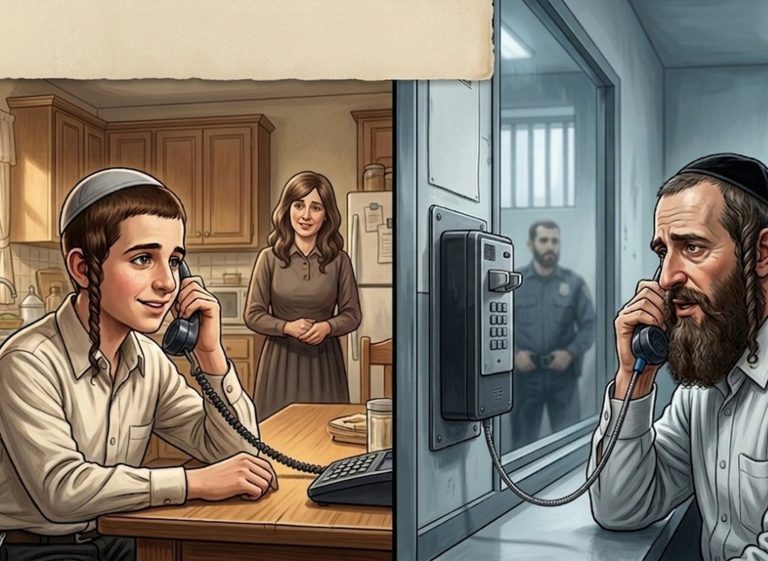
A week had passed since the bris when loud knocking was heard at the wooden door of Avremel’s home. Avremel was in the middle of learning Mishnayos with his eleven-year-old son Meir. When the door burst open, Avremel just managed to push the sefer under his shirt in a way that it wouldn’t be noticed.
In the doorway stood four policemen. They announced they had come to conduct a search of the house.
“Hello, Zhids,” called out the commander in a deep voice. That derogatory term has been used for Jews for many years by their enemies.
“We just came to say hi,” went on the commander and he burst into laughter that shook the walls. He found his own joke quite funny. As he laughed, the commander gave Avremel a mighty slap on the shoulder. As a result, the Mishnayos fell from his shirt and landed on the floor.
The commander’s countenance changed in an instant.
“Continue searching,” he told the other policemen, “and you, come with us.”
One of the men, who remained to guard Avremel, put his hand menacingly on the weapon in his belt. The policemen didn’t care about the new mother who stood trembling in a corner of the room.
Not long after, the police finished the search and left the house, taking Avremel along with them. They pushed him into a car. The door was shut and the car began driving through the streets of Leningrad in the direction of the large, central KGB building from which many did not return.
The car stopped near the building and Avremel was forcibly taken out. He was dragged by two policemen to the door of the fearsome building and was swallowed up within.
On the way from the car to the door, someone wrapped in a Russian wool coat, who stood on the street, saw the police dragging Avremel inside. The person turned and headed in a certain direction, the same direction from where the cars had come – Avremel’s house.
The knocking at the door did not interest them and they didn’t go to open it. The person standing outside had no choice but to open the door and walk in, and then close the door politely behind him.
The man found Avremel’s wife and older son sobbing. As he walked in, they looked at him and stopped crying. The tall man got to the point without saying who he was:
“Many years ago, I traveled together with your father by train. At that time, I hated Jews and I took a Jewish prayer book and hid it under the pillow of his bed in order to incriminate him.”
Avremel’s wife nodded. She remembered hearing about it from her husband.
“Your righteous father discovered what I had done and nevertheless did not inform on me; I thus earned my freedom. You know that incrimination is a serious crime in Russia,” said the Russian. “That’s why I came here to repay the favor considering the painful situation you are in.”
Saying this, he put his hand into his inside coat pocket and took out a bundle of paper wrapped in torn brown tape. He handed the package to the emotional woman and left.
Yerushalayim 5785
Zalmy and Moishy noticed Mendy entering the Russian neighbor’s apartment. They realized he could be in danger and they consulted with one another silently. Within two minutes, they decided not to leave him alone and instead, to endanger themselves and join him.
The three boys were taken aback. From the outside, the apartment looked plain and ordinary. Inside, it was decorated like a palace. Large couches stood the length of the living room and they were adorned with fine embroidery. Near the couches was an expensive glass table with a gold-plated fancy pitcher. They assumed it was real gold.
The children’s stares nearly broke the delicate tiles and they were definitely most surprised. Chazal’s famous dictum, “Don’t look at the kankan but at what it contains,” came to mind.
“Come and sit down,” said Boris, motioning toward the sumptuous couches. The children sat down gingerly and he sat facing them and began to speak.
“Many things have happened lately,” he said in his direct fashion. “You own me an explanation; actually, explanations, many explanations … I am hosting you now nicely and I think that if he – he motioned to Mendy – knocked on the door and asked to speak to me, then it must be something important.”
“First of all, hello Boris, how are you?” began Mendy politely. The boys felt uncomfortable and they shifted slowly in their places. When Mendy did not get an answer from the neighbor who gave them a long, silent look, he went on.
“A long time ago, my two friends and I,” he said, pointing at them, “met an old man by the name of Yitzchok in a senior center, who suffered from anxiety. We couldn’t help but pity him. When we looked into his past, we found that he used to live in Russia. At a certain point, he was caught by the Yevsektsya because he was part of a group of Chabad Chassidim. During his arrest, there was one interrogator who greatly mistreated him.”
Boris remained expressionless. Mendy went on.
“When we checked who his interrogator was, we discovered that he’s someone familiar who lives in our building …”
“Allow me to interrupt you, my young friend,” said Boris in an overly friendly way that made the boys suspicious. “I don’t know why you’re hinting. I was born in Ukraine and lived there for many years. When I was forty, I moved to Israel and lived in the north. In a nearby house lived someone named Yonatan, someone who made aliya from America. We were good friends.
After several years of friendship, we got into an argument over land between the two houses. That day, we became enemies and I threatened him that if he didn’t return the land that belonged to me, he would pay dearly. The difference between us was that I threatened but he took action. The next day, he went to the police and told them that his neighbor was previously a senior interrogator in Russia who abused Jews. Being afraid they would arrest me, I fled to Yerushalayim and live in this building now. Now I know it was nonsense and I had nothing to worry about, but back then, I was a new immigrant and I was afraid!”
Boris finished his story and the children nodded.
“So you want to tell us that the fact that you were an interrogator in Russia is a lie?” asked Moishy. The neighbor slowly nodded.
“Well then, I apologize for myself and my friends for suspecting you,” said Zalmy and he warmly shook the neighbor’s hand. He had already left the neighbor’s house when he remembered something and turned around.
“I have something important to ask you,” said Zalmy as his friends blushed to the tips of their ears.
To be continued
Beis Moshiach #1486 • pp. 59-61
© 2026 Beis Moshiach Magazine. All rights reserved.
This article originally appeared in Beis Moshiach #1486. You are welcome to share it with friends and family by email or in print, provided that you do not change, add to or omit any part of it, you credit the author and Beis Moshiach, and you include a link to archive.bmoshiach.org (written out in full in printed copies).
To republish this article in a newspaper, magazine, book or website, please request permission in advance at [email protected].