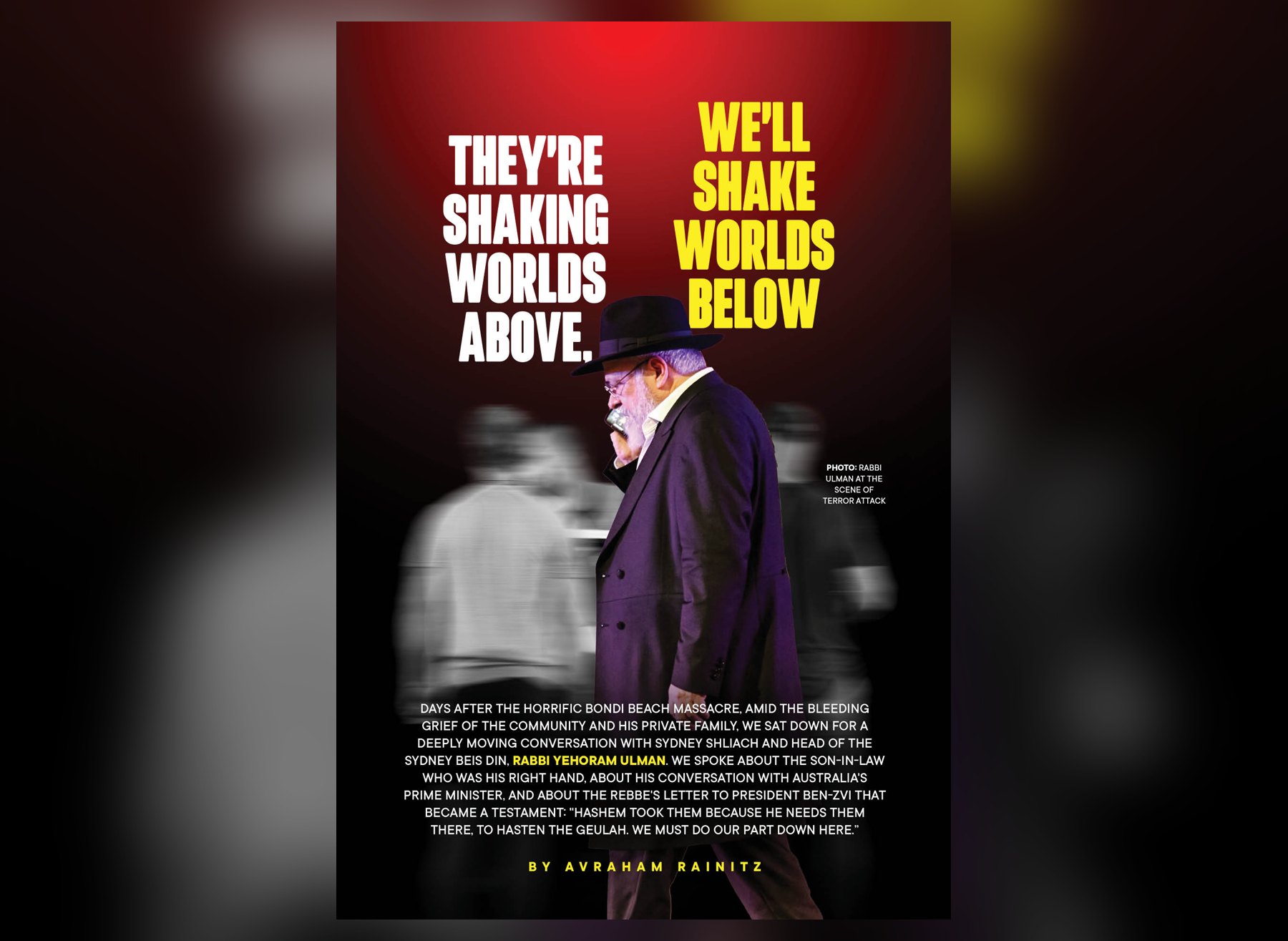
They’re Shaking Worlds Above, We’ll Shake Worlds Below
Time in Sydney, Australia, seems to have stopped. The waves at Bondi Beach continue to crash against the shore, but for the Jewish community – and for the worldwide Chabad family – the world changed in a single moment of fire and smoke.
I’m speaking with Rabbi Yehoram Ulman, shliach and Rav of the Beis Din of Sydney, during the most difficult hours of his life. His voice, usually steady and authoritative like that of a dayan and posek, is cracked with pain, yet firm as iron when he speaks about emuna and shlichus. Just days ago, he lost his beloved son-in-law, Rabbi Eli (Eliezer) Schlanger hy’d, his right hand and the “living spirit” of Chabad of Bondi. Together with him, sixteen other community members and guests hy’d were murdered, in an event that transformed “Chanuka by the Sea” into a mass killing field.
“It’s hard to speak,” he opens, and the silence beyond the line thunders louder than any scream. “Eli was everything to us. He’s my son-in-law, but truly like my son. My right hand, my faithful one. Everything I’m involved with – in the community, in the rabbinate, in the batei din – Rabbi Eli was there.”
“The Captain Leaves Last”
The morning after the massacre, the F.R.E.E. shul in Bondi was filled beyond capacity. People stood outside, weeping. Rabbi Ulman, despite his personal mourning, approached the bimah. At the conclusion of davening, he turned to the congregation and said in a choked but confident voice: “We cannot allow the terrorists to win. They want us to fall into despair. But that’s not what the kedoshim would want. We must say ‘Baruch Dayan HaEmes’ and begin building anew. Anyone who has a dispute with his fellow – this is the time to make peace. From here, from this unity, salvation will grow.”
The first question hovering in the air, even before the words, is “why.” But among Chassidim, the question quickly changes to “for what purpose” – for what. Rabbi Ulman, in the midst of heavy mourning, refuses to sink into despair.
Rabbi Ulman, people are asking you now – maybe Australia is no longer safe?
“They asked us, ‘Now maybe you’ll run away from Australia?’ The answer is no. Absolutely not. We, shluchim, remain here at our place of shlichus until the completion of the shlichus with the coming of Moshiach. The captain is the last one to leave the ship.”
This answer rests on a solid worldview of shlichus. “The Rebbe taught us that every time there are tragedies, and darkness and concealment and hiding, our response must be one: to do much more. The reason is twofold: First, because against darkness you need much light. And second, and this is the main point – this is what the kedoshim want.”
Here Rabbi Ulman pauses for a moment and continues with an emotion-filled voice: “They were killed al kiddush Hashem. They are kedoshim. But even kedoshim say ‘I need my children.’ They want that here below, in the world they left, there should be an increase of Torah and mitzvos. They’re asking us to continue. Already today someone sent me that because of this awakening, they put on tefillin with a thousand people in one day in Sydney. Do you understand? The levaya hasn’t even taken place yet, and he’s already moving Jews to mitzvos.”
Feeling the Need for Geula More
As Chassidim who live with the message of Geula, and with the Rebbe’s directive that everything should be permeated with preparing the world to greet Moshiach – how do you take this event to strengthen emunahin general, and emuna in Moshiach in particular?
“The Rebbe always says that the Geula, when it comes very soon, is not just ‘an end to troubles’ – it will also contain an ‘explanation’ for the troubles. Hashem will reveal to us what was the reason for all this suffering.
“In the Rebbe’s famous letter to Mr. Yitzchak Ben-Zvi, the Rebbe writes: ‘From the day I went to cheder and even before that, a picture of the future redemption began to form in my imagination – the redemption of the Jewish people from its final exile, a redemption of such a kind and in such a manner that through it the suffering of exile, the decrees and destructions will be understood. And as part of this bright future and as part of this redemption will be the Nasi “this Nasi is a king,” not a tribal leader – but one who has none above him except Hashem his G-d.”’
“I look at Eli,” he says, “a young man, full of energy, who did tremendous things. Why did Hashem take specifically him? We believe they’re needed there above. They, who were full of action here, will now make noise in heaven. They will cry out until Hashem sends us Moshiach, and we’ll merit to see not only the end of exile, but also the reason – why we had to go through all this.”
The Writing Was on the Wall
Following the event, the media published a letter that Rabbi Eli Schlanger hy’d wrote to Australia’s Prime Minister, Anthony Albanese, just weeks before his murder. In the letter, which has now become a political and spiritual testament, Rabbi Schlanger warned of “betrayal of the Jewish people” and the danger of giving legitimacy to terror.
Rabbi Ulman, when you read that letter today, do you feel that Eli saw what was coming?
“Eli was a Chassid. He understood the Rebbe’s words precisely. The Rebbe always cried out that every time you give terrorists what they want, it only gives them more appetite and endangers lives. This is ‘pikuach nefesh.’ Eli saw concretely how the talk about recognizing a Palestinian state gave a tailwind to antisemitism in Sydney’s streets.”
Rabbi Ulman held a difficult conversation with Prime Minister Albanese after the attack. “He called to console. I told him: ‘Mr. Prime Minister, we begged you not to recognize a Palestinian state. When they see that after the October 7 massacre they receive a diplomatic reward, they understand that terror pays. The writing was on the wall, and this blood is a direct result of this policy.’
“I told him: ‘When you slander Eretz Yisrael, it doesn’t stay in politics. It comes down to the street and translates into hatred against Jews.’ We respect the government and as Chabad Chassidim we were educated to separate between the personality and the actions, but when it reaches pikuach nefesh, the Rebbe’s shliach doesn’t stay silent.”
The Character of a Shliach: “Obsessed with Life”
Within the public pain, there is private pain, incomprehensible pain. Rabbi Ulman’s daughter, Chaya (Chayela), was left a widow with five young orphans. The youngest baby was born just two months ago. “He was so happy with him,” the grandfather recalls in pain.
“Eli wasn’t just a ‘rabbi,’” Rabbi Ulman describes his son-in-law. “He was a person beloved by everyone. He had boundless energy. One day he organizes a huge event, and the next day he drives five hours each way to visit a solitary Jewish prisoner in a remote jail, to give him a Torah class. That was Eli.”
Rabbi Ulman tells about Eli’s meticulousness in chinuch. “The directive of the Rebbe Rashab is well-known, that one must think every day for half an hour about educating children. Eli took this with profound seriousness. With all his community involvement, he was an exceptionally devoted father. My daughter is simply in shock. He was everything to her.”
Alongside Eli, other figures who were pillars of the community were killed. The Rav mentions R’ Reuven Morrison hy’d, a businessman who came from the Soviet Union. “He was an example of a Jew devoted to the community. He has an only daughter, who is a miracle of the Rebbe. He built a beautiful family, and now was taken from us while trying to protect others with his body.”
Among the community members close to the Rav were also R’ Alexander Kleytman, R’ Yaakov HaLevi Levitan (the director and manager of the Chabad House), R’ Moshe Aharon HaKohen Weizen, and Edith Bruten – hy’d.
“Specifically There, Specifically Now”
The big question hovering now is “what next.” Will the community close in on itself? Will fear win? Rabbi Ulman’s answer is a spiritual “offensive.”
“This is the 31st event I’ve done at Bondi Beach. And specifically because of what happened, we’re planning to do something big on Zos Chanuka night. At the same location. To show that we’re not running away. People think ‘after something like this you surely won’t do events there anymore.’ The Chabad answer is the opposite: specifically there we’ll do it, and with even greater strength and power.” (see sidebar)
Rabbi Ulman, in closing, what’s your message to Chabad Chassidim around the world who are reading these words and whose hearts are torn?
“We need to know: The Rebbe promised Geula. When people are in suffering, the desire for Geula is natural and strong, because they want the suffering to end. But the wisdom is to want the Geula even when things are good. My message is one: Don’t let the darkness confuse you. The light of Eli, the light of Chanuka, is eternal. Take a good resolution, put on tefillin with another Jew, light another candle. That’s what Eli would want. He lived ‘Moshiach,’ he was joyful in every situation, and now he demands that we continue this simcha until the complete revelation.”
The Thirty-Second Event
Rabbi Ulman’s determination to hold another public Chanuka event at Bondi Beach – at the exact location of the massacre – stunned even some members of his own community.
“People told me, ‘Rabbi, it’s too soon. It’s too dangerous. Maybe next year,’” he shared. “But that’s exactly the wrong response. That’s what the terrorists want – for us to hide, to be afraid, to stop being publicly Jewish.”
The decision to hold the Zos Chanuka celebration, Rabbi Ulman explained, comes directly from the Rebbe’s teachings. “After Kfar Chabad, the Rebbe didn’t say ‘close the school.’ He said ‘b’hemshech ha’binyan tenuchamu’ – through continued building, you will be comforted. After Mumbai, did we stop sending shluchim to dangerous places? No. We sent more.”
The event on the eighth night of Chanuka drew an estimated 20 thousand participants, even more than the original gathering. “It was the 31st time we’ve held Chanuka celebrations at Bondi Beach,” Rabbi Ulman noted. “This one was different. This time, every person there understood what it meant to light those candles. We weren’t just celebrating Chanuka. We were declaring: ‘You tried to extinguish our light. You failed. We’re still here. We’re not leaving. And we’re shining brighter than ever.’”
Security was heavy, but the message was clear. “Specifically there. Specifically now. That’s the Chabad way.”
Beis Moshiach #1490 • pp. 20-23
© 2026 Beis Moshiach Magazine. All rights reserved.
This article originally appeared in Beis Moshiach #1490. You are welcome to share it with friends and family by email or in print, provided that you do not change, add to or omit any part of it, you credit the author and Beis Moshiach, and you include a link to archive.bmoshiach.org (written out in full in printed copies).
To republish this article in a newspaper, magazine, book or website, please request permission in advance at [email protected].